
Matching Engagement and Wedding Rings: The 2026 Guide to Bridal Sets

A perfect bridal pairing is far more than an aesthetic choice; it's a precise feat of structural engineering where profile alignment is just as critical as visual symmetry. When selecting matching engagement and wedding rings, many couples focus on the initial sparkle but overlook how two distinct geometries will interact on the finger. You likely want a set that feels like a single, unified piece rather than two competing components. Gaps between bands often look unintended, and more importantly, they can lead to metal rubbing that wears down your settings over time.
This 2026 guide explores the essential technical and aesthetic principles required to ensure your bridal suite offers long term comfort and durability. We'll examine how bespoke CAD design and specific metal compatibility prevent common structural failures while achieving a seamless "flush fit" look. From navigating the complexities of curved and wishbone bands to understanding the performance of different alloys, you'll learn how to engineer a ring set that remains a permanent and evolving asset for decades to come. By prioritizing technical precision alongside design, you can ensure your investment maintains its integrity for a lifetime.
Key Takeaways
- Learn the technical requirements for matching engagement and wedding rings to achieve a "Wed-Fit" profile that allows both bands to sit flush without gaps.
- Understand how metal hardness and the galling effect impact longevity; selecting compatible alloys prevents the bands from causing structural damage to one another.
- Identify the ideal band architecture, whether straight, contoured, or notched, based on the specific geometry and elevation of your engagement ring's setting.
- Discover how bespoke CAD manufacturing ensures a seamless fit, transforming two separate pieces into a cohesive and durable bridal suite.
- Apply professional design principles to eliminate the "messy" look of mismatched bands while maximizing daily wearing comfort and long term stability.
What Defines a Perfectly Matched Engagement and Wedding Ring Set?
A bridal set represents the technical intersection of form and function. While the history and customs of wedding rings often focus on the symbolism of the circle, modern engineering prioritises how these circles interact. It's not just about the sparkle; achieving a cohesive look requires matching engagement and wedding rings through precise structural alignment. This goes beyond simple metal matching; it involves the "Wed-Fit" concept, where the engagement ring setting is elevated or recessed to allow a standard wedding band to sit flush against the shank. Without this specific design consideration, a gap often forms, which can lead to mechanical wear and a disjointed aesthetic.
Psychologically, a unified bridal suite provides a sense of completion. It signals that the two pieces were intended for one another, mirroring the commitment they represent. However, the visual balance is delicate. A wedding band should provide a supportive frame for the centre stone without overpowering its light performance or profile. If the band is too wide, it can make a high-quality diamond appear smaller; if it's too thin, it may look fragile and disproportionate.
View More: most expensive gem in the world
Bridal Sets vs. Individual Pairings
Pre-designed bridal sets offer the advantage of guaranteed symmetry because they are cast from the same CAD (Computer-Aided Design) model. This ensures the curves and heights are identical. In contrast, custom matching is the preferred approach for those who already own bespoke engagement rings. Buying rings separately often results in unsightly gaps. These gaps occur when the basket or prongs of the engagement ring extend beyond the width of the band, creating a physical obstruction that prevents the wedding ring from sliding into place.
The Role of Proportional Symmetry
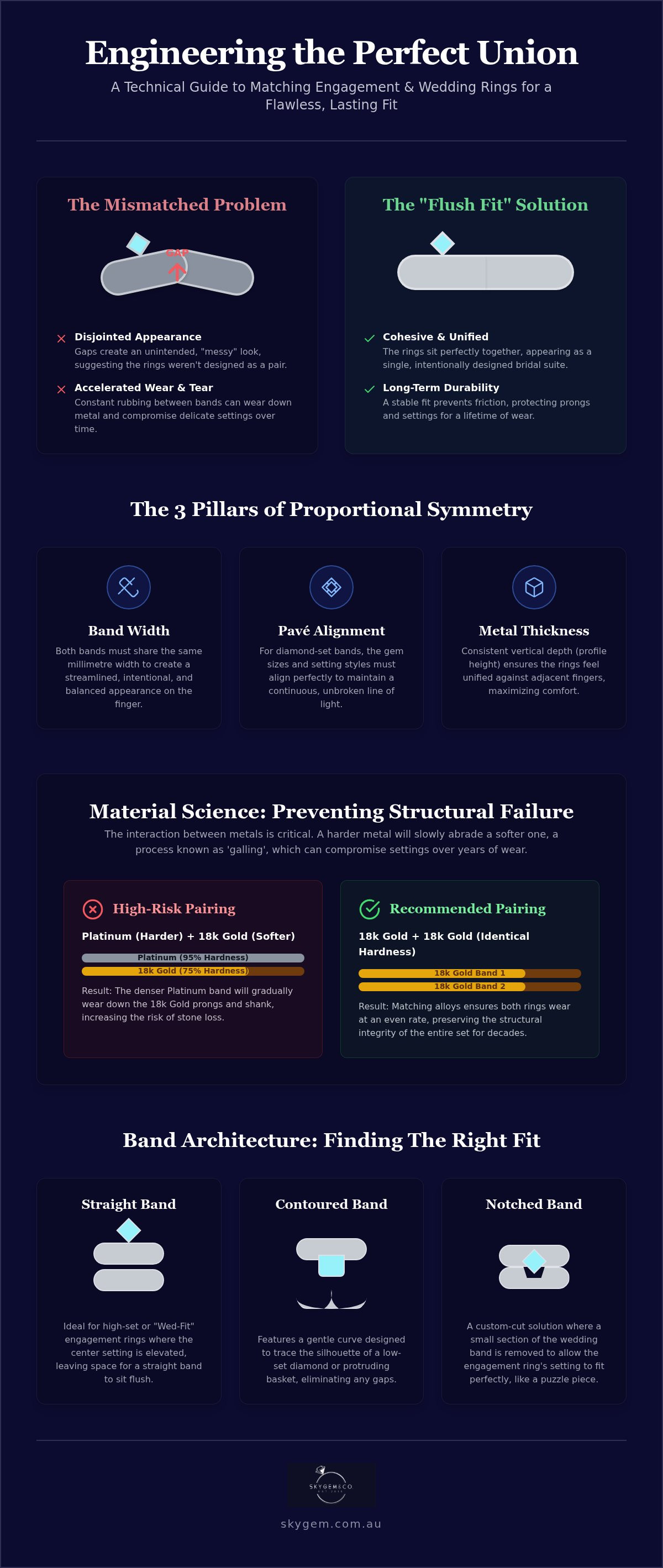
Technical precision in a bridal suite relies on three primary metrics that ensure the rings function as a single unit:
- Band Width: Ensuring both bands share the same millimetre width creates a streamlined, intentional appearance.
- Pavé Alignment: If both rings feature diamond-set bands, the diamond sizes and setting styles must align perfectly to maintain a continuous line of light.
- Metal Thickness: Consistency in the vertical depth of the metal ensures the rings feel unified against the adjacent fingers, preventing irritation.
Maintaining these proportions ensures the set remains comfortable for daily wear while protecting the structural integrity of the individual settings. When these elements align, the result is a seamless "bridal suite" that feels permanent and secure.
The Technical Mechanics of a Perfect Flush Fit
Engineering a cohesive bridal suite requires more than matching styles. It demands an understanding of material properties and physical interaction. When matching engagement and wedding rings, the hardness of the metals must be considered to prevent the "galling" effect. Galling occurs when two metal surfaces rub together, causing microscopic bits of material to adhere to the opposite surface, eventually "eating" into the setting. On the Mohs scale, different alloys exhibit varying resistance to this abrasion. If one ring is significantly harder than the other, the softer metal will degrade at an accelerated rate, potentially compromising the security of your gemstones over time.
Metal Compatibility and Wear Resistance
Mixing 18k white gold with Platinum is often a technical error because Platinum is much denser and more abrasive. Over years of daily wear, a platinum wedding band will slowly file away the prongs or the shank of an 18k gold engagement ring. This friction is particularly dangerous for delicate pavé settings where the metal holding the diamonds is already minimal. Metal memory refers to the tendency of a metal to return to its original cast shape or resist deformation under stress; this property ensures your rings maintain their circular profile despite the rigours of daily activity. To ensure long-term viability, professional expert advice on wearing bridal sets suggests sticking to identical alloys for both pieces.
Understanding the 'Wed-Fit' Setting
The architecture of the engagement ring setting determines the compatibility of the wedding band. High-set rings, where the basket is elevated above the finger, allow a straight band to sit flush without interference. Conversely, low-set rings usually require a contoured or notched band to avoid a large gap. A tapered under-rail is a specific design feature where the base of the setting narrows, creating a "seat" for the wedding band to tuck into. This allows for a flush fit even with larger centre stones. While high settings offer better band compatibility, they may increase the risk of accidental impact, representing a trade-off between aesthetic versatility and daily wearability.
Ensuring that the profile heights of both rings align is essential for comfort. If one ring sits higher than the other, it creates an uneven surface that can trap debris or cause irritation to the surrounding skin. Protecting the prongs of the engagement ring from the constant vibration of a wedding band is the ultimate goal of technical matching. If you're unsure how your current setting will interact with a new band, you might consider booking a technical consultation to review your ring's specific geometry and ensure a durable, lifelong fit.
Comparing Contoured, Notched, and Straight Wedding Bands
Selecting the physical architecture of the band is the next logical step after verifying metal compatibility. Matching engagement and wedding rings requires choosing between a straight, contoured, or notched profile. Each serves a specific structural purpose. Straight bands remain the gold standard for versatility, particularly for "wed-fit" designs where the setting is elevated. They offer a clean aesthetic and are easily worn independently of the engagement ring. Because they don't have a specific orientation, they're often more durable over decades of daily use.
When to Choose a Contoured Band
Contoured bands are engineered to follow the specific arc of a centre stone. This is essential for oval diamonds or round brilliants in low-profile settings. By matching the curve to the exact millimetre of the stone's perimeter, you create a halo effect that enhances the visual footprint of the engagement ring. It's a popular choice for those seeking matching engagement and wedding rings with a seamless, organic flow. However, keep in mind that a highly contoured band may look asymmetrical when worn as a standalone piece, which is a key consideration for those who occasionally leave their engagement ring in a safe.
The Precision of the Notched Band
Notched bands, including chevron or V-shaped styles, provide a mechanical "lock" between the two rings. Through bespoke CAD design, the notch is carved to the precise dimensions of the engagement ring's basket. This is particularly effective for emerald cut natural diamonds, where the linear edges require a sharp, clean transition. The notch ensures the wedding band doesn't exert pressure on the stone's culet, preserving the structural integrity of the setting. It results in a flush, gapless appearance that feels like a single, unified component rather than two separate items.
Open-wrap bands represent a contemporary alternative for large centre stones. These bands feature a physical gap that allows the engagement ring's setting to sit within the band rather than alongside it. It's an ideal solution for pear cut natural diamonds or marquise stones that traditionally create significant fitment challenges. This architecture maintains a low profile on the finger while providing the visual weight of a full bridal suite. By eliminating the metal that would normally sit under the stone, it allows the engagement ring to sit as low as possible on the hand, improving daily comfort.
How to Match Bands with Specific Engagement Ring Styles
Success in matching engagement and wedding rings depends on the specific geometry of the primary setting. Every style, from a minimalist solitaire to a complex trilogy, presents unique mechanical challenges. Understanding these structural nuances allows you to select a band that complements the central design without causing interference or visual clutter. A well-considered pairing ensures that the wedding band supports the engagement ring's profile rather than competing with it for space on the finger.
Enhancing the Solitaire Engagement Ring
Solitaire rings serve as a blank canvas for bridal design. Because they lack side stones, they offer the greatest flexibility for band pairing. You can add light and brilliance by pairing a simple shank with a pavé diamond wedding band. Alternatively, mixed metal pairings, such as a platinum band against a yellow gold Solitaire Engagement Ring, create a sophisticated contrast that highlights the central diamond. This versatility makes them the ideal starting point for a custom bridal suite that can evolve over time.
Halo settings require careful balance to avoid an overly bulky appearance. When pairing a band with a halo, ensure the width of the wedding ring doesn't exceed the width of the halo's outer edge. This prevents the "double-halo" look from becoming visually overwhelming. For trilogy rings, the wider footprint of the three-stone setting often creates a side-stone protrusion. This protrusion can prevent a straight band from sitting flush, often necessitating a contoured design or a discreet spacer ring to prevent the rings from grinding against each other.
Navigating Multi-Stone and Trilogy Designs
Cathedral shoulders, which rise from the shank to meet the head of the stone, affect band placement by narrowing the available space for a wedding ring to sit flush against the base of the setting. If the shoulders are too steep, a straight band may be pushed away, creating a noticeable gap. Using a thin spacer ring can act as a protective barrier, preventing the girdle of a side diamond from scratching the adjacent band. This technical solution preserves the polish and structural integrity of both pieces over years of wear.
Coordinating gemstone rings, such as those featuring Australian sapphires or rubies, requires a focus on colour harmony. If your engagement ring features a vibrant teal sapphire, consider a wedding band with matching diamond accents to provide a neutral frame. This ensures the primary gemstone remains the focal point while the wedding band provides a supporting role in the overall light performance of the set. Selecting the right band is a process of technical consultation rather than just a retail purchase.
Designing Your Cohesive Bridal Suite with SkyGem & Co.
Achieving a flawless integration between two separate pieces of jewellery requires a methodical design approach. While ready-to-wear options exist, the most effective method for matching engagement and wedding rings is through bespoke manufacturing. This process treats the bridal suite as a single engineering project, ensuring that every curve, height, and metal thickness is calculated to work in harmony. By moving beyond off-the-shelf pairings, you eliminate the risk of structural misalignment that often leads to long term maintenance issues. It's about creating a partnership between the two rings that mirrors the commitment they represent.
The Bespoke CAD Design Process
The foundation of a successful bridal suite lies in Computer-Aided Design (CAD). This technology allows you to visualise the entire set in a three-dimensional digital environment before any metal is cast. When creating Custom Made Engagement Rings, our technical consultants adjust the profiles of both bands to ensure ultimate comfort and security. We can manipulate the under-rail of the setting to ensure a flush fit, even for complex stone shapes like marquise or pear cuts. This level of precision ensures the rings don't just look matched but are structurally interdependent, providing a stable foundation that prevents the bands from rotating independently or causing abrasive wear.
Selecting the Perfect Gemstones
Consistency in light performance is vital for a unified look. If you've selected a high-specification centre stone, the accent diamonds in the wedding band must match in colour and clarity to prevent a disjointed sparkle. Our 'Ringbuilder' tools facilitate the precise selection of stones that complement your existing setting, ensuring a seamless integration of natural or lab-grown diamonds. We specialise in coordinating GIA-certified stones and Lab Grown Diamonds Australia wide, ensuring every stone in the set exhibits uniform fire and brilliance.
- Colour Calibration: Matching the GIA colour grade ensures the metal doesn't reflect different hues across the two bands.
- Clarity Synchronisation: Aligning clarity levels maintains consistent transparency across the entire suite.
- Cut Precision: Ensuring the facet patterns of pavé stones mirror the centre diamond's light return for maximum brilliance.
This technical rigour ensures your set isn't just a purchase but a durable asset intended for future generations. By focusing on the intersection of precision engineering and personal style, we help you build a bridal suite that maintains its integrity and aesthetic appeal for a lifetime. The consultation process acts as a bridge between your vision and the practical requirements of high-level jewellery design, resulting in a set that feels like a single, unified piece.
Engineering the Future of Your Bridal Suite
Creating a perfectly integrated bridal set is a technical process that extends far beyond visual aesthetics. By prioritising structural alignment and material compatibility, you ensure that your rings don't just look cohesive but function as a durable, single unit for decades. Expert CAD design eliminates unsightly gaps while protecting the delicate settings of your engagement ring from mechanical wear. Whether you choose GIA-certified natural or lab-grown diamonds, matching the light performance across both bands is essential for a uniform sparkle.
Since 2018, our family-owned boutique has focused on the intersection of technical precision and personal style. We provide the expertise required to navigate the complexities of matching engagement and wedding rings, ensuring a 100% flush fit that stands the test of time. Investing in a bespoke solution transforms your jewellery into a permanent asset that remains comfortable and secure.
Take the next step in securing a ring set that feels like it was always meant to be together.
Frequently Asked Questions
Is it better to buy engagement and wedding rings as a set?
Buying as a set ensures structural and aesthetic unity from the start. Since both rings are designed together using CAD technology, you guarantee a "wed-fit" profile where the band sits flush without gaps. This prevents mechanical wear and ensures the metal heights and diamond weights are perfectly balanced. While buying individually is possible, a pre-designed set offers a level of technical precision that's difficult to replicate with separate purchases.
Can I add a matching wedding band to an existing engagement ring?
You can certainly add a matching wedding band to an existing piece through bespoke manufacturing. Using precise measurements or 3D scanning, we can engineer a custom band that follows the exact contours of your engagement ring. This is particularly useful for low-set or unusually shaped stones where off-the-shelf straight bands would leave unsightly gaps. Custom matching ensures the new band supports the original setting's structural integrity and daily comfort.
What metal is best for a matching ring set?
The best metal for matching engagement and wedding rings is always the same alloy for both pieces. Mixing metals with different hardness levels, such as 18k gold and platinum, leads to the galling effect where the harder metal wears down the softer one. Consistent metal choice ensures that both rings age at the same rate and maintain a uniform colour profile, which is especially important for the periodic maintenance of white gold.
How do I stop my wedding ring from rubbing against my engagement ring?
The most effective way to prevent rubbing is to ensure a "flush fit" through precise CAD design. If the rings aren't engineered to sit together, the girdle of the engagement diamond or the setting's prongs can act as a file against the wedding band. In some cases, a notched or contoured band is necessary to create a structural lock. If a gap is unavoidable, a thin spacer ring can act as a protective buffer between the two.
Should the wedding band be the same width as the engagement ring?
While width is often a personal preference, matching the millimetre width of the engagement ring shank creates a more streamlined and intentional appearance. A band that's significantly wider can overpower the centre stone, while a much thinner band may look disproportionate. Maintaining a consistent width across the bridal suite ensures visual balance and provides a unified feel on the finger, which is essential for long-term wearing comfort and structural stability.
Do I have to match the diamond shape in both rings?
You don't have to match the diamond shape, but you should align the setting style and light performance. For example, a round brilliant solitaire pairs beautifully with a baguette-set wedding band for a modern contrast. However, the colour and clarity grades should be closely matched to ensure a uniform sparkle across the set. Coordinating the diamond heights is also technically important to prevent one ring from sitting higher than the other and catching on fabrics.
Can I wear a curved wedding band by itself?
You can wear a curved band alone, but it may look asymmetrical due to the intentional arc designed to fit around an engagement ring. For many, this unique geometry is a stylish contemporary choice. However, if you plan to wear your wedding ring solo frequently, you might prefer a notched or "wed-fit" straight band. These styles offer a more traditional, balanced look when worn without the accompanying engagement ring while still providing a seamless fit together.
What is a 'spacer ring' and do I need one for my bridal set?
A spacer ring is a very thin, plain band placed between the engagement and wedding rings. It's used as a technical solution to prevent the galling effect or to protect delicate pavé settings from friction. You may need one if your engagement ring has a low-set basket that prevents a wedding band from sitting flush. It acts as a sacrificial barrier, preserving the structural integrity of your primary investment and preventing the settings from damaging each other.
Disclaimer
This article is for general informational purposes only and may include AI-assisted content. Pricing, specifications, and availability are subject to change. For accurate advice and current information, please contact SkyGem & Co. directly. Nothing in this content constitutes professional or financial advice.