
Luxury Gemstone Jewellery in Melbourne - Professional Guide

What if the vibrant hue of your sapphire isn't a gift from the earth, but the result of industrial heat treatment? It's a valid concern for discerning collectors of luxury gemstone jewellery, where the distinction between a natural wonder and a lab-enhanced stone can be worth thousands of dollars. You deserve to know that your investment represents genuine geological rarity rather than a mass-produced compromise.
This guide will clarify the technical benchmarks of fine accessories, focusing on the unheated status and structural integrity that define a true heirloom. We'll examine the specific properties of rare Australian sapphires, the shifting optics of alexandrite, and how a consultancy-led design process ensures your piece avoids the common flaws of commercial manufacturing. By understanding grading transparency and technical standards, you can move beyond the uncertainty of the retail floor. We'll explore how precision-cut stones and bespoke engineering create accessories that serve as both a personal statement and a permanent asset.
Key Takeaways
- Learn the three fundamental pillars that distinguish investment-grade stones from commercial alternatives, ensuring your selection meets global standards for material rarity and setting precision.
- Understand how GIA certification and unheated status safeguard the value of luxury gemstone jewellery melbourne, protecting you from purchasing treated stones at natural prices.
- Explore the geological phenomena behind rare accessories, including the chromium-induced colour-change of alexandrite and the unique teal profiles of Australian sapphires.
- Gain insight into the methodical bespoke design journey, from the initial technical consultation to the precise procurement of stones that meet specific carat and clarity requirements.
- Identify the essential professional inspection schedules and gemstone-specific cleaning protocols needed to maintain the structural integrity and long-term viability of your fine jewellery collection.
Technical Standards of Investment-Grade Gemstones:
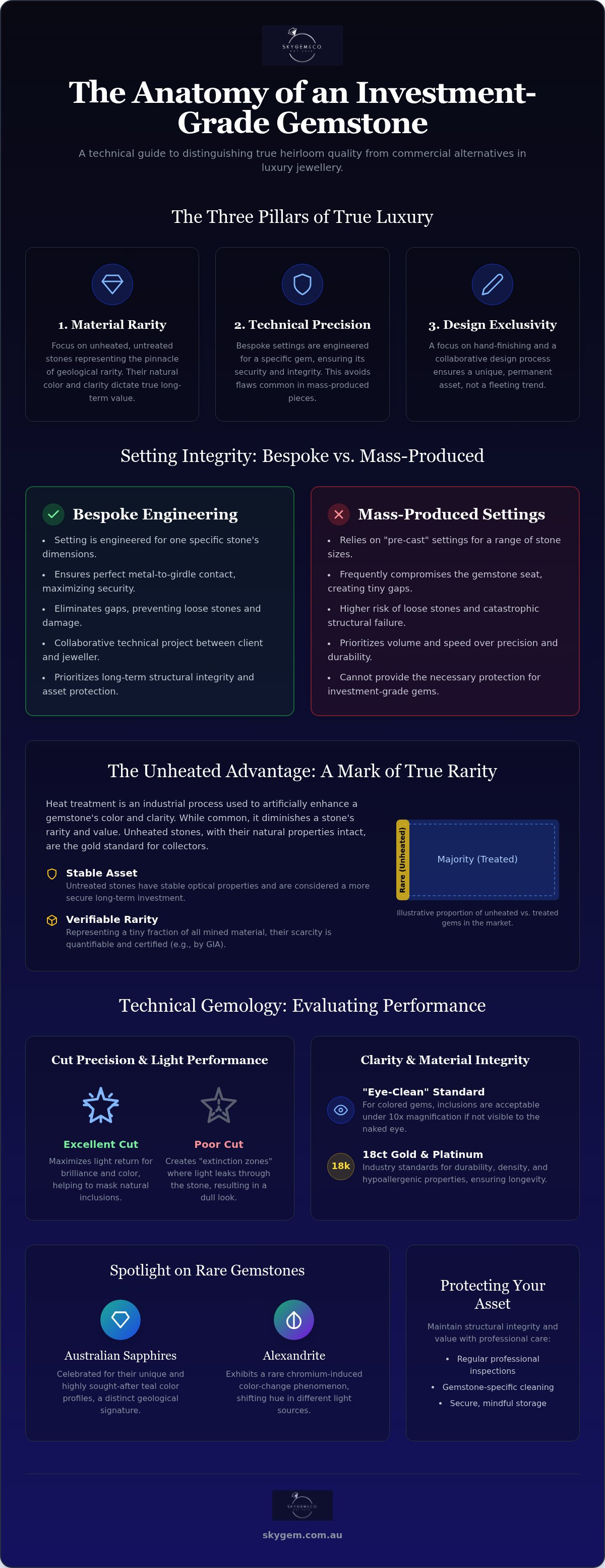
True luxury gemstone jewellery melbourne is defined by a rigorous set of technical standards that go beyond mere visual appeal. While commercial retail often prioritises volume and speed, high-level fine jewellery relies on three specific pillars: material rarity, technical setting precision, and design exclusivity. For the discerning collector, the distinction lies in the transition from commercial-grade stones to investment-grade specimens. Understanding Gemstone characteristics and value is essential here, as factors like colour saturation, clarity, and the absence of thermal enhancement dictate the long-term viability and market standing of the piece. Hand-finishing is a non-negotiable prerequisite for any piece considered true luxury; it ensures that every surface, even those not visible to the eye, is polished and structurally sound.
The contrast between a standard retail item and a piece from a boutique atelier is often found in the "heft" and the microscopic details of the metalwork. Investment-grade stones require a level of protection that mass-produced settings cannot provide. By focusing on technical precision, a jeweller acts as a consultant, ensuring that the aesthetic vision doesn't compromise the physical safety of the precious gemstones involved. This approach treats the accessory as a permanent asset rather than a temporary trend.
Bespoke Settings vs. Mass-Produced Jewelry
Mass production often relies on "pre-cast" settings designed to fit a range of stone sizes. This approach frequently compromises the gemstone seat, creating tiny gaps that lead to loose stones or structural failure over time. In contrast, a bespoke setting is engineered specifically for the unique dimensions of a single stone. This precision ensures the metal supports the stone's girdle without applying undue stress, which is critical for maintaining the integrity of the setting. Bespoke jewellery is a collaborative technical project between client and jeweller.
Choosing 18ct Gold & Platinum for Fine Jewelry
The choice of metal is a functional decision as much as an aesthetic one. 18ct gold and platinum are the established industry standards for luxury gemstone accessories due to their density and durability. 18ct gold provides the necessary hardness to resist daily wear while maintaining a high gold content that retains value. Platinum, being naturally white and exceptionally dense, offers superior security for prongs and bezels, making it the preferred choice for high-value solitaires. These metals ensure the longevity of the piece and offer essential hypoallergenic properties for items like earrings and pendants, ensuring they remain comfortable for life-long wear.
Evaluating Rarity, Cut & Clarity in Coloured Stones
The valuation of luxury gemstone jewellery melbourne rests on quantifiable geological data rather than subjective aesthetic appeal. For the serious collector, value is derived from the convergence of rarity and technical performance. While commercial retailers often rely on visual saturation, a technical consultant evaluates the physical properties of mineral gemstones to determine long-term stability. This includes assessing the "extinction zones"-areas where light leaks through the back of the stone rather than reflecting back to the eye-and the precision of the cut facets. A well-executed cut doesn't just provide brilliance; it manages light to mask natural inclusions and maximize the stone's inherent colour profile.
Clarity standards for coloured gemstones differ significantly from the protocols used for diamonds. While a "flawless" rating is the goal for many, most high-value coloured stones are graded on an "eye-clean" basis. This means that while inclusions may be present under 10x magnification, they don't interfere with the stone's transparency or structural integrity when viewed by the naked eye. When sourcing luxury gemstone jewellery melbourne, understanding these grading nuances prevents the common pitfall of paying premium prices for treated materials.
Why Unheated & Untreated Sapphires Hold Higher Value
Heat treatment is a standard industrial process used to artificially intensify colour or dissolve inclusions. While common, this process can reduce the stone's rarity and, in some cases, its structural resilience. Unheated stones represent a fraction of all mined material, making them the pinnacle of geological rarity. These untreated specimens are considered more stable assets because their optical properties are entirely natural. When selecting natural sapphires, confirming the unheated status is vital for ensuring the piece holds its value as a genuine heirloom.
Independent GIA Certification & Gemstone Authenticity
Transparency in the procurement process is non-negotiable. A reputable laboratory report, such as those provided by the GIA for natural diamonds, acts as a technical audit of the stone. These documents verify the origin, weight, and any detected treatments. Reading a gemstone report requires an understanding of technical lexicon; for example, a mention of "flux" or "lead-glass filling" indicates significant artificial enhancement that drastically lowers value. For those requiring a detailed analysis of specific specimens, you can book a professional gemological consultation to review certification data in detail.
Rare Gemstones: Alexandrite, Emeralds & Australian Teal Sapphires
While diamonds remain a staple of fine accessories, the market for luxury gemstone jewellery melbourne is increasingly driven by a desire for geological rarity and technical distinction. Modern heirlooms are now often defined by stones that exhibit unique optical phenomena or specific regional origins. This shift reflects a growing appreciation for the mineralogical complexity found in coloured stones, where the value is derived from a combination of natural scarcity and the technical skill required to showcase it. Moving beyond standard offerings allows for a more personalised approach to fine jewellery, focusing on the specific chemical compositions that produce extraordinary visual results.
Setting stones like natural emeralds requires a sophisticated understanding of mineralogy. Emeralds are naturally more brittle than sapphires or diamonds due to their characteristic inclusion patterns, often referred to as a "jardin." This necessitates specific engineering in the setting process; bezel or heavy-prong configurations are typically used to protect the stone from impact while allowing sufficient light entry to illuminate its internal structure. For those seeking large-scale accessories like tennis bracelets, lab-grown diamonds offer a high-tech alternative. These stones provide the same physical properties as mined diamonds but allow for greater consistency in colour and clarity across a high volume of small stones, which is essential for the visual flow of a bracelet or necklace.
The Allure of Alexandrite
Alexandrite gemstones are prized for their chromium-induced colour-change phenomenon. Under natural daylight, the stone typically appears green or bluish-green, shifting to a soft raspberry red under incandescent light. This optical shift is exceptionally rare and requires precise orientation during the cutting process to ensure the effect is visible across the entire table of the stone. Because of this complexity, alexandrite is considered one of the most sophisticated additions to any luxury accessory collection, offering a dynamic aesthetic that changes with the environment.
Australian and Teal Sapphires
Australian sapphires have gained global luxury status for their unique teal and deep blue hues. Unlike the bright cornflower blue of Ceylon varieties, teal sapphires offer a complex secondary green undertone that creates a "moody" and sophisticated colour profile. This aesthetic is highly sought after for bespoke projects because it provides a modern look that stands out from traditional commercial jewellery. Integrating these rare minerals into custom designs is a hallmark of luxury gemstone jewellery melbourne, ensuring that every piece remains a distinct and permanent asset.
The Custom Bespoke Design Process: CAD to Final Setting
The creation of luxury gemstone jewellery melbourne begins with a technical consultation designed to align aesthetic goals with mineralogical reality. This isn't a standard retail transaction; it's a collaborative project where the jeweller acts as a technical consultant. During the initial phase, we define the performance metrics of the required stone, focusing on specific carat weights and colour saturation levels. Stone procurement follows a methodical path, often involving a global search to find a specimen that meets the exact technical requirements established in the brief. This ensures that the final accessory is a unique mineral asset rather than a generic inventory item. By establishing these parameters early, the project remains grounded in practical application and long-term viability.
Once the primary gemstone is secured, the focus shifts to the engineering of the mount. Every millimetre of the setting must be calculated to support the stone's specific geometry, ensuring that the final piece is both visually balanced and structurally resilient. This methodical approach reflects the precision required in large-scale technical design, moving from high-level conceptual benefits to granular manufacturing details.
From Concept to CAD
Digital design serves as the bridge between a conceptual sketch and a structurally sound accessory. By utilizing high-resolution CAD (Computer-Aided Design), a jeweller can simulate the physical stresses on a piece, ensuring that complex earring or pendant designs remain durable. This process mirrors the rigorous standards used for a custom-made engagement ring, where every facet of the metalwork is accounted for. Clients play an active role in this stage, approving the technical proportions and ensuring the design meets their functional needs before any metal is cast. This transparency allows for testing structural integrity in a virtual environment, preventing maintenance issues before they arise.
The Setting Process
The final security of a gemstone depends entirely on the precision of the setting. Whether utilizing a traditional claw, a modern protective bezel, or a sophisticated pave arrangement, the metalwork must be engineered around the specific girdle and pavilion of the individual stone. Mass-produced settings often lead to "stone rattle" or eventual loss because they aren't tailored to these unique dimensions. In a bespoke environment, the setting is hand-finished and polished to a mirror shine, ensuring the metal reflects light back into the stone rather than away from it. This final stage of manufacturing is what transforms raw materials into a permanent asset, where the intersection of technical precision and aesthetic design is fully realized.
Start your bespoke design project
How to Clean, Inspect & Maintain High-End Gemstone Jewelry
The long-term viability of luxury gemstone jewellery melbourne depends on a structured maintenance schedule. Fine jewellery is a collection of precision-engineered components that are subject to physical stress through daily wear. Prongs, being the most exposed part of a setting, act as sacrificial elements that slowly wear down over time. Without regular technical audits, this metal loss can lead to structural instability and the eventual loss of high-value stones. Positioning maintenance as a form of asset protection ensures that the aesthetic integrity and financial value of the piece remain intact for decades. A professional inspection should occur annually to verify the security of every gemstone and the condition of the metal housing.
Cleaning protocols must be tailored to the specific mineralogical properties of each stone. Diamonds are chemically robust but lipophilic, meaning they naturally attract oils and grease that dull their brilliance. These can typically handle ultrasonic cleaning. In contrast, stones like emeralds or opals require a non-invasive approach. Because emeralds often contain natural oils or resins within their internal structure, exposure to high-frequency vibrations or harsh detergents can cause these fillers to leach out, compromising the stone's transparency. Using a pH-neutral solution and a soft-bristled brush is the technical standard for maintaining these more sensitive specimens at home.
Professional Restoration Services
Professional restoration involves more than simple cleaning; it is a technical recalibration of the accessory. This process includes prong retipping, where additional metal is laser-welded onto worn claws to restore their original grip. Polishing is also essential for maintaining the lustre of 18ct gold and platinum, as it removes the microscopic scratches that accumulate through friction. You can identify the need for repair by performing a "rattle test"-gently tapping the piece near your ear to listen for movement. Any audible vibration indicates that the stone's seat has become compromised and requires immediate professional intervention to prevent loss.
Storage and Care
Storage is a critical factor in preventing mechanical damage. Stones of different hardness should never be stored together in a way that allows them to make contact. A diamond, sitting at 10 on the Mohs scale, will easily scratch a sapphire or an emerald. Utilizing individual soft-lined compartments prevents this cross-scratching. Additionally, the lustre of 18ct gold and platinum can be affected by prolonged exposure to chlorine or industrial chemicals, which can cause stress corrosion cracking in some alloys. Removing fine accessories before using cleaning agents or entering chlorinated pools is a simple but effective strategy for ensuring the long-term structural health of your collection.
Securing the Longevity of Your Fine Accessories
Acquiring luxury gemstone jewellery melbourne requires a shift from standard retail browsing to a methodical process of technical procurement. By prioritising GIA-certified natural diamonds and rare untreated specimens, such as unheated alexandrite or Australian sapphires, you ensure your collection consists of genuine geological rarities. The integration of bespoke CAD design services allows for a level of structural precision that mass production simply cannot replicate; it provides a necessary foundation for long-term durability and aesthetic balance.
We've explored how technical gemology and rigorous manufacturing standards transform raw materials into permanent heirlooms. Whether you're seeking a one-of-a-kind pendant or a complex trilogy ring, focusing on material integrity and expert craftsmanship is the only way to safeguard the value of your fine accessories. Establishing a partnership with a technical consultant ensures your vision is realised without compromising on engineering standards or stone security.
Taking a methodical approach to both procurement and ongoing maintenance ensures your collection remains a source of pride and a stable asset for years to come. We look forward to helping you navigate the complexities of rare gemstone design.
Frequently Asked Questions
What is the difference between natural and unheated sapphires?
Natural sapphires are stones of earth origin, while unheated sapphires are a rare subset that hasn't been subjected to thermal enhancement to alter colour or clarity. Most commercial sapphires undergo heat treatment at high temperatures to dissolve inclusions and intensify hues. Unheated specimens represent a tiny fraction of gem-quality material. These untreated stones are prized for their geological purity and typically command a significant price premium in the market for luxury gemstone jewellery melbourne.
Is Alexandrite more expensive than a diamond?
High-quality alexandrite with a strong colour-change effect often exceeds the price per carat of a standard colourless diamond. While smaller, commercial-grade specimens are accessible, top-tier natural alexandrite is one of the rarest minerals on earth. Its value is driven by the percentage of colour shift from green to red. For serious collectors, a large alexandrite of exceptional quality is significantly rarer and more valuable than a diamond of equivalent weight.
How long does the bespoke design process take for a gemstone pendant?
The timeline for a bespoke gemstone pendant typically ranges from four to eight weeks. This schedule accounts for the methodical stone procurement phase, where we source a specimen meeting your specific technical requirements. Following stone selection, the CAD design and 3D rendering stage takes approximately one week. The final manufacturing, which includes casting, hand-finishing, and precise stone setting, requires several weeks to ensure the structural integrity of the accessory is maintained.
Are lab-grown diamonds considered real for luxury accessories?
Lab-grown diamonds are chemically, physically, and optically identical to natural diamonds. They consist of carbon atoms arranged in a crystal structure, providing the same hardness of 10 on the Mohs scale. In luxury accessories, they're often used for high-volume pieces like tennis bracelets to ensure consistent colour and clarity. While they lack the geological rarity of natural stones, they offer a high-performance alternative that meets the same technical standards for brilliance and durability.
Why is GIA certification important for coloured gemstones?
GIA certification provides an independent, technical audit of a gemstone's identity and treatment status. For coloured stones, this report is essential for verifying whether a stone is unheated or has undergone artificial enhancements like flux filling or beryllium diffusion. It also confirms the geographic origin, which is a primary driver of value for stones like Australian sapphires. Without this documentation, it's difficult to accurately assess the rarity or market standing of a high-value accessory.
Can I use my own gemstone for a bespoke accessory design?
You can use your own gemstone for a bespoke project, provided the stone passes a rigorous technical assessment. We evaluate the stone's structural integrity, looking for surface-reaching inclusions or cleavage planes that might pose a risk during the setting process. Once cleared, we use CAD technology to engineer a mount specifically for that stone's unique dimensions. This consultancy-based approach ensures your heirloom stone is secured within a setting designed for its long-term viability.
What is the best metal for a luxury gemstone ring or earring?
18ct gold and platinum are the industry standards for luxury gemstone jewellery melbourne due to their density and durability. Platinum is preferred for its superior prong security; it's a dense metal that doesn't wear away as quickly as gold. 18ct gold, available in yellow, white, or rose, provides the necessary hardness to resist daily abrasion while maintaining a high precious metal content. Both metals offer the hypoallergenic properties required for lifelong wear in earrings and rings.
How often should I have my luxury accessories professionally cleaned?
Professional inspections and cleanings should occur at least once a year. This isn't just for aesthetics; it's a critical safety check for your gemstones. A jeweller uses high-magnification tools to inspect prong tightness and metal wear that isn't visible to the naked eye. Regular maintenance prevents stone loss by identifying structural fatigue early. Between these annual visits, you can maintain lustre at home using a soft brush and pH-neutral solution for most hard gemstones.
Disclaimer
This article is for general informational purposes only and may include AI-assisted content. Pricing, specifications, and availability are subject to change. For accurate advice and current information, please contact SkyGem & Co. directly. Nothing in this content constitutes professional or financial advice.