
Lab-Grown Diamonds: The Complete Guide to Quality & Value

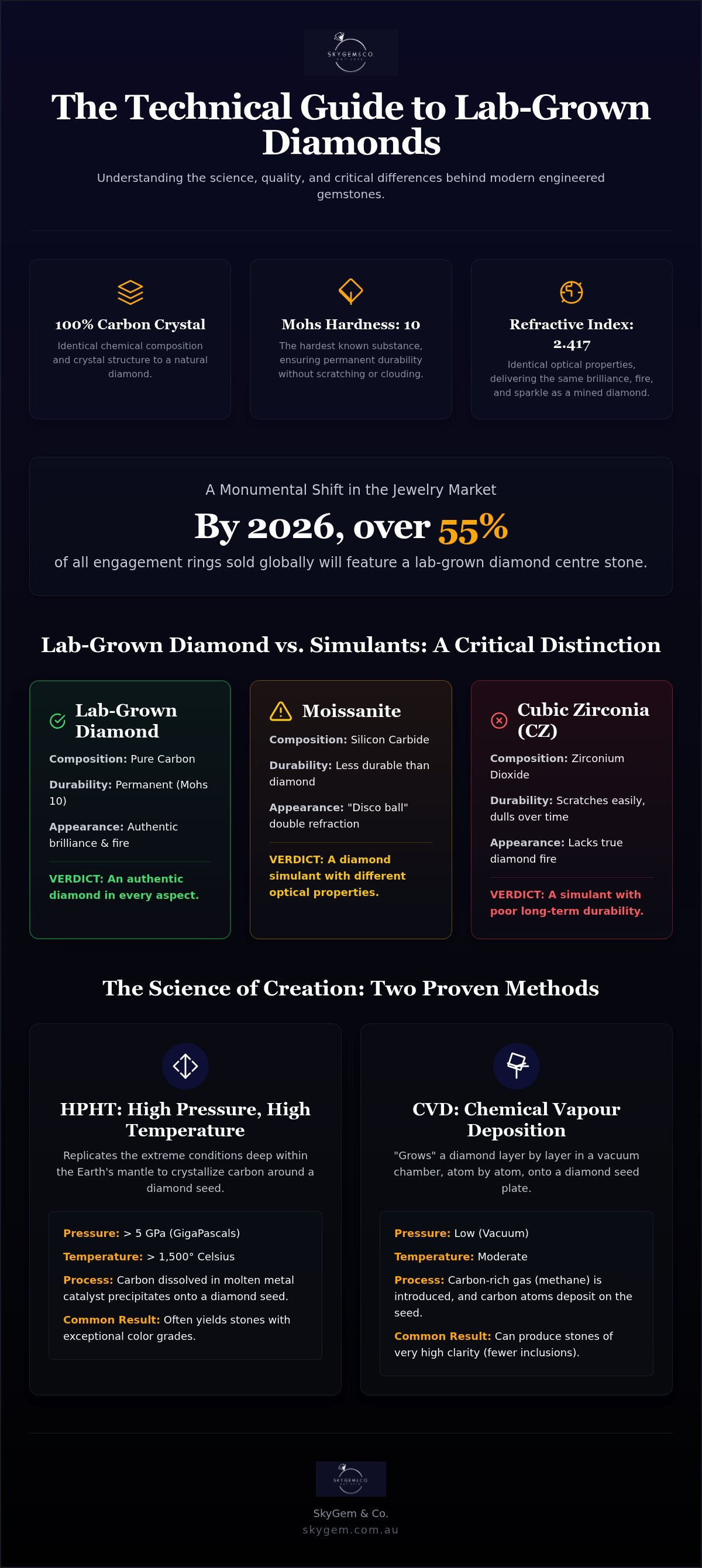
Did you know that as of 2026, over 55% of all engagement rings sold globally now feature a lab grown diamond as their centre stone? This shift marks a significant transition in how we define luxury and value in the modern jewellery market. It's understandable if you feel overwhelmed by the technical jargon surrounding these stones. Between distinguishing between a true diamond and a simulant, or trying to decipher the differences between HPHT and CVD growth methods, the path to a confident purchase often feels clouded by complexity. You want the brilliance of a high-carat stone without the fear of it looking fake or losing its lustre over time.
This guide provides the technical precision and industry insight you need to master these nuances, ensuring you select a stone that offers uncompromising quality and exceptional value. We'll examine the latest GIA grading standards, the physical properties that ensure your diamond lasts for generations, and how to leverage bespoke design to maximise your budget. By the end of this article, you'll have the expertise of a technical consultant, ready to secure a visually perfect piece that aligns with your ethical standards.
Key Takeaways
- Learn the fundamental difference between diamond simulants and a lab grown diamond, which shares the identical chemical composition and physical properties of its natural counterpart.
- Understand how HPHT and CVD technologies precisely replicate the earth's natural processes to create stones with uncompromising structural integrity.
- Discover why the Cut remains the most critical factor in determining brilliance and how to apply the 4Cs to ensure your stone meets premium grading standards.
- Evaluate the significant price-to-carat advantages and ethical traceability of laboratory-grown stones to maximise your investment without sacrificing aesthetic impact.
- Explore the bespoke design process, from selecting loose stones to custom CAD rendering, to create a unique piece that reflects your personal style.
Understanding Lab Grown Diamonds: Composition, Origin, and Evolution
A lab grown diamond is a 100% pure carbon crystal, structured in the same isometric-hexoctahedral crystal system as a mined diamond. For decades, Synthetic (lab-grown) diamonds were primarily confined to industrial applications where their extreme hardness was utilised for high-precision cutting and grinding tools. As technology matured, the ability to control nitrogen levels and crystal growth cycles allowed for the production of gem-quality stones. These are not "simulants" or "imitations"; they are diamonds in every sense of the definition, cultivated within controlled environments that replicate the extreme heat and pressure found deep within the Earth's mantle.
In Australia, transparency and nomenclature are governed by the Australian Consumer Law. This regulatory framework mandates clear disclosure, requiring sellers to distinguish between natural and laboratory-grown origins. This isn't just a legal requirement but a hallmark of industry integrity. It ensures that when you choose a stone for engagement rings, you understand the precise origin and value proposition of your purchase. The evolution of the lab grown diamond represents a shift from accidental discovery to intentional, technical perfection.
The Physical and Chemical Reality
The technical profile of a lab grown diamond is indistinguishable from a natural one without specialised laboratory equipment. Both possess a Mohs scale hardness of 10, making them the hardest known substance. They share a refractive index of approximately 2.417 and identical thermal conductivity. Because they share the same carbon-based crystal lattice, these stones don't "cloud" or degrade over time. The structural stability is permanent. Even for a seasoned gemologist, identifying the origin requires advanced spectroscopic analysis to detect the subtle growth patterns that differ from those formed over billions of years underground.
Lab-Grown vs. Simulants: A Critical Distinction
It is vital to separate lab diamonds from simulants like Cubic Zirconia (CZ) or Moissanite. While a simulant is designed to mimic the appearance of a diamond, its chemical composition and performance metrics are entirely different. A lab diamond is the only true alternative for those seeking the specific optical properties of a diamond.
- Cubic Zirconia: This is zirconium dioxide. It lacks the durability of carbon and often develops scratches or a dull appearance after just a few years of wear.
- Moissanite: Composed of silicon carbide, moissanite has a higher refractive index than diamond. This often results in a "double refraction" or "disco ball" effect that can look artificial to the trained eye.
- Lab-Grown Diamond: Offers the exact "fire" and "brilliance" that defines a high-quality diamond, ensuring the stone performs perfectly in lab-grown white diamonds and bespoke settings.
Choosing a lab-grown stone isn't about compromising on quality; it's about selecting a product of modern engineering that meets the same rigorous standards as its natural counterpart. This technical parity is why lab-grown options have become a staple in high-end, custom jewellery design.
The Science of Growth: HPHT vs. CVD Technologies
The production of a lab grown diamond relies on two distinct engineering philosophies: High Pressure High Temperature (HPHT) and Chemical Vapour Deposition (CVD). While both methods result in a stone that is chemically identical to a natural diamond, the growth environment significantly influences the rough crystal's morphology and internal characteristics. Understanding these differences allows for a more informed selection process when seeking a stone with specific performance metrics.
HPHT: The Classic Synthesis
HPHT technology replicates the extreme conditions found 150 kilometres below the Earth's surface. Using massive hydraulic presses, a carbon source is subjected to pressures exceeding 5 GPa and temperatures above 1,500 degrees Celsius. A molten metal catalyst, typically consisting of iron, nickel, or cobalt, dissolves the carbon, which then precipitates onto a diamond seed.
This method often yields stones with exceptional colour grades, particularly in smaller carats. However, the use of metal catalysts can occasionally introduce trace elements like Boron, which may give the stone a subtle blue nuance or affect its electrical conductivity. From a technical perspective, HPHT diamonds grow in a cuboctahedral shape, which provides a sturdy foundation for traditional round brilliant cuts.
CVD: The Modern Precision Method
CVD represents a more controlled, surgical approach to diamond synthesis. It is an increasingly popular way to create a lab grown diamond with high clarity and significant carat weight. Inside a vacuum chamber, a carbon-rich gas such as methane is ionised into plasma using microwaves. This process breaks the molecular bonds, allowing pure carbon atoms to settle onto a diamond seed plate layer by layer.
CVD technology is particularly effective for producing larger stones with high clarity. Because the process doesn't involve molten metals, the risk of metallic inclusions is eliminated. One technical nuance to consider is that CVD stones can sometimes develop a faint brown tint during the growth process. To correct this, many stones undergo post-growth HPHT treatment to achieve a colourless state. When reviewing lab-grown white diamonds, it's essential to check the grading report for these treatment notations to ensure you're getting the transparency you deserve.
The success of either method depends on the precision of the growth cycle. Rapid growth can lead to internal strain or striation lines, which affect the stone's light performance. We focus on sourcing stones from laboratories that prioritise stability over speed, ensuring your diamond possesses the structural integrity required for a lifetime of wear.
Evaluating Quality: How the 4Cs Apply to Laboratory-Grown Stones
The 4Cs—Cut, Colour, Clarity, and Carat—remain the universal benchmark for assessing diamond performance. While these metrics were originally developed for mined stones, they are just as vital when evaluating a lab grown diamond. The technical precision of laboratory growth allows for a higher yield of stones that meet the top tiers of these scales, but it doesn't remove the necessity for a critical eye. In fact, because the growth environment is controlled, expectations for light performance are often higher than they are for natural counterparts.
Among the 4Cs, Cut is undeniably the most critical factor for brilliance. In the natural diamond trade, cutters often face a dilemma: preserve carat weight from a rare, irregularly shaped rough or cut for maximum sparkle. Laboratory-grown rough crystals are typically more uniform, which allows technicians to prioritise mathematical precision over weight retention. This results in a significantly higher percentage of "Ideal" and "Excellent" cuts. When a stone is cut to these exacting proportions, it reflects light with the maximum possible fire and scintillation, which is the primary goal of any high-quality jewellery piece.
Colour and Clarity in the Lab
Most premium lab diamonds are classified as Type IIa. This is the most chemically pure category, representing only 2% of natural diamonds but nearly all high-quality laboratory stones. Because Type IIa stones lack measurable nitrogen, they often achieve exceptional colour grades in the colourless to near-colourless range. However, "lab-grown" doesn't mean "flawless." HPHT growth can leave microscopic metallic inclusions from the molten catalyst, while CVD processes can result in tiny carbon spots or internal "strain" lines. For those commissioning bespoke engagement rings, the focus should remain on "Eye Clean" stones. This ensures that any technical inclusions are invisible to the naked eye, allowing for a visually perfect centrepiece without the unnecessary premium of an internally flawless grade.
Certification: Protecting Your Investment
Independent verification is the only way to ensure the technical specifications of your stone are accurate. While the International Gemological Institute (IGI) remains a dominant force in grading laboratory stones, the Gemological Institute of America (GIA) has recently refined its approach. As of 2026, the GIA has transitioned its lab-grown reports to focus on "premium" and "standard" classifications, though the underlying data regarding the 4Cs is still utilised to reach these conclusions. Every certified stone features a microscopic laser inscription on the girdle, providing a permanent link to its grading report. You can explore these nuances further in our guide to lab-grown white diamonds, which serves as a technical resource for selecting stones with verified provenance and performance.
Sustainability and Value: Why Australian Couples Choose Lab Diamonds
The adoption of laboratory-grown stones is driven by a fundamental re-evaluation of what constitutes value in the luxury sector. For many Australian couples, the traditional rarity premium of mined diamonds is being replaced by a preference for technical precision and verifiable origins. As of 2026, research indicates that a lab grown diamond typically costs between 60% and 85% less than a natural stone of comparable quality. This price differential doesn't represent a decrease in quality; it reflects the efficiency of a streamlined, technology-driven supply chain that bypasses the high overheads of industrial mining operations.
This economic shift allows for a more balanced allocation of your budget. Instead of the majority of funds being absorbed by the raw material's scarcity, resources can be redirected into the design and craftsmanship of the piece. This ensures the final product is a bespoke asset tailored to your specific aesthetic requirements rather than a generic retail purchase constrained by stone costs.
The Economic Advantage
The primary benefit of this price structure is the ability to maximise the physical impact of the jewellery within a fixed budget. When you aren't paying the "scarcity tax" associated with natural stones, you can secure a significantly larger carat weight or a higher colour and clarity grade. A budget that might accommodate a standard one-carat natural stone can often secure a two-carat, visually perfect lab stone. This is particularly advantageous for large solitaire engagement rings, where the centre stone's scale is the defining feature. The focus moves from what you can afford to what you actually desire in a design.
Ethical and Environmental Considerations
Beyond the financial metrics, ethical transparency is a core requirement for the modern consumer. Data from 2025 shows that 65% of Australians now prefer ethically sourced diamonds, a trend that has accelerated into 2026. Because these stones are produced in controlled laboratory environments, the supply chain is short and entirely traceable. This eliminates the ecological disruption of large-scale mining and provides a level of conflict-free assurance that is inherent to the product's origin. It's a solution-oriented approach for those who value both aesthetic excellence and environmental responsibility.
This transparency is particularly valuable for those seeking SkyGem’s bespoke engagement rings, where the focus is on creating a piece with a clear, positive history. The ability to verify the stone's origin from the growth facility to the final setting offers a level of confidence that traditional mining often struggles to match. To see how these savings can be applied to your own design, you can explore our lab-grown ring builder to compare various stone specifications and setting styles in real-time.
Integrating Lab Grown Diamonds into Bespoke Jewellery Design
The transition from selecting a loose stone to finalising a piece of fine jewellery is where technical precision meets aesthetic design. While many retailers treat a lab grown diamond as a simple commodity, a bespoke approach views it as a high-performance material that allows for greater creative freedom. Because these stones are cultivated with consistent crystal structures, they often present a higher level of structural integrity during the cutting process. This reliability allows designers to explore complex shapes and delicate settings that might be too risky or prohibitively expensive with natural stones of similar scale.
The Custom Design Journey
Our bespoke process functions as a technical partnership, ensuring that every specification serves the final environment of the piece. This journey moves through three distinct phases of engineering and craftsmanship:
- Step 1: Selection of the Loose Stone. We begin by identifying a specific lab grown diamond that meets your requirements for colour, clarity, and cut. By focusing on Type IIa stones, we ensure the highest level of chemical purity as a foundation for your design.
- Step 2: Technical CAD Rendering. Using Computer-Aided Design (CAD), we create a 3D model of your piece. This allows us to calculate the exact metal volume and stone placement required for structural stability. It's during this phase that we refine the balance of the setting, ensuring it's both visually striking and durable enough for daily wear.
- Step 3: Hand-Finishing and Setting. While CAD provides the blueprint, the final performance of the stone depends on the human element. Each diamond is hand-set by skilled artisans to maximise light return and ensure the security of the prongs. This level of finish is essential for maintaining the stone's brilliance over generations.
Beyond the Solitaire
The value proposition of laboratory-grown stones extends far beyond the traditional solitaire. The consistency in growth allows for precise matching of stones, which is vital for complex designs like trilogy engagement rings or halo settings. When stones aren't perfectly matched in colour and fluorescence, the visual harmony of the piece is compromised; lab-grown technology makes achieving this symmetry far more accessible.
This precision also benefits high-carat accessories. Matching dozens of stones for diamond tennis bracelets or gemstone earrings requires a level of inventory control that is difficult to achieve with mined stones. By using lab-grown options, you can ensure that every stone in a multi-stone piece performs with the same intensity. Whether you're interested in a pear, marquise, or radiant cut, these stones pair perfectly with premium 18K gold or platinum to create a permanent asset. We invite you to build your custom lab-grown diamond ring with our expert team to experience this technical design process firsthand.
Securing Lasting Value Through Technical Excellence
Selecting a lab grown diamond is a strategic decision that balances sophisticated engineering with timeless aesthetic appeal. By mastering the technical distinctions between HPHT and CVD growth and prioritising GIA or IGI certification, you ensure your stone possesses the structural integrity and brilliance required for a lifetime of wear. This technical foundation allows you to focus your resources where they matter most; on the bespoke craftsmanship and high-quality settings that define a piece of fine jewellery. It's about moving beyond the standard retail experience to create a piece that is both a personal milestone and a technical marvel.
As an Australian-owned and operated bespoke jeweller, we act as your technical consultants throughout the design process. We provide expert consultations in our boutique to guide you through every granular specification, from initial stone procurement to the final hand-setting. Explore Our Curated Selection of Lab-Grown Diamonds to begin the journey of creating a permanent asset that reflects your unique vision. Your path to a visually perfect, ethically sourced diamond is a rewarding investment in both quality and design.
Frequently Asked Questions
Are lab-grown diamonds real diamonds?
Yes, lab-grown diamonds are chemically, physically, and optically identical to natural diamonds. They consist of 100% pure carbon arranged in an isometric-hexoctahedral crystal lattice, which is the same structure found in stones formed deep within the Earth. Unlike imitations or simulants, these stones possess the same Mohs scale hardness of 10 and the identical refractive index that defines a true diamond.
Do lab-grown diamonds test positive on a diamond tester?
Yes, a lab grown diamond will test positive on a standard diamond tester. Because these stones share the same thermal and electrical conductivity as natural diamonds, basic handheld devices used by jewellers cannot distinguish between the two origins. Identifying the difference requires advanced spectroscopic equipment used by gemological laboratories to detect specific growth patterns or microscopic trace elements inherent to the laboratory process.
Will a lab-grown diamond ever go cloudy or change colour?
No, lab-grown diamonds are structurally stable and won't go cloudy, fade, or change colour over time. Their optical properties are permanent because they are made of the same durable carbon bonds as mined stones. If a stone appears dull, it's usually due to surface accumulation of oils or dust. Professional cleaning easily restores the original brilliance, as the stone's internal integrity remains unchanged for generations.
Why are lab-grown diamonds so much cheaper than natural ones?
The lower price point reflects a streamlined, technology-driven supply chain rather than a reduction in quality. Producing diamonds in a laboratory environment eliminates the massive overheads associated with industrial mining, land restoration, and complex global logistics. These efficiency gains allow for a price reduction of 60% to 85% compared to natural stones, making high-carat, visually perfect diamonds more accessible for bespoke designs.
Can insurance companies cover lab-grown diamond jewellery?
Yes, most major insurance providers offer comprehensive coverage for jewellery featuring lab-grown stones. Policies are typically based on the current replacement value of the piece. To secure coverage, you'll need to provide an independent valuation and a grading report from a recognised laboratory like the GIA or IGI. This ensures your investment is protected against loss, theft, or damage based on its verified technical specifications.
How can I tell if a diamond is lab-grown without a certificate?
It's impossible to distinguish a lab-grown stone from a natural one using only the naked eye or a standard jeweller's loupe. The most reliable non-technical method is to check the diamond's girdle for a microscopic laser inscription. Reputable laboratories include these inscriptions to ensure full disclosure of the stone's origin. Without this mark, only specialised laboratory equipment can confirm whether a diamond is natural or laboratory-grown.
Do lab-grown diamonds have a resale value?
Lab-grown diamonds do have a resale value, though it's generally lower than that of natural diamonds. While the secondary market is evolving, these stones are best viewed as a high-quality personal asset rather than a financial investment. The primary value remains the significant initial savings, which allow couples to redirect their budget toward premium settings and custom craftsmanship that lasts a lifetime.
Are lab-grown diamonds better for the environment?
Lab-grown diamonds offer a significantly reduced environmental footprint by eliminating the ecological disruption of large-scale mining. Laboratory production requires less land use and avoids the risk of water contamination or soil erosion. This verifiable traceability is a key reason why 65% of Australian consumers now prioritise ethically sourced options. It's a practical solution for those seeking a sustainable luxury product without compromising on technical or aesthetic performance.
Disclaimer
This article is for general informational purposes only and may include AI-assisted content. Pricing, specifications, and availability are subject to change. For accurate advice and current information, please contact SkyGem & Co. directly. Nothing in this content constitutes professional or financial advice.