
Lab-Grown Diamonds: The Complete Comparison and Buyer’s Guide for 2026

The most technically superior diamond in a 2026 jewellery collection wasn't necessarily forged in the earth a billion years ago; it was likely engineered in a controlled environment last month. You might assume that a shorter growth cycle compromises the structural integrity of the stone, but the chemical reality tells a different story. It's understandable to feel cautious when terms like 'synthetic' and 'simulant' are frequently misapplied, creating a false impression that lab grown diamonds are merely high-end imitations rather than genuine, carbon-based gemstones.
This guide provides the technical precision required to make an informed investment. You'll learn why these stones are atom-for-atom identical to mined counterparts and how they offer a 60% to 75% price advantage in the current Australian market. We'll examine the specific engineering behind Chemical Vapour Deposition (CVD), analyse the A$ resale outlook for the coming year, and outline a clear path to securing a stone with reputable GIA or IGI certification. By the end of this analysis, you'll have the confidence to choose a diamond that meets the highest standards of luminous efficacy and structural excellence.
Key Takeaways
- Understand the technical specifications that define **lab grown diamonds** as chemically and physically identical to mined stones, ensuring your selection meets rigorous gemological standards.
- Evaluate the substantial value proposition of these gemstones, which typically offer a 60-80% cost saving in the Australian market without compromising on refractive performance or aesthetic integrity.
- Gain a methodical understanding of HPHT and CVD synthesis to appreciate how precision engineering replicates the earth’s natural geological processes to create gem-quality results.
- Analyse the ethical and environmental advantages of lab-grown origins, facilitating a procurement process that prioritises long-term sustainability and social compliance.
- Learn to interpret independent grading reports from the GIA and IGI to ensure your investment is backed by industry-leading certification and technical data.
What Are Lab-Grown Diamonds? Definition and Core Properties
Lab grown diamonds are authentic diamonds produced within a controlled laboratory environment. These facilities utilize advanced engineering to replicate the extreme high-pressure and high-temperature conditions found 150 kilometres below the Earth's crust. Unlike simulants that merely imitate the appearance of a gemstone, these stones consist of a lattice of pure carbon atoms. This structural integrity ensures they possess the exact chemical, physical, and optical properties as diamonds extracted from a mine. They're not "fakes" or "imitations" but are real diamonds that have been grown through human-led technological processes.
It's vital to differentiate these from materials like cubic zirconia or moissanite. Cubic zirconia is a synthetic zirconium dioxide, while moissanite is silicon carbide. Neither shares the carbon-based DNA of a diamond. Lab grown diamonds represent a shift toward precision-engineered luxury, offering a sustainable alternative without compromising on the material's inherent durability or brilliance. Because they're formed from the same element as natural stones, they exhibit the same refractive index and dispersion, resulting in the identical "sparkle" that consumers expect from high-end jewellery.
The Chemical Identity of Lab Diamonds
Every diamond, whether formed over billions of years or weeks in a lab, belongs to the cubic crystal system. This specific arrangement of carbon atoms provides the stone with its legendary brilliance and fire. Because the two are identical at an atomic level, professional gemologists can't distinguish them using traditional handheld tools like loupes or thermal probes. Identification requires sophisticated laboratory equipment, such as photoluminescence spectroscopy, to detect minute growth patterns. Lab diamonds are composed of 100% carbon and achieve a rating of 10 on the Mohs scale of mineral hardness.
Terminology: Synthetic vs. Simulant
The jewellery industry increasingly avoids the term "synthetic" because it often suggests an inferior or "fake" product to the average buyer. In Australia, consumer protection laws and the Jewellers Association of Australia (JAA) Code of Ethics mandate clear disclosure of a stone's origin. Sellers must explicitly state if a diamond is lab-grown to maintain market transparency. When reviewing a laboratory report from institutions like the GIA or IGI, look for the "Laboratory-Grown" heading to verify the stone's provenance. Selecting stones through a specialised lab-grown diamond platform ensures you receive a certified asset that meets rigorous Australian compliance standards and technical specifications. This level of transparency is a core part of our commitment to providing turnkey solutions for modern engagement needs.
Lab-Grown vs. Natural Diamonds: A Technical Comparison
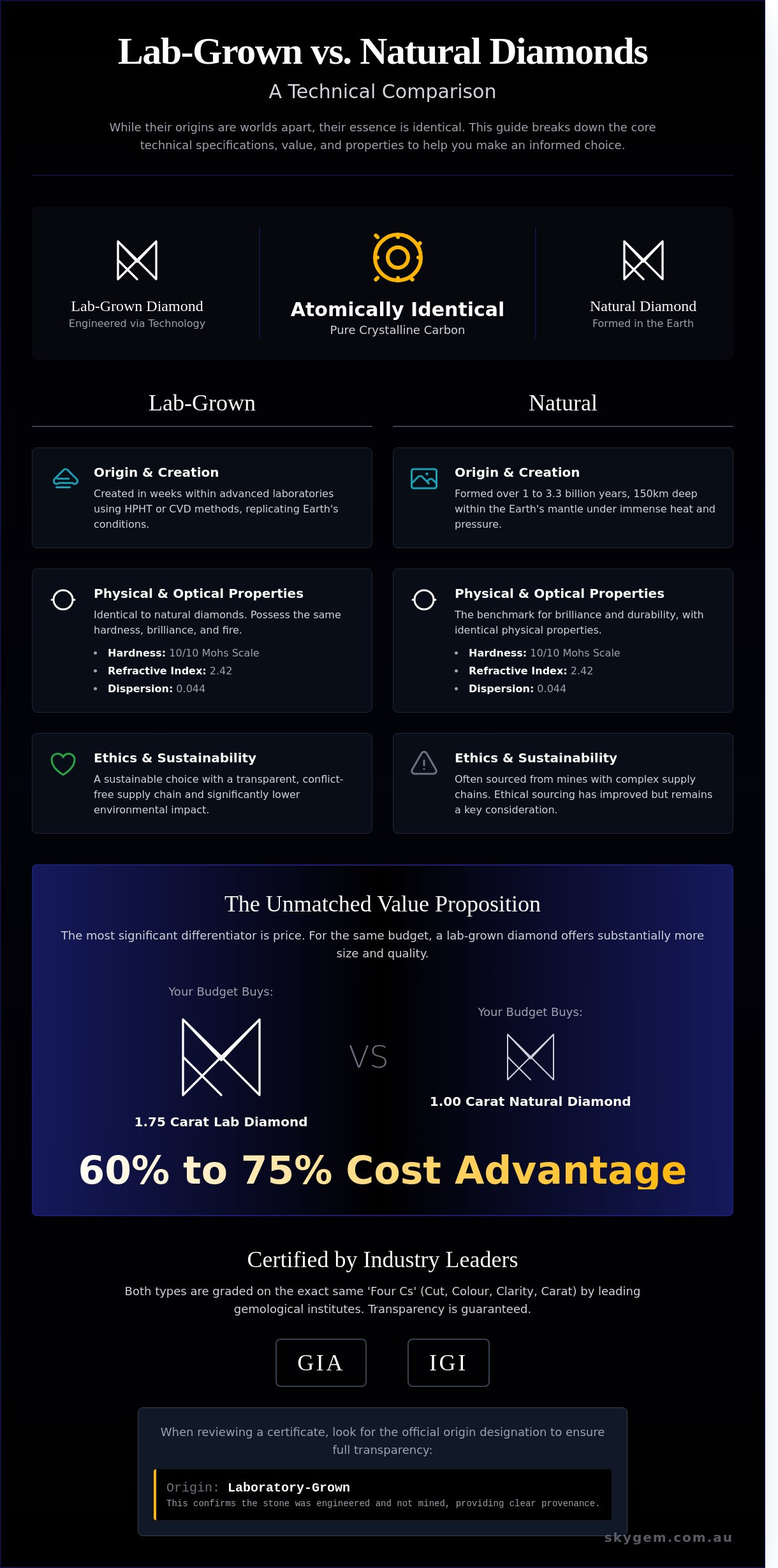
Choosing between origins requires an understanding of the underlying physics. Both stones share an identical cubic carbon structure, meaning their performance under light is indistinguishable to the naked eye. Whether earth-mined or created in a laboratory, these stones achieve a 10 on the Mohs scale of hardness; this makes them the most durable material for daily wear in an engagement ring. At a molecular level, lab grown diamonds are carbon crystals, not a different species of gemstone.
Physical and Optical Properties
- Hardness: 10 (Mohs Scale)
- Refractive Index: 2.42
- Thermal Conductivity: High (500–2000 W/m·K)
- Dispersion: 0.044
The visual brilliance of a diamond relies on how light travels through the stone. Fire refers to the rainbow flashes of light caused by dispersion, while scintillation is the sparkle seen when the stone or the light source moves. Because both stones possess a refractive index of 2.42, they manipulate light with the same precision. You can explore our engagement rings to see these optical properties in action across various settings.
The 'Four Cs'—Cut, Colour, Clarity, and Carat—apply universally. Certification bodies like the GIA and IGI use the same rigorous standards to grade both types. A D-grade colourless stone will exhibit the same crisp transparency regardless of whether it was formed in the mantle or a reactor. Precision cutting remains the primary driver of beauty, as the facet angles determine how efficiently light returns to the viewer's eye.
The Rarity vs. Availability Debate
Natural diamonds are finite geological resources, often formed between 1 and 3.3 billion years ago under intense pressure 150 kilometres below the earth's surface. This history creates a sense of rarity that many find emotionally compelling. Conversely, lab grown diamonds represent a feat of modern engineering. They provide a sustainable, scalable supply that bypasses the environmental footprint of traditional mining operations.
While the emotional value of an earth-mined stone is rooted in its ancient heritage, the value of a lab-grown stone lies in its technical perfection and accessibility. For many Australian couples, the ability to secure a higher carat weight for a specific budget is a practical advantage that outweighs the 'rarity' premium. If you're ready to compare specific stones, you can build your own lab-grown ring using our live inventory data.
The Science of Creation: HPHT and CVD Processes Explained
The transition from 1954 industrial abrasives to 2026's gem-quality stones represents a significant leap in material science. Early synthesis focused exclusively on hardness for cutting tools; today, the priority is optical perfection and chemical purity. Understanding these methods is essential for any professional selecting lab grown diamonds for high-end applications. The growth method dictates the diamond's internal structure, which directly influences its final light performance and colour grading.
While both processes result in a stone that is chemically identical to a mined diamond, the engineering pathways differ. Choosing between them often depends on the desired carat weight and specific colour requirements. For those seeking bespoke solutions, our lab grown diamonds selection tool provides access to stones created through both advanced methods.
High Pressure High Temperature (HPHT)
The HPHT process recreates the volatile conditions found 150 kilometres below the Earth's surface. A small diamond seed is placed in a carbon source, typically graphite, and subjected to pressures exceeding 5.5 GPa and temperatures reaching 1,500°C. This environment forces carbon atoms to bond to the seed layer by layer. It's a precise science that requires massive hydraulic presses. Beyond initial growth, HPHT is a vital tool for colour enhancement. It can transform brownish Type IIa diamonds into D-grade colourless gems by repairing the crystal lattice. HPHT crystals typically grow in a cuboctahedral shape, often featuring 14 growth directions, which makes them ideal for certain square and rectangular cuts.
Chemical Vapour Deposition (CVD)
CVD technology offers a different path by growing diamonds from a hydrocarbon gas mixture. Inside a vacuum chamber, technicians introduce methane and hydrogen, then use microwaves to ionise the gas into plasma. This release of pure carbon atoms allows them to settle onto a diamond plate. The process requires extreme precision; even a minor fluctuation in the 1,000°C environment can cause the crystal to fracture. CVD is the preferred method for producing high-clarity white diamonds because it allows for greater control over trace impurities. A standard 2.0-carat stone may take 3 to 4 weeks to grow. This method produces a tabular crystal shape, which is highly efficient for cutting round brilliant and oval shapes.
- HPHT: Best for large, high-colour stones and fancy blue or yellow diamonds.
- CVD: Exceptional for high-clarity white diamonds with no internal strain.
- Timeline: Growth cycles range from 14 to 50 days depending on the target carat size.
The Value Proposition: Ethics, Sustainability, and Price
The value proposition of lab grown diamonds centers on a radical recalibration of the luxury supply chain. In the 2026 Australian market, these stones typically retail for 60% to 80% less than their mined counterparts. This price delta isn't a reflection of inferior chemical or physical properties; it's the direct result of removing the immense overheads associated with geological exploration and open-pit extraction. For a client with a fixed budget of A$12,000, choosing a lab-grown alternative often facilitates the transition from a 1.2-carat stone to a 3.0-carat specimen with superior VVS1 clarity and D-grade colour. It's a pragmatic shift from paying for rarity to paying for performance.
Traceability remains a core technical advantage for the modern buyer. Every stone produced in a controlled laboratory environment possesses a documented provenance from the initial carbon seed to the final polish. This transparency eliminates the social and geopolitical risks historically linked to the diamond trade, offering a verifiable path for every carat. By choosing lab grown diamonds, you're opting for a product that bypasses the complexities of conflict-zone monitoring, replacing ambiguity with technical precision and ethical certainty.
Environmental Impact and Sustainability
Traditional mining requires the displacement of approximately 250 tonnes of earth per single carat of diamond. In contrast, laboratory growth utilizes Chemical Vapor Deposition (CVD) methods that bypass terrestrial disruption entirely. Leading laboratories in 2026 have transitioned to 100% renewable energy grids, significantly reducing the carbon intensity of each production cycle. View our lab-grown white diamonds for eco-conscious options that align with these rigorous technical standards.
Financial Considerations and Long-term Value
Market data for 2026 indicates that lab diamonds should be viewed as a lifestyle asset rather than a speculative financial investment. While natural stones may retain higher resale percentages due to geological scarcity, lab diamonds offer immediate utility and superior aesthetic impact for the initial outlay. We advise our clients to prioritise the "visual yield" of their purchase. By allocating funds toward a higher-quality cut and a bespoke setting, you ensure the piece functions as a permanent, high-performance asset. It's about maximising the architectural beauty of the jewellery rather than banking on future commodity fluctuations.
Ready to design a piece that balances technical excellence with ethical integrity? Explore our custom-made engagement rings in Melbourne to begin your project.
Selecting Your Diamond: Certification and Quality Standards
Purchasing a diamond without independent verification is a critical error in any high-value transaction. For lab grown diamonds, certification acts as a technical blueprint that confirms the stone's origin and physical properties. We advise clients to never acquire uncertified stones; they lack the documented proof of quality required for insurance and accurate resale valuation. In the Australian market, where transparency is paramount, a certificate ensures you're receiving exactly what you paid for without ambiguity.
The Gemological Institute of America (GIA) and the International Gemological Institute (IGI) represent the global benchmarks for grading. While the IGI was an early adopter in documenting lab-grown stones, the GIA provides a rigorous assessment that many collectors prefer for its conservative grading scales. Every certified stone features a microscopic laser inscription on the girdle. This permanent mark allows you to verify the diamond against its digital record at any time, providing a layer of security that future-proofs your investment against substitution or loss. It's a non-negotiable standard for any modern laboratory-grown asset.
Reading a Grading Report
A standard report identifies the stone clearly as 'Laboratory-Grown' or 'Lab-Grown' to prevent market confusion. You should always verify the report number on the issuing laboratory's official database before finalising a purchase. At SkyGem & Co., we filter through thousands of options to select only the finest gemstones that meet our stringent optical performance criteria. We focus on stones with 'Excellent' or 'Ideal' cut grades to ensure maximum light return and fire, ensuring the technical specifications translate into visible brilliance.
The SkyGem & Co. Approach to Lab Diamonds
Our methodology treats every diamond as a feat of precision engineering. We prioritise technical excellence and architectural aesthetics, ensuring that the setting complements the stone's specific dimensions and light-handling properties. Our specialists work with you to find the perfect balance of the Four Cs, tailored to your specific budget in A$. You can explore our curated range or start your journey with our lab-grown colour diamonds for a unique look. We focus on long-term durability and compliance with international standards, ensuring your piece remains a permanent and evolving asset.
Securing Your Investment in Modern Brilliance
The transition toward lab grown diamonds reflects a logical evolution in Australian luxury, where technical precision meets ethical responsibility. Market data from 2025 indicates that lab-created stones offer approximately 70% better value than mined alternatives, allowing for superior specifications without compromising your budget. By prioritizing GIA and IGI certified stones, you ensure your gem meets rigorous international standards for clarity and cut. Skygem provides the technical expertise necessary to navigate these metrics, treating every diamond selection as a collaborative engineering project rather than a simple transaction.
Our commitment to bespoke Australian-led design ensures your diamond is housed in a setting built for long-term durability and local compliance. We don't just supply stones; we offer expert technical consultations to help you understand the nuances of diamond synthesis and light performance. It's about finding a solution that balances aesthetic impact with sound financial logic. You're ready to create a piece that's both future-proof and visually stunning. Explore Our Curated Lab-Grown Diamond Collection today and find a stone that aligns with your standards for excellence.
Frequently Asked Questions
Are lab-grown diamonds real diamonds?
Yes, lab-grown diamonds are chemically, physically, and optically identical to mined diamonds. They consist of pure carbon atoms arranged in a cubic crystal structure. Unlike cubic zirconia or moissanite, which are diamond simulants, these stones are 100% authentic diamonds. The Federal Trade Commission updated its guidelines in 2018 to confirm that a diamond is a diamond regardless of its origin, whether it grew in the earth or a laboratory.
Do lab-grown diamonds pass a diamond tester?
Lab-grown diamonds will pass a standard diamond tester because they possess the same thermal and electrical conductivity as natural stones. Most handheld testers used by Australian jewellers measure how heat or electricity moves through the crystal. Since the atomic structure is the same, the device registers a positive result. Professional labs use more advanced UV-VIS spectrometers to identify specific growth patterns or trace elements like nitrogen.
Will a lab-grown diamond get cloudy over time?
A lab-grown diamond will never get cloudy, fade, or change colour over time. Because they're composed of the same stable carbon lattice as natural stones, they're impervious to environmental factors. A stone rated with VVS1 clarity today will maintain that same internal structure for centuries. Any perceived cloudiness is usually just surface oil or dirt, which you can easily remove using a standard ultrasonic cleaner or a soft cloth.
Why are lab-grown diamonds so much cheaper than natural ones?
Lab-grown diamonds cost significantly less because the supply chain is shorter and more efficient. You'll typically find that lab grown diamonds retail for 60% to 85% less than mined diamonds of equivalent quality in the Australian market. This price difference stems from the elimination of expensive mining operations and the ability to scale production in controlled environments. A 1-carat lab stone might cost A$1,200, while a comparable mined stone exceeds A$6,000.
Can you tell the difference between lab-grown and natural diamonds with a loupe?
You cannot distinguish between a lab-grown and a natural diamond using a standard 10x jeweller's loupe. Even a highly trained gemologist cannot see the difference with the naked eye because the optical properties are identical. Identification requires sophisticated laboratory equipment to detect minute growth morphology or microscopic laser inscriptions. Every certified stone carries a laser inscription on the girdle, usually visible only under 20x magnification, to ensure full transparency for the buyer.
Do lab-grown diamonds have resale value?
Lab-grown diamonds currently hold lower resale value than their natural counterparts. While you can sell them back to some specialised Australian retailers, the secondary market typically offers between 10% and 25% of the original purchase price. Natural diamonds generally retain 40% to 60% of their value. Buyers should view these stones as a high-performance lifestyle purchase rather than a financial investment, focusing on the immediate cost savings of several thousand dollars.
Are lab-grown diamonds GIA certified?
Yes, the Gemological Institute of America (GIA) provides full digital grading reports for lab-grown diamonds. Since 2020, the GIA has issued certificates that specify the exact colour and clarity grades rather than using ranges. Other reputable bodies, such as the International Gemological Institute (IGI), grade the majority of the Australian market's inventory. These reports provide a technical blueprint of the stone’s 4Cs, ensuring you receive the exact specifications you paid for.
Is a lab-grown diamond as hard as a natural diamond?
Lab-grown diamonds are exactly as hard as natural diamonds, measuring a 10 on the Mohs scale of mineral hardness. This makes them the hardest known material on Earth, suitable for daily wear in engagement rings. They offer the same durability and resistance to scratching or chipping. Because they share the same physical integrity, they're often used in industrial applications where extreme thermal management and structural strength are critical requirements.
Disclaimer
This article is for general informational purposes only and may include AI-assisted content. Pricing, specifications, and availability are subject to change. For accurate advice and current information, please contact SkyGem & Co. directly. Nothing in this content constitutes professional or financial advice.