
Lab-Grown Diamond vs Moissanite: A Practical Ring-Buying Comparison

What if the stone with the most colourful sparkle isn’t the one that best matches your idea of a diamond ring? In product photos, lab-grown diamonds and moissanite can look remarkably similar, so it’s understandable to compare them by appearance or price alone. But a lab grown diamond vs moissanite comparison starts with identity: a lab-grown diamond is made of carbon, while moissanite is a different gemstone made of silicon carbide.
That distinction affects more than what the stone is called. The two materials handle light differently, and although both can be durable choices for everyday wear, they don’t look or behave identically in every ring design. Your preference depends on the stone’s identity, the light performance you enjoy, how you’ll wear the ring and the role the centre stone plays in the setting.
This guide explains the material and optical differences, compares practical wear considerations and shows what to examine in a loose stone or finished ring. You’ll be better equipped to weigh each option against your priorities instead of relying on a product image or marketing language. If you prefer a lab-grown diamond, those preferences can also guide a considered bespoke ring design.
Key Takeaways
- In a lab grown diamond vs moissanite comparison, start with gemstone identity: one is diamond, while the other is a distinct gemstone.
- Compare how each stone handles light in person, because product images can make their visual differences difficult to judge.
- Consider wear properties alongside your lifestyle and setting design when deciding which stone suits your ring.
- Before choosing, confirm the stone’s identity, review its available documentation and assess its appearance before settling on a setting.
- There’s no universal winner. Weigh identity, preferred look, wear expectations and design priorities to make a considered choice.
Lab-Grown Diamond vs Moissanite: What Is Actually Different?
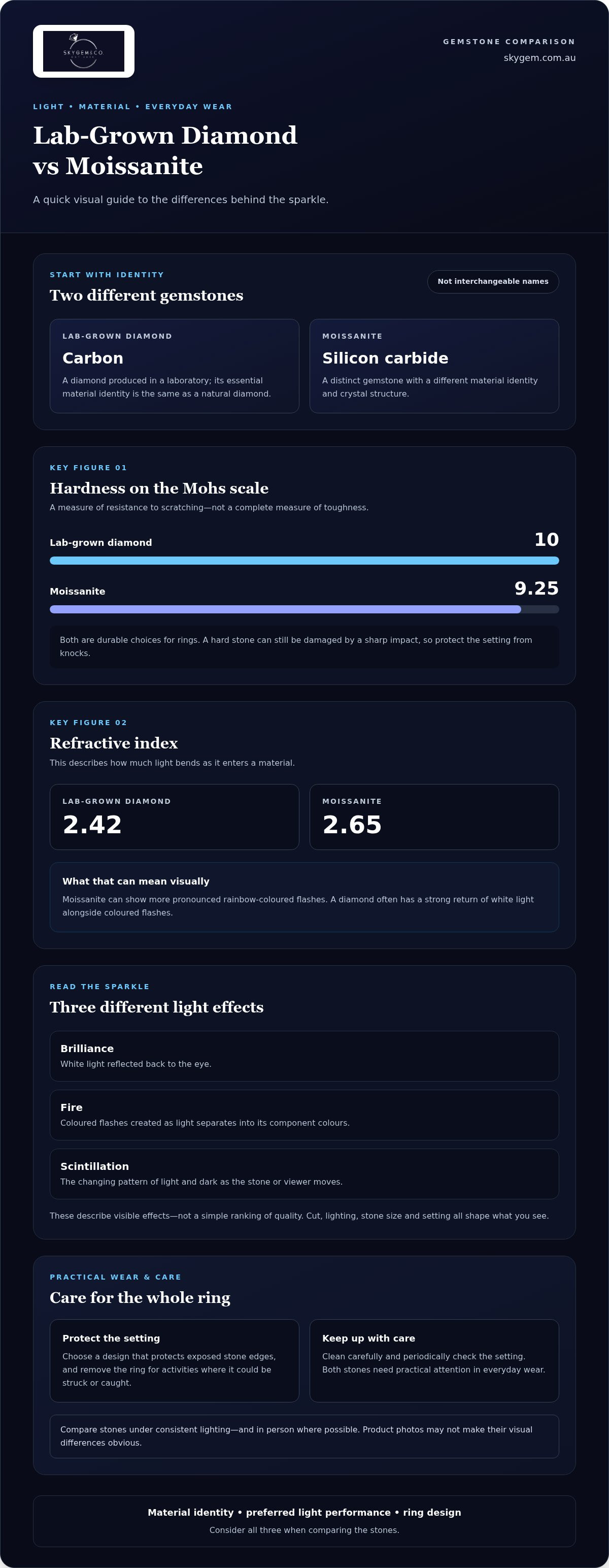
A lab-grown diamond is diamond; moissanite is a separate gemstone. Both can suit an engagement ring, but they aren’t interchangeable names for the same material. This distinction matters when deciding what you want the centre stone to be, as well as how you want it to look in a particular design.
Lab-grown diamond: A diamond produced in a laboratory rather than formed naturally underground. It has the same essential material identity as a natural diamond.
Moissanite: A gemstone made from silicon carbide. It can be used in jewellery, but it isn’t a type of diamond.
In composition and crystal structure, diamond is carbon arranged in a cubic crystal lattice, while moissanite is silicon carbide with a different crystal structure. For an overview of how laboratory-grown diamonds are produced and their physical properties, see What is a lab-grown diamond.
Is moissanite a lab-grown diamond?
No. Moissanite and diamond are different gemstones, not different names for one material. The Gemological Institute of America identifies moissanite as silicon carbide, whereas diamond consists of carbon. “Lab-grown” describes how a diamond is produced; it doesn’t change the stone’s identity into another gemstone. In a lab grown diamond vs moissanite comparison, first decide which material you want, then consider appearance and ring design.
Why can the two stones look similar at first glance?
Both can be cut into familiar engagement-ring shapes and set in similar styles, so a photograph may not make their differences obvious. Cut quality influences how effectively a stone returns light, while lighting affects the brightness and colour of the flashes you see. Stone size and setting also shape the overall impression. For example, a halo can make the centre stone appear more prominent than it would in a simpler setting.
Sparkle alone doesn’t establish gemstone identity. Moissanite can show more colourful flashes, while a diamond’s light return often appears brighter and whiter. The effect varies with the individual stone, cut and viewing conditions. Compare stones under consistent lighting and, where possible, in person. For more detail on selecting a diamond, read the Australian lab-grown diamond buying guide.
How Appearance, Light Performance, and Durability Compare
A useful comparison separates what you can observe from what gemological measurements describe. Both stones can return light attractively, but their optical properties differ. Cut, lighting and setting all influence the effect you see. The American Gem Society’s guide to what moissanite is explains its distinct material identity and properties.
| Comparison | Lab-grown diamond | Moissanite |
|---|---|---|
| Material identity | Diamond, made of carbon. | A separate gemstone made of silicon carbide. |
| Visual character | Often produces a strong return of white light, alongside coloured flashes. | Can show more pronounced rainbow-coloured flashes. |
| Hardness | 10 on the Mohs scale. | 9.25 on the Mohs scale. |
| Care considerations | Protect the setting from knocks and clean the ring with care. | Use the same practical attention to setting protection and routine cleaning. |
How do brilliance, fire, and sparkle differ?
Brilliance is the white light reflected back to the eye. Fire means the coloured flashes created when light separates into its component colours. Scintillation is the changing pattern of light and dark as the stone or viewer moves. These terms describe visible effects, not a simple ranking of quality.
Refractive index helps explain one difference. It describes how much light bends as it enters a material. Moissanite’s refractive index is 2.65, compared with diamond’s 2.42, so moissanite can display more fire. What you notice depends on lighting and cut proportions. A stone viewed under bright spotlights may show a different balance of flashes from one seen in softer, everyday light.
Which stone is more suitable for regular ring wear?
On the Mohs scale, diamond has a hardness of 10 and moissanite 9.25. These figures describe resistance to scratching, not overall toughness. Hardness and toughness aren’t interchangeable: a hard stone can still be damaged by a sharp impact, and the scale doesn’t predict every risk of daily wear. Both are durable choices for rings, but care still matters.
Choose a setting that protects the stone’s exposed edges, and take the ring off for activities where it could be struck or caught. Periodic attention to the setting and careful cleaning help you monitor the whole ring, not just the gemstone. The best fit in a lab grown diamond vs moissanite comparison depends on the light performance you prefer and how your design will be worn.
Lab-Grown Diamond vs Moissanite: A Side-by-Side Buying Framework
A practical lab grown diamond vs moissanite decision starts with your priorities, not a search for a universal winner. One stone is diamond, while the other is a distinct gemstone. Both can work in an engagement ring, but the material you choose, the look you prefer and the design you have in mind may point in different directions.
| Decision factor | Lab-grown diamond | Moissanite |
|---|---|---|
| Identity | A diamond produced in a laboratory. | A separate gemstone made of silicon carbide. |
| Appearance | May suit someone drawn to diamond’s characteristic balance of white light and coloured flashes. | May appeal to someone who prefers more pronounced rainbow-coloured flashes. |
| Wear properties | Mohs hardness of 10; hardness does not describe every aspect of toughness. | Mohs hardness of 9.25; the same distinction between hardness and toughness applies. |
| Design considerations | Consider how the diamond’s shape, proportions and setting work together. | Consider how its light display and shape complement the setting and overall ring style. |
Which stone fits the look and meaning you want?
Start with a direct question: do you specifically want a diamond, or are you open to a different gemstone? If having a diamond is central to your choice, a lab-grown diamond meets that preference while differing from a natural diamond in origin. If you’re open to an alternative, moissanite’s distinct identity and vivid coloured flashes may be part of its appeal.
Compare stones in more than one lighting condition when possible. Look at how each appears in bright, direct light and in softer surroundings. Consider whether you prefer stronger white-light return or more visible rainbow flashes. Your own response matters more than a general claim that one stone looks “better”.
How should budget and design influence the decision?
Budget is a design constraint, not a verdict on which stone is right. It can influence the balance between the centre stone, its size and cut, the setting and the chosen metal. Decide which features matter most before settling on a complete ring. A considered setting can support the stone’s appearance and suit how you plan to wear the design.
If a lab-grown diamond is your preference, explore lab-grown diamond ring-building options as one way to consider a centre stone alongside its setting. Match the stone to your priorities, not to a supposed universal winner.
How to Assess a Stone Before Choosing an Engagement Ring
Assess the stone first, then judge how it works in a complete ring. This sequence helps separate documented information about the gemstone from your own observations of its appearance and the design choices that shape its presentation.
- Confirm the stone’s identity. Check whether it’s described as a diamond or moissanite, and make sure that wording is consistent wherever the stone is presented.
- Review available documentation. A grading or identification report may record details such as a diamond’s measurements and assessed characteristics. The type and scope of documentation can differ, and not every stone has the same report. A report describes the stone assessed; it doesn’t show how it looks in every setting or guarantee how a finished ring will wear.
- Inspect the appearance. Look at the cut and overall presentation, and note any visible inclusions or colour appearance. View the stone under consistent lighting and from more than one angle. This makes comparisons more useful than relying on photographs taken in different conditions.
- Consider the setting. Once you understand the stone, assess how the proposed design affects its appearance, comfort and exposure to knocks.
What should you examine in a diamond or moissanite?
Read documentation alongside the stone, not as a substitute for seeing it. A grading report can provide assessed information within the scope of that report, but it doesn’t decide which appearance you’ll prefer or how the stone will look once set. In a lab grown diamond vs moissanite comparison, keep the identity clear, then evaluate each stone on its own documented details and visible qualities. Don’t assume a particular grading format applies to both materials.
How can the setting change the final appearance?
Prong style affects how much of the stone is visible and how the setting frames it. Metal colour can influence the ring’s overall contrast, while setting height changes how prominently the stone sits above the band and how exposed it may be to everyday knocks. These choices involve both aesthetics and practical wear. No setting removes the need to care for the ring.
SkyGem & Co.’s bespoke engagement-ring process brings the design from CAD through to stone setting, helping translate preferences into a considered finished ring. A consultation can focus on how stone choice, setting and daily wear priorities work together.
Explore bespoke engagement-ring design
Choose a Stone and Create a Ring That Suits You
Once you’ve established what matters most, use those priorities as a design brief. Clear preferences around the centre stone, its visual presence and everyday wear can guide decisions about proportions, setting and metal, creating a ring that feels considered as a whole.
A quick design brief for your priorities
- Record your priorities: Note the qualities you want the centre stone and finished ring to express.
- Think about daily wear: Consider how the setting should balance visibility, comfort and practical protection.
- Set design preferences: Identify shapes, proportions and metal colours that appeal to you, then use these to guide the design discussion.
A concise brief makes it easier to turn ideas into a coherent design. Refine the details by considering how each element works with the stone.
Turn your preferred stone into a considered ring design
In bespoke engagement-ring design, the stone’s proportions inform the setting, while the setting’s height and structure influence the ring’s profile and how it feels to wear. Metal colour contributes to the overall character. SkyGem & Co. develops bespoke designs from CAD through to stone setting, with consultations tailored to your preferences and budget.
Explore engagement-ring styles for design ideas, then bring the elements you like into a conversation about a custom piece.
Make Your Ring Choice with Confidence
The lab grown diamond vs moissanite decision comes down to what you want the centre stone to be, how you want it to look and how it fits your expectations for everyday wear. A lab-grown diamond is diamond; moissanite is a distinct gemstone. Their different light performance can guide your preference, but neither is the universal choice for every ring.
Before deciding, confirm the stone’s identity, review its available documentation and assess its appearance under consistent lighting. Then consider how the cut, proportions, setting and metal work together in the finished design. Looking at the complete ring helps connect technical details with the way you’ll wear and enjoy it.
At SkyGem & Co., bespoke engagement-ring design and manufacturing bring those details together, from CAD design through to stone setting. Consultations are tailored to your design preferences and budget, helping shape a ring around what matters to you.
Take the time to choose deliberately. With clear priorities, you can move forward with a ring design that feels distinctly yours.
Frequently Asked Questions
Can you tell the difference between a lab-grown diamond and moissanite by looking at them?
Not reliably in every case, especially from online images. Photography, lighting and screen settings can alter a stone’s apparent brightness and colour, while a finished setting changes how the whole ring reads. Treat photographs as a first impression, not proof of identity. For a visual comparison, view the stones under the same conditions and use documentation to establish what each one is.
Which sparkles more, lab-grown diamond or moissanite?
There isn’t one answer that captures every stone or viewing situation. Instead of relying on a general sparkle claim, decide what kind of light display you enjoy and view the actual stones side by side if possible. See them in more than one lighting environment, then consider whether you still like the effect outside bright showroom lighting. Your preference is a more useful guide than a ranking.
Which is harder, a lab-grown diamond or moissanite?
Diamond ranks higher on the Mohs hardness scale, but that figure alone isn’t a complete guide to how a finished ring will handle wear. The stone’s exposure, the setting’s construction and the wearer’s activities all affect practical care. Consider whether the ring could be knocked or caught during regular routines, and include setting protection and maintenance in your decision rather than relying on hardness as a guarantee.
Is moissanite suitable for an engagement ring worn every day?
Moissanite can be used in an engagement ring intended for regular wear, provided the ring is treated as jewellery that needs care. Consider your daily activities when choosing the setting, and remove the ring for tasks that could expose it to impact or catching. Routine inspection and careful cleaning help you keep an eye on the setting as well as the stone.
How can you identify whether a stone is a lab-grown diamond or moissanite?
Begin with the stone’s description and any report supplied with it, checking that the information refers to the stone you’re considering. Reports can vary in scope, so read what the document actually assesses rather than assuming every report covers the same details. If the identity remains unclear, a qualified gemological assessment is more dependable than trying to decide by eye or from a photograph.
Should I choose a lab-grown diamond or moissanite for an engagement ring?
Choose according to what you want the ring to represent and how you want it to fit your life. If you’re deciding with a partner, discuss whether the word “diamond” is important, what visual qualities appeal to you both and which design features matter most. A bespoke design consultation can help turn those preferences and your budget into a coherent ring plan without treating either stone as the automatic choice.
Disclaimer
This article is for general informational purposes only and may include AI-assisted content. Pricing, specifications, and availability are subject to change. For accurate advice and current information, please contact SkyGem & Co. directly. Nothing in this content constitutes professional or financial advice.