
Lab Diamond vs Natural Diamond Value Retention: A 2026 Economic Analysis

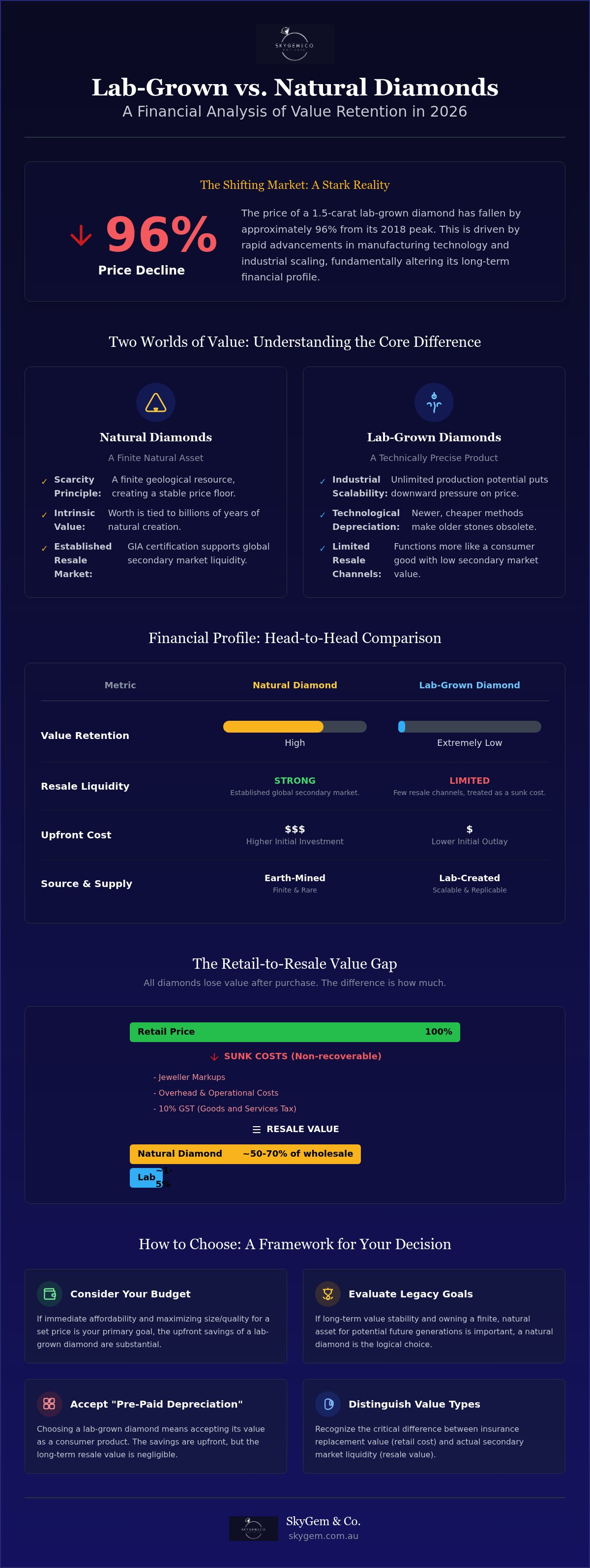
The price of a 1.5-carat lab-grown diamond has fallen by approximately 96% from its 2018 peak as of early 2026, creating a complex landscape for modern buyers. This stark data point often fuels the anxiety surrounding lab diamond vs natural diamond value retention. You likely recognize the immediate appeal of lab-grown stones but worry about whether you're purchasing a depreciating consumer good or a lasting store of value. It's a valid concern, especially as the Gemological Institute of America (GIA) now utilizes descriptive Premium and Standard categories to differentiate these stones from their natural counterparts.
This article provides an authoritative guide to the long-term financial reality and resale potential of both options. We'll move beyond marketing claims to examine technical market trends, including the impact of the 18% tariff on stones from India. You'll gain a clear understanding of resale liquidity and a logical framework to help you decide between immediate affordability and long-term worth. Our analysis focuses on the intersection of technical precision and economic viability to ensure your decision is grounded in data rather than hype.
Key Takeaways
- Identify the critical distinction between insurance replacement value and actual secondary market liquidity to ensure your financial expectations align with 2026 market realities.
- Analyze how the technical evolution of CVD and HPHT production directly influences lab diamond vs natural diamond value retention over a multi-year horizon.
- Examine the role of GIA certification in maintaining a global secondary market for natural diamonds compared to the limited resale channels available for lab-grown stones.
- Apply the concept of "pre-paid depreciation" to determine if the substantial upfront savings of a lab-grown diamond outweigh the long-term value stability of a natural alternative.
- Develop a structured framework for choosing between a finite natural asset and a technically precise lab-grown stone based on your specific budget and legacy goals.
Defining Value: Resale, Replacement, and Scarcity in 2026
Value retention is the percentage of the original purchase price recoverable on the secondary market. Understanding this specific metric is vital for any significant acquisition in the luxury sector. In the jewellery industry, a clear distinction exists between "intrinsic value," which relates to the physical properties and rarity of a stone, and "market value," which is the price a consumer pays at retail. For those evaluating lab diamond vs natural diamond value retention, this distinction becomes the foundation of a sound financial decision.
Establishing a baseline for this value requires objective, third-party data. GIA certification serves as this technical benchmark, providing a universal language for quality that facilitates secondary market liquidity. Without such certification, a stone lacks the verified specifications needed for a transparent resale process. While a Synthetic diamond possesses identical chemical properties to a natural one, its market trajectory is fundamentally different due to industrial production scalability. We treat these categories as distinct assets with different long-term profiles.
The Retail-to-Resale Gap
Every diamond experiences an immediate reduction in value once it leaves the showroom. This occurs because retail prices include jeweller markups, overhead, and the 10% GST. These components are essential for professional business operations but don't translate to the secondary market. Consequently, describing consumer-grade jewellery as an "investment" is often technically inaccurate. True liquidity depends on the gap between the initial acquisition cost and what a professional buyer can offer based on current wholesale indices. It's a matter of accounting for these upfront "sunk costs" before the stone even enters the secondary market.
The Scarcity Principle
The primary driver of long-term worth in any asset class is scarcity. Natural diamonds are a finite geological resource, created over billions of years under specific conditions. This finite nature creates a price floor that has historically remained stable over decades. In contrast, lab-grown stones are products of industrial scalability. As technology improves, the cost of production for lab-grown white diamonds continues to decrease, leading to an increase in supply that naturally puts downward pressure on resale prices.
Market perception also plays a critical role in technical valuation. Buyers consistently demonstrate a willingness to pay a premium for "Earth-mined" history, viewing natural white diamonds as a permanent asset. This preference isn't merely sentimental; it's a reflection of the market's trust in a resource that cannot be manufactured in unlimited quantities. When analyzing lab diamond vs natural diamond value retention, the ability to replicate the product at scale is the single most significant factor in price depreciation.
Technical Drivers of Lab-Grown Diamond Price Depreciation
The rapid decline in lab-grown diamond prices is a direct result of engineering efficiency. Unlike natural stones, which require massive geological excavation, lab-grown diamonds are manufactured in controlled environments. The transition from older High Pressure High Temperature (HPHT) methods to advanced Chemical Vapour Deposition (CVD) has drastically reduced the energy required per carat. This shift allows for the creation of larger, higher-quality crystals at a fraction of the historical cost. As production methods refine, the cost of entry for manufacturers continues to plummet.
We're observing a "Moore’s Law" effect within the sector. Just as silicon chips become cheaper and more powerful over time, lab-grown stones from 2026 are technically superior and significantly less expensive than those produced in 2020. As of early 2026, the wholesale price of a one-carat lab diamond has dropped to approximately $191 per carat. This follows a trend where the price of a 1.5-carat stone has fallen by approximately 96% from its 2018 peak. This ongoing technological advancement creates a unique challenge for lab diamond vs natural diamond value retention. A stone purchased today is effectively an older iteration in an industry rapidly moving toward higher efficiency and lower costs.
Industrial Scaling vs Luxury Positioning
The transition of lab-grown stones from "rare technology" to an "industrial commodity" is nearly complete. In 2026, improved reactor designs have further slashed production energy costs compared to the early 2020s, making mass-market entry inevitable. This industrial scalability is why many jewellers don't offer buy-back programmes for synthetic stones. There's no incentive to repurchase a secondary-market stone when a brand-new, technically perfect replacement can be manufactured for a lower wholesale price. It's a fundamental shift from a luxury asset to a high-end consumer good. If you're weighing these technical factors, you can explore our range of natural white diamonds to see how rarity influences long-term stability.
The Grading Paradox
Modern production techniques have made "D-Flawless" specifications the standard for lab-grown specimens. While a perfect stone sounds ideal, it creates a grading paradox. In the natural market, perfection is a rare geological anomaly that commands a massive premium. In the lab-grown market, perfection is the baseline. Consequently, a "perfect" stone has less value retention than a natural stone with unique, rare characteristics that cannot be replicated. Institutions like the IGI and GIA have adapted to this by using descriptive categories, acknowledging that these stones are valued for their aesthetic utility rather than their rarity. This lack of individual stone premium further accelerates the depreciation of synthetic options in the secondary market.
Resale Realities: Natural Diamond Liquidity vs Lab Sunk Costs
Liquidity defines the ease with which an asset can be converted into cash without affecting its market price. In the jewellery sector, the fundamental difference in lab diamond vs natural diamond value retention becomes most apparent during the liquidation process. Natural diamonds benefit from a global, centuries-old secondary market supported by professional buyers, auction houses, and private collectors. This established infrastructure ensures that a seller can typically recover between 20% and 60% of the original retail price, depending on the stone's quality and the chosen sales channel.
Lab-grown diamonds face a significantly more challenging resale environment. Because technology continues to lower production costs, professional buyers are often reluctant to purchase pre-owned lab stones. There is little incentive for a jeweller to buy a second-hand lab diamond when they can acquire a brand-new, technically superior stone from a wholesaler for a lower price. Consequently, lab-grown stones often retain only 10% to 30% of their original retail value on the secondary market. In many cases, pawn shops or high-street buyers may only offer "melt value," focusing on the precious metal of the setting rather than the synthetic stone itself.
Where Can You Actually Sell?
If you own a natural stone, your options for liquidation are diverse. You can explore professional diamond buyers, consignment through boutique jewellers, or specialized auction houses. These avenues exist because natural diamonds are viewed as a permanent store of value. Conversely, lab-grown stones are often limited to peer-to-peer marketplaces like eBay or Facebook. Most traditional jewellers don't offer trade-in credit or buy-back programmes for lab stones because the rapid wholesale price decline makes holding such inventory a financial risk. It's a reality that shifts the lab-grown purchase from a financial asset to a purely aesthetic acquisition.
The Role of Certification in Resale
Technical verification is the cornerstone of resale value. For natural stones, a report from the Gemological Institute of America is non-negotiable. Natural GIA Certified Diamonds provide a verified baseline of quality that professional buyers trust, which directly supports higher value retention. While lab-grown stones are also graded by institutions like the IGI or GIA, the financial impact of these reports is different. Paying for premium grading on a lab stone often yields diminishing returns; the cost of the certification can represent a significant percentage of the stone's total value, further complicating the resale math. In the natural market, the certificate is an essential component of the asset's provenance.
The Opportunity Cost: A Financial Counter-Argument
While the previous sections establish that natural stones possess superior secondary market liquidity, a comprehensive economic analysis must account for the initial capital outlay. The primary lab diamond vs natural diamond value retention debate often focuses on percentages, yet the absolute dollar difference is where the practical decision resides. By choosing a lab-grown stone, a buyer is effectively engaging in "pre-paid depreciation." You accept a lower resale percentage in exchange for retaining a significant portion of your capital at the point of purchase.
Consider a technical comparison involving two stones of identical specifications. A natural diamond may require an acquisition cost of $15,000, while a comparable lab-grown alternative costs $3,000. If the natural stone retains 50% of its value, the owner recovers $7,500 but realizes an absolute loss of $7,500. If the lab-grown stone retains 0% value, the loss is capped at the $3,000 purchase price. In this scenario, the buyer who chose the lab-grown option is $4,500 ahead in absolute terms, even with zero resale success. For some, the "value" of a lab diamond is found in the capital it frees up today.
Calculating the "Break-Even" Point
Determining the rational choice requires looking at how many years you'd need to hold a natural diamond for it to outperform a lab diamond combined with invested savings. If the $12,000 price gap is diverted into traditional financial markets with a conservative annual return, the compound interest can eventually exceed the projected resale value of the natural stone. This calculation is particularly relevant for budget-conscious buyers who don't intend to sell their jewellery. While natural diamonds offer a hedge against inflation and a baseline of scarcity, the immediate liquidity of cash savings provides a different type of financial security.
Emotional ROI vs Financial Equity
The decision isn't purely mathematical; it involves balancing emotional return on investment with tangible financial equity. Natural stones carry a sense of "peace of mind" and historical permanence that many wish to pass down to future generations as a legacy asset. Conversely, choosing lab-grown white diamonds allows for a higher "utility value" today. This means securing a larger, more visually impressive stone that would otherwise be outside the allocated budget. It's a choice between owning a finite geological asset and maximizing the aesthetic impact of your purchase.
If you're ready to evaluate these financial trade-offs in person, you can book a technical consultation to discuss your custom design requirements and explore which path aligns with your long-term goals.
Conclusion: Making an Informed Choice at SkyGem & Co.
The technical reality of lab diamond vs natural diamond value retention in 2026 is defined by the contrast between geological rarity and industrial scalability. Natural diamonds remain a permanent asset class with established secondary market liquidity, making them suitable for those prioritizing legacy and long-term equity. Lab-grown diamonds function as high-performance consumer alternatives, offering immediate capital efficiency and superior aesthetic specifications for a lower upfront cost. Both options serve distinct roles within a well-considered acquisition strategy, and neither is objectively "better" without the context of your specific financial architecture.
At SkyGem & Co., we position ourselves as technical consultants rather than traditional retailers. We offer both GIA-certified natural stones and premium lab-grown specimens because we believe transparency is the foundation of a successful partnership. Our role is to provide the granular data you need to align your choice with your specific financial goals. We don't believe in aggressive sales tactics; instead, we focus on the intersection of technical precision and aesthetic design to ensure the long-term success of your project. Whether you value the finite nature of an Earth-mined stone or the technical precision of a manufactured crystal, our focus remains on the long-term viability of your purchase.
Tailoring Your Choice to Your Budget
Our Bespoke Engagement Rings Melbourne guide details how we integrate these stones into custom-engineered designs. During a private consultation, we encourage a side-by-side comparison of both diamond types. This allow you to observe the intersection of technical specifications and aesthetic impact in person. By examining the stones under professional lighting and magnification, you can determine if the immediate utility of a larger lab stone outweighs the historical stability of a natural one for your specific requirements. This methodical approach respects your professional time and ensures your decision is grounded in practical application.
Next Steps with SkyGem & Co.
You can use our online ring builder to compare current market prices for natural and lab-grown options in real-time. This tool provides immediate clarity on the price gap, allowing you to calculate your own "pre-paid depreciation" versus long-term equity. Every stone we provide meets rigorous ethical standards and regulatory adherence, ensuring your asset is as responsible as it is beautiful. We understand that these solutions are permanent and evolving assets, and we're dedicated to acting as your technical partner throughout the process. We invite you to book a consultation to find your perfect diamond and experience a data-driven approach to fine jewellery.
Our commitment to quality over hype means we prioritize performance metrics over marketing trends. We understand that an engagement ring is a permanent asset that requires ongoing maintenance and careful selection. By providing a holistic view of the market, we ensure you aren't surprised by future valuation shifts. We recommend choosing a natural diamond if your primary objective is a store of value that can be liquidated or passed down. Conversely, a lab-grown diamond is the logical choice if your priority is maximizing visual impact and diverting capital into other assets today.
Securing Your Future Legacy through Informed Acquisition
Choosing between a finite geological asset and a technically precise manufactured stone requires balancing immediate utility against long-term equity. Our analysis demonstrates that natural diamonds provide a reliable store of value supported by global secondary markets. Conversely, lab-grown stones offer exceptional aesthetic scale for a lower initial outlay. Understanding the technical nuances of lab diamond vs natural diamond value retention ensures your purchase aligns with your specific financial objectives rather than short-term marketing trends.
Our commitment to transparent pricing and education empowers you to make this decision with quiet confidence. Whether you prioritize the scarcity of GIA Certified Natural Diamonds or the capital efficiency of lab-grown specimens, we act as your technical consultant throughout the bespoke design process. This methodical approach ensures your selection remains a permanent asset that meets your standards for precision. We invite you to explore our curated selection of Natural and Lab-Grown Diamonds and benefit from our expert bespoke consultations. Your journey toward a meaningful acquisition starts with data you can trust.
Frequently Asked Questions
Do lab-grown diamonds have any resale value in 2026?
Lab-grown diamonds typically retain between 10% and 30% of their original retail price on the secondary market. This limited liquidity occurs because wholesale production costs continue to decline, making second-hand stones less attractive to professional buyers than brand-new inventory. In many cases, a buyer may only offer a price based on the value of the precious metal setting.
Why are natural diamonds considered a better "store of value" than lab diamonds?
Natural diamonds are a finite geological resource, which creates an inherent price floor based on scarcity. Unlike lab-grown stones that can be produced in unlimited quantities, the fixed global supply of natural diamonds supports their long-term stability. This fundamental difference in rarity is the primary driver behind the gap in lab diamond vs natural diamond value retention over several decades.
Will the price of lab diamonds continue to fall?
Prices for lab-grown diamonds are expected to continue their downward trajectory as manufacturing technology becomes more efficient. With production costs for CVD and HPHT stones dropping by approximately 15% to 20% annually, a stone purchased today will likely be replaced by cheaper versions in the near future. This ongoing industrial scaling makes it difficult for synthetic stones to maintain a stable market price.
Can a jeweller tell the difference between a lab and a natural diamond during a valuation?
A professional valuer can identify the difference using specialized laboratory equipment such as photoluminescence spectroscopy. While the stones are chemically identical, lab-grown specimens often display specific growth patterns and trace elements that are distinct from those found in natural diamonds. These technical markers are easily detectable by experts using the correct diagnostic tools.
Is it true that natural diamonds appreciate by 2-3% every year?
Natural diamonds have historically shown price stability, but they aren't a guaranteed 2-3% annual investment for every stone. Their value is influenced by global economic conditions and mining output, though they remain significantly more resilient than synthetic alternatives. They function more as a hedge against inflation rather than a high-growth financial asset.
What happens to the value of a lab diamond if the company that made it goes out of business?
The value of a lab-grown diamond is tied to its technical specifications and current wholesale market rates rather than the specific laboratory that produced it. If a manufacturer closes, the stone remains a commodity asset. However, its resale potential is still limited by the overall downward trend of the synthetic market and the lack of brand-specific buy-back programs.
Should I buy a lab diamond if I might want to upgrade my ring later?
If you plan to upgrade in the future, a natural diamond is the more practical choice. Most jewellers don't offer trade-in credit for lab-grown stones due to their rapid depreciation. With a natural stone, you can often apply a significant portion of its original value toward a larger replacement, whereas a lab stone usually requires a full new purchase.
Does GIA certification help a lab diamond retain its value?
GIA certification provides essential technical verification but doesn't insulate a lab-grown stone from market-wide price drops. While the report establishes a baseline for quality and helps with peer-to-peer sales, it can't counteract the industrial scalability of the product. The certificate is a tool for transparency rather than a guarantee of future financial performance.
Disclaimer
This article is for general informational purposes only and may include AI-assisted content. Pricing, specifications, and availability are subject to change. For accurate advice and current information, please contact SkyGem & Co. directly. Nothing in this content constitutes professional or financial advice.