
Lab Diamond Engagement Rings: The 2026 Australian Buyer’s Guide to Ethical Luxury

By 2026, the most optically perfect diamond you can secure for a proposal isn't sourced from a mine, but engineered through precise chemical vapour deposition. While the term "synthetic" often causes hesitation among buyers, lab diamond engagement rings are chemically and physically identical to their mined counterparts, offering a level of purity that is often unattainable in nature. You likely understand that a significant investment requires a balance of architectural integrity and ethical sourcing, yet the conflicting information surrounding IGI versus GIA certification can make a high-value purchase feel like a calculated risk rather than a celebration.
We believe that technical transparency is the foundation of a confident purchase. This guide provides the analytical clarity you need to select a stone that meets rigorous international standards while offering a 40% value advantage over traditional alternatives. You'll discover how to evaluate stone performance, navigate the Australian market's specific compliance standards, and design a bespoke piece that represents a sophisticated, future-proof investment. We will examine the reality of long-term durability in high-carat settings and the specific photometric data that ensures your ring maintains its brilliance for decades to come.
Key Takeaways
- Gain a technical understanding of CVD and HPHT growth processes, ensuring your selection meets the rigorous 2026 standards for chemical and physical diamond integrity.
- Evaluate the significant price-per-carat advantage in the Australian market, allowing for superior clarity and colour grades for lab diamond engagement rings without exceeding your A$ investment goals.
- Discover how precision-engineered settings—from trilogy to solitaire—are essential for securing high-carat stones and maintaining long-term structural durability.
- Explore the bespoke design methodology at SkyGem & Co., where technical consultation and Australian-led craftsmanship transform high-grade stones into permanent, future-proof assets.
- Navigate the shift toward ethical luxury by understanding why lab-grown diamonds have transitioned from a niche alternative to the primary choice for sophisticated Australian buyers.
Understanding Lab Diamond Engagement Rings in the Modern Era
As we enter 2026, the Australian jewellery sector has reached a definitive transition point. Lab-grown stones are no longer viewed as a secondary alternative; they have become the primary choice for high-end custom-made engagement ring Melbourne projects. This shift is driven by a sophisticated consumer base that prioritises technical precision and ethical transparency over traditional mining narratives. The 2026 standard for lab diamond engagement rings is defined by a commitment to engineering excellence, where the origin of the stone is a verified technical specification rather than a marketing claim.
Transparency in sourcing has evolved into the new benchmark for luxury. For the modern Australian buyer, luxury is defined by the absence of compromise. Skygem approaches this landscape as a Trusted Specialist, treating each gemstone as a high-performance component that must meet rigorous structural and optical criteria. Our focus remains on the intersection of architectural aesthetics and sustainable procurement, ensuring that every piece serves as a permanent asset for the client.
The Evolution of Ethical Luxury
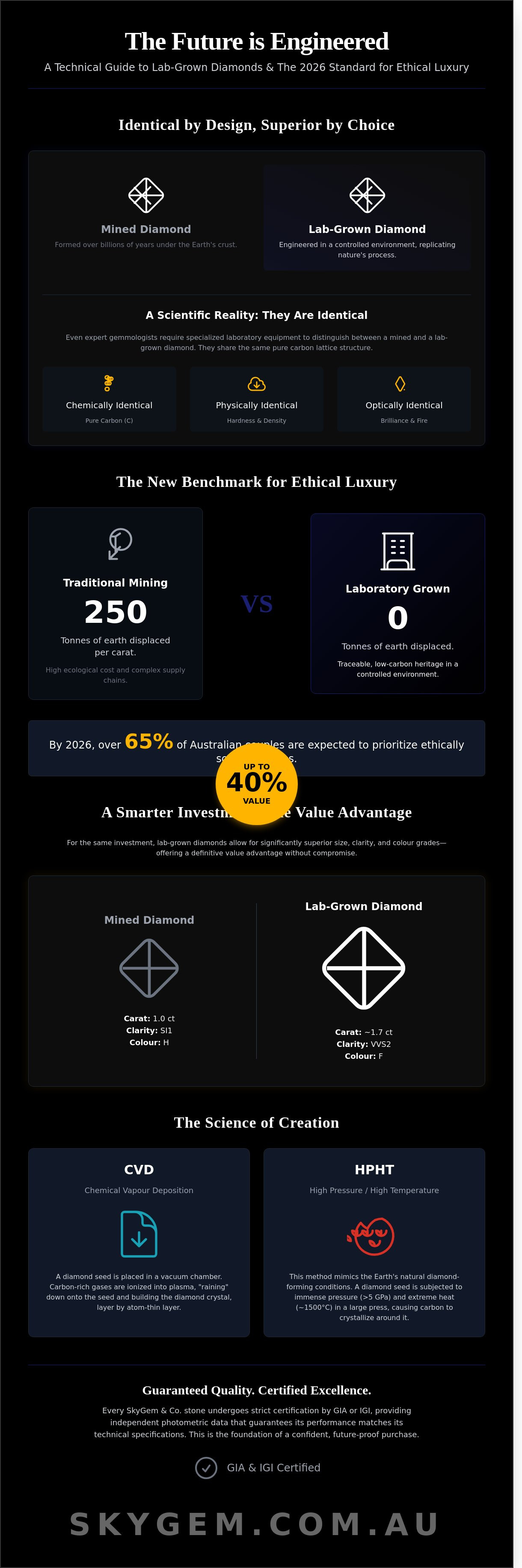
Modern Australian values have shifted heavily toward sustainability and long-term environmental impact. Traditional diamond mining requires the displacement of approximately 250 tonnes of earth per carat; conversely, lab-grown stones are produced in controlled environments with a significantly reduced physical footprint. This methodology ensures that "conflict-free" is a technical certainty rather than a statistical probability. By 2026, over 65% of Australian couples are expected to prioritise stones with a traceable, low-carbon heritage. This preference aligns with a broader movement toward future-proofing luxury investments against the ecological costs of legacy industries.
Lab-Grown vs. Natural: The Core Identity
It's a scientific reality that lab-grown diamonds possess identical chemical, physical, and optical properties to those extracted from the earth. Whether grown via High Pressure High Temperature (HPHT) or Chemical Vapour Deposition (CVD), a Synthetic diamond is composed of the same carbon lattice structure as a natural stone. The data is conclusive. Even expert gemmologists cannot distinguish between the two using standard magnification tools. Identification requires specialised laboratory equipment designed to detect trace elements or growth patterns invisible to the naked eye.
To ensure total compliance with international standards, every stone used in our lab diamond engagement rings undergoes strict certification. We rely on the GIA (Gemological Institute of America) and IGI (International Gemological Institute) to provide independent photometric data and grading reports. This level of documentation is essential for clients using our ringbuilder for lab-grown white diamonds, as it guarantees the stone's performance matches its technical specifications. Professional certification provides the stability and reliability required for a high-value purchase in the Australian market.
The Technical Specifications: Why Lab Diamonds Are Identical to Natural
The structural integrity and optical performance of lab diamond engagement rings are indistinguishable from their mined counterparts because they share an identical chemical composition. Every stone consists of pure carbon arranged in a tetrahedral crystalline lattice. This isn't a simulation of a diamond; it's the result of replicating specific geological conditions within a controlled laboratory environment. By maintaining precise thermal management and atmospheric pressure, technicians facilitate the same carbon bonding that occurs 150 kilometres below the Earth's surface.
Two primary methods dominate the industry: Chemical Vapour Deposition (CVD) and High Pressure High Temperature (HPHT). The HPHT method utilizes large presses to subject a diamond seed to pressures exceeding 5 GPa and temperatures near 1,500 degrees Celsius, mimicking the natural formation process. In contrast, the CVD process represents a technical marvel of modern engineering, utilizing a carbon-rich gas plasma to deposit atom-by-atom layers onto a diamond seed. This controlled growth ensures a high degree of purity, often resulting in Type IIa diamonds, which represent the top 2% of all diamonds found in nature.
While the 4Cs (Colour, Clarity, Cut, and Carat) remain the industry standard for evaluation, lab-grown stones often exhibit superior metrics in a side-by-side comparison. The ability to monitor growth allows for the creation of stones with fewer structural defects. This level of precision allows couples to redefine your engagement ring budget by prioritising higher colour and clarity grades that might be cost-prohibitive in mined stones.
Achieving an "Excellent" or "Ideal" cut is significantly more consistent in a lab environment. Because the rough crystal geometry is more predictable than irregularly shaped mined stones, master cutters can follow strict photometric data to maximise light return. This results in a finished product with optimal proportions, ensuring that every facet contributes to the stone's fire and brilliance.
Certification and Quality Assurance
Rigorous grading by the Gemological Institute of America (GIA) provides the necessary compliance and transparency for the Australian market. Each certified stone features a microscopic laser inscription on the girdle, matching its unique digital grading report. SkyGem & Co. prioritises stones with superior luminous efficacy, a technical metric we use to describe how efficiently a diamond reflects and refracts light. We treat each selection as a technical consultation, ensuring the stone meets strict benchmarks for light performance and durability.
Dispelling Common Myths
A frequent error involves confusing lab-grown diamonds with cubic zirconia (CZ). While a CZ is composed of zirconium dioxide and ranks at 8.5 on the Mohs scale, a lab-grown diamond is 100% carbon and maintains a Mohs scale rating of 10. This makes it the hardest known material on Earth, suitable for daily wear over a lifetime. There's no risk of "clouding" or scratching under normal conditions, as the physical properties are identical to mined stones.
Every stone we offer is vetted for its long-term durability and aesthetic value, ensuring your custom-made engagement ring melbourne is built on a foundation of engineering excellence.
Comparing Value: How Lab Diamonds Redefine Your Engagement Ring Budget
The economic landscape for lab diamond engagement rings in 2026 is defined by a significant divergence from traditional mining costs. Choosing lab-grown stones allows couples to reallocate their capital toward higher technical specifications rather than paying for the scarcity premium associated with geological extraction. Industry data indicates that lab-grown diamonds currently cost between 60% and 85% less than natural stones of equivalent quality. This price-per-carat advantage transforms the purchasing process from a compromise into a strategic engineering exercise.
The "Value Gap" is best illustrated through a direct comparison. A budget of A$10,000 typically secures a 1.00-carat natural diamond with G colour and VS2 clarity. Within the lab-grown sector, that same A$10,000 investment often yields a 2.50-carat stone with D colour and VVS1 clarity. This isn't just a size increase. It's a leap in luminous performance. By removing the heavy supply chain overheads of traditional mining, more value remains within the diamond itself. Many Australians now use these savings to upgrade to bespoke craftsmanship, ensuring the setting is as durable and precise as the stone it holds.
Maximising Your Investment
Visual impact depends on technical precision. While colour and clarity are vital, the "Cut" grade is the most critical factor for brilliance. A perfectly proportioned lab diamond maximises light return, making it appear larger and more vibrant than a poorly cut natural stone. To evaluate these variables in real-time, you can use the SkyGem Ring Builder to compare different carat weights against your specific budget. This tool provides a transparent view of how technical upgrades influence the final aesthetic of lab diamond engagement rings.
Long-Term Value and Market Trends
The 2026 outlook for the lab diamond market indicates a phase of maturity and price stability. While resale speculation often dominates natural diamond discussions, the reality is that engagement rings are sentimental assets, not liquid commodities. The true value lies in the ethical provenance and the engineering excellence of the piece. Future appraisals will increasingly focus on verifiable origin and the carbon-neutral footprint of the jewellery. This reflects the evolving priorities of the Australian luxury market, where sustainability is a permanent and evolving asset rather than a passing trend.
- Price Advantage: Lab diamonds offer a 60-85% reduction in cost compared to mined equivalents.
- Quality Ceiling: Budgets that previously limited buyers to "Near Colourless" grades now easily accommodate "Colourless" (D-F) stones.
- Bespoke Potential: Savings on the centre stone allow for higher-grade metals like platinum or 18K gold and intricate custom design work.
Selecting the Perfect Setting for High-Carat Lab Diamonds
High-carat lab diamonds represent a significant shift in the Australian luxury market. Data from 2024 indicates that buyers are now opting for stones approximately 40% larger than they were five years ago, driven by the cost-effectiveness of lab-grown technology. These larger volumes require precision-engineered settings to ensure structural stability and optimal light performance. When you select lab diamond engagement rings with stones exceeding 2 carats, the setting is no longer just an aesthetic choice; it's a critical structural component.
Architectural Integrity in Bespoke Design
Hand-finished settings offer a level of security that mass-produced casts cannot provide. A standard cast ring often lacks the metallurgical density required to hold a high-carat stone securely over decades of daily wear. We focus on the human-centric experience, ensuring the ring's centre of gravity prevents it from spinning on the finger. This involves precise weight distribution in the band and gallery.
- Thermal Management and Prong Tightening: During the setting process, the metal undergoes specific thermal management to prevent stress fractures. Professional prong tightening ensures the stone remains static, preventing the "rattle" that leads to long-term wear on the diamond's girdle.
- Metal Integrity: Platinum is the preferred choice for high-carat stones due to its density (approx. 21.45 g/cm³) and superior tensile strength. While 18K Gold is a classic Australian choice, its softer composition requires more frequent maintenance to ensure the prongs remain secure.
- Glare Control: Architectural design manages light entry. By elevating the stone or using open galleries, we maximise the stone's brilliance while reducing internal glare, ensuring the diamond performs optimally under all lighting conditions.
Popular Styles for 2026
The 2026 market shows a clear preference for refined complexity and technical excellence. Solitaire Engagement Rings with hidden halos are surging in popularity. This design adds structural reinforcement to the base of the prongs while providing a subtle brilliance visible from the side profile. It's a solution that offers both aesthetic detail and engineering stability.
Trilogy Engagement Rings are also seeing a resurgence in the Australian market. They're ideal for lab-grown stones because they allow for a balanced distribution of carat weight across the finger, creating a high-impact look that remains comfortable. For those seeking a unique challenge, the Toi et Moi style remains a technical feat. It requires a bespoke bridge to balance two high-carat stones without compromising the structural integrity of the band. Each stone must be positioned with mathematical precision to ensure they don't clash or loosen during movement.
Choosing the right architecture ensures your lab diamond engagement rings remain as durable as they are beautiful. Our team treats every setting as a technical project where aesthetics meet engineering.
Bespoke Craftsmanship: Creating Your Ring with SkyGem & Co.
SkyGem & Co. operates at the intersection of technical precision and artistic expression. Our approach to creating lab diamond engagement rings mirrors a high-level engineering project, starting with a comprehensive technical consultation to define the structural requirements of the piece. Every design is led by Australian expertise, ensuring local compliance and long-term durability. We don't just supply jewellery; we act as technical consultants to ensure your investment is sound and aesthetically superior.
We source the highest quality lab-grown diamonds through a rigorous vetting process that exceeds standard retail metrics. Our specialists look beyond the basic 4Cs, analysing light performance and crystal integrity to ensure every stone meets our professional benchmarks. This methodical selection process guarantees that the diamond's luminous efficacy is maximised, providing a level of brilliance that lower-grade stones cannot achieve.
Technical precision is further maintained through our Computer-Aided Design (CAD) phase. This process transforms conceptual ideas into a high-fidelity digital model. We provide 360-degree renderings that allow you to inspect the piece from every angle before any metal is cast. This phase is critical for structural validation, ensuring the proportions of the stone are perfectly balanced with the setting. It eliminates the margin for error and allows for granular adjustments to the architectural aesthetics of the ring.
The Consultation Process
Your session with a SkyGem & Co. expert is a technical briefing rather than a standard sales appointment. We focus on matching a specific engagement ring style to your lifestyle and functional requirements. If your daily routine involves high physical activity, we recommend settings with reinforced structural integrity to protect the stone. Every diamond we present has passed our "Trusted Specialist" criteria, which involves a multi-point inspection of facet symmetry and thermal stability. We ensure that the diamond’s performance remains consistent under all Australian lighting conditions, from bright outdoor environments to low-light interiors.
Lifetime Care and Maintenance
Fine jewellery requires a structured maintenance strategy to preserve its architectural integrity over decades. We view your ring as a permanent asset that requires periodic professional oversight. Our maintenance protocols include annual claw inspections and ultrasonic cleaning to prevent metal fatigue or stone displacement. SkyGem’s commitment to future-proofing means we provide the technical support needed to keep your piece in peak condition. This proactive approach aligns with Australian consumer standards for high-value luxury goods, ensuring your ring remains a lasting symbol of quality. Begin your bespoke journey with SkyGem & Co. today to secure a piece defined by engineering excellence and timeless design.
Defining Your Future with Precision-Engineered Brilliance
Selecting an engagement ring in the 2026 Australian market requires a sophisticated balance of technical specifications and aesthetic value. By choosing lab diamond engagement rings, you're securing a stone that's physically and chemically identical to a mined diamond while significantly optimising your A$ budget for superior carat weight and clarity. Every diamond we source carries GIA or IGI certification, providing the technical transparency necessary for a high-level investment.
As a boutique specialist, SkyGem & Co. prioritises bespoke Australian design and local craftsmanship. Our expert consultations move beyond simple sales, offering a partnership that focuses on long-term durability and architectural integrity in every setting. We bridge the gap between engineering excellence and ethical luxury, ensuring your piece meets the rigorous standards of the Australian jewellery industry.
Explore our curated collection of Lab Grown Diamond Engagement Rings
Your journey toward a sustainable and high-performance legacy starts with a commitment to quality that lasts a lifetime.
Frequently Asked Questions
Do lab-grown diamonds look different from natural diamonds over time?
Lab-grown diamonds don't change in appearance or lose their lustre over time because they possess the identical chemical structure of mined stones. They're rated 10 on the Mohs scale of hardness, meaning they won't cloud, scratch, or yellow over decades of daily wear. These stones maintain their refractive index indefinitely, ensuring the brilliance you see on day one remains constant for the life of the piece.
Are lab-grown diamond engagement rings GIA certified?
Most high-quality lab-grown diamonds come with certification from the Gemological Institute of America (GIA) or the International Gemological Institute (IGI). Since 2020, the GIA has issued full digital grading reports for laboratory stones, providing the same technical scrutiny for the 4Cs as they do for natural diamonds. We recommend choosing stones with a laser-inscribed report number to ensure the diamond's provenance and technical specifications are verified.
Can a lab-grown diamond chip or break more easily than a natural one?
A lab-grown diamond isn't more prone to damage than a mined diamond since both share the same carbon atom lattice. While diamonds are the hardest known material, they remain brittle and can chip if they're struck with significant force at a vulnerable angle. This physical property is consistent across all Type IIa diamonds, which represent the top 2% of diamond quality globally, regardless of their origin.
How much can I save by choosing a lab diamond for my engagement ring?
Buyers typically save between 60% and 80% when selecting a lab diamond over a mined equivalent with identical specifications. Based on 2024 Australian market data, a 1.50-carat round brilliant lab diamond might cost approximately A$2,200, whereas a mined stone of the same grade often exceeds A$15,000. These cost efficiencies allow you to prioritise higher clarity and colour grades for your lab diamond engagement rings without exceeding your set budget.
Will a lab-grown diamond pass a diamond tester?
A lab-grown diamond will pass a standard thermal or electrical conductivity diamond tester because it's chemically identical to a natural diamond. These handheld devices measure the speed at which heat or electricity travels through the stone. Since lab diamonds are composed of pure carbon, they produce the exact same technical reading as mined stones. Only advanced laboratory spectroscopy equipment can detect the specific growth patterns that differentiate the two.
What is the best metal for a lab-grown diamond engagement ring?
Platinum and 18ct gold are the most reliable metals for securing a lab diamond due to their long-term structural integrity. Platinum is a dense, naturally white metal that doesn't wear away over time, making it an excellent choice for a permanent asset. For those who prefer traditional tones, 18ct yellow or rose gold provides a durable alloy mix that handles the rigours of the Australian climate while maintaining a premium aesthetic finish.
How do I maintain my lab diamond ring to keep it sparkling?
Maintaining the light performance of your diamond involves a simple cleaning routine using warm water and a mild, ammonia-free detergent. Soak the ring for 15 to 20 minutes and use a soft-bristled toothbrush to gently remove oils and debris from the underside of the setting. This process ensures the stone's facets remain clear. We suggest a professional inspection every six months to verify the security of the prongs and the overall condition of the metal.
Is it possible to insure a lab-grown diamond engagement ring in Australia?
It's standard practice to insure lab-grown diamond jewellery through specialist Australian providers like Q Report or JewelCover. These companies offer comprehensive policies that protect against theft, loss, and accidental damage both at home and while travelling. You'll need to provide a current valuation from a member of the National Council of Jewellery Valuers (NCJV) to establish the correct replacement value in Australian Dollars for your policy.
Disclaimer
This article is for general informational purposes only and may include AI-assisted content. Pricing, specifications, and availability are subject to change. For accurate advice and current information, please contact SkyGem & Co. directly. Nothing in this content constitutes professional or financial advice.