
Is Alexandrite a Good Investment? The 2026 Gemstone Investor’s Guide

A top-tier alexandrite often commands three times the price of a standard diamond of the same size, yet it remains one of the most misunderstood assets in the gemstone market. You've likely noticed that while gold and diamonds follow predictable indices, determining if alexandrite is a good investment requires a much deeper dive into technical specifications and geological rarity. The absence of a universal pricing scale creates a challenging environment for collectors who value precision and transparency.
We agree that assessing this opaque market is difficult without a clear framework for grading colour-change quality and verifying authenticity. This guide will help you discover the exact technical and market factors that determine if a stone is a viable asset for your jewellery portfolio. You'll gain a comprehensive understanding of the rarity-to-value ratio, the 200% premium associated with specific origins, and the methodology for sourcing certified specimens that maintain long-term viability as we move through 2026.
Key Takeaways
- Understand the technical composition of chrysoberyl and how chromium traces create the rare pleochroism known as the "emerald by day, ruby by night" phenomenon.
- Learn to evaluate the Three Cs of investment-grade specimens, focusing on why the percentage of colour change has an exponential impact on valuation.
- Determine if alexandrite is a good investment by comparing its expert-appraisal model and historical price-per-carat growth against traditional diamond indices.
- Identify the critical differences between natural specimens and lab-grown simulants while establishing a protocol for GIA-certified procurement.
- Discover how to source rare specimens through specialized global networks and protect your asset through bespoke jewellery design.
Understanding Alexandrite: Why Scarcity Drives Investment Value
Alexandrite represents a geological rarity that few other gemstones can match. It's the colour-change variety of the mineral chrysoberyl, uniquely defined by its ability to shift hues under different lighting conditions. This phenomenon, often described as "emerald by day, ruby by night," is technically known as pleochroism. For collectors evaluating whether is alexandrite a good investment, the primary driver of value is this extreme scarcity. While high-quality diamonds are rare, natural alexandrite is significantly more difficult to source in investment-grade sizes. Only natural, untreated specimens possess the market stability required for a serious jewellery portfolio. Synthetic alternatives exist, but they lack the intrinsic value appreciation associated with earth-mined stones.
The Science of Colour Change
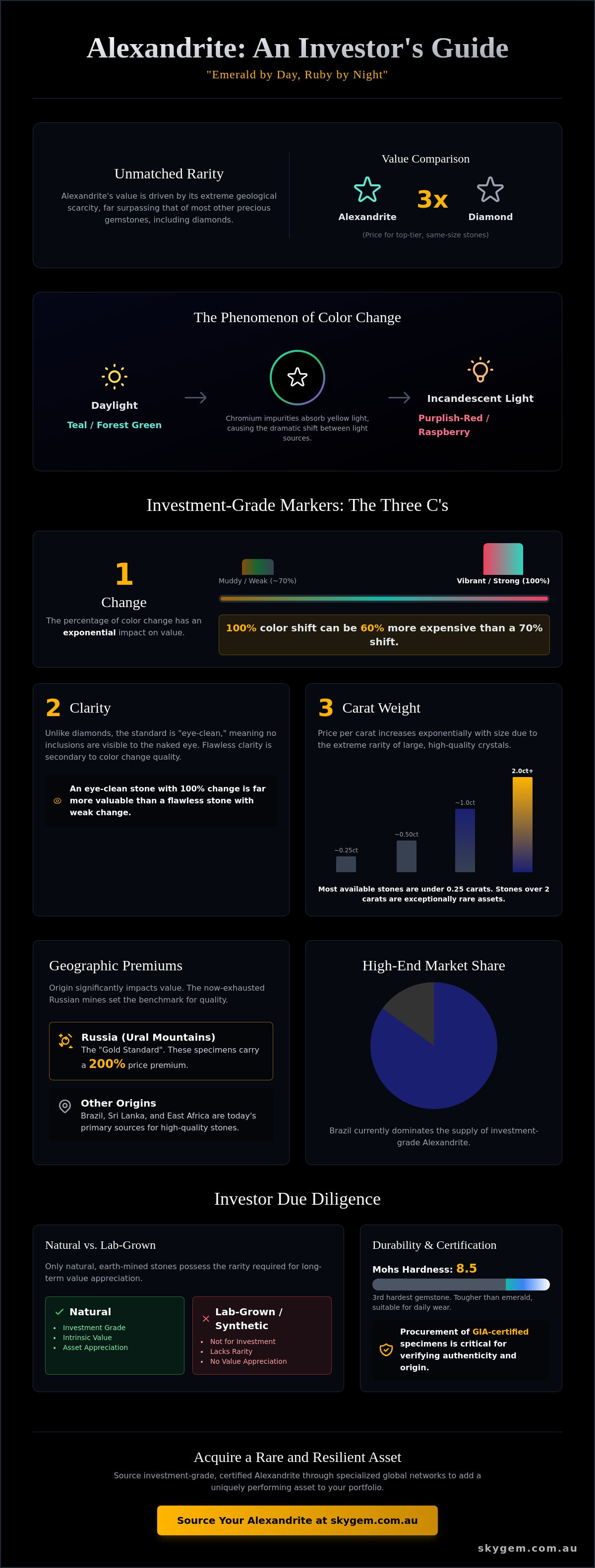
The dramatic shift in hue occurs because of chromium impurities within the crystal structure. These impurities absorb light specifically in the yellow spectrum. When viewed in daylight, which is rich in blue and green light, the stone appears teal or forest green. Under incandescent light, which contains more red wavelengths, the stone shifts to a purplish-red or raspberry tone. Alexandrite's unique properties are measured by the "percentage of change." A 100% shift is the gold standard for investors. Stones achieving this complete transformation can be 60% more expensive than those with only a 70% shift.
Historical Performance and Modern Scarcity
The original deposits in Russia's Ural Mountains set the global benchmark for quality. These mines are now largely exhausted, making Russian stones the "gold standard" with a 200% price premium over other origins. Today, the market relies on natural alexandrite from Brazil, Sri Lanka, and East Africa. Brazil currently dominates 85% of the high-end market. The closure or depletion of major mining sites creates a persistent supply squeeze. Because most available stones are under 0.25 carats, larger specimens of two carats or more are exceptionally rare. This rarity-to-value ratio ensures that high-quality specimens remain a resilient hard asset against currency fluctuations.
The Technical Markers of Investment-Grade Alexandrite
The technical valuation of alexandrite rests on a specific geological fluke. For beryllium and chromium to bond in the same crystal structure is exceptionally rare, as these elements typically reside in different parts of the Earth's crust. This chemical improbable nature is what fundamentally answers whether is alexandrite a good investment. While diamonds rely on a standardized grading system, alexandrite requires a more nuanced technical assessment of the "Three Cs": Colour, Clarity, and Change.
Unlike diamonds, where "internally flawless" is the peak benchmark, investment-grade coloured gems are evaluated based on being "eye-clean." This distinction is vital; it means that while microscopic inclusions may exist, they don't interfere with light return or the stone's structural integrity. A stone that is completely flawless but lacks a strong colour change will always be worth less than an eye-clean stone with a 100% shift. Long-term asset viability also depends on physical durability. With a rating of 8.5 on the Mohs scale, alexandrite is the third hardest natural gemstone. It's tougher than emeralds or opals, making it suitable for daily wear in bespoke alexandrite jewellery without the risk of surface abrasion or chipping.
Evaluating Colour Shift Quality
A vibrant transition is the most critical of all investment-grade alexandrite markers. You should distinguish between "muddy" shifts and "vibrant" transitions. A muddy stone might show a brownish-green or a greyish-purple, which significantly reduces its desirability. The highest value premium is reserved for stones that maintain deep saturation in both lighting conditions. Saturation is the intensity and purity of the hue. If the specimen retains a vivid forest green in daylight and a rich raspberry red under incandescent light, its market liquidity remains exceptionally high. Investors should prioritize the "completeness" of the change over the specific shade of the primary colour.
The Carat Weight Threshold
Carat weight has an exponential impact on pricing because large, high-quality crystals are almost non-existent in nature. While a 0.50-carat stone is an excellent choice for jewellery, a 1.0-carat specimen is generally the entry point for those determining if is alexandrite a good investment for long-term capital growth. Specimens exceeding 3.0 carats are considered museum-grade assets. These larger stones appear at major auctions only a few times a year and command prices that far outstrip their smaller counterparts on a per-carat basis. Larger stones also tend to display the colour-change phenomenon more dramatically. The increased path of light through a larger crystal volume allows for more efficient absorption of yellow light, resulting in a more pronounced visual shift.
Market Performance: Alexandrite vs. Traditional Diamond Investments
Investors often look for a "Rapaport" equivalent when assessing if is alexandrite a good investment, but the gemstone market operates on a fundamentally different model. While diamond pricing is highly standardized and transparent, alexandrite valuation relies on expert appraisal and historical auction data. This lack of a central index is a direct result of the stone's extreme scarcity; there simply isn't enough high-quality material to facilitate a commodity-style exchange. Instead, value is driven by the rarity-to-demand ratio, where a single stone's unique characteristics dictate its price point.
Data from the last decade demonstrates a robust growth trajectory for top-tier specimens. A high-quality one-carat alexandrite purchased in 2014 has seen its market value increase by 300% as of 2024. More recently, high-quality one-carat gems have appreciated by over $6,000 in the last 48 months leading into 2026. This performance often outpaces traditional diamond investments, with alexandrite typically costing three times more than a standard-sized diamond. For collectors, this represents a powerful alternative asset that diversifies a portfolio away from traditional equities and currency-dependent markets.
Liquidity and Resale in the Gemstone Market
Resale remains the primary concern for any hard-asset investor. Unlike gold, you can't liquidate alexandrite instantly at a spot price. It's a long-term hold that requires a strategic exit through high-end auction houses like Sotheby’s or Christie’s, or specialized private networks. To maximize resale potential, "unheated" and "natural" designations are non-negotiable. Using bespoke jewellery settings can also enhance the value of a stone by providing a functional context that appeals to high-net-worth collectors, effectively turning a loose specimen into a wearable masterpiece.
Alexandrite as a Portable Wealth Asset
The value-to-volume ratio of alexandrite is almost unparalleled. A single investment-grade stone worth $35,000 can be smaller than a pea, making it an incredibly portable form of wealth. During periods of stock market volatility, the natural alexandrite market has historically shown stability, as its value is anchored in finite geological supply rather than corporate performance. This "Heirloom Factor" adds a layer of psychological and financial value that spans generations, ensuring the asset remains relevant long after it's first acquired.
Due Diligence: Origin, Certification, and Avoiding Pitfalls
Verification is the final hurdle in determining whether is alexandrite a good investment. Without a reputable laboratory report from an institution like the Gemological Institute of America (GIA), a specimen is merely a commercial-grade curiosity rather than a verified financial asset. Sophisticated lab-grown simulants currently account for nearly 95% of stones marketed online. Identifying these requires more than a visual inspection; it demands an understanding of growth methods like the flux-grown or Czochralski processes. Flux-grown stones often contain metallic inclusions that mimic natural patterns, while Czochralski (pulled) stones might show curved striae under high magnification.
Origin remains a primary determinant of value. While African deposits in Tanzania or Madagascar provide beautiful specimens, they rarely command the "Origin Premium" associated with Brazilian or Russian stones. A Brazilian specimen can carry a significantly higher market price than an African stone of identical weight and colour change percentage. Investors must also distinguish true alexandrite from simulants like colour-change garnet or sapphire. While these alternatives are beautiful, they lack the specific chrysoberyl mineral structure that anchors alexandrite's long-term value and appreciation potential.
Decoding the Lab Report
A professional grading report is your technical roadmap. You should verify three specific fields: Species (must be Chrysoberyl), Variety (must be Alexandrite), and Treatment (must be "none" or "untreated"). For high-value specimens, the "geographic origin" comment is essential for justifying the premium. The report will also describe the "Colour Change" in technical terms, often noting the specific hues observed under daylight and incandescent light. If you are ready to secure a verified specimen, you can browse GIA-certified alexandrite gemstones to ensure your portfolio is built on authentic assets.
Red Flags for Potential Investors
Price is often the first indicator of a stone's legitimacy. If a one-carat stone with a 100% colour change is offered at a fraction of the $15,000 to $35,000 market range, it is almost certainly synthetic. Transparency regarding a stone’s provenance is equally important. A lack of history or previous ownership data can be a significant risk. You should also be wary of stones with excessive inclusions that reach the surface. While some internal characteristics are expected, surface-reaching fractures threaten the stone's structural integrity and its status as a permanent asset. Assessing these factors carefully is the only way to confirm if is alexandrite a good investment for your specific financial goals.
Bespoke Acquisition: Sourcing Rare Alexandrite with SkyGem & Co.
Securing a specimen that definitively answers whether is alexandrite a good investment requires more than a casual purchase. It demands a strategic partnership with experts who understand the technical nuances of the global gemstone market. SkyGem & Co. acts as a technical consultant throughout this process, leveraging an extensive global network to source specimens that meet the rigorous standards of investment-grade quality. Our acquisition model focuses on transparency and education, ensuring that the intersection of technical precision and aesthetic design is clear before any transaction occurs.
Moving from an investment goal to a physical asset involves a methodical evaluation of the stone's performance metrics. We prioritize stones that exhibit the most dramatic colour shifts and highest clarity, as these factors drive long-term viability. By focusing on quality over quantity, we ensure that every specimen in our care is a legitimate hard asset capable of retaining value irrespective of currency fluctuations. This solution-oriented approach respects your professional time, providing the essential data required for the decision-making process of a complex project.
Custom Settings for Investment Stones
When dealing with a high-value asset, the physical environment of the stone is a critical consideration for both protection and presentation. We recommend 18K gold or platinum as the standard for investment-grade alexandrite rings because these metals provide the structural stability required to secure the gem over decades of wear. A well-constructed setting does more than highlight the stone's pleochroism; it serves as a protective barrier that maintains the stone's integrity. You can explore our custom engagement ring services to see how we balance technical security with user-focused design.
The SkyGem & Co. Expert Consultation
The path to ownership begins with accessing a curated collection of natural alexandrite gemstones that have already passed our internal rigorous screening. Every stone we provide is verified through independent, reputable laboratories, ensuring that the "unheated" and "natural" designations are technically accurate. This commitment to regulatory adherence serves as a signature of our reliability. We invite you to schedule a professional gemstone consultation to discuss your specific investment goals and discover how a rare alexandrite can function as a permanent and evolving asset in your jewellery portfolio. Whether you are looking for a solitaire or a trilogy setting, our focus remains on the long-term success of your acquisition.
Securing Long-Term Value in Rare Gemstones
The decision to acquire a rare gemstone requires a balance of technical scrutiny and an appreciation for geological rarity. We've established that the finite supply of chromium-bearing chrysoberyl, particularly from depleted Russian and high-yield Brazilian deposits, creates a resilient foundation for capital preservation. By prioritizing stones with a complete 100% colour shift and ensuring every specimen is natural and unheated, you position your portfolio for long-term viability. These technical markers are the primary drivers of appreciation in the 2026 market.
Ultimately, the answer to the question, is alexandrite a good investment, depends on your commitment to sourcing GIA-certified specimens that meet the rigorous standards of the international market. Our specialists in the Royal Arcade focus on these rare, unheated gemstones, offering the technical expertise needed to navigate this opaque sector with confidence. We invite you to View our Investment-Grade Alexandrite Collection to see how these specimens serve as portable wealth assets. Through bespoke design and precise sourcing, we help you transform a technical acquisition into a permanent legacy.
Frequently Asked Questions
Is natural alexandrite more expensive than a diamond?
Natural alexandrite is typically more expensive than a standard diamond on a per-carat basis, particularly for stones under one carat. In the current market, a high-quality alexandrite can cost approximately three times more than a diamond of equivalent weight. This price gap is driven by extreme geological rarity and the finite nature of certified deposits compared to the more predictable global diamond supply.
Does alexandrite increase in value over time?
Historical data indicates that high-quality alexandrite has seen significant appreciation, with top-tier one-carat stones increasing in market value by 300% between 2014 and 2024. Global financial shifts in early 2026 have further solidified its position as collectors move toward hard assets. This consistent upward trend for unheated, certified specimens suggests a strong long-term outlook for those asking if is alexandrite a good investment.
How can I tell if an alexandrite is real or lab-grown?
Verifying authenticity requires a professional laboratory report from an institution like the GIA to distinguish natural chrysoberyl from synthetic simulants. Lab-grown stones, often produced via Czochralski or flux methods, can look identical to the naked eye but lack the specific microscopic inclusions found in earth-mined gems. Investors should avoid any specimen lacking independent certification, as nearly 95% of stones marketed online fail to meet investment-grade criteria.
Which origin of alexandrite is best for investment?
Russian alexandrite from the Ural Mountains is considered the global benchmark and commands a 200% price premium over other sources due to its historical significance and depleted mines. Brazil currently accounts for 85% of the high-end market and is the primary source for investment-grade material. While stones from Sri Lanka and East Africa are available, Brazilian specimens are generally preferred for their superior colour change and established market liquidity.
What is the most valuable colour for alexandrite?
The most valuable colour is a 100% shift from a vivid bluish-green in daylight to a warm purplish-red under incandescent light. Market value is dictated by the completeness and saturation of this change rather than just the primary hue. A stone with a perfect 100% shift can be 60% more expensive than one with a 70% shift; the strength of the transformation remains the hallmark of investment-grade material.
Is it better to buy a loose alexandrite or one already set in a ring?
Buying a loose stone allows for a more thorough technical inspection of the clarity and cut, which is essential for verifying if is alexandrite a good investment. A bespoke setting in 18K gold or platinum can subsequently enhance the stone's resale value by protecting its edges and presenting it as a finished heirloom. Many investors choose to source a loose, certified stone first and then commission a custom setting to ensure the asset's long-term security.
What is the minimum carat weight for an investment alexandrite?
A weight of 1.0 carat is generally the entry point for investment-grade specimens, as the price per carat increases exponentially beyond this threshold. Most natural crystals are found under 0.25 carats, making a single two-carat stone four or five times more expensive than a one-carat stone. Museum-grade assets typically exceed 3.0 carats, appearing only a few times annually on the global market.
How should I store and maintain an alexandrite investment?
Alexandrite has a Mohs hardness of 8.5, making it highly durable, but you should still store it separately from harder gems like diamonds to prevent surface scratches. Regular maintenance involves gentle cleaning with warm, soapy water and a soft brush to ensure light can pass through the crystal without obstruction. Maintaining the stone's brilliance is vital for preserving its visual performance and eventual liquidity in the secondary market.
Disclaimer
This article is for general informational purposes only and may include AI-assisted content. Pricing, specifications, and availability are subject to change. For accurate advice and current information, please contact SkyGem & Co. directly. Nothing in this content constitutes professional or financial advice.