
How to Verify a Diamond Certification: The 2026 Australian Buyer’s Guide

Would you be able to identify if the diamond in your hand actually matches the technical paperwork sitting on your desk? For many Australian buyers, the transition from admiring a stone's aesthetic to scrutinising its scientific data is where uncertainty begins. You likely understand that a grading report is essential, but the fear of purchasing a misrepresented stone remains a valid concern in a complex global market. Learning how to verify a diamond's certification is not just about peace of mind; it's about ensuring your financial investment is backed by verifiable, physical evidence.
Explore More: tennis bracelet
We recognise that navigating the intersection of gemological data and retail claims requires a methodical approach. This guide provides the technical steps to authenticate your diamond, moving beyond a simple visual check to master stone-to-report alignment. We'll examine the specific roles of laboratories like the GIA and the Sydney-based DCLA, explain the significance of microscopic laser inscriptions, and outline the Australian regulatory standards that safeguard your purchase. By the end of this analysis, you'll have a clear checklist to confirm that your diamond's performance metrics and physical properties are exactly as promised.
Order Now: diamond prices
Key Takeaways
- Distinguish between independent laboratory grading and commercial valuations to establish a technical baseline for your stone's quality.
- Master the process of how to verify a diamond's certification by aligning the unique report number with the microscopic laser inscription found on the girdle.
- Utilise official digital portals from the GIA or IGI to confirm that the physical stone's characteristics match the lab's permanent records.
- Learn to use a 10x jeweller's loupe for precise physical inspection, providing a final layer of certainty during the consultation process.
Understanding Diamond Certification: More Than Just Paperwork
A diamond certification, technically referred to as a grading report, serves as a comprehensive blueprint of a gemstone's physical and optical properties. It is not a marketing document or a retail receipt; it is a scientific record issued by an independent laboratory that holds no financial interest in the transaction. This document details the results of a rigorous evaluation based on the 4Cs: Cut, Colour, Clarity, and Carat weight. These specific metrics establish a universal language for quality, allowing natural diamonds and lab-grown diamonds to be objectively compared against international standards.
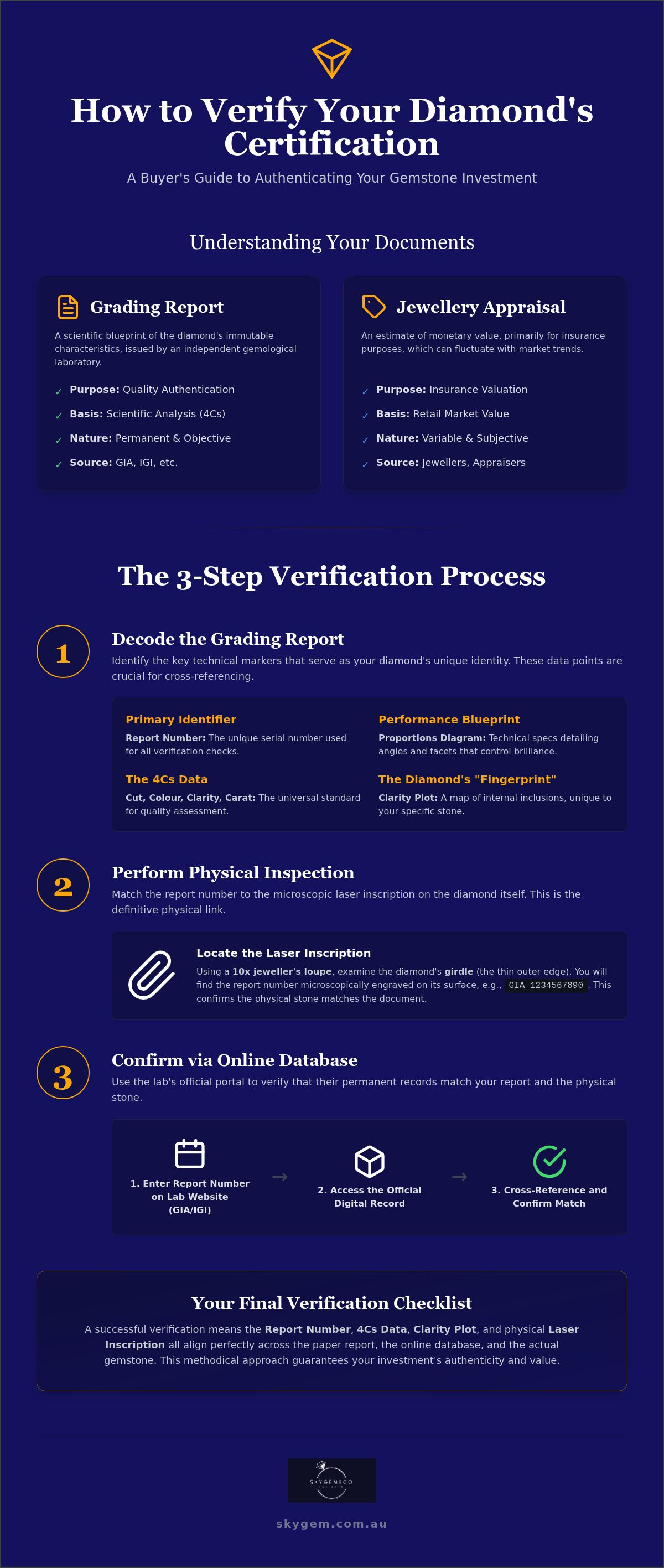
Many buyers confuse a grading report with a jewellery appraisal, but the two serve different functions. An appraisal assigns a monetary value for insurance purposes, which can fluctuate based on current market trends. Conversely, a certification is a permanent record of the stone's physical attributes. Understanding this distinction is the first step in learning how to verify a diamond's certification, as the report provides the immutable data points required to authenticate the asset throughout its lifetime. This technical foundation is essential for the long-term viability and insurance of fine jewellery, ensuring the stone's identity remains clear even if it is moved or reset.
The Role of Independent Laboratories
Major global entities, such as the Gemological Institute of America (GIA) and the International Gemological Institute (IGI), operate as unbiased third-party evaluators. In the Australian market, sourcing stones with these certifications prevents any conflict of interest between the retailer and the grading authority. Maintaining laboratory accreditation requires extreme technical precision. Technicians utilise advanced spectroscopy and high-magnification microscopy to ensure every stone is evaluated in a controlled environment. This level of rigour provides a reliable baseline for any significant jewellery purchase.
Why Verification is a Critical Step for Buyers
Verification is the process of ensuring the stone in your hand is the exact stone described on the paperwork. This step is critical to mitigate the risk of report switching or the accidental misrepresentation of lab-grown stones. When you know how to verify a diamond's certification, you protect the future resale and replacement value of the piece. Insurance providers often require verified reports to settle claims accurately. While the report offers confidence, the physical stone must match the digital and paper records to confirm the integrity of the investment. It's a matter of ensuring the technical specifications on the page translate to the actual performance of the stone.
View More: purple diamond
Decoding the Grading Report: Key Technical Markers
The Report Number is the most critical element of the document. This unique string of digits allows you to access the laboratory’s digital archives instantly. When learning how to verify a diamond's certification, this number acts as the primary key for all subsequent cross-referencing. You'll usually find it at the top of the report or within the sidebar. Every reputable grading report contains several essential data points designed to provide a complete profile of the stone:
- Report Number: The primary identifier used for digital verification.
- Date of Issue: A marker for the specific grading standards applied during examination.
- Proportions Diagram: A technical breakdown of the stone's physical dimensions and angles.
- Clarity Plot: A visual map of internal and external characteristics.
The Date of Issue provides context regarding the grading standards applied at the time of examination. Gemological science is not static; for instance, the GIA introduced its current cut grading system for round brilliant diamonds in 2005. A report dated significantly earlier may lack the granular data found in modern certificates. Similarly, the Proportions Diagram lists specific measurements like table percentage and pavilion angle. These metrics dictate how light travels through the diamond, which directly influences its brilliance. Below this, the Clarity Plot serves as a visual map of the stone's internal inclusions and external blemishes. Since no two diamonds possess the exact same inclusion pattern, this plot functions as a "fingerprint" that distinguishes your stone from all others.
The 4Cs Breakdown on a Certificate
Carat weight is measured with extreme precision, typically to three decimal places, though it's often rounded to two for the final report. Colour is graded in a neutral environment where the stone is compared against a set of master stones. This ensures the grade, ranging from D to Z, is determined by physical properties rather than subjective observation. Clarity grades provide a technical hierarchy of the stone's purity. If you're looking to compare these technical markers across different stones, you can view certified diamonds in Melbourne to see how these grades manifest in person.
Additional Grading Criteria: Fluorescence and Polish
Polish and Symmetry grades assess the quality of the diamond's finish and the precision of its facet alignment. High-quality finishing ensures that the stone reflects light with maximum efficiency. Fluorescence refers to the diamond's reaction to long-wave ultraviolet light, which can range from "None" to "Very Strong." While it doesn't always affect appearance, strong fluorescence can sometimes cause a stone to look hazy. When a diamond achieves "Excellent" grades in Cut, Polish, and Symmetry, it is technically classified as a "Triple Ex" diamond.
Physical Verification: Matching the Stone to the Report
Once you have decoded the technical markers on the grading report, the next phase involves direct physical authentication. This process ensures the stone in your hand is the exact asset described in the documentation. Learning how to verify a diamond's certification requires a methodical, hands-on approach using specific gemological tools to bridge the gap between paper data and physical reality. This stone-to-report alignment is the most effective way to eliminate the risk of substitution or misrepresentation during a purchase.
The primary tool for this task is a 10x jeweller’s loupe. Using a loupe for the first time requires a steady hand and a specific technique. To achieve a clear view, tuck your elbows into your sides and rest the hand holding the loupe against your cheek for stability. Bring the diamond toward the lens until the girdle, the thin outer edge of the stone, comes into sharp focus. You are searching for a microscopic laser inscription that matches the unique report number identified in the previous section. This etched serial number provides an immediate, verifiable link to the laboratory's records.
For stones that lack a laser inscription, the clarity plot serves as the definitive method for authentication. This diagram maps the internal inclusions and external blemishes that constitute the stone's unique gemological DNA. No two diamonds possess the exact same inclusion pattern in the same locations. By aligning the physical stone under magnification with the symbols plotted on the report, you can verify that the location, size, and type of inclusions are consistent. This manual cross-referencing provides a layer of security that digital records alone cannot offer.
Locating the Girdle Inscription
A genuine laser inscription from a major laboratory will typically feature a specific prefix, such as the GIA or IGI logo, followed by the report number. These markings are etched with extreme precision using cold laser technology, ensuring the stone's structural integrity remains unaffected. While most modern stones are inscribed, some older or very high-clarity diamonds may not be. In these instances, a professional plotting analysis is the only reliable way to verify the stone's identity against its certificate.
Weight and Measurement Verification
Digital callipers and high-precision scales offer quantitative proof of a diamond's identity. Precise weight, measured in carats to three decimal places, is one of the most difficult metrics to forge because it is tied directly to the stone's physical volume and density. When you examine natural white diamonds, measurement precision is paramount. The length, width, and depth recorded on the certificate must align with your physical measurements within a standard tolerance of approximately 0.02mm. Any significant deviation from these dimensions should be treated as a technical red flag.
Digital Verification: Using Online Laboratory Databases
Digital verification serves as the final, immutable layer of security in the authentication process. While physical markers like laser inscriptions provide immediate evidence, the laboratory's own digital database acts as the ultimate source of truth. By accessing these portals, you can confirm that the data on your physical certificate matches the lab's permanent records exactly. This step is non-negotiable for anyone learning how to verify a diamond's certification, as it protects against the possibility of sophisticated document forgeries. It ensures that the technical specifications you're relying on are backed by the institution that issued them.
The Gemological Institute of America (GIA) and the International Gemological Institute (IGI) maintain robust online portals that are accessible to the public. These databases provide a "Report Check" service where you can input the unique report number and the stone's carat weight. A successful query will generate a digital version of the full grading report. It's essential to compare every metric, including proportions, clarity characteristics, and fluorescence, against your physical copy. Any discrepancy, however minor, suggests that the documentation may have been tampered with or that the stone does not match the report. If you're ready to explore a curated selection of authenticated stones, you can browse natural GIA certified diamonds that have already undergone this rigorous digital vetting.
In the current market, you must remain vigilant against fraudulent websites designed to mimic official laboratory databases. Scammers may create "spoof" sites with URLs that look remarkably similar to the GIA or IGI domains. Always verify that you're on the official laboratory website before entering sensitive report information. Look for secure "https" protocols and cross-reference the URL with known, verified links from reputable industry sources. Remember that a digital "Full Report" often contains more comprehensive data than a small physical summary card, making it the superior reference for technical analysis.
Step-by-Step: Using the GIA Report Check
To begin, navigate to the official GIA website and locate the Report Check tool. You'll need to enter the report number exactly as it appears on your certificate. For modern reports issued in 2026, you can simply scan the integrated QR code with a smartphone to be directed straight to the stone's digital profile. Once the record loads, download the PDF version of the full report. This digital file provides a permanent, shareable record of the stone's technical specifications, which is vital for insurance and future resale.
What to Do if a Report is Not Found
A "Report Not Found" result is a significant red flag that requires immediate investigation. While a data lag can occasionally occur with very recently graded stones, this is rare with modern laboratory infrastructure. If the database doesn't recognise the number, contact the laboratory directly via their official customer service channels for manual verification. Don't rely on the seller's explanation alone. A missing digital record often indicates a counterfeit report, and you should halt the transaction until the laboratory confirms the document's authenticity.
The Role of the Jeweller in the Verification Process
While the technical steps of stone-to-report alignment are vital, the jeweller serves as the essential partner in the final authentication phase. A professional jeweller acts as a technical consultant, providing the high-magnification equipment and gemological expertise that a typical buyer may not possess. This partnership ensures that the data points you've identified in the grading report are physically manifest in the stone. By mastering the technical steps of how to verify a diamond's certification, you move from a position of uncertainty to one of quiet confidence. Sourcing from a reputable Australian boutique ensures you benefit from an established vetting process that begins long before the diamond reaches the viewing room.
Learning how to verify a diamond's certification is a technical skill best honed alongside an expert who can provide the necessary tools for inspection. During a professional consultation, you should expect to view the stone under a microscope or a 10x loupe while the jeweller explains the specific nuances of the certificate. This transparency ensures that the unique "fingerprint" of the diamond, as mapped on the clarity plot, is clearly visible and understood. This expert vetting is the final safeguard that guarantees your investment matches its technical profile exactly.
Transparency in Sourcing
Ethical sourcing and regulatory adherence are the cornerstones of the modern diamond trade in Australia. Professional boutiques vet their suppliers through rigorous international standards, such as the Kimberley Process, to ensure every stone is conflict-free and accurately represented. This high-level vetting process is particularly critical when selecting stones for bespoke engagement rings, where the quality of the centre stone must meet the precision of the final design. A transparent supply chain is a recurring signature of reliability in the regional professional landscape, ensuring the long-term viability of your purchase.
Consultation and Expert Vetting
A technical consultation offers the opportunity to go beyond the paperwork. You should always request to see the laser inscription on the girdle before finalising any purchase. An expert can guide you through this process, ensuring your hand is steady and the focus is sharp enough to read the unique serial number. This level of detail is standard in the creation of custom-made engagement rings, where verification is treated as a fundamental part of the design journey. Once the stone is authenticated, ensure the physical certificate is handed over immediately, as this original document is required for accurate insurance valuation and future replacement.
Securing Your Investment Through Technical Verification
Authenticating a diamond is a process that relies on the precise alignment of physical evidence and digital records. We've explored how microscopic laser inscriptions and specific clarity characteristics act as a unique gemological fingerprint, ensuring the stone in your hand matches the lab's permanent archive. This methodical approach to how to verify a diamond's certification removes the ambiguity often associated with high-value purchases, replacing it with scientific certainty and long-term viability.
Since 2018, SkyGem & Co. has operated as a technical specialist in high-precision bespoke design. We provide an extra layer of vetting for every stone in our collection, which includes GIA and IGI certified natural and lab-grown diamonds. To experience this level of transparency first-hand, we invite you to book a technical consultation with SkyGem & Co. to view our certified diamond collection in our premium boutique setting. Moving forward with a verified asset ensures your investment remains protected, allowing you to focus on the aesthetic design of your project with complete peace of mind.
Frequently Asked Questions
Can a diamond certificate be faked?
Yes, physical reports can be counterfeited, but the laboratory's digital database remains the ultimate source of truth. By learning how to verify a diamond's certification through official portals, you can instantly confirm if the document in your hand is legitimate. Always check for security features like holograms and microprint on the physical paper, but treat a successful digital match as the final confirmation of authenticity.
Is GIA better than IGI for diamond certification?
GIA is widely regarded as the premier authority for natural diamonds due to their historically strict grading standards. IGI has established itself as a leading grader for lab-grown stones, often providing more granular detail for that specific market segment. Both laboratories provide the technical infrastructure needed to verify a stone's identity, so the preferred option often depends on whether you're purchasing a natural or lab-created asset.
How do I find the laser inscription on my diamond?
You can locate the laser inscription by using a 10x jeweller's loupe to examine the girdle of the stone. This microscopic serial number is typically etched on the thin outer edge that separates the top and bottom of the diamond. It's best to hold the stone in tweezers or a ring mount and rotate it slowly under a bright, neutral light source until the digits come into focus.
Do all diamonds have a certificate?
Not all diamonds come with a grading report, especially those under 0.30 carats or vintage pieces from earlier eras. However, for any significant investment, a certificate from a reputable lab like GIA or IGI is essential for establishing technical value. If a stone lacks documentation, you can have it submitted to a laboratory for a new grading report to ensure its physical properties match the seller's claims.
What happens if I lose my diamond certificate?
If you lose your physical report, you can usually download a digital copy from the laboratory's website using your unique report number. If you don't have the number, a professional jeweller can use high-magnification tools to find the laser inscription on the girdle. In cases where no inscription exists, the stone may need to be sent back to the laboratory for re-examination and a replacement report.
Is a digital diamond report as valid as a physical one?
Digital diamond reports are entirely valid and are becoming the industry standard due to their enhanced security and accessibility. Laboratories like GIA have transitioned many services to digital-only formats to prevent physical document tampering. These reports are stored in secure databases, making it easier for you to understand how to verify a diamond's certification by scanning a QR code or entering a serial number online.
Can I verify a diamond without a professional jeweller?
You can perform initial verification by checking the report number in an online database and using a loupe to find the girdle inscription. However, a professional jeweller provides the high-precision microscopy and digital callipers required for a definitive stone-to-report match. Their expertise is particularly valuable for identifying subtle clarity characteristics and inclusion patterns that an untrained eye might miss during a manual inspection.
Does the certificate prove a diamond is conflict-free?
A grading report from a reputable laboratory like GIA provides assurance that the stone has been sourced through the Kimberley Process. This international initiative is designed to prevent conflict diamonds from entering the mainstream market. While the certificate focuses on technical specifications, the laboratory's adherence to these regulatory standards confirms that the diamond's origins are ethical and documented throughout the global supply chain.
Disclaimer
This article is for general informational purposes only and may include AI-assisted content. Pricing, specifications, and availability are subject to change. For accurate advice and current information, please contact SkyGem & Co. directly. Nothing in this content constitutes professional or financial advice.