
How to Tell if a Ruby is Real: A Specialist’s Guide to Authenticating Natural Gemstones

A flawless ruby without a verified lab report is almost certainly a synthetic creation rather than a geological miracle. Recent data from major gemological institutions indicates that over 95% of rubies in the global retail market have undergone thermal enhancement to artificially improve their aesthetic profile. Understanding how to tell if a ruby is real requires looking beyond the surface brilliance to the microscopic inclusions that define its geological origin. You likely feel that an investment in fine jewellery should represent authentic value, yet the distinction between a natural stone and a high-quality synthetic is often invisible to the naked eye.
We provide the technical framework you need to identify high-level red flags and understand the specific markers that separate investment-grade natural stones from glass-filled imitations. You'll gain confidence in evaluating internal structures while learning why certain treatments compromise a stone's long-term durability. We'll examine internal crystallography, the impact of flux-healing, and the specific instances where a professional Australian lab report is a non-negotiable requirement for your financial security.
Key Takeaways
- Understand the technical distinctions between earth-mined corundum and lab-grown synthetics to ensure the long-term value and authenticity of your acquisition.
- Identify the specific secondary hues and the 'Pigeon Blood' standard used by specialists to assess the aesthetic and commercial grade of a natural gemstone.
- Master professional-grade evaluation methods, such as thermal conductivity and Mohs hardness assessments, to learn how to tell if a ruby is real.
- Recognise the risks associated with lead-glass fillings and why these common treatments fail to meet the rigorous quality standards of reputable Australian jewellers.
- Learn to interpret GIA and GRS certification reports to verify origin and treatment status, ensuring your purchase aligns with international industry benchmarks.
Defining a 'Real' Ruby: Natural, Synthetic, and Simulants
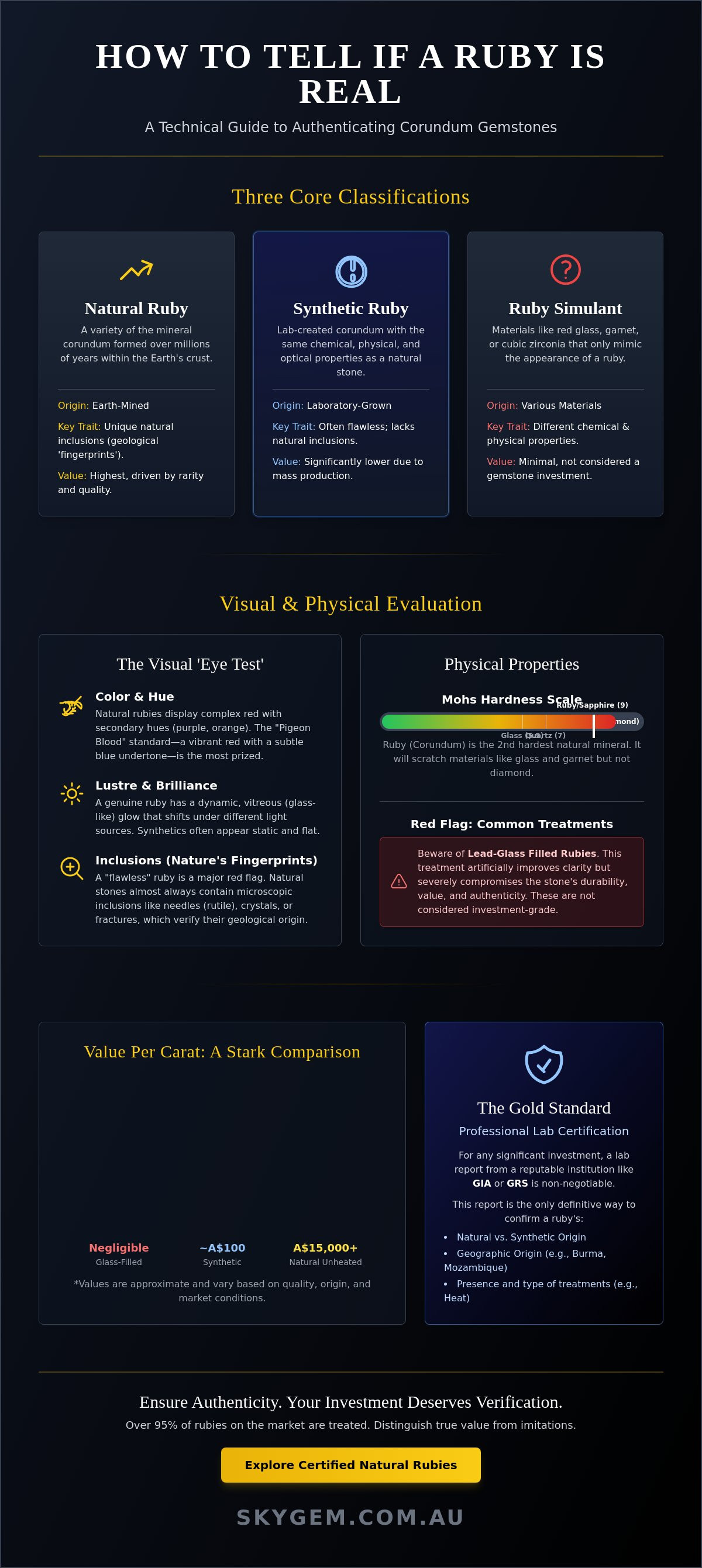
Understanding how to tell if a ruby is real requires a technical appreciation for mineralogy rather than just a keen eye. In the Australian jewellery market, the term "real" often leads to confusion because it conflates geological origin with chemical composition. A natural ruby is a variety of the mineral corundum that has developed over approximately 500 million to 2 billion years under intense heat and pressure deep within the Earth's crust. To accurately classify these gemstones, specialists distinguish between three distinct categories:
- Natural Rubies: Earth-mined stones with unique inclusions that act as a geological fingerprint.
- Synthetic Rubies: Lab-created corundum that possesses the same chemical structure as natural stones but is produced in weeks.
- Simulants: Materials such as red glass, garnet, or cubic zirconia that mimic the appearance of ruby but share none of its physical properties.
The importance of precise terminology cannot be overstated. While a synthetic stone is chemically "real" corundum, it lacks the rarity and investment profile of an earth-mined gem. For those looking to acquire an authentic piece, browsing a curated selection of rubies from a reputable specialist ensures the distinction between these categories is clearly documented.
The Corundum Family and the Role of Chromium
The distinction between a ruby and a sapphire is defined solely by colour. Both gems belong to the corundum species, but the presence of chromium trace elements replaces some aluminium atoms in the crystal lattice to create the signature red hue. While other trace elements like iron or titanium produce blue or yellow sapphires, chromium provides the fluorescence and saturation found in high-quality specimens. The specific concentration of chromium dictates the "pink" versus "red" boundary, a technical threshold that significantly impacts market value. Ruby is composed of aluminium oxide (Al2O3) and maintains a hardness of 9 on the Mohs scale, making it the second hardest natural mineral after diamond.
Lab-Grown vs. Earth-Mined: The Chemical Twins
Identifying Ruby gemstone properties becomes complex when comparing earth-mined stones to lab-grown counterparts. Because lab-grown rubies are chemically, physically, and optically identical to natural ones, they're technically "real" corundum. This is why standard home tests, such as the breath test or basic scratch tests, fail to provide a definitive answer on origin. While a synthetic stone might cost A$100 per carat, a natural unheated ruby of similar quality can exceed A$15,000 per carat in the Australian wholesale market. This value disparity makes professional laboratory certification essential for any significant investment. When consumers ask how to tell if a ruby is real, they're often seeking to confirm a natural, earth-mined origin rather than just the presence of corundum.
The Visual 'Eye Test': Identifying Natural Markers
Authenticating a gemstone begins with a disciplined visual assessment. When evaluating how to tell if a ruby is real, one must first examine the depth of colour. Natural rubies rarely present as a pure, singular red. Instead, they typically exhibit secondary hues such as purple, orange, or pink. The presence of these nuances is a primary indicator of geological origin. The "Pigeon Blood" standard represents the pinnacle of this spectrum, defined by a high-intensity red with a subtle blue secondary undertone and high fluorescence. According to the GIA on Ruby Quality, these specific colour factors are essential for determining the stone's grade and market value.
Beyond colour, the stone's lustre provides critical technical data. A genuine ruby displays a vitreous, glass-like glow when polished. Under different lighting conditions, such as moving from natural daylight to a 3000K incandescent environment, a natural stone's appearance will shift and react to the spectrum. Synthetic counterparts often maintain a static, flat appearance regardless of the light source's Kelvin rating. This lack of dynamic response is a common red flag for specialists during the initial inspection phase.
Inclusions: Nature's Fingerprints
In the Australian gemstone market, "flawless" is a term that should trigger immediate caution. Rubies formed over millions of years in the Earth's crust almost always contain internal characteristics. One of the most reliable markers is "rutile silk." These are fine, needle-like inclusions that intersect at 60-degree angles. If you observe these under a 10x loupe, it's a strong sign of natural growth. You might also identify liquid-filled "fingerprint" inclusions or veils, which are complex structures that laboratory processes struggle to replicate with precision.
Checking for Colour Zoning and Consistency
Natural rubies often demonstrate uneven colour distribution, known as colour zoning. This occurs because the trace elements, primarily chromium, aren't distributed with perfect uniformity during the crystal's growth. If you encounter a large stone with perfectly consistent colour throughout at an unusually low price point, it's likely a synthetic or glass-filled imitation. Professionals look for these slight variations as proof of a stone's organic history.
There is a persistent myth regarding the "streak test" that needs to be addressed. You should never perform a streak test on a finished gemstone. Since a ruby has a Mohs hardness of 9.0, it's significantly harder than a standard ceramic streak plate, which typically sits between 6.5 and 7.0 on the scale. Attempting this test will only damage the plate or the jewellery setting without providing useful diagnostic data. For those seeking authenticated stones, reviewing our technical selection of natural loose rubies provides a benchmark for what genuine Australian-sourced quality looks like.
Physical Testing: Methods for Home and Lab
Physical metrics provide an objective framework for how to tell if a ruby is real. While visual inspection offers initial clues, testing the material's physical properties helps distinguish genuine corundum from common glass or mineral imitations. These tests focus on hardness, thermal reaction, and density, providing a scientific basis for authentication.
The Mohs Scale and Durability
A ruby's status as a variety of corundum places it at a 9 on the Mohs scale, making it the second hardest natural mineral after diamond. This extreme hardness is a primary indicator for anyone determining the authenticity of a gemstone. Common simulants like glass (5.5) or garnet (6.5 to 7.5) lack this structural integrity. A genuine ruby won't be scratched by a steel knife or standard sandpaper, which typically contains quartz or garnet abrasives. While these metrics are reliable, SkyGem & Co. recommends professional assessment over invasive home testing to prevent accidental damage to the stone's facet edges or settings.
Thermal Conductivity and the 'Breath Test'
The breath test relies on the stone's ability to dissipate heat quickly. To perform this, hold the gemstone close to your mouth and breathe on it until the surface fogs, much like you would a mirror. Corundum's high thermal conductivity prevents long-lasting fogging. In a natural ruby, the moisture should evaporate almost instantly, usually within 1 to 2 seconds. If the fog lingers for 5 seconds or longer, the material is likely glass or a composite with lower thermal efficiency. It's vital to remember that this test doesn't distinguish between natural and lab-grown stones, as both share the same chemical composition and thermal properties.
Weight and Density
Weight provides another technical benchmark for authentication. Rubies have a specific gravity of approximately 4.0, which makes them significantly denser than most common imitations. Because of this high density, a ruby will feel noticeably heavier in the hand than a piece of glass or plastic of the same dimensions. This "heft" is a subtle but consistent characteristic of natural corundum. Professional laboratories use hydrostatic weighing to confirm this density with 99% accuracy, a process that offers far more precision than a simple tactile test at home.
The Scratch Test
The scratch test is a definitive but high-risk method. Because of its 9 rating on the Mohs scale, only a diamond or another piece of corundum can leave a permanent mark on a ruby's surface. If a piece of glass or a steel file can scratch the stone, the specimen is a simulant. Most experts avoid this method on finished jewellery because it's inherently destructive. Instead, they rely on refractive index testing and microscopic analysis to confirm identity without compromising the stone's market value or aesthetic appeal.
The Danger of Treatments: Lead-Glass Filled Rubies
The market for red gemstones is frequently flooded with lead-glass filled rubies. These are low-grade corundum specimens that undergo a heavy chemical treatment to mimic the appearance of premium stones. By injecting high-lead content glass into deep fractures, manufacturers create a deceptive level of transparency in material that would otherwise be industrial grade. Australian gemological standards are strict regarding these stones. Reputable jewellers across Melbourne and Sydney classify them as composite rather than natural rubies because the glass content can sometimes exceed 30% of the stone's total weight.
One of the most effective ways for how to tell if a ruby is real involves checking for chemical stability. Real rubies are incredibly durable, sitting at a 9 on the Mohs scale. However, the lead-glass filler is highly susceptible to household acids. A simple splash of lemon juice or a common household cleaner can etch the glass filler, causing the stone to turn cloudy or develop a white, frosted appearance within minutes. This vulnerability makes composite stones a poor choice for engagement rings or any jewellery intended for daily wear.
Heat Treatment vs. Diffusion
Heat treatment is a standard industry practice. Approximately 95% of rubies found in Australian retail stores have been heated to dissolve silk inclusions and improve colour saturation. This is a stable, permanent process that has been accepted for decades. Surface diffusion is different; it involves adding chemicals like beryllium during the heating process to force colour into the outer layer of the stone. If you recut a diffused stone, the original pale colour is revealed. This is why unheated rubies, which represent less than 1% of the global supply, command a price premium of 200% or more over their treated counterparts.
Identifying Composite Rubies
Identifying a composite stone requires a 10x loupe and a keen eye for flash effects. When you tilt a glass-filled ruby under a bright light, you'll often see distinct blue or yellow flashes. These occur where the light hits the boundary between the natural corundum and the glass filler. You should also look for trapped gas bubbles. Natural rubies contain solid or liquid inclusions, but they never contain perfectly spherical bubbles. If you see a network of surface-reaching fractures that looks like a cobweb, you're likely looking at a composite. Understanding these technical markers is essential when learning how to tell if a ruby is real.
Professional Authentication and Certification
While visual inspections provide a baseline for identification, they cannot replace the technical precision of a laboratory report. For anyone researching how to tell if a ruby is real, a certificate from the Gemological Institute of America (GIA) or GemResearch Swisslab (GRS) remains the only definitive proof of authenticity and market value. These documents act as a technical passport for the stone, detailing its geographical origin, carat weight, and treatment status. Approximately 95% of rubies in the commercial market undergo some form of heat treatment to improve colour and clarity. A professional report distinguishes between standard heat treatment and invasive procedures like lead-glass filling, which significantly diminishes a gemstone's durability and resale value.
Technical data on a report provides the transparency required for high-stakes purchases like Engagement Rings. An unheated ruby from a verified origin like Mozambique or Burma often commands a 50% to 100% premium over heated counterparts of the same size. SkyGem & Co. maintains the integrity of every natural gemstone in our collection by ensuring that high-value rubies are accompanied by independent, third-party verification. This focus on engineering excellence ensures that the stone's physical properties align with its documented specifications.
The Role of Gemmological Laboratories
Gemmological laboratories in Australia and abroad utilise advanced instrumentation to move beyond what the human eye can perceive. Labs employ FTIR (Fourier-transform infrared) and Raman spectroscopy to detect synthetic growth signatures that are invisible under standard magnification. These tools identify the specific chemical "fingerprints" left by flux-growth or flame-fusion methods used to create lab-grown stones. You should avoid 'self-certified' stones from unknown sellers or retailers who provide in-house appraisals rather than independent laboratory reports. These internal documents often lack the objective rigour found in GIA standards, leading to inflated clarity grades or obscured treatment disclosures.
Choosing a Trusted Specialist
Selecting a natural ruby requires a partnership with a specialist who understands the rigours of the Australian gemstone market. A boutique specialist provides a level of security that mass-market retailers cannot match, particularly during the bespoke design process. At SkyGem & Co., we operate as technical consultants, providing granular data on light performance and structural stability for every ruby we source. This solution-oriented approach ensures that your gemstone is not just an aesthetic choice but a long-term asset. We prioritize local compliance and transparent sourcing to future-proof your investment.
To secure a certified natural ruby for your bespoke piece, Book a consultation with SkyGem & Co. and speak with our specialists in Melbourne.
Securing Your Investment with Specialist Authentication
Identifying a genuine gemstone involves distinguishing between natural inclusions and the telltale signs of synthetic growth or lead-glass treatments. While home tests provide a preliminary baseline, professional laboratory certification remains the only definitive method for verifying origin and treatment status. Understanding how to tell if a ruby is real protects you from the risks of misidentified simulants that lack the durability and value of a natural corundum. At Skygem, we bridge the gap between technical mineralogy and bespoke design. Our inventory focuses on GIA certified natural gemstones, ensuring every piece meets rigorous international standards for clarity and colour. We specialise in unheated rubies, which represent less than 1% of the global market. This provides a level of rarity that mass-market retailers can't match. By combining this specialist expertise with bespoke Australian craftsmanship, we ensure your acquisition is a permanent asset.
Explore Our Collection of Certified Natural Rubies
We're ready to assist you in selecting a stone that meets the highest benchmarks of quality and authenticity.
Frequently Asked Questions
Can you tell if a ruby is real with a blacklight (UV light)?
UV light reveals fluorescence, but it doesn't provide a final verdict on authenticity. Natural rubies containing high chromium levels emit a distinct red glow under long-wave UV radiation. Synthetic flame-fusion rubies also exhibit this glow, often with greater intensity. You should use this as a preliminary indicator rather than a conclusive diagnostic tool because many glass-filled variants also show similar reactions under a 365nm light source.
What is the most common fake ruby found in Australia?
Synthetic flame-fusion rubies are the most prevalent imitations encountered in the Australian market. These lab-created stones have been mass-produced since 1902 and frequently appear in vintage jewellery collections. Glass-filled rubies, which are low-grade corundum infused with lead glass, represent another 40% of the non-natural stones circulating in local secondary markets. These composites are fragile and require specific care compared to natural gemstones.
Is a lab-grown ruby considered a 'real' ruby?
A lab-grown ruby is chemically, physically, and optically identical to a natural stone, but it isn't classified as a natural gemstone. It consists of the same aluminium oxide crystal structure. For those learning how to tell if a ruby is real, the distinction lies in the origin. Lab-created versions lack the geological inclusions that define natural rubies formed over millions of years.
How much does a professional ruby appraisal cost?
Professional appraisal fees in Australia typically range from A$110 to A$250 per item according to 2024 industry standards from the National Council of Jewellery Valuers (NCJV). This fee covers the technical assessment of the stone's quality and market value. Complex items or those requiring laboratory certification from organisations like GSL (Gem Studies Laboratory) may incur additional costs for detailed spectroscopic analysis.
Do real rubies have bubbles inside them?
Natural rubies don't contain spherical gas bubbles. If you observe perfectly round bubbles under 10x magnification, the specimen is likely glass or a composite material. Natural stones contain angular inclusions, silk-like rutile needles, or liquid-filled "fingerprints" that form over millions of years. Understanding these internal microscopic structures is essential when determining how to tell if a ruby is real during a physical inspection.
What is a 'Pigeon Blood' ruby and why is it so valuable?
'Pigeon Blood' refers to a specific, highly saturated red hue with a soft blue undertone, traditionally associated with the Mogok Valley in Myanmar. This grade represents the pinnacle of ruby quality, often commanding prices exceeding A$1,000,000 per carat for stones over 5 carats. The value stems from the rare combination of high transparency and intense fluorescence that makes the colour appear vivid in any lighting.
Can a real ruby be scratched by a coin or glass?
A real ruby cannot be scratched by a coin or a piece of glass. Rubies rank 9 on the Mohs scale of mineral hardness, second only to diamonds. A copper coin has a hardness of 3, while standard glass sits at approximately 5.5. If a common steel blade or glass shard leaves a mark on the surface, the stone is a counterfeit material or a glass-based stimulant.
Why is my ruby turning pinkish in bright sunlight?
Your ruby likely appears pinkish because it contains a lower concentration of chromium or is actually a pink sapphire. The transition between ruby and pink sapphire occurs at a specific saturation threshold defined by the Gemmological Association of Australia. Bright 5500K sunlight often highlights these lighter tones, revealing the stone's true secondary hues. This shift is common in stones sourced from Vietnam or Madagascar.
Disclaimer
This article is for general informational purposes only and may include AI-assisted content. Pricing, specifications, and availability are subject to change. For accurate advice and current information, please contact SkyGem & Co. directly. Nothing in this content constitutes professional or financial advice.