
How to Match a Wedding Band to an Engagement Ring: The 2026 Expert Guide

The perfect bridal stack is less about finding a ring you love and more about solving a complex engineering puzzle. Learning how to match a wedding band to an engagement ring requires a balance of structural precision and aesthetic harmony. You've likely spent hours worrying about an unsightly gap between your rings or wondering if a bold band might overpower your delicate solitaire setting. It's a common frustration, especially when trying to reconcile the technical constraints of a high-set stone with the desire for a flush, seamless fit.
We understand that your wedding set is a long-term investment that must withstand daily wear while maintaining its visual impact. This 2026 guide is designed to give you the technical confidence to choose between lab-grown and natural diamond accents while navigating metal hardness and setting heights. We'll explore the latest sculptural trends and the practicalities of bespoke CAD design to ensure your rings function as a unified, elegant system. From the nuances of metal chemistry to the rise of step-cut diamond bands, you'll gain the expertise needed to build a bridal stack that lasts a lifetime.
Key Takeaways
- Evaluate how gallery height and basket design dictate whether your rings will sit flush or require a contoured solution for a gap-free fit.
- Understand the metallurgical risks of mixing platinum with white gold and why matching metal purity is essential for long-term structural integrity.
- Apply the "Golden Ratio" of proportions to select a band width that enhances your centre stone rather than competing with its visual impact.
- Master how to match a wedding band to an engagement ring through bespoke 3D CAD modelling to ensure a micron-perfect fit for non-standard settings.
The Foundation of a Perfect Match: Identifying Your Engagement Ring Style
The structural success of a bridal set depends on the initial design specifications of the engagement ring. It is not merely an aesthetic choice; it is a matter of engineering. Mastering how to match a wedding band to an engagement ring starts with identifying the specific setting architecture of your piece. While the history and tradition of wedding rings often points toward simple, unadorned bands, modern technical design allows for complex pairings that must account for gemstone "flow" and shank geometry.
The shank profile serves as the primary point of contact between the two rings. Whether your ring features a knife-edge, rounded, or flat band, the wedding band should ideally mirror this profile to ensure visual symmetry. A mismatch in shank height or width can lead to uneven wear, as the harder edges of one ring may gradually erode the metal of the other. Evaluating these physical properties early in the process prevents long-term maintenance issues and ensures the set functions as a cohesive unit.
Matching Solitaire Engagement Rings
Solitaire engagement rings provide the most versatile foundation for a bridal stack. Their minimalist design allows for a wide range of pairings, from plain metal bands to high-carat eternity rings. This versatility is why many people focus on solitaire styles when learning how to match a wedding band to an engagement ring for a classic look. You must, however, evaluate the prong orientation and setting height. If the prongs extend beyond the shank's width, a straight wedding band may cause friction against the setting, leading to structural thinning over time. Choosing a band that sits slightly lower than the solitaire's girdle can highlight the centre stone without creating a bulky profile.
Pairing Halo and Trilogy Designs
Halo and trilogy rings present a wider footprint that requires careful spatial management. Because halo settings often feature a lower profile to protect the delicate micro-pave diamonds, a standard straight band frequently creates a significant gap. Trilogy rings, with their three-stone configuration, dictate the "flow" of the set through the shapes of the side stones. For example, a trilogy ring with baguette side stones pairs best with a wedding band featuring similar step-cut diamonds. If the "shoulders" of the engagement ring flare outwards, a traditional band might be obstructed. In these instances, bespoke design is the most effective solution to ensure the wedding band follows the exact contour of the primary setting.
Achieving Structural Harmony: The Flush-Fit vs. Gapped-Fit Debate
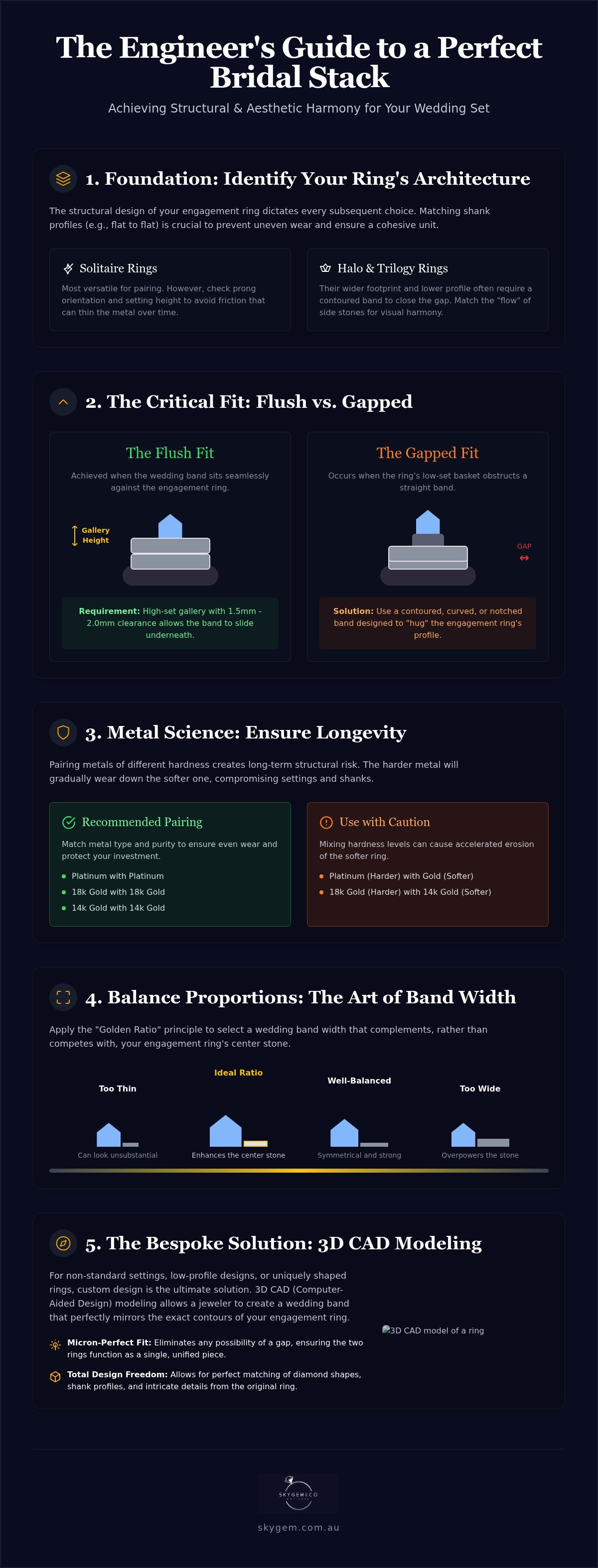
The physical relationship between two rings is governed by the gallery height of the engagement ring. This technical specification refers to the vertical distance between the finger and the lowest point of the setting basket. When considering how to match a wedding band to an engagement ring, this measurement determines whether you can achieve a flush fit or if a visible gap is inevitable. A high-set gallery allows the wedding band to slide underneath the primary setting, creating a seamless parallel look. Conversely, low-set rings, which often sit closer to the skin for comfort, create an obstruction that a straight band cannot bypass.
While many modern wearers strive for the "flush-fit" ideal for its clean symmetry, the "gapped-fit" remains a legitimate aesthetic choice for those who appreciate a more traditional, tiered appearance. This distinction is often a result of the specific setting style chosen. For a deeper understanding of these structures, you can consult the GIA guide to engagement ring styles. To determine which fit your ring supports, measure the clearance from the top of your finger to the base of the basket using a digital calliper. A clearance of 1.5mm to 2.0mm is typically required for a standard wedding band to sit flush without interference.
The Role of Contoured and Curved Bands
Contoured bands are engineered to "hug" the perimeter of a low-set engagement ring, effectively eliminating the gap. These are essential for halo or vintage-inspired settings where the centre stone is positioned low. However, there is a functional trade-off; a curved band often looks incomplete when worn independently. If you prefer a more modern alternative to traditional curves, chevron or notched designs provide a similar nesting effect with a sharper, more contemporary silhouette. For rings with highly irregular geometries, bespoke design services can create a band that mirrors the exact curvature of your setting.
Straight Bands for High-Set Rings
High-set solitaire rings are the gold standard for achieving a perfectly flush set. Because the centre stone is elevated, a straight wedding band can rest directly against the shank without interference. To maintain structural harmony, the vertical thickness of the wedding band should match the height of the engagement ring shank. This prevents the band from feeling "sunken" or overly dominant. Additionally, matching the internal curvature (the "comfort fit" profile) of both rings is vital to avoid "spinning," ensuring the rings stay aligned throughout the day. Understanding how to match a wedding band to an engagement ring in this way ensures both rings wear evenly over time.
Metal and Material Consistency: The Science of Longevity
Longevity in a bridal set is as much a matter of metallurgy as it is of style. When you are determining how to match a wedding band to an engagement ring, the purity of the precious metals is a critical technical variable. Pairing an 18K gold engagement ring with a 14K or 9K gold wedding band creates a disparity in hardness. Over years of daily contact, the harder alloy will gradually abrade the softer one, leading to structural thinning of the ring shanks. To prevent this mechanical failure, we recommend maintaining consistent metal purity across both pieces.
Colour consistency requires a similar level of technical attention. White gold, for instance, relies on a surface layer of rhodium to achieve its bright, reflective finish. If one ring is freshly plated while the other has worn down to its natural warm-white base, the set will appear mismatched. Maintaining a regular rhodium plating schedule for both rings simultaneously is the only way to ensure a uniform appearance. For yellow and rose gold, ensure the alloy mix is consistent; different jewellers use varying percentages of copper and silver, which can shift the hue of the metal.
Hardness and Wear: Platinum vs. Gold
Platinum and gold possess fundamentally different physical properties. While platinum is denser and more durable, it is also more prone to developing a "patina" of fine scratches. Gold, being an alloy, is harder but loses microscopic amounts of metal with every scratch. Mixing a platinum band with a white gold engagement ring is a common error that leads to structural damage. The denser platinum will act like a file against the gold, eventually compromising the integrity of the setting. Expert advice always favours matching the metal type to avoid this friction-induced wear and ensure the rings age at the same rate.
Diamond Consistency: Lab-Grown vs. Natural
Visual harmony also depends on the consistency of the "melee" diamonds used in the wedding band. It is essential that these small accent stones match the colour and clarity of the primary stone in your engagement ring. Whether you select lab-grown white diamonds or natural diamonds, the origin is often less important than the grading. A wedding band with stones that are two colour grades lower than the engagement ring will appear noticeably yellow by comparison. We focus on micron-perfect grading to ensure the light performance remains identical across the entire stack, regardless of the diamond's source.
Visual Proportions: Balancing Diamond Weights and Band Widths
Achieving visual equilibrium in a bridal set is a matter of mathematical proportion, often referred to as the "Golden Ratio" of ring design. While many believe that matching widths exactly is the only path to symmetry, the technical reality is more nuanced. Understanding how to match a wedding band to an engagement ring requires evaluating how the band width complements the centre stone's carat weight. A band that is too wide can dwarf a delicate solitaire, while one that is too thin may fail to provide the necessary structural support for a larger trilogy setting.
Matching diamond shapes across both rings is equally vital for maintaining a consistent light performance. If your engagement ring features round brilliant stones, pairing it with a wedding band using the same cut ensures the "river of light" remains uninterrupted. Setting styles also play a pivotal role; pavé, channel, and grain settings each interact with light differently. Mixing a grain-set engagement ring with a channel-set wedding band can create a disjointed aesthetic, as the metal-to-stone ratio varies significantly between these methods. This lack of uniformity can distract from the overall brilliance of the set.
Width and Thickness Coordination
Technical precision in shank dimensions prevents the set from feeling restrictive or bulky on the finger. As a general rule, a 2mm engagement ring shank pairs optimally with a wedding band between 2mm and 2.5mm. This slight increase in the wedding band's width provides a grounded foundation without overpowering the primary ring. Managing the "stack height" is also essential for comfort; if the vertical thickness of the rings exceeds the natural clearance between your fingers, it can cause irritation. A tapered wedding band, which narrows as it approaches the centre stone, is a strategic design choice used to draw the eye toward the engagement ring's focal point.
Diamond Setting Styles
Aligning the setting work is a fundamental requirement for a high-quality bridal stack. When pavé work is perfectly matched, it creates a continuous flow of brilliance. You must also consider the functional differences between half-eternity and full-eternity bands. While full-eternity bands offer a complete circle of diamonds, they cannot be resized and are more prone to damage on the underside. Half-eternity bands offer a practical compromise, allowing for future adjustments while maintaining the desired aesthetic. From an engineering perspective, ensure the "culet" (the bottom point) of the diamonds in the band does not protrude through the setting, as this can scratch the engagement ring's shank over time. If you are unsure about the technical compatibility of your current set, you can consult our specialists for a bespoke design analysis to ensure a perfect fit.
The Bespoke Solution: Creating a Seamless Custom Wedding Set
For engagement rings with non-standard geometries, off-the-shelf solutions often result in a compromised fit that can lead to structural instability or accelerated metal wear. Mastering how to match a wedding band to an engagement ring often requires moving beyond stock inventory to address unique structural constraints like curved shanks or low-profile galleries. A bespoke design is not merely a luxury; it is a practical engineering response to complex setting architectures. Whether your ring features an asymmetrical shank or a low-set basket, a custom-manufactured band ensures that the two pieces function as a single, integrated unit, preventing the rings from grinding against one another during daily movement.
A custom approach also provides the technical flexibility to incorporate specific precious gemstones or heirloom diamonds that carry personal significance. This ensures that the wedding band is not just a secondary addition but a deliberate extension of the original design's aesthetic and physical properties. By controlling every variable from metal weight and alloy composition to stone orientation, we eliminate common issues like rubbing, spinning, or unsightly gaps that often plague mass-produced pairings. We focus on technical synergy. This transforms two separate rings into a high-quality bridal set intended for a lifetime of wear, ensuring that the visual impact remains consistent from every viewing angle.
The Precision of CAD Design
3D Computer-Aided Design (CAD) serves as the foundation of modern jewellery engineering. This technology allows us to create a digital twin of your ring, ensuring the wedding band’s "seat" locks into the existing setting with micron-level accuracy. Digital rendering provides the opportunity to visualize the completed set before manufacturing begins. This level of precision is particularly beneficial when matching the specific hue and saturation of stones like Australian sapphires.
Final Expert Consultation
The process concludes with a technical consultation where a master jeweller oversees the final stone setting. While CAD provides the structural framework, the human eye is essential for ensuring long-term comfort and the refined, hand-finished difference. This expert-led approach is the definitive way to learn how to match a wedding band to an engagement ring when dealing with complex settings. Starting your bespoke wedding ring journey ensures your set remains a permanent and evolving asset.
Building Your Permanent Bridal Legacy
Creating a cohesive bridal set is a technical project that requires balancing metallurgical integrity with visual symmetry. As we've explored, achieving structural harmony depends on understanding gallery height and maintaining consistent metal purity to prevent long-term wear. Whether you prioritize a flush-fitting stack or a bespoke contoured design, the goal is to ensure your rings function as a unified system. Mastering how to match a wedding band to an engagement ring allows you to invest in a set that retains its elegance and structural stability for decades.
At SkyGem & Co., we specialize in high-quality solitaire and bespoke rings, using expert CAD design to ensure a micron-perfect technical fit. Our commitment to ethically sourced natural and lab-grown diamonds ensures your bridal stack meets the highest standards of performance and design. Explore our bespoke wedding band collections or start your custom design today. Your journey toward a perfectly matched set is a significant milestone, and we're dedicated to ensuring your rings remain a beautiful, enduring symbol of your partnership.
Frequently Asked Questions
Do my wedding band and engagement ring have to be the same metal?
They don't have to match, but it's technically recommended for long-term durability. While mixing rose and white gold is a popular aesthetic trend, you should ensure the metal purity is identical, such as pairing 18K with 18K. Avoid mixing platinum with any gold alloy. Platinum is significantly denser and will act as an abrasive against the softer gold ring, eventually compromising the structural integrity of your set.
Should the wedding band be the same width as the engagement ring?
Matching widths provides a symmetrical look, but it's not a requirement for a cohesive set. A slightly wider wedding band can provide a stable foundation for a high-set solitaire, while a thinner band can make the centre stone appear larger. The goal is to balance the "Golden Ratio" of the stack so the band complements the engagement ring's proportions rather than competing for visual attention.
Is it okay to have a gap between my engagement ring and wedding band?
A visible gap, known as a "gapped-fit," is a perfectly acceptable aesthetic choice that highlights the individual design of each ring. Many traditional sets feature this space, especially when the engagement ring has a low-set basket. If you prefer a seamless look, you'll need to evaluate the gallery height to determine if a straight band can sit flush or if a contoured design is required.
Can I wear a straight wedding band with a low-profile engagement ring?
You can wear a straight band, but it won't sit flush against the engagement ring. Low-profile settings lack the necessary clearance for a band to slide underneath the primary stone. For those learning how to match a wedding band to an engagement ring with this specific architecture, a contoured or notched band is the technical solution to eliminate the gap and prevent the rings from shifting excessively.
How do I match a wedding band to a uniquely shaped engagement ring like a Pear or Marquise?
Unique shapes dictate the "flow" of the entire bridal stack. A pear or marquise stone often requires a chevron or V-shaped band to navigate the pointed edges of the setting. To maintain visual continuity, consider matching the diamond cuts in the band to the primary stone. Using marquise-shaped accents in the wedding band, for example, creates a sophisticated and intentional design language across both pieces.
Should I choose lab-grown or natural diamonds for my wedding band accents?
The choice depends on your preference for origin, as both options provide identical light performance. When selecting accent stones, or "melee," colour and clarity matching are more critical for visual harmony than the diamond's source. Ensure the stones in your wedding band match the grading of your engagement ring to avoid a mismatched look where one ring appears warmer or less brilliant than the other.
What is the best way to clean my matched bridal set at home?
Professional maintenance is essential, but you can maintain brilliance at home using a gentle solution of warm water and mild dish soap. Soak your rings for 20 to 30 minutes to loosen oils and debris. Use a soft-bristled toothbrush to gently clean the hard-to-reach areas under the stone settings. Avoid harsh chemicals or abrasive cleaners, as these can damage the metal or erode protective rhodium plating.
Is it better to buy a wedding band from the same jeweller who made the engagement ring?
It's technically advantageous to work with the original jeweller. They possess the specific CAD files and technical measurements of your engagement ring's shank profile and gallery height. This is the most reliable way how to match a wedding band to an engagement ring with a micron-perfect fit. It also ensures that the metal alloys and diamond grading remain consistent across both pieces for a uniform finish.
Disclaimer
This article is for general informational purposes only and may include AI-assisted content. Pricing, specifications, and availability are subject to change. For accurate advice and current information, please contact SkyGem & Co. directly. Nothing in this content constitutes professional or financial advice.