
How to Feel Confident in Your Diamond Purchase

What if the most reassuring diamond description still leaves you unsure about the stone itself? Learning how to feel confident in your diamond purchase starts with looking beyond polished images and headline grades to information you can check and questions you can get answered.
It’s reasonable to want more than attractive photographs before making a considered purchase. A grading report describes specific characteristics, but it won’t show every detail of how a diamond appears in different lighting or how it will work with your intended design. Comparing stones consistently can turn those unknowns into practical decisions.
Here you will get the evidence-first process for reviewing information, comparing stones and clarifying what matters most to you. You’ll learn what records and views to request, what to ask before committing, and how to weigh natural and lab-grown options against your priorities. If you’re considering a bespoke ring, an expert consultation and diamond sourcing matched to your specifications can help you assess a stone in the context of its design. The aim is a choice you can explain, supported by a clear record of why it fits.
Key Takeaways
- Build confidence around evidence and unanswered questions, not pressure or promises about future value.
- Check that a diamond’s report corresponds to the stone, and understand what the report can and can’t establish.
- Compare natural and lab-grown diamonds using relevant facts and your own preferences, rather than relying on sales claims.
- Ask focused questions about identity, documentation and appearance before committing.
- Learn how to feel confident in your diamond purchase by setting priorities, reviewing evidence and resolving uncertainties before making a decision.
How to Feel Confident in a Diamond Purchase Starts with Better Questions
Buying a diamond can feel uncertain when grading terms are unfamiliar, photographs show only a carefully presented view, or you feel expected to decide quickly. Those concerns are reasonable. Confidence doesn’t mean knowing that a diamond will hold or increase its value. It means understanding the available evidence and choosing a stone that fits your priorities.
Evidence-based confidence is a considered decision supported by information you can check, not a promise about what a diamond will be worth in the future.
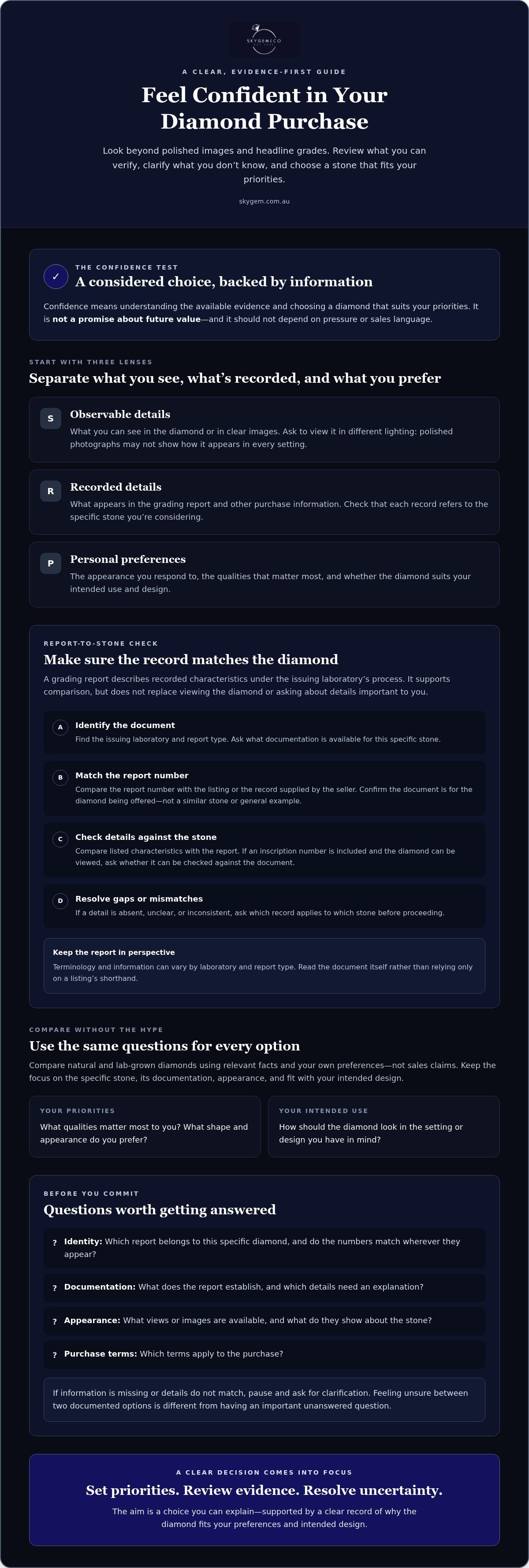
Separate three kinds of information as you assess a stone. Observable details include what you can see in the diamond or in clear images. Documented claims are details recorded in its report or other purchase information. Personal preferences cover how you respond to its appearance and whether it suits your intended use. Sales language may draw attention to a feature, but it shouldn’t replace evidence for a claim.
This section focuses on a sound decision process, not a complete grading or ring-style guide. A foundational overview of the four Cs of diamonds can make grading vocabulary more familiar. Your decision should still be grounded in the documentation and appearance of the specific stone you’re considering.
What should a buyer know before comparing diamonds?
Start with your intended use and the appearance you prefer. Decide which qualities matter most, then write down what you don’t yet understand before browsing listings or speaking with a jeweller. For example, your notes might include the shape you prefer, how the diamond should look in your intended setting, and which details in a report you want explained. This keeps prominent sales descriptions from setting your priorities for you. You don’t need to know every grading detail in advance; you do need to understand the stone and the records provided for it.
Which concerns are worth resolving before committing For Purchasing Diamond?
List open questions about the stone’s identity, its grading details, what images show and the purchase terms that apply. Feeling unsure while comparing two documented options is normal. Missing information or details that don’t match are different concerns and deserve clarification. You can pause, ask for an explanation or request clearer images rather than decide under pressure.
That distinction is central to how to feel confident in your diamond purchase: not every uncertainty is a warning, but important unanswered questions shouldn’t be brushed aside. Use this starting point to examine the report, assess what you can see and compare options according to your priorities.
How to Check a Diamond’s Report Against the Stone
A grading report is useful only if it relates to the diamond you’re considering. Start by identifying the issuing laboratory and report type, then locate the report number and compare it with the number shown in the listing or supplied by the seller. Don’t assume every diamond comes with the same kind of documentation. Ask what records are available for that specific stone.
A grading report is a description of a diamond’s recorded characteristics under the issuing laboratory’s process. A seller’s description is information to check against that record.
What details should match between the report and listing?
Check that the report number is consistent wherever it appears, then compare the listed characteristics with the report. Confirm that the document is for the specific diamond being offered, not a similar stone or a general example. If the report includes an inscription number and the diamond can be viewed, ask whether the inscription can be checked against the document. If a detail is absent, unclear or inconsistent, ask the seller to explain it before proceeding. A clear answer should identify which record applies to which stone.
What can a diamond grading report tell you?
A report records an assessment made under the issuing laboratory’s process, giving you a reference point for evaluating the stone. Its terminology and information can vary by laboratory and report type, so read the document itself rather than relying on a listing’s shorthand. For foundational context, GIA’s guide to the 4Cs explains familiar grading terms. A report supports comparison, but it doesn’t replace viewing the diamond or asking about details that matter to you.
Use this sequence before treating a report as evidence for a particular listing:
- Identify the issuing laboratory and the type of report provided.
- Match the report number to the listing or other information for the stone.
- Compare the stated characteristics and ask about any mismatch or missing detail.
Keep the report’s scope in mind. It describes recorded characteristics; it doesn’t guarantee a diamond’s value, future performance or how its appearance will suit your preferences. Natural and lab-grown diamonds may also have different report formats, so don’t assume identical terminology or grades will appear across every document. The key question is whether the information is clear and applies to the stone under consideration.
If you’re unsure how a report relates to a particular diamond, an expert consultation can help you discuss the documentation alongside your priorities. Reviewing the report is one practical step in understanding how to feel confident in your diamond purchase.
How to Compare Diamond Options Without Relying on Hype
A useful comparison shows which differences are documented and which come down to personal preference. Rather than judging options by a headline label or sales phrase, use the same criteria for each stone. Record the details side by side, including what you still need to ask. This gives you a consistent basis for deciding whether the evidence and appearance align with what you value.
| Comparison point | What to review | What you decide |
|---|---|---|
| Evidence | Are the stated characteristics supported by information for the specific stone? | Which details matter most to you? |
| Appearance | What can you assess from the diamond itself or the images available? | Does its appearance suit your taste and intended design? |
| Disclosure | Are relevant details, including origin, clearly stated? | Do you have enough information to make your choice? |
| Documentation | What report or other records are provided, and what do they describe? | Are you comfortable with the information available? |
| Priorities | Do the documented details align with the criteria you set? | Which trade-offs are acceptable to you? |
How should you assess the information provided?
Check that the seller clearly identifies the stone and explains what documentation is available for it. If origin matters to your decision, confirm how it is disclosed and what supporting information accompanies the listing. Different stones may come with different records, so compare what each document actually states rather than assuming the same format or terminology applies to every option.
Which comparison criteria matter beyond a headline grade?
A headline grade can be a useful reference, but it shouldn’t replace a closer look at details that matter to you. Consider whether the available information addresses your priorities, then assess the stone’s appearance from the views provided. For example, if you have a particular ring design in mind, ask whether the diamond’s appearance suits that design. This is a personal judgement, separate from documented facts.
Keep evidence separate from sales language. Claims about rarity, resale, ethics or long-term value should be clearly explained and supported by relevant information. Don’t treat a broad phrase as proof about an individual stone. Ask what a claim refers to if it affects your decision.
A consistent comparison reveals which differences are verifiable and which reflect your preferences. To understand how to feel confident in your diamond purchase, write down your priorities, assess each option against the same criteria and note any trade-offs or unanswered questions before choosing.
A Diamond Purchase Checklist: Questions to Ask Before You Commit
Before paying, make sure you understand which diamond is being offered, what information supports its description and what purchase terms apply. You don’t need every seller to provide identical materials, but you should be able to ask reasonable questions and understand the answers. If something remains unclear, pause and follow up rather than filling the gap with an assumption.
What should you ask a jeweller before buying?
Ask how the specific diamond is identified and what documentation accompanies it. If an image or report detail is difficult to interpret, request a clearer explanation or additional images if available. Then confirm the applicable purchase terms directly with the seller, including any details you need to understand before proceeding. Keep the responses with your notes so you can refer to them as you make your decision.
Use this checklist to organise your final review:
- Identity: Is it clear which specific diamond the listing or offer describes?
- Documentation: What report or other supporting information is available for that stone?
- Disclosure: Is the diamond’s origin clearly stated, and are the descriptions consistent across the information provided?
- Appearance: Have you seen images that help you assess the stone, or asked what further views may be available?
- Purchase terms: Have you confirmed the terms that apply with the seller?
- Open questions: Can you explain each detail that matters to you, or is anything still unresolved?
What are practical warning signs to investigate?
A mismatch between a listing and its supporting information, an unexplained report detail or a seller who can’t clearly answer reasonable questions are reasons to seek clarification. They aren’t, by themselves, proof of wrongdoing. Ask for the specific detail to be explained and assess whether the response resolves the inconsistency. If you feel rushed, take time to review what you’ve been told before deciding.
Keep requests precise. For example, ask, “Could you clarify which report applies to this diamond?” or “Can you provide a clearer view of the stone if one is available?” This helps the seller respond to the exact point you need to resolve without assuming every seller has the same images or documents.
Before payment, verify the diamond’s identity, review the available documentation, confirm its origin and purchase terms, and resolve unanswered questions. That final pause is a practical part of how to feel confident in your diamond purchase: you’re checking that the decision is supported by information you understand, not simply persuasive language.
Make Your Diamond Decision with Clear Advice and a Defined Next Step
A clear decision follows a practical sequence: define what matters to you, review the evidence for the specific diamond, compare the trade-offs and resolve remaining questions. You don’t need to eliminate every preference-based uncertainty. You do need to understand the information you’re relying on and why the stone suits your priorities.
If report details are difficult to interpret, or you’re unsure how to weigh your preferences against the available options, an expert consultation can help clarify the decision. SkyGem & Co. offers consultations to discuss diamond choices and budget considerations in an educational setting. Bring your questions, the qualities you’ve prioritised and any information you’re comparing. The aim is to help you understand your options, not to promise a particular outcome or provide an independent appraisal.
When can expert guidance make the decision clearer?
A conversation may be useful when you’ve narrowed your options but still need help interpreting information or considering how a stone fits your intended design. If you’re exploring bespoke procurement, SkyGem & Co. can source a diamond matched to your specifications, helping you consider the stone alongside the piece you want to create. If you’re considering a custom setting, discussing the intended design alongside the diamond can help clarify how the two will work together.
What is a useful next step after choosing a diamond?
Before proceeding, confirm the selected stone’s documentation and the purchase terms directly with the seller. If it’s for a ring, discuss how the diamond will work with the intended design and setting, rather than treating the stone and finished piece as separate decisions. Keep a record of the information you reviewed and the reasons the diamond meets your priorities. That gives you a clear reference point for the choice you’ve made.
Following this process is a practical way to understand how to feel confident in your diamond purchase: make the decision with evidence, clear trade-offs and questions answered, then take the next step when you’re ready.
Make Your Next Diamond Decision with Clarity
Confidence grows when your choice reflects reliable information and what matters to you. Set your priorities, check that the available documentation relates to the specific stone, and compare natural and lab-grown options according to your preferences rather than sales claims. Resolve unanswered questions before you commit.
That’s a practical way to understand how to feel confident in your diamond purchase: know what supports the decision and why the diamond suits your needs. SkyGem & Co. offers expert consultations to discuss diamond options and budget considerations, as well as natural and lab-grown diamonds. Its bespoke sourcing can match a diamond to your specifications.
If you’re ready to talk through your priorities and next steps, arrange a consultation.
Take the time you need to make a considered choice. With clear information and your priorities in focus, you can move forward with greater assurance.
Frequently Asked Questions
How can I feel confident when buying a diamond online?
To understand how to feel confident in your diamond purchase online, check the information for the specific stone rather than relying on a polished listing alone. Review the available report and confirm its details match the diamond described. Ask what images, further explanations and purchase terms are available, since sellers may provide different materials. If an important detail remains unclear, request clarification and take time to consider the answer before committing.
Does a diamond certificate guarantee that I am buying a good diamond?
No. A grading report records information about a diamond under the issuing laboratory’s process, but it doesn’t guarantee that the stone is right for you, establish its future value or promise future performance. “Good” depends partly on your own preferences and intended use. Read the report alongside the diamond’s appearance and other available information, and ask the seller to explain any detail you don’t understand before deciding.
What should I check on a diamond grading report before buying?
Identify the issuing laboratory and report type, then compare the report number and stated characteristics with the listing or details provided by the seller. Confirm that the document applies to the specific diamond you’re considering. Not every listing will necessarily include the same documentation, so ask what is available. If information is missing, difficult to interpret or inconsistent, request an explanation before proceeding.
Can I trust diamond photos and videos when shopping online?
Use photos and videos as helpful viewing aids, not as a complete substitute for understanding the stone. Lighting, angles and presentation can affect how a diamond appears on screen, and images may not answer every question about its appearance. Ask whether clearer or additional views are available and what conditions they show. Compare visual material with the documented details, and ask the seller to explain anything that seems unclear.
How do I compare natural and lab-grown diamonds confidently?
Start by confirming that each diamond’s origin is clearly disclosed, then compare the specific stones using the information available for each. Consider documented characteristics, appearance and how well each option fits your priorities. The documentation may differ, so don’t assume the same report format or terminology applies to both. Neither origin is universally preferable; the right choice depends on what matters to you and what you can verify.
What questions should I ask before buying a diamond?
Ask how the specific diamond is identified, what documentation is available and whether its listed details match that information. If you’re buying online, ask what images or further views can be provided. Confirm the diamond’s origin and the purchase terms that apply. Write down anything you don’t understand, then ask for a clear explanation. Conflicting details or unanswered questions are reasons to pause and verify, not automatic proof of a problem.
Should I speak with a jeweller before choosing a diamond?
Speaking with a jeweller can help if you’re unsure how to interpret a report, compare options or connect a stone with your intended design. Bring your questions, preferred characteristics and budget considerations so the discussion stays focused on your priorities. SkyGem & Co. offers expert consultations to discuss natural and lab-grown diamond options and budgets, as well as bespoke diamond sourcing matched to client specifications. A conversation can inform your decision without guaranteeing a particular outcome.