
How to Combine Your and Your Partner’s Style in One Ring

What if a ring that reflects two different tastes feels more distinctive, not less personal? If one of you favours clean, understated lines and the other is drawn to detail, it’s understandable to worry that compromise could leave one person’s style behind. When you’re working out how to combine mine and my partner's style in one ring, start by identifying what matters most to each of you, rather than choosing a design that simply splits the difference.
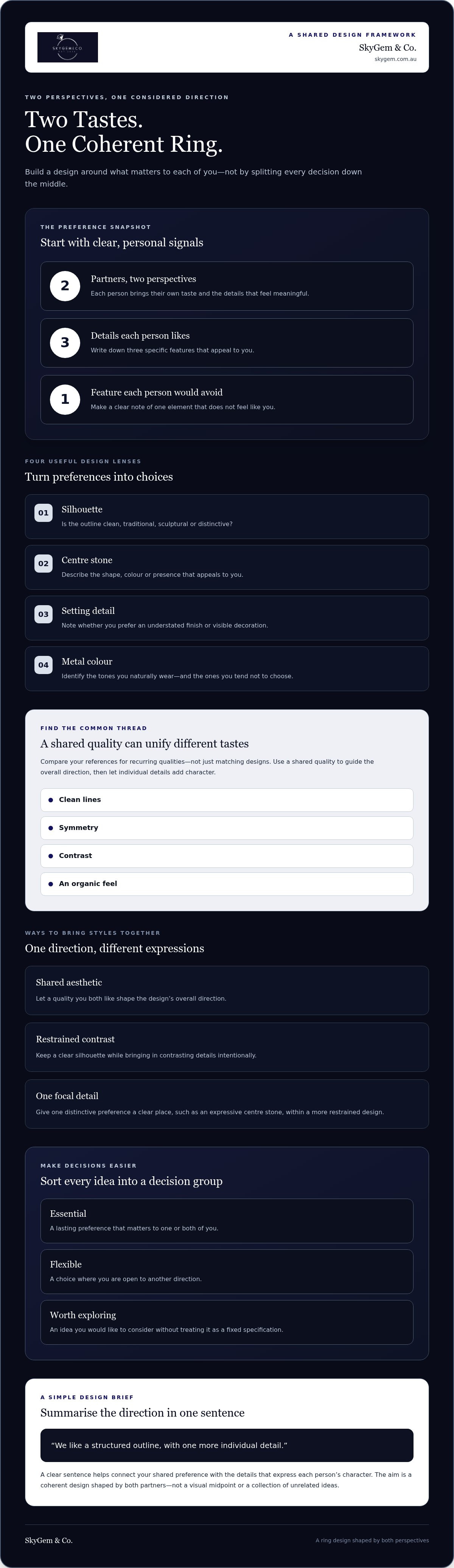
You don’t need specialist design vocabulary to explain what you like. Notice the features you’re drawn to, such as a simple silhouette, a coloured gemstone, mixed metals or a distinctive setting. Then discuss which elements feel essential and which are flexible. That turns different preferences into useful design direction.
This guide offers a practical framework for comparing your tastes, choosing a shared focal point and bringing contrasting details into one coherent ring. You’ll also learn how a bespoke design consultation can help translate your ideas into a considered engagement ring shaped around both partners’ preferences. The aim isn’t to make the ring equally understated and detailed. It’s to create a design that feels true to both of you.
Key Takeaways
- Shared style doesn’t mean matching preferences. Agree on what matters most to each of you.
- Collect design references separately, then look for recurring themes that can guide your ring brief.
- Consider whether a shared aesthetic, restrained contrast or one focal detail best brings your tastes together.
- Label each preference as essential, flexible or worth exploring to make decisions easier.
- A personalised bespoke design consultation can help turn your shared brief into a considered direction, supported by SkyGem & Co.’s team with over 100 years of combined experience.
Why combining two styles in one engagement ring can feel difficult
An engagement ring is worn by one person, but choosing its design can involve two people with different ideas of what feels meaningful. One may prefer a minimal band and classic outline, while the other is drawn to decorative details or a contemporary look. Treat every preference as a requirement and the ring can become crowded. Let one person’s taste dominate and the result may feel less personal to the other.
Shared style doesn’t mean matching tastes or giving every feature equal visual prominence. It means deciding how different preferences can work together and which ones genuinely matter. Separate lasting preferences from details that appeal mainly because they’re fashionable or because one partner feels obliged to agree. Ask whether a feature would still feel right after years of wearing the ring, not just whether it looks appealing in a trend image.
Personal meaning can also come from what a ring represents, not only its appearance. The history and symbolism of engagement rings offers broader cultural context, but your own design choices can reflect the meanings you both value. A shared ring style is a coherent design shaped by both partners, not a visual midpoint between two different tastes.
What makes two partners’ ring preferences different?
Differences often show up in the overall mood: minimal or decorative, classic or contemporary, subtle or expressive. To make those instincts easier to discuss, think about the jewellery you wear regularly. Do you reach for clean shapes and little ornament, or pieces with noticeable colour and detail? Which features feel unlike you, even if they look appealing on someone else?
Then separate the overall appearance from individual details. One person might favour a simple silhouette but enjoy a distinctive gemstone. The other may prefer a more embellished look with a familiar, classic outline. Recognising this distinction helps clarify what each preference is really about, without assuming one choice dictates every part of the ring.
Does a shared design mean splitting every decision?
No. Collaboration means both perspectives influence the design, not that each feature needs to be negotiated into a compromise. One partner’s preference could guide the ring’s silhouette, while the other contributes a meaningful detail, such as a particular gemstone or decorative accent. The aim is to make those choices feel intentional together, rather than like unrelated ideas placed side by side.
When deciding how to combine mine and my partner's style in one ring, separate the choices that set the overall direction from those that add individual character. A clear silhouette can give contrasting details a consistent framework. The result can express two personalities without reproducing both partners’ tastes in every element.
Translate each partner’s taste into clear engagement ring design choices
Design translation turns likes, dislikes and meaningful references into choices about a ring’s appearance. Instead of stopping at “I like this one”, identify what caught your attention: the outline, centre stone, setting detail or metal colour. This gives you a shared vocabulary for comparing references and prevents a favourite picture from becoming a fixed specification.
For useful starting points, browse different engagement ring designs separately before comparing notes. Each partner can save examples that genuinely appeal to them, without trying to predict what the other person will choose.
Build two short lists of ring preferences
Each partner can write down three details they’re drawn to and one feature they’d avoid. Keep descriptions observable: “a narrow-looking band” is easier to discuss than “elegant”, while “a prominent centre stone” is more specific than “special”. Then ask what each choice communicates to you, whether that’s simplicity, individuality, heritage or visual impact.
- Silhouette: Note whether the overall outline feels clean, traditional, sculptural or distinctive.
- Centre stone: Describe the shape, colour or presence that appeals to you, rather than assuming you both mean the same thing by “classic”.
- Setting detail: Record whether you prefer an understated finish or visible decorative elements.
- Metal colour: Identify the tones you’re naturally drawn to and those you tend not to wear.
Compare your lists for shared reactions before debating individual choices. You might both favour a defined outline even if one prefers simplicity and the other likes ornament. Start with those common signals. They give you a constructive basis for discussing the differences.
Choose a common thread between different aesthetics
Look beyond matching objects in your saved references and search for a shared quality. It could be clean lines, symmetry, contrast or an organic feel. Let that quality guide the ring’s overall direction, then use a distinctive preference from each partner to add character. For example, a restrained silhouette could sit alongside a more expressive centre stone, as long as the details feel considered together.
Repeated preferences across several images often reveal a more useful design direction than one favourite. To test a possible direction, describe it in one sentence: “We like a structured outline, with one more individual detail.” If that summary reflects both lists, you have a working principle rather than a collection of disconnected features.
This is a practical way to approach how to combine mine and my partner's style in one ring: keep the shared quality visible, then use each partner’s preferences to guide specific design choices. You don’t need to settle every detail at once. A concise set of observations gives a bespoke design conversation a clear starting point while leaving room to refine the ring together.
How to combine contrasting ring styles without a cluttered result
Once you’ve identified what each of you likes, decide how those preferences should relate in the finished ring. Three approaches can help you compare options: build around a shared aesthetic, introduce a restrained contrast, or make one feature the focal point and keep the rest quieter. None is automatically better. Choose based on which preferences you want the ring to express most clearly.
| Approach | When it may suit you | Visual effect |
|---|---|---|
| Shared aesthetic | You both respond to a quality such as symmetry or clean lines. | A unified appearance, with agreement carried through the overall design. |
| Restrained contrast | You want to retain a clear difference in taste without making every element compete. | A coherent design with a deliberate point of contrast. |
| One focal detail | You have different preferences, but one feature can represent a key personal choice. | A strong centre of attention supported by quieter elements. |
A limited number of deliberate contrasts usually makes a design easier to read. If the silhouette, stone, metal colour and setting detail all make separate statements, the ring may lack a clear visual priority. Choose what should attract attention first, then consider how the remaining elements can support it. This doesn’t mean removing character. It means giving each choice a clear role.
Pair classic and contemporary details with intention
A classic silhouette can provide a steady framework for a contemporary detail, such as a more expressive stone shape or an unexpected setting element. Consider proportion and visual balance: a prominent detail may need simpler surrounding features to remain distinct. In a bespoke design discussion, compare possible combinations as complete rings, rather than judging each feature on its own.
Balance preferences for gemstones, metals and detail
A centre stone can anchor the design, while another partner’s taste informs the surrounding details. For example, one preference might guide the choice between a coloured gemstone and a diamond, while the other shapes the overall mood through the setting or metal colour. If you’re considering a diamond, discuss whether a natural or lab-grown stone better fits your shared priorities. Treat metal colour as part of the composition, not an isolated decision, and consider how it relates to the stone and other visible details.
To decide how to combine mine and my partner's style in one ring, compare each option against the preferences you’ve already identified. Ask what the eye notices first, whether the supporting features feel related, and whether both partners can explain what feels personal about the result. That simple test keeps the design grounded in your tastes rather than a formula.
Create a shared ring brief before moving into design
A concise ring brief turns a good conversation into practical design direction. It doesn’t need technical terminology or a final decision on every feature. Its purpose is to show what you agree on, what matters most to each partner and where you’re open to exploring options. This keeps later discussions focused on the reasons behind your choices, instead of cycling through separate preferences.
Agree on priorities before debating individual details
Before discussing specific features, ask each other: “What’s the one quality you most want the finished ring to express?” You might name simplicity, individuality, a connection to family or a sense of visual presence. Record shared priorities separately from choices that can remain open. If you disagree, ask what a preference means to the person who holds it before suggesting alternatives.
Then work through the brief in order:
- Collect references. Save a small set of images that genuinely appeal to each of you, rather than trying to find one perfect example.
- Name shared themes. Note recurring qualities in your references, such as a particular mood, outline or level of detail.
- Agree priorities. Identify the qualities that should guide the design and distinguish them from individual details.
- Describe open choices. Record the questions you haven’t resolved, so they can be explored during design instead of treated as disagreements.
For each preference, use one of three labels: essential if it needs to guide the design, flexible if you’re willing to consider alternatives, or worth exploring if you’re curious but undecided. The labels show where there’s room to collaborate without diminishing a choice that matters deeply to one partner.
Turn inspiration into a useful bespoke design brief
Beside each reference image, write one sentence about what appeals to you. Describe the element, not just the overall impression: note whether it’s the shape, level of detail or contrast that caught your eye. Add practical considerations, features you’d prefer to avoid, any gemstone category you’re interested in and details with personal meaning. Keep the notes open-ended. You don’t need to specify a stone, shape or setting before design begins.
- Preferences: Which qualities should the ring express?
- Dislikes: What would feel uncomfortable or unlike you?
- Practical considerations: What should the design account for in everyday wear?
- Meaningful details: Are there personal references you’d like considered?
With a brief in hand, a personalised consultation can help translate your shared priorities and open questions into a considered bespoke direction. SkyGem & Co.’s bespoke engagement ring design is shaped around your preferences, giving both partners a clear basis for discussing how to combine mine and my partner's style in one ring.
Bring both perspectives together through bespoke ring design
A personalised design consultation can turn your shared ring brief into a considered direction for a bespoke engagement ring. Bring your preferences, references and open questions. The design conversation can then translate them into choices that work together as a complete piece. Rather than adding a feature for every preference, the aim is to understand which choices express your priorities and how they can be brought together with clarity.
What to expect from a collaborative design conversation
Bring both partners’ references and explain what draws you to each one. It might be the overall outline, a detail, a gemstone or the feeling the design evokes. Sharing that context helps distinguish the feature itself from what it represents to you. It also gives the conversation room to explore alternatives while keeping your original intentions in view.
SkyGem & Co.’s designers, diamond setters, jewellers and gemologists bring over 100 years of combined experience. Their expertise supports a considered conversation about how the elements relate, including which features should lead and which can play a supporting role. Personalised consultations are available virtually or in-store by appointment, so you can discuss bespoke jewellery design in a format that suits you.
Keep the finished ring personal to both of you
As the design direction develops, return to your brief and assess it against the priorities you agreed on. Ask whether the overall result reflects the qualities you want the ring to express and whether each partner can recognise a meaningful part of their perspective in it. This keeps the design grounded in your shared intentions without turning every preference into another detail.
Craftsmanship and considered design matter more than including a visible symbol for each person. One partner’s taste might be expressed through the overall form, and the other’s through a carefully selected detail, while the complete ring still reads as one unified design. Expert guidance can help refine these decisions while keeping your stated priorities in view.
That’s a practical way to approach how to combine mine and my partner's style in one ring: use your brief to guide the conversation, then consider each choice in relation to the whole design. With bespoke design and manufacturing, your preferences can inform a ring shaped around the two of you, rather than a generic compromise.
Explore bespoke engagement ring design
Start shaping a ring that feels like yours
The first design conversation doesn’t need to settle every detail. Begin with a more meaningful question: what do you want this ring to represent about your partnership? Your answer gives the design a purpose beyond combining visual preferences and helps you make choices connected to your life together. Keep that idea close as you explore possibilities, and let it guide decisions that might otherwise feel difficult to resolve.
Learning how to combine mine and my partner's style in one ring isn’t about reaching a perfect midpoint. It’s about creating a shared direction where both people can recognise their values and feel heard. As you move from ideas to design, stay open to refining your priorities. A considered ring can reflect your partnership because it comes from a conversation that belongs to you both.
Bring your shared brief to a personalised consultation and begin shaping a ring that reflects both of you.
Frequently Asked Questions
Is it possible to combine two different engagement ring styles?
Yes. Different tastes can shape separate parts of one ring, such as its silhouette, focal gemstone or a subtle decorative feature. Rather than bringing every preferred element together, decide which shared quality should hold the design together and where contrast will add meaning. Start by naming your priorities, then use a bespoke design conversation to consider the balance.
Can an engagement ring combine different metal colours?
A design can explore more than one metal colour, but the overall effect depends on how those tones relate to the ring and the wearer’s existing jewellery. Consider whether you want the colours to stand apart or create a more unified impression. Each partner can identify the metal colour they’re drawn to, then discuss how those preferences fit the design as a whole during a personalised consultation.
Should both partners be involved in choosing an engagement ring?
There’s no single right approach. Some couples prefer to make decisions together, while others want one person to lead or keep the proposal a surprise. Shared input can make preferences clearer, but it shouldn’t feel compulsory. Before discussing design, agree on how much involvement feels comfortable to each of you. For a surprise, a conversation about broad likes and dislikes can offer direction without revealing a specific ring.
What if one partner prefers a diamond and the other prefers a coloured gemstone?
Start by asking what each person values about their preferred stone. Is it the colour, appearance, symbolism or a strong personal connection? Those reasons can guide the design even if you ultimately choose one focal stone. The other preference might influence the ring’s wider character or a supporting detail. Discuss the possibilities without assuming every combination will suit every design or reflect both tastes equally.
Can a classic ring design include a modern detail?
Yes. A classic overall shape can provide a composed foundation for a contemporary feature, provided the elements feel related. First identify what makes a reference feel modern to you: perhaps it’s the stone’s outline, the setting or the balance of detail. Then consider whether that feature should be prominent or understated. Comparing design options can help you judge how it sits alongside the qualities you want to retain.
What should we bring to an engagement ring design consultation?
Bring examples of jewellery you each wear, a few reference images and brief notes on what appeals to you in each. Include features you’d avoid and practical considerations, such as how the wearer uses their hands day to day. Separate firm preferences from ideas you’re willing to explore. This gives the conversation useful context while allowing the design to develop without treating every image as a specification.
Can a bespoke ring include a gemstone instead of a diamond?
Yes. SkyGem & Co. works with coloured gemstones, including sapphires, rubies and emeralds, as well as natural and lab-grown diamonds for engagement rings. The right centre stone depends on your preferences and the design you have in mind. Discuss whether colour, symbolism or overall appearance matters most, then consider how the chosen gemstone relates to the ring’s other details in a personalised consultation.
Disclaimer
This article is for general informational purposes only and may include AI-assisted content. Pricing, specifications, and availability are subject to change. For accurate advice and current information, please contact SkyGem & Co. directly. Nothing in this content constitutes professional or financial advice.