
Men's Diamond Wedding Bands: The 2026 Guide to Technical Precision and Style

The most sophisticated piece of engineering you own shouldn't be your car or your watch; it should be the ring that must withstand every hour of your daily life. It's a common concern that choosing men's diamond wedding bands means sacrificing rugged durability for a delicate, flashy aesthetic. You likely want a piece that signals personal style and commitment without the constant fear of a stone coming loose during physical activity or a day on-site. We recognize that a wedding band is a permanent asset, requiring a logical balance of structural integrity and refined design that feels bespoke rather than mass-produced.
In this 2026 guide, you'll discover how to select a band that bridges the gap between industrial-grade resilience and high-jewellery excellence. We'll provide a technical breakdown of the current precious metal landscape, noting how recent price shifts in gold and platinum impact your investment. You'll also learn the critical differences between natural and lab-grown diamond values following the price stabilisations seen in July 2026. This preview of modern setting types and material performance will ensure your choice remains a reliable, high-performance asset for decades to come.
Key Takeaways
- Understand the transition from traditional plain bands to high-jewellery statements that prioritise symbolic strength and enduring material value.
- Evaluate the technical performance of platinum versus 18K gold to determine which precious metal provides the necessary density and wear-resistance for your daily environment.
- Identify the most secure setting techniques for men's diamond wedding bands, including flush and channel styles, to ensure stone security during rigorous physical activity.
- Discover how custom CAD design creates a superior ergonomic fit compared to mass-produced alternatives, resulting in a piece that functions as a permanent and comfortable asset.
- Learn why 'Cut' remains the primary performance metric for brilliance in accent diamonds and how to navigate the current value landscape of natural and lab-grown stones.
The Evolution of the Men's Band: Why Diamonds are Defining Modern Wedding Jewellery
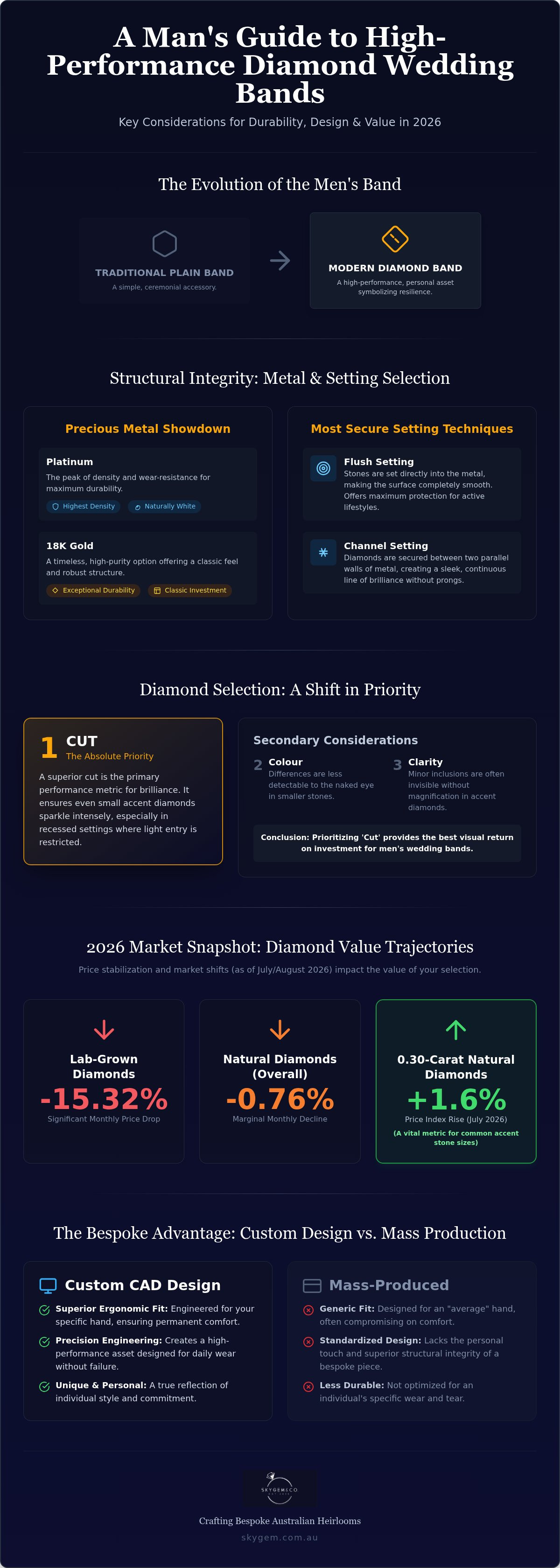
The traditional gold band is no longer the default choice for the modern professional. For decades, the standard was a simple, unadorned metal ring. However, as we move through 2026, the market is witnessing a decisive shift toward high-jewellery statements. Men's diamond wedding bands are no longer considered outliers; they've become a primary vehicle for expressing both personal style and technical appreciation. This evolution reflects a broader movement where fine jewellery is viewed as a durable, long-term asset rather than a mere ceremonial accessory.
A wedding band is often the only piece of jewellery a man wears daily. This constant use necessitates a design that balances aesthetic excellence with rigorous performance standards. While some industry professionals suggest that simple bands remain a staple, the current demand for bespoke, diamond-set pieces suggests a desire for something that feels personal and technically superior. It's a pivot from mass-produced simplicity to curated, high-performance engineering.
Diamonds as a Symbol of Resilience and Commitment
Looking at the history of wedding bands, it's clear that the materials chosen have always reflected the values of the era. Today, the choice of a diamond represents more than just luxury. It signals resilience. As the hardest natural substance, a diamond is a logical choice for a man who values durability in his professional and personal life. The resurgence of diamonds in men's regalia isn't just about status; it's about selecting materials that mirror a professional’s milestones and long-term success. Many clients now view their band as a curated asset, opting for natural white diamonds or lab-grown white diamonds that align with their specific ethical and financial goals.
The Aesthetic Intersection: Precision Engineering Meets Fine Art
The defining characteristic of modern design is "quiet confidence." This approach moves away from the flashy stereotypes of the past, focusing instead on purposeful stone placement and structural integrity. A well-designed ring uses diamonds to highlight the band's architecture. Think recessed channels or flush-set accents that maintain a sleek, masculine profile. This "Industrial-Premium" aesthetic ensures the piece feels substantial and modern. It's about precision engineering meeting fine art. By focusing on technical specifications like stone depth and metal density, we create pieces that are both visually striking and practically indestructible. This methodology ensures the ring functions as a permanent part of your daily environment without compromising on its high-jewellery origins.
Diamond Selection: Technical Specifications for Performance and Brilliance
Selecting the right stones for men's diamond wedding bands requires a departure from standard retail logic. While the 4Cs (Cut, Colour, Clarity, and Carat) remain the industry benchmark, their application shifts when evaluating the smaller accent diamonds typically used in masculine designs. For these pieces, 'Cut' is the absolute priority. A superior cut ensures that even a small stone maintains high brilliance in recessed or flush settings where light entry is restricted. This technical focus prevents the ring from looking dull or 'flat' over time. In these smaller sizes, the human eye rarely detects slight clarity inclusions, so prioritising cut and colour provides a much better visual return on investment.
As of August 2026, the market reflects a clear distinction in value trajectories that should inform your selection. Data indicates that while natural diamond prices saw a marginal monthly decline of -0.76%, lab-grown prices dropped significantly by -15.32%. Interestingly, the Rapaport Trade Diamond Index for 0.30-carat diamonds rose by 1.6% in July 2026. This is a vital metric for men's bands, which frequently utilise stones in this size range. Just as the properties of gold influence how a metal is alloyed for hardness, the diamond's cut determines how it interacts with that metal to produce light. Understanding these market fluctuations helps in deciding which material aligns with your long-term goals.
The Case for GIA Certification in Men's Diamonds
Independent grading is a critical safeguard, even for the smaller stones found in a wedding band. GIA standards provide a transparent record of a stone’s quality, ensuring you aren't paying a premium for substandard materials. This level of documentation is essential for long-term investment security and insurance purposes. When researching online diamond selection, looking for GIA-certified stones is the most reliable way to verify that technical specifications match the physical product. It moves the purchase from a subjective choice to a verified acquisition.
Geometric vs. Brilliant: Choosing the Right Diamond Shape
The choice of shape dictates the ring's overall architectural profile. Round Brilliant diamonds are engineered for maximum light return, making them ideal for individual flush settings where they act as singular points of light. Conversely, geometric cuts like the Baguette or Emerald cut offer a sleek, understated look. These step-cut stones are particularly effective in channel settings, where they create a continuous, mirror-like surface that feels structural rather than decorative. For those seeking a seamless, wall-to-wall appearance, Princess cuts allow for a tight fit with minimal metal visible between the stones. This precision in stone selection ensures the final piece remains sophisticated and functional. If you're ready to explore these technical configurations, you can begin to customise your ideal band through our guided design process.
Structural Integrity: Comparing Metals and Setting Techniques
The structural integrity of men's diamond wedding bands depends entirely on the synergy between the choice of precious metal and the mechanical execution of the setting. While alternative metals like tungsten are often marketed for their hardness, they lack the ductility required for secure stone setting and long-term maintenance. If a ring cannot be resized or repaired, it fails the test of being a permanent asset. In the Australian market, adhering to the AS 2140 standard for metal purity is the industry benchmark. This ensures that an 18K gold band contains exactly 750 parts per thousand of pure gold, providing a reliable foundation for complex diamond work.
A critical technical distinction often overlooked in mass-market retail is the difference between cast and hand-finished rings. Most commercial rings are produced through lost-wax casting, a process that can introduce microscopic porosity or air bubbles into the metal. Over time, this porosity weakens the prongs or walls holding a diamond in place. Hand-finishing involves compressing the metal, which increases its density and ensures a more secure mechanical bond with the stone. This technical precision is why bespoke design remains the superior choice for men with active lifestyles.
Platinum: The Industrial Standard for Durability
Platinum is frequently specified for high-performance jewellery due to its unique displacement properties. Unlike gold, which loses microscopic amounts of metal when scratched, platinum simply shifts. This means the prongs and walls of a platinum setting remain substantial over decades of wear. As of August 2026, platinum is priced at approximately $1,735.80 USD per troy ounce, offering a high-density, low-maintenance alternative to gold. While it develops a 'patina' of fine scratches over time, this actually hardens the surface, reinforcing the ring's structural strength. Its significant weight on the hand provides a tactile sense of stability that many professionals prefer for daily wear.
Setting Styles That Protect Your Investment
The method used to secure a diamond is the primary factor in preventing stone loss during physical activity. We recommend three specific styles for maximum security:
- Channel Settings: These protect the diamond's vulnerable edges (the girdles) between two continuous walls of metal. This is ideal for geometric cuts like baguettes.
- Flush (Gypsy) Settings: The diamond is set slightly below the surface of the band, shielding it from direct impact. This is a preferred choice for bespoke men's bands where a minimalist, snag-free profile is required.
- Grain Settings: Small beads of metal are raised to hold the stone, adding a subtle texture while ensuring the diamond remains flush with the band's architecture.
By selecting an 18K white gold or platinum base, you ensure your ring can be maintained and resized as your life evolves, securing its status as a lifetime heirloom.
The Bespoke Advantage: Designing for Daily Performance
Standard retail rings are built for a generic profile, often neglecting the specific ergonomic requirements of the wearer. When you invest in men's diamond wedding bands, the fit is as critical as the stone quality. Off-the-shelf options frequently sacrifice metal thickness to reduce costs, leading to a piece that feels unsubstantial or prone to warping over time. Bespoke design allows for a technical approach where every millimetre is accounted for, ensuring the ring functions as a high-performance tool for daily life rather than a fragile accessory.
Computer-Aided Design (CAD) serves as the primary bridge between a conceptual vision and a finished asset. This technology allows us to calculate the exact depth required for a flush setting or the precise wall thickness needed for a channel-set baguette. By using CAD, we can simulate how the ring interacts with your hand's specific geometry, eliminating the guesswork associated with traditional hand-carved waxes. This precision ensures that the final product is not just a piece of jewellery, but a permanent, evolving asset that maintains its structural integrity through decades of wear.
Ergonomics and Comfort Fit: Engineering the Perfect Wear
A 'Comfort Fit' profile is defined by a domed interior surface. This geometry reduces the surface area in contact with the skin, allowing for better airflow and easier movement over the knuckle. For wider bands, typically between 6mm and 8mm, this cross-sectional design is essential for maintaining daily dexterity. We also consider how physiological changes, such as temperature fluctuations or physical exertion, affect your finger's diameter throughout the day. A bespoke approach allows for a more nuanced sizing strategy that accounts for these variables, providing a stable fit regardless of your environment.
The Custom Journey: From Concept to Finished Asset
The transition from a high-level concept to a physical heirloom begins with a detailed technical brief. During this phase, we translate your lifestyle requirements and aesthetic preferences into specific design parameters. You can explore the bespoke ring design process to see how these specifications are formalised. The use of 3D renders is a mandatory validation step, providing a granular view of the ring from every angle before manufacturing begins. This ensures that personal elements, like a hidden gemstone or a custom laser engraving, are perfectly integrated into the band's architecture without compromising strength.
If you're ready to begin engineering a piece that reflects your personal standards and professional lifestyle, you can book a technical consultation with our design team today.
SkyGem & Co.: Crafting Bespoke Australian Heirlooms
SkyGem & Co. operates as a technical consultant for those seeking men's diamond wedding bands that surpass standard retail expectations. Our philosophy is grounded in transparency and education, ensuring every client understands the physical properties and performance metrics of their chosen materials. We move away from aggressive sales tactics, focusing instead on a solution-oriented approach that treats the creation of a ring as a collaborative engineering project. This boutique model provides direct access to high-level expertise, eliminating the traditional retail markup while maintaining a standard of technical excellence that mass-produced jewellery cannot match. By prioritising quality over hype, we ensure that the final product is a reliable, long-term asset.
Our role extends beyond the initial design phase. We act as a dedicated partner in the long-term success of your project, offering guidance on material performance and structural stability. Whether you are selecting a high-density platinum band or an 18K gold setting, our focus remains on the intersection of precision engineering and aesthetic design. This methodical approach respects your professional time and investment, providing a narrative flow from high-level conceptual benefits to granular technical details. It's a commitment to regional expertise that ensures every piece is hand-finished to meet rigorous Australian standards.
Ethical Sourcing and Material Transparency
We maintain a rigorous commitment to ethical procurement, sourcing only conflict-free diamonds from reputable global suppliers. For those who value regional design origins, we offer the integration of Australian-sourced stones, such as Australian sapphires, to celebrate local heritage. You can review our natural diamond selection to understand the specific sourcing standards we uphold. This level of transparency ensures that your ring is not only a masterpiece of precision but also a product of responsible environmental and social practices. We believe that understanding the origin of your materials is a fundamental part of the bespoke journey.
Lifetime Maintenance: Protecting Your Permanent Asset
A high-performance ring requires ongoing professional care to maintain its structural integrity over a lifetime. We view our relationship with clients as a long-term partnership focused on the viability of the asset. Annual checks of the diamond settings are essential to identify microscopic wear before it leads to stone loss. Because we prioritise resizable precious metals like platinum and 18K gold, your ring remains adaptable to physiological changes over time. Professional cleaning and maintenance ensure that the technical brilliance of your men's diamond wedding bands persists for decades. SkyGem & Co. acts as your ongoing technical partner, providing the necessary maintenance to ensure your heirloom remains a reliable and evolving asset rather than a one-off purchase.
Engineering Your Permanent Legacy
Selecting a wedding band is a significant technical acquisition that requires a logical balance of structural integrity and refined style. We've explored how the intersection of high-density metals, such as platinum or 18K gold, and precision setting techniques like channel and flush mounts create a piece capable of withstanding a rigorous daily environment. By moving away from mass-produced options and embracing the bespoke advantage, you ensure that your ring is an ergonomic asset tailored specifically to your hand's geometry and professional lifestyle.
Investing in men's diamond wedding bands should be a transparent process backed by independent certification and regional expertise. At SkyGem & Co., we specialise in GIA-certified diamonds and hand-finished Australian craftsmanship, using expert CAD design services to validate every specification before production begins. This methodology guarantees that your ring remains a permanent, evolving heirloom rather than a temporary accessory. If you're ready to begin the design of a piece that reflects your personal standards and technical requirements, we invite you to Book a Technical Consultation for Your Bespoke Wedding Band. We look forward to partnering with you on this enduring project.
Frequently Asked Questions
Can a man's diamond wedding band be resized?
Yes, provided the ring is constructed from traditional precious metals such as 18K gold or platinum. Unlike alternative materials like tungsten or titanium, which are brittle and cannot be altered, precious metals allow for professional resizing to accommodate physiological changes over time. It's important to note that a full eternity diamond pattern may limit the range of adjustment compared to a band with a metal sizing gap.
Are lab-grown diamonds as durable as natural diamonds for a wedding ring?
Lab-grown diamonds possess the exact same physical, chemical, and optical properties as natural diamonds. Both materials reach a 10 on the Mohs scale of hardness, making them the most durable choice for men's diamond wedding bands. Whether you select a natural or lab-grown stone, the resistance to scratching and surface wear remains identical, ensuring the stone's long-term viability in a daily-wear environment.
Which diamond setting is the most secure for a man with an active lifestyle?
Flush (Gypsy) and channel settings are the most secure options for those with active lifestyles. These techniques place the diamond level with or slightly below the metal surface, protecting the stone's girdle from direct impact. This structural approach effectively eliminates the risk of snagging on clothing or equipment and ensures the mechanical bond between the metal and diamond remains intact during physical exertion.
How do I choose the right diamond size for a men's wedding band?
Choosing the right diamond size involves balancing the stone's diameter with the band's width to maintain structural integrity. For subtle accents, stones between 0.01 and 0.05 carats are standard. If you prefer a more prominent central statement, stones up to 0.30 carats can be integrated into wider bands without compromising the ring's masculine profile or the ergonomic comfort fit of the piece.
What is the best metal for a men's diamond ring if I work with my hands?
Platinum is the superior choice for manual work due to its unique displacement properties. When platinum is scratched, the metal is merely shifted rather than lost, ensuring the setting and prongs remain substantial over years of wear. While 18K gold is highly durable and a staple for men's diamond wedding bands, it is slightly more prone to microscopic metal loss through abrasion compared to the high-density nature of platinum.
How often should a diamond wedding band be professionally inspected?
You should have your wedding band professionally inspected at least once every twelve months. An annual technical review allows a jeweller to check for signs of metal fatigue or loose stones that aren't visible to the naked eye. This proactive maintenance is a critical step in protecting your permanent asset and preventing stone loss before it occurs, ensuring the ring's long-term structural health.
Does a diamond wedding band require more maintenance than a plain gold band?
A diamond band requires slightly more attention than a plain band to ensure the stones remain secure. While the metal requires the same occasional polishing or cleaning, the mechanical settings must be checked annually for integrity. Regular cleaning is also necessary to remove oils and debris from behind the stones, which can otherwise dull the diamond's brilliance and light return over time.
What is the difference between GIA and other diamond certifications?
The Gemological Institute of America (GIA) is regarded as the world's most consistent and objective grading authority. While other laboratories exist, GIA standards are the global benchmark for transparency and accuracy. Choosing a GIA-certified diamond ensures that the technical specifications of your stone are verified by a neutral third party, providing you with long-term investment security and peace of mind regarding quality.
Disclaimer
This article is for general informational purposes only and may include AI-assisted content. Pricing, specifications, and availability are subject to change. For accurate advice and current information, please contact SkyGem & Co. directly. Nothing in this content constitutes professional or financial advice.