
How to Choose a Practical Ring for an Active Lifestyle

What if the ring that suits your routine could also feel unmistakably like you? If work, exercise or hands-on hobbies make you worry about snagging a setting, discomfort or a loose stone, include those concerns in your design brief. How to choose a practical ring for an active lifestyle starts with understanding what your days ask of it, not with assuming you must settle for a plain or purely functional design.
A ring’s setting, profile and fit all affect how it feels and wears during everyday activities. The right balance depends on your routine, and no design or gemstone suits every situation. Compare the trade-offs before choosing, while keeping appearance and personal style in view.
This guide helps you assess your work, exercise habits and comfort, then connect those needs to practical design details. A bespoke consultation at SkyGem & Co. can translate your priorities into a ring design, from initial CAD design through to stone setting. Natural diamonds, lab-grown diamonds and coloured gemstones offer different design directions to consider.
Key Takeaways
- Describe the specific activities your ring needs to suit, from hands-on work to exercise and outdoor hobbies.
- Consider how setting height, exposed details and band design may affect comfort and everyday wear.
- Compare design trade-offs against your priorities when deciding how to choose a practical ring for an active lifestyle.
- A bespoke design process can bring your routine, comfort preferences and visual priorities together in a personal ring.
Start with your routine: what does an active lifestyle mean for a ring?
Frequent movement and hands-on tasks can make choosing a ring less straightforward. A ring worn through desk work, gym sessions, gardening and childcare faces different daily demands, so “active” alone isn’t a useful design brief. A better starting point for how to choose a practical ring for an active lifestyle is to identify when you wear it, what your hands do and when you’d rather take it off.
Separate the considerations. Exposure is what the ring encounters during an activity; impact means knocks or pressure; snagging is when raised or projecting details catch on clothing, gloves or equipment. Comfort is shaped by how the ring feels as your hands move and work. No design removes every risk, but understanding your routine helps you weigh these concerns individually instead of treating them as one problem.
A practical ring is one matched to your wear habits, comfort preferences and willingness to care for it. For a general overview of types of rings and materials, consider how a ring’s form relates to the way you plan to wear it.
Map the moments when you wear or remove jewellery
Think across a typical week, not only your most demanding workout. Note recurring activities and the details that affect your hands: lifting weights, handling tools, wearing work gloves, caring for children, walking a dog with a lead or tending to plants. Include repeated contact with equipment and surfaces, which may matter as much as the activity itself.
- Exercise: Which sessions involve gripping bars, weights or other equipment?
- Work and caregiving: Do gloves, tools, cleaning tasks or frequent hand contact shape your routine?
- Outdoor hobbies: Are your hands often in contact with soil, sports equipment or rough surfaces?
Mark which activities you expect to do with your ring on and which are more practical without it. Removing jewellery for a particular task may suit your habits better than expecting one design to accommodate every situation. Think about where you’ll store the ring safely while it’s off, too.
Identify the trade-off you most want to manage
Once you’ve mapped your week, rank your priorities. You might value a low profile that feels unobtrusive, a distinctive appearance, ease of care or comfort during repeated hand movements. These preferences can pull in different directions, so decide which concerns matter most to your actual routine rather than relying on a generic idea of durability.
Keep appearance in the ranking. A ring doesn’t have to look purely functional to suit your needs; its shape, stone and band details can express your style while reflecting how you wear it. Exploring different engagement ring designs can help you identify the visual qualities you want to carry into later design decisions. Write down your main concerns and the activities behind them. That list gives your comparisons a clear purpose.
How setting, profile and fit shape everyday ring wear
A ring’s profile describes how high or low its setting sits in relation to the band. A higher setting can give a centre stone more visual prominence, while a lower one may sit closer to the finger. Neither is automatically right for every routine. Depending on the design and your tasks, raised details may meet clothing, gloves or nearby objects.
Profile, setting and fit work together: the right balance suits your routine, feels comfortable and reflects the look you want. Consider the whole construction rather than judging a ring by height alone. How the stone is held, the band’s proportions and the fit on your finger all contribute to how the piece feels in daily wear.
Compare setting profiles without assuming one is safest
A lower profile may sit closer to the hand, while a higher one can make a stone more visible from the side. The difference may matter if you often pull on gloves or reach into pockets, but the effect depends on the design and the task. Consider where the setting might meet fabric or equipment, and whether that contact would be distracting.
Prongs hold a stone at selected points, while a bezel uses a metal rim around its edge. These approaches create different appearances and forms of coverage; neither is a universal guarantee of durability. During a bespoke design consultation, describe your specific tasks and the appearance you prefer. This gives the design process practical context without assuming one setting suits everyone.
Consider band shape, width and the centre stone
Band width and shape affect a ring’s proportions and how much metal you feel around your finger. A broader band may feel more present than a narrower one, while a contoured shape changes how the band sits against neighbouring fingers. Comfort is personal, so consider how the ring feels as your hand bends and moves, not just how it looks.
Fit matters for both comfort and security. Fingers can change in size with temperature, activity and other circumstances, so a ring that feels comfortable at one moment may feel different later. Think about when you’ll wear it most and how it feels during ordinary hand movements. If the fit changes over time, resizing may be a relevant aftercare topic.
The centre stone’s size and outline also influence its visual presence and the setting needed to frame it. A prominent stone can become the ring’s main feature, while a different outline may call for a different arrangement of surrounding metal. Gemstone choice brings its own characteristics; the GIA’s gemstone durability and the Mohs scale reference can help you explore those properties. For coloured-stone possibilities, browse precious gemstone options.
Bring your routine, preferred profile and fit concerns into a bespoke consultation. These details can guide design decisions while keeping your personal style in view.
Practical ring choices: compare design trade-offs, not just looks
Instead of looking for one feature that solves every concern, compare how different construction choices shape the ring as a whole. Consider where stones sit, how the band’s surface is arranged and which details you want to draw attention to. This makes choosing a practical ring for an active lifestyle a matter of weighing specific preferences, not relying on a broad label such as “durable”.
| Design feature | Possible everyday benefit | Trade-off to consider | Question to resolve |
|---|---|---|---|
| Flush-set stone | The stone sits level with the band, creating a continuous outline | The design may give the centre stone a less prominent appearance | Do you prefer a subtle stone detail or a stronger focal point? |
| Channel-set accents | Smaller stones sit within the band’s design | The arrangement can make the band’s overall look more intricate | Would accent stones complement your preferred style? |
| Single centre stone | Keeps attention on one main feature | The visual effect depends on the stone’s size and outline | How prominent do you want the centre stone to appear? |
| Additional accent stones | Can add detail around or along the band | More elements contribute to the ring’s overall construction | Which details matter enough to include in the design? |
| Plain band surface | Creates a restrained, uninterrupted appearance | Offers fewer decorative elements than a patterned design | Does simplicity suit the look you want over time? |
Choose a setting style around how your hands are used
Use the comparison to consider where the stone sits in relation to the band and how much visual emphasis you want. A flush-set stone sits level with the band; channel settings incorporate smaller stones within the band’s design. These are different construction approaches, not guarantees about how a ring will perform. Explain your routine and priorities during design discussions so the setting can be considered as part of the complete piece.
Look at the design from more than one angle. The side view, the transition between the centre and the band, and the placement of accents all shape the ring’s character. If a detail matters to you, identify it clearly and discuss how it fits with the rest of the construction.
Balance stone character with the way you wear a ring
A diamond or coloured gemstone can give a ring a distinct visual identity, but choosing by colour or appearance alone leaves important design questions unanswered. Consider the stone’s characteristics alongside its shape, position and how it will be incorporated into the ring. Don’t assume one gemstone automatically suits every routine; the relevant assessment depends on the specific stone and design.
Compare the complete design rather than judging the setting, band or stone in isolation. Reviewing these elements together can help you identify acceptable trade-offs and details to refine before settling on a direction.
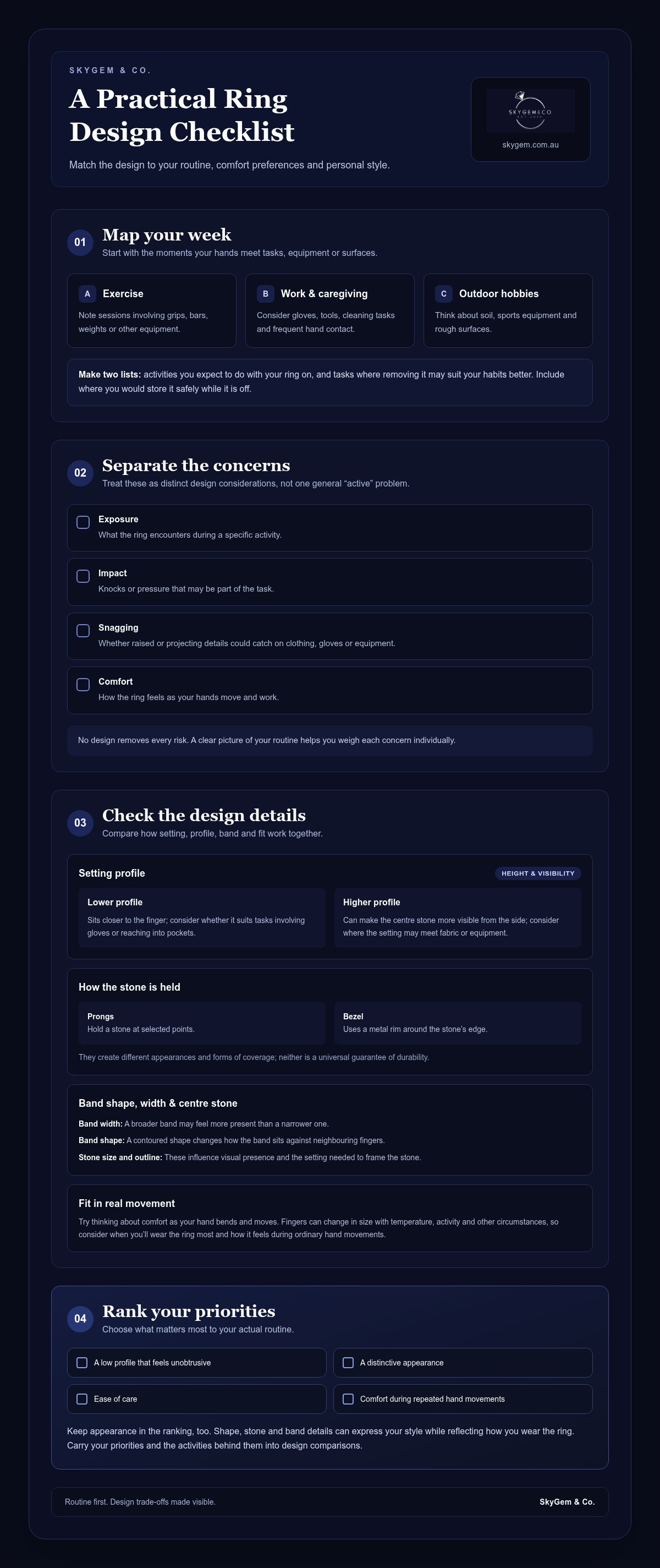
A practical checklist for testing your ring design before choosing
A clear design brief makes it easier to assess whether a ring suits your day-to-day life. Rather than describing yourself simply as active, record the tasks you do, how the ring might interact with them, and what you want it to look and feel like. This turns choosing a practical ring for an active lifestyle into a series of decisions you can discuss and refine.
- List your activities across a typical week. Include work, exercise, caregiving and leisure, noting tasks that involve frequent hand contact, equipment or gloves. Record when you usually wear jewellery and when you tend to remove it. Consider where you’ll store a ring while it’s off, since that habit is part of your routine too.
- Prioritise your practical concerns. Rank preferences such as a low profile, an unobtrusive feel, ease of cleaning or fewer snagging concerns. Be specific: “I wear close-fitting gloves for work” is more useful than “I’m very active.” No design removes every risk, so identify the issues that matter most instead of expecting one ring to suit every task.
- Separate essentials from preferences. Note which requirements affect everyday comfort or use, then list the aesthetic details you’d like to explore. A particular band shape or stone colour may be a strong preference without being essential to your routine. Keeping these categories distinct lets practical needs and personal style inform the design together.
- Compare design directions and review the fit. Use your priorities to consider proportions, setting options and gemstone choices. Pay attention to how the ring feels during ordinary hand movements, not only how it looks when your hand is still. If you know what has felt uncomfortable in another ring, include that experience in your assessment.
A useful checklist turns everyday habits into design requirements while leaving room to refine the details that make the ring yours.
Create a concise design brief from your weekly routine
Summarise your notes in a few clear points: your activities, when you remove jewellery, your main practical priorities and the visual qualities you value. Mark each item as essential or preferred. For example, needing a ring to feel unobtrusive during a repeated task is different from preferring a particular decorative detail. This short brief gives a design discussion a practical starting point.
Use a consultation to assess comfort and construction
In a bespoke consultation, describe how you use your hands and what has felt uncomfortable before. Discuss band proportions, setting options and gemstone choices against your brief, balancing construction with appearance. Resizing and prong tightening are also useful maintenance topics to understand as part of ongoing care. They aren’t guaranteed fixes for every ring or situation.
Turn your active-lifestyle priorities into a bespoke ring design
A bespoke ring can bring practical needs and personal style into the same design process. Your routine, comfort preferences and visual priorities become useful inputs rather than competing demands. At SkyGem & Co., a consultation supports the creation of a unique piece tailored to your preferences and budget, with design and manufacture progressing from initial CAD design through to stone setting.
There isn’t one specification that suits every active routine. Use what you’ve learned about your habits to make considered choices about the ring’s proportions, setting and stone, while keeping its appearance distinctly yours.
What to bring to a bespoke ring discussion
Bring your activity notes and priorities, including tasks involving gloves, repeated hand contact or equipment, and when you prefer to remove jewellery. Share anything that has felt uncomfortable in the past. Specific examples give the design discussion more direction than a broad description of your lifestyle.
Visual references can clarify the details you’re drawn to. Point out what matters most, such as a particular profile, a simple band or a distinctive centre stone. Then discuss how those preferences fit your brief, including stone options and setting approaches. Natural diamonds, lab-grown diamonds and coloured gemstones are different design directions to consider, not automatic recommendations for a particular activity.
Plan for ongoing wear, care and maintenance
Care is part of the design decision, not an afterthought. The way a ring is worn, along with its materials and construction, informs the care it may need. Consider what feels manageable for you: keeping an eye on the ring’s condition, taking it off for selected tasks or arranging maintenance when appropriate. Your habits help shape a realistic plan for long-term wear.
SkyGem & Co. offers jewellery maintenance services including resizing, prong tightening, restoration, cleaning and polishing. These are useful topics to include in a conversation about caring for a ring over time, without assuming one service will suit every design or resolve every concern. Fit and setting can also be considered as part of ongoing care, particularly if your circumstances or wearing habits change.
By weighing comfort and appearance alongside future care, you can make a more complete design decision. If you’re ready to discuss how your routine and preferences could shape a bespoke piece, begin with a personalised design consultation.
Let your next design choice reflect the life you lead
A ring can carry personal meaning while becoming part of the ordinary moments that make up your week. The aim isn’t to make every activity fit around a piece of jewellery or to choose a design based on worry alone. Treat your preferences and habits as useful design information, then make decisions that feel considered rather than restrictive.
As you decide how to choose a practical ring for an active lifestyle, leave room for your needs to change. Work, hobbies and comfort preferences can shift over time, so make a choice you understand: why its details appeal to you, how you expect to wear it and what care feels appropriate. That clarity can make the ring feel personal from the outset and help you wear it with confidence.
Frequently Asked Questions
Can an engagement ring be resized after it has been made?
Often, but whether a ring can be resized depends on its design, construction and materials. The individual piece needs to be assessed before an adjustment is recommended, particularly if it has details around the band or a setting that may affect the work. If the fit feels uncertain while you’re choosing a ring, raise that concern during design discussions so it can inform the original specifications.
Can a jeweller tighten a loose ring setting?
Yes, a jeweller can assess a loose setting and determine whether tightening is appropriate for its condition and construction. SkyGem & Co. offers prong-tightening services. If a stone appears to move, stop wearing the ring and arrange a professional assessment promptly, as movement can put the stone at risk. Don’t try to adjust the setting yourself; pressure applied without the right assessment could cause further problems.
How often should an engagement ring be professionally cleaned?
There’s no single cleaning interval that suits every ring, as wear habits, materials and construction vary. Gentle routine care may help with everyday residue, but the right method depends on the piece. Follow care guidance suited to your ring rather than using an unfamiliar cleaning product or technique. If a stone, setting or band looks different from usual, have the ring assessed instead of relying on cleaning alone.
Can I use hand sanitiser while wearing an engagement ring?
It depends on the sanitiser’s ingredients and the ring’s materials, so don’t assume every combination is harmless. Product residue can collect around a setting, and some substances may affect particular materials or finishes. Follow care advice for your specific ring and pay attention to how it responds. If product guidance recommends removing jewellery, or you notice a change, remove the ring and follow its recommended care instructions.
Can a ring be made around a gemstone I already own?
A bespoke design discussion can consider a gemstone you already own, including its condition and how it might sit in a new ring. Bring any information you have about the stone, such as its identity or a previous assessment, and explain the appearance you want. The setting and construction should be considered in relation to that particular stone, its characteristics and how you expect to wear the finished piece.
What should I do if my ring feels uncomfortable during the day?
Note when the discomfort starts and whether it occurs during a particular task, after activity or at a certain time of day. Don’t force a ring over a swollen finger or ignore persistent discomfort. Fit and design can both affect how a ring feels. SkyGem & Co. offers resizing, although suitable options depend on the individual ring. An assessment can help identify whether fit or another design feature is contributing.
Does an active lifestyle mean I should avoid a gemstone engagement ring?
No, an active lifestyle doesn’t automatically rule out a gemstone ring. The decision depends on the individual stone’s characteristics, the ring’s construction and the activities involved. There isn’t one gemstone recommendation for every routine. If you’re considering how to choose a practical ring for an active lifestyle, discuss how you wear jewellery and what matters visually, then weigh those preferences against the qualities of the specific stone.
Disclaimer
This article is for general informational purposes only and may include AI-assisted content. Pricing, specifications, and availability are subject to change. For accurate advice and current information, please contact SkyGem & Co. directly. Nothing in this content constitutes professional or financial advice.