
How to Choose a Diamond Shape: The Technical and Aesthetic Guide

Selecting a diamond silhouette is more than a simple aesthetic preference; it is a structural engineering decision that defines the architecture of the entire jewellery piece. It's common to feel a sense of hesitation when faced with the technical distinctions between 'cut' and 'shape', or to worry that a specific geometry might not complement your hand anatomy. Understanding how to choose a diamond shape requires a focus on both visual impact and long-term structural integrity.
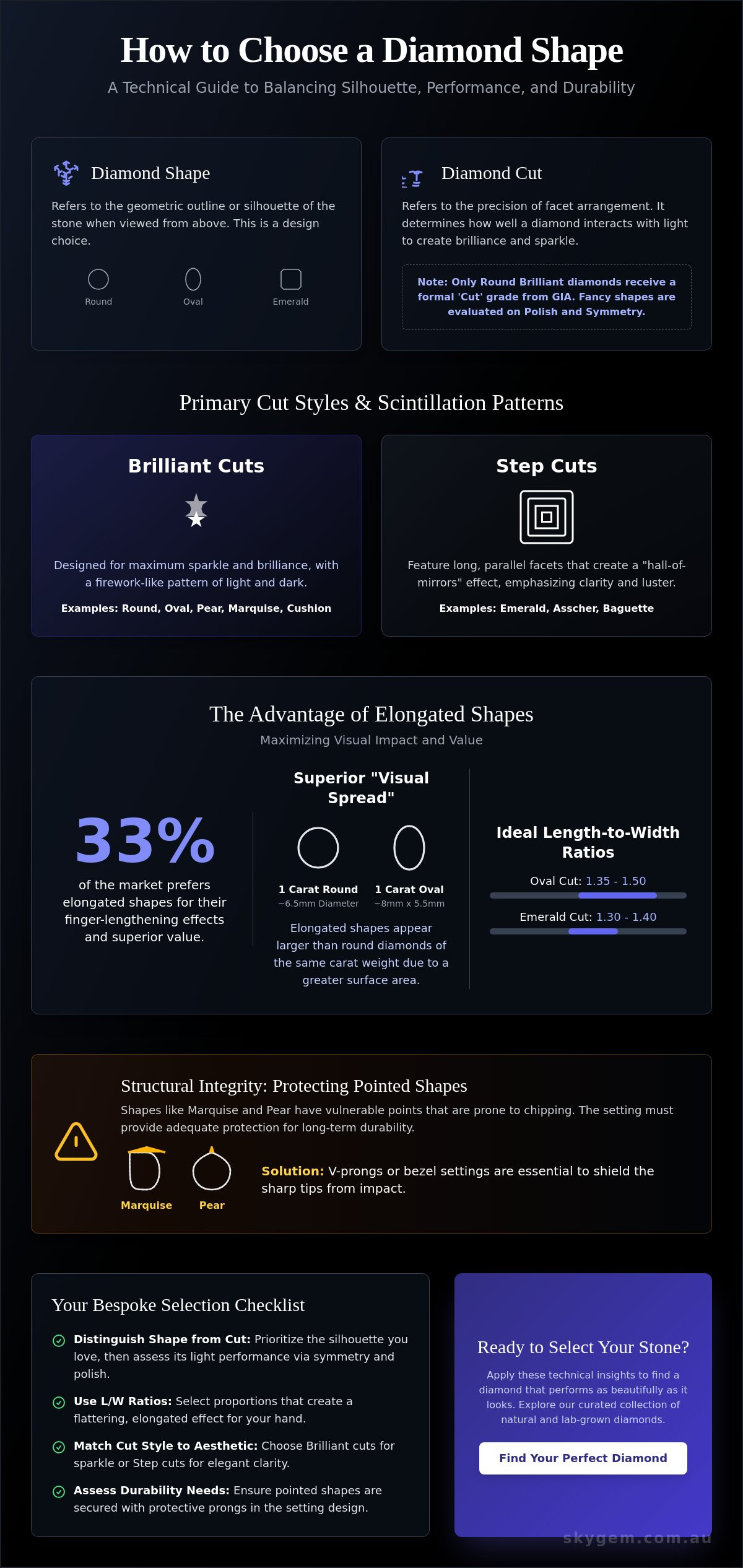
This guide provides the technical clarity you need by balancing performance metrics with bespoke design principles. You'll master the nuances of length-to-width ratios to ensure your selection remains secure and proportionate within its setting. We will examine the durability requirements of pointed shapes like the marquise and pear, while reviewing why elongated silhouettes currently dominate up to 33% of the market for their finger-lengthening effects and superior value. By the end of this analysis, you'll have the confidence to select a stone that serves as a permanent and high-performing asset for your project.
Key Takeaways
- Distinguish between a diamond's geometric silhouette and its technical cut grade to ensure optimal light performance and symmetry in your final design.
- Utilise length-to-width ratios as a quantitative metric to select a shape that provides a flattering, elongated effect for your hand anatomy.
- Evaluate the unique scintillation patterns of Brilliant and Step cuts to match the stone's visual performance with your preferred aesthetic.
- Assess the structural requirements of pointed silhouettes to determine the necessary prong configurations for long-term durability in a bespoke setting.
- Gain expert insights on how to choose a diamond shape that balances technical specifications with your project's budgetary and design requirements.
Diamond Shape vs. Cut Quality: Establishing the Technical Foundation
The first step in understanding how to choose a diamond shape involves distinguishing between the silhouette of the stone and its technical cut quality. While these terms are frequently used interchangeably, they represent two distinct variables in gemological engineering. The shape refers exclusively to the geometric outline of the diamond when viewed from above, such as a round, oval, or emerald silhouette. In contrast, the 'cut' refers to the precision of the facet arrangement and how effectively those facets interact with light to produce brilliance, fire, and scintillation.
Establishing this technical foundation is essential because it dictates the grading standards you'll encounter during your search. For instance, the GIA provides a formal 'Cut' grade exclusively for round brilliant diamonds. Fancy shapes, which include all non-round geometries, do not receive a standard cut grade on a laboratory report. Instead, their quality is assessed through individual metrics like symmetry and polish. Understanding these Diamond gemstone characteristics allows you to evaluate a stone's performance beyond a simple certificate. This is particularly relevant when navigating the nuances of elongated shapes, where the 'bow-tie effect'—a dark, bow-shaped shadow across the centre of the stone—can occur if the facets are not aligned with high precision.
The Geometry of the Silhouette
The choice between a round brilliant and a fancy shape often begins with the rough crystal's natural state. Diamond cutters select a silhouette based on the original growth pattern of the rough stone to maximise carat weight retention and minimize waste. While round diamonds are the industry standard for light return, fancy shapes offer unique visual advantages. An elongated silhouette, such as a marquise or pear, often appears larger than a round stone of the same carat weight due to its greater surface area. This perception of scale is a primary driver in the selection process for bespoke engagement rings, where the stone's footprint must balance with the wearer's hand anatomy.
Why Cut Quality Still Matters for Fancy Shapes
Because fancy shapes lack a unified cut grade, evaluating their performance requires a more granular approach. Symmetry and polish become the primary indicators of craftsmanship. You should look for stones where the facets are crisp and well-defined. 'Mushy' or blurred facets indicate poor cutting precision, which leads to a dull appearance regardless of the diamond's colour or clarity. Whether you are browsing Natural GIA Certified Diamonds or Lab-Grown Diamonds, the technical execution of the shape remains the most critical factor in its long-term visual success and brilliance.
Evaluating Proportions: Ratios and Finger Anatomy
Determining how to choose a diamond shape is often a matter of balancing structural dimensions against the wearer's physical traits. While carat weight measures mass, the Length-to-Width (L/W) ratio measures the visual footprint. A diamond's L/W ratio determines its aesthetic balance and how it occupies the finger's surface area. This calculation is the most reliable way to predict how a stone will appear once set in a bespoke ring design. By understanding these proportions, you can ensure the diamond complements the hand's natural geometry rather than working against it.
The concept of 'visual spread' explains why a 1-carat oval often appears significantly larger than a 1-carat round brilliant. Because elongated shapes distribute their mass across a wider surface area, they offer a superior face-up size for the same investment. This efficiency makes shapes like the oval, emerald, and pear particularly attractive for those who prioritising a commanding presence. When planning a custom-made engagement ring in Melbourne, these technical ratios serve as the blueprint for your stone selection.
Mastering Length-to-Width Ratios
For an Oval cut, a ratio between 1.35 and 1.50 is typically considered the industry standard for balanced proportions. Emerald cuts generally perform best between 1.30 and 1.40 to maintain their classic rectangular silhouette. Ratios falling outside these ranges can affect light performance; a stone that is too 'skinny' may suffer from excessive light leakage, while a 'fat' ratio might fail to provide the desired lengthening effect. Identifying your preference between classic and modern elongated proportions is a critical step in the technical consultation process.
Matching Shapes to Hand Proportions
Matching a diamond's geometry to hand anatomy is a core component of user-focused design. Individuals with shorter fingers often benefit from elongated cuts like the Marquise or Pear, which create vertical lines that slim the hand. Conversely, those with wider fingers may find that an Oval or Radiant cut provides better coverage across the finger's width. For petite hands, the goal is to maintain a sense of scale, ensuring the stone complements rather than overwhelms the finger. This methodical approach to selection ensures the final piece achieves a harmonious balance between the stone and the wearer.
The Three Primary Diamond Shape Categories
Categorising diamonds by their faceting style is a critical step in determining how to choose a diamond shape that aligns with your performance expectations. While the previous section focused on external silhouettes and proportions, this technical analysis examines the internal architecture of the stone. Diamond shapes are broadly classified into three families: Brilliant, Step, and Mixed cuts. Each category utilises a specific facet arrangement to manipulate light, which directly impacts the stone's scintillation pattern and its ability to mask internal characteristics like inclusions or body colour.
Brilliant Cuts: Maximising Scintillation
The Brilliant family includes the Round, Oval, Pear, and Marquise. These shapes are engineered with triangular and kite-shaped facets that radiate from the centre toward the girdle. This arrangement is specifically designed to maximise light return and scintillation. Because of this high-intensity light play, Brilliant cuts are exceptionally efficient at hiding inclusions and masking body colour. The Round Brilliant remains the gold standard for light performance, but Ovals have emerged as a preferred modern alternative for those seeking a similar sparkle with a more elongated footprint. Whether selecting Natural GIA Certified Diamonds or lab-grown options, the Brilliant cut offers the most forgiving technical profile for buyers.
Step Cuts: Elegance and Clarity
Emerald and Asscher cuts belong to the Step cut family, characterised by long, parallel facets that resemble a staircase. Unlike the 'crushed ice' scintillation of Brilliant cuts, Step cuts produce a 'large flash' effect known as the 'Hall of Mirrors'. This architectural style prioritises transparency over sparkle. Consequently, clarity is paramount; we typically recommend a minimum of VS2 clarity for these shapes, as the large, open table doesn't hide inclusions. Step cuts offer a sophisticated, understated aesthetic that emphasises the crystalline purity of the material.
Mixed and Modern Cuts
Mixed cuts, such as the Cushion and Radiant, represent a hybrid approach to gem design. They combine the silhouette of a Step cut with the faceting patterns of a Brilliant cut. The Radiant cut, for example, features the rectangular outline of an Emerald cut but with 70 facets designed for maximum brilliance. A technical advantage of the Radiant cut is its cropped corners, which significantly improve durability by removing vulnerable sharp points. Cushion cuts act as a bridge between vintage aesthetics and modern light performance, offering a softer, pillowy silhouette that remains a staple in custom-made engagement ring designs.
Structural Integrity and Setting Compatibility
Structural integrity is a primary consideration when determining how to choose a diamond shape for a ring intended for daily wear. While aesthetic appeal often drives the initial selection, the physical properties of each silhouette dictate the engineering requirements of the setting. A diamond's shape directly influences its vulnerability to mechanical stress, particularly at the edges and points. Selecting a shape that aligns with your lifestyle ensures the long-term security of the asset without compromising the visual design of the piece.
The relationship between diamond depth and the final height of the ring setting is another technical factor to evaluate. Shapes with greater depth, such as certain Cushion or Princess cuts, require a higher setting to accommodate the stone's pavilion. This increases the ring's profile, which may affect its practicality for those with active professions. Pointed shapes like Pear and Marquise require V-prongs to protect the vulnerable tips from mechanical stress. These specialised prongs act as a protective buffer, ensuring that the thinnest parts of the stone aren't exposed to direct impact during wear.
Protecting Vulnerable Points
The necessity of V-prongs extends to Princess, Pear, and Marquise cuts, where sharp corners are prone to chipping if left exposed. In contrast, rounded silhouettes like Round, Oval, and Cushion shapes offer superior everyday durability because they lack high-stress focal points. For those who prefer rectangular outlines but prioritise resilience, the Radiant and Emerald cuts provide an ideal solution. Their corner-cropping enhances structural integrity by removing the sharpest points, making them more resistant to edge-wear than a traditional Princess cut. This technical modification allows for a sophisticated rectangular aesthetic with reduced risk of damage.
Shape and Setting Styles
The chosen silhouette defines the architecture of the entire ring. Solitaire Engagement Rings are designed to highlight a shape's pure silhouette, making symmetry and proportion critical. Alternatively, Halo settings can be utilised to square off a rounded stone or soften the edges of a sharper geometry, providing both visual enhancement and additional physical protection. When designing Bespoke Engagement Rings Melbourne, mixing different shapes requires a methodical approach to ensure the prongs and rails provide uniform security across all stones. To ensure your selected shape is housed in a secure and durable mounting, you should consult with our technical specialists on your custom setting.
The Bespoke Selection Process for Natural and Lab Diamonds
The final phase of the acquisition journey involves reconciling technical preferences with material availability. Deciding how to choose a diamond shape often leads to a direct comparison between Natural GIA Certified Diamonds and Lab-Grown Diamonds. While the optical performance and physical properties remain identical across both origins, the market availability of specific ratios can vary. A natural stone may offer a unique character shaped by geological history, whereas lab-grown diamonds frequently provide access to larger carat weights and more precise elongated ratios within a controlled budget. Both options serve as high-performing assets when selected through a rigorous technical lens.
SkyGem & Co. facilitates this decision through technical consultations that bridge the gap between a digital certificate and a physical stone. It's essential to view loose stones before they are secured in a mount. This allows for an unobstructed evaluation of the stone's light return and any potential bow-tie effects that a laboratory report cannot fully capture. Once the primary stone is selected, the project transitions into the CAD design phase. Here, the shape's exact dimensions are integrated into a digital model, ensuring the bespoke ring is engineered specifically for that individual stone's geometry.
Comparing Material Options
The origin of the diamond does not influence the technical requirements of the silhouette selection. Both natural and lab-grown stones are cut to the same rigorous geometric standards. You can explore these silhouettes using the SkyGem & Co. Ringbuilder, which serves as a practical tool for visualising how different shapes occupy a digital setting. Certification remains a non-negotiable standard in our process. GIA or IGI reports provide the verified data on symmetry and polish necessary to confirm the technical execution of the shape before it reaches our workshop.
The Value of Expert Consultation
While a certificate provides quantitative data, a technical specialist evaluates the stone's 'personality' and visual performance. This is particularly critical for Engagement Rings, where the stone must maintain consistent brilliance across various lighting environments. Our curated selection process involves filtering through thousands of available stones to present only those that meet our internal performance metrics. This methodical approach ensures that moving from shape selection to a finished, hand-crafted piece is a seamless transition grounded in technical precision and long-term viability.
Engineering Your Ideal Silhouette
Mastering how to choose a diamond shape involves a synthesis of geometric precision and personal style. By prioritising technical metrics like length-to-width ratios and understanding the specific durability requirements of different faceting styles, you ensure your selection is both visually striking and structurally sound. We've examined how the architecture of a stone defines the setting's engineering, from V-prongs for pointed tips to the light return efficiency of modern brilliant cuts. This methodical approach transforms a simple purchase into a calculated investment in a permanent asset.
At SkyGem & Co., our expert GIA-trained consultants act as your technical partners throughout this journey. We specialise in both natural and lab-grown diamonds, providing a curated selection process that prioritises long-term structural integrity and user-focused design. By viewing loose stones and utilising digital modelling, we bridge the gap between technical data and lived environments. We invite you to start your bespoke journey with a diamond consultation at SkyGem & Co. and experience a professional approach to fine jewellery design. Selecting the perfect stone is a significant milestone, and we're dedicated to ensuring your project achieves lasting success.
Frequently Asked Questions
Which diamond shape looks the largest for its carat weight?
The Marquise, Pear, and Oval shapes offer the largest face-up appearance for their carat weight. These silhouettes distribute their mass across a greater surface area compared to deeper shapes like the Round Brilliant or Cushion. By prioritising a higher length-to-width ratio, you can achieve a more commanding visual presence on the finger. This efficiency allows you to maximise the stone's footprint without necessarily increasing the total mass or budget of the project.
Is the Round Brilliant really the most sparkly diamond shape?
The Round Brilliant is engineered to provide the highest level of light return and scintillation. Its 58-facet arrangement is mathematically optimised to reflect light back through the table, creating the intense sparkle known as brilliance. While fancy shapes like the Oval or Radiant are designed to mimic this effect, the symmetry of a round stone remains the technical standard for light performance. It's the most effective choice for those prioritising maximum fire and brilliance.
Do certain diamond shapes cost more than others?
Round Brilliant diamonds typically carry a higher price per carat than fancy shapes. This price premium is due to the significant amount of rough diamond lost during the cutting process and the high global demand for this silhouette. Fancy shapes like Emerald, Cushion, and Princess cuts utilise more of the original rough crystal, resulting in lower manufacturing costs. Understanding these market dynamics is essential when determining how to choose a diamond shape that fits your financial parameters.
What is the best diamond shape for someone with short fingers?
Elongated diamond shapes like the Oval, Pear, and Marquise are the most flattering options for shorter fingers. These silhouettes create strong vertical lines that visually extend the length of the hand, providing a slimming effect. Choosing a stone with a higher length-to-width ratio enhances this lengthening perception. This design strategy ensures the ring remains proportionate to the wearer's hand anatomy while providing a sophisticated and elegant aesthetic.
Are Princess cut diamonds more likely to chip than Round diamonds?
Princess cut diamonds are more susceptible to chipping than Round diamonds due to their sharp, 90-degree corners. These points represent structural vulnerabilities where mechanical stress is most concentrated during daily wear. Round diamonds lack these high-risk focal points, offering superior long-term durability. If you select a Princess cut, it's critical to use a protective setting, such as V-prongs, to shield the corners from accidental impact and ensure the stone's integrity.
What diamond shape is currently the most popular for engagement rings?
While the Round Brilliant remains the most popular choice globally, the Oval cut has seen a significant rise in demand, now holding approximately 25-33% of the market share. This shift is driven by the desire for the sparkle of a brilliant cut combined with the finger-lengthening benefits of an elongated shape. Other silhouettes like the Emerald and Radiant cuts maintain steady popularity for their architectural appeal, reflecting a broader trend toward personalised bespoke designs.
How do I choose between an Oval and a Cushion cut?
Choosing between an Oval and a Cushion cut depends on whether you prioritise elongation or a vintage aesthetic. Ovals offer a modern, slimming effect and a larger face-up appearance for their weight. Cushion cuts provide a softer, pillowy silhouette with rounded corners, often leaning toward a classic or romantic feel. Both are brilliant-style cuts, but their impact on hand anatomy differs significantly. Your decision should align with the overall architectural goals of your bespoke project.
Can any diamond shape be used in a halo setting?
Any diamond shape can be successfully integrated into a halo setting, provided the mount is custom-engineered to the stone's specific dimensions. A well-designed halo follows the exact silhouette of the centre stone, whether it's a sharp Princess cut or a soft Oval. This setting style not only enhances the stone's visual scale but also provides an additional layer of physical protection for the girdle. It's a versatile design choice for both natural and lab-grown stones.