
How Long Does It Take to Make a Custom Ring? A 2026 Bespoke Timeline Guide

The most significant risk to a perfectly planned proposal isn't the weather or the venue, but the technical lead time required for a high-calibre bespoke ring. While the convenience of retail is tempting, a truly unique piece demands a methodical approach to engineering and craftsmanship. Many clients find themselves asking, how long does it take to make a custom ring? The answer typically spans 4 to 12 weeks, a duration that reflects the intersection of precise CAD modelling and meticulous gemstone procurement.
Explore More: Red Gemstones
We understand the pressure of a fixed deadline and the confusion that arises when comparing bespoke timelines to off-the-shelf options. This guide provides a transparent, data-driven breakdown of the 2026 bespoke timeline, ensuring you can plan your milestone with total confidence. You'll discover the specific phases of the design process, from the initial consultation to the final setting of an Australian sapphire or lab-grown diamond. We also provide professional insights on how to navigate the sourcing of rare materials and identify opportunities to expedite the technical design phase without sacrificing long-term structural integrity.
Key Takeaways
- Understand the standard 4 to 12-week window required for high-quality bespoke commissions and how design complexity directly influences the final delivery date.
- Discover how long does it take to make a custom ring by examining the technical CAD modelling phase, which serves as the precision blueprint for your unique design.
- Learn how sourcing rare GIA-certified diamonds or Australian sapphires impacts your project schedule and why global procurement requires advanced planning.
- Gain insight into the manufacturing process, from casting to the delicate art of hand-finishing, to ensure both structural longevity and aesthetic excellence.
- Identify critical proposal planning strategies, including the recommended two-week buffer to account for seasonal demand and holiday closures.
The Standard Timeline for Custom Jewellery Creation
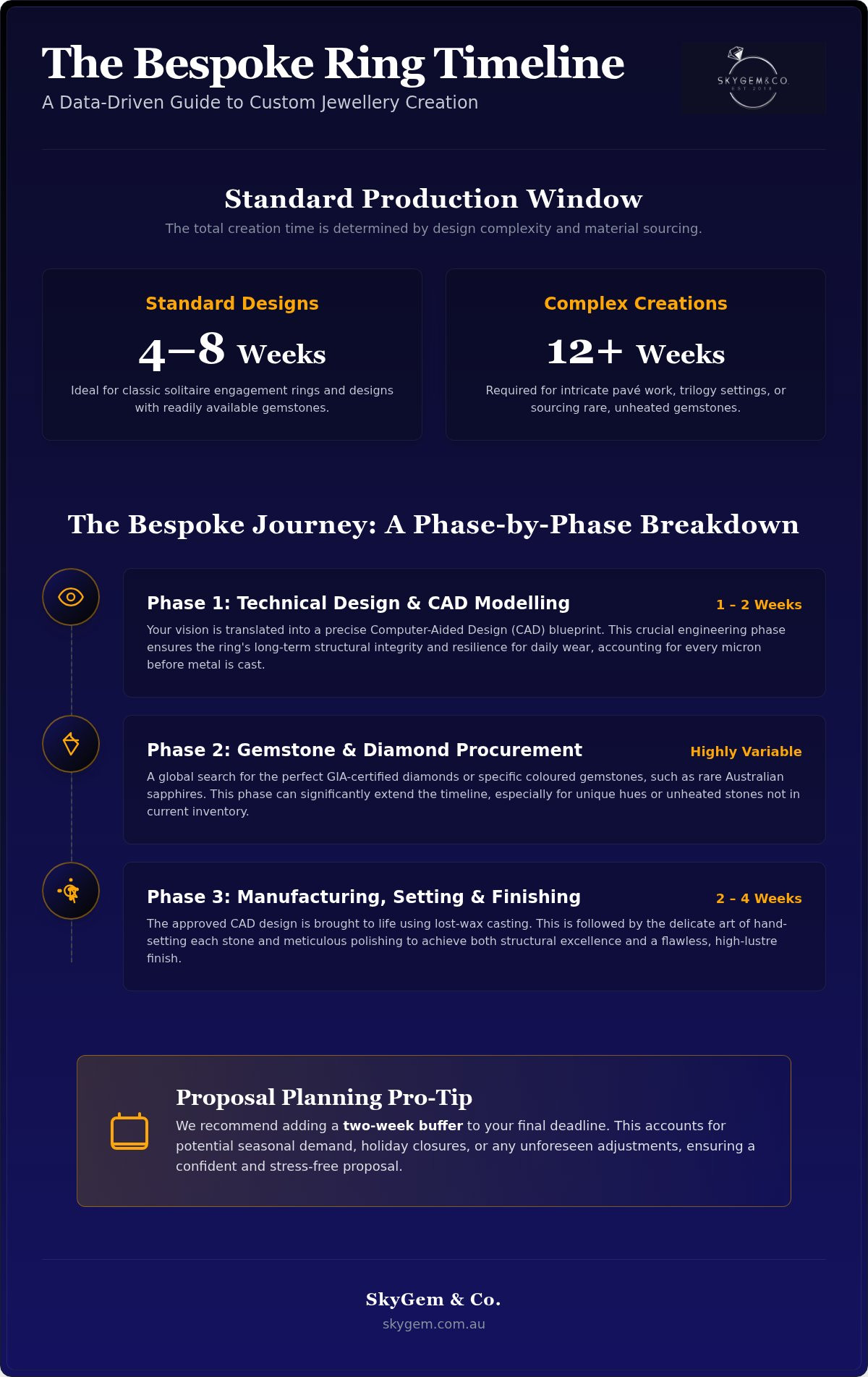
The production of a high-calibre bespoke ring is a methodical engineering project rather than a simple retail transaction. While many clients initially ask how long does it take to make a custom ring with the hope of a fortnight turnaround, the reality of world-class craftsmanship requires a more deliberate schedule. For a standard high-quality bespoke commission, you should anticipate a timeline of 4 to 8 weeks. This window ensures that every technical specification, from the structural integrity of the gallery to the precision of the stone setting, meets rigorous professional standards.
The duration of your project is primarily dictated by the complexity of the design and the availability of materials. A classic solitaire engagement ring, which focuses on a single central stone and a clean band, can often be completed toward the shorter end of the spectrum. In contrast, complex trilogy settings or rings featuring intricate pavé work require additional hours of bench time and more intensive quality control phases. When a design involves rare, unheated gemstones or specific Australian sapphire hues that aren't currently in inventory, the procurement phase alone can extend the total timeline to 12 weeks or more.
Why Custom Rings Require a Multi-Phase Approach
A reliable bespoke timeline is built upon a structured four-phase workflow. This methodology ensures that the final product is not only aesthetically superior but also built for long-term durability. The process includes:
- Phase 1: Technical Consultation. We translate your aesthetic vision into viable engineering specifications, discussing metal choice and setting styles.
- Phase 2: Gemstone Procurement. This involves a global search for GIA-certified diamonds or specific coloured stones that meet your performance metrics.
- Phase 3: CAD Design and Approval. Computer-Aided Design (CAD) creates a precise digital blueprint, allowing for exact measurements before any metal is cast.
- Phase 4: Manufacturing and Finishing. This final stage utilizes the lost-wax casting process to create the physical form, followed by expert stone setting and hand-polishing.
Bespoke vs. Ready-to-Wear: Choosing Your Path
Understanding the distinction between bespoke and ready-to-wear is essential for effective proposal planning. If your timeline is restricted by an imminent date, our ready-to-wear collections provide immediate access to finished pieces that maintain our high standards of design and material quality. These are ideal for those who find a perfect match within existing inventory.
However, a bespoke commission offers a "one-of-one" creation that carries significant sentimental value. You should choose the custom path when you require a specific combination of assets, such as a teal sapphire paired with a unique halo configuration, that cannot be found in a standard collection. The additional time invested in the custom process results in a permanent asset tailored specifically to the wearer's lifestyle and aesthetic preferences.
Phase 1: Technical Design and CAD Modelling
The transition from a conceptual vision to a physical asset begins with a rigorous technical consultation. This stage is where aesthetic desires meet the realities of structural engineering. When clients ask how long does it take to make a custom ring, they're often surprised to learn that the design phase alone typically requires 1 to 2 weeks. This timeframe allows our technical consultants to translate your preferences into a precise digital architecture, ensuring that the final piece is both beautiful and resilient enough for daily wear.
Computer-Aided Design (CAD) serves as the indispensable blueprint for modern precision jewellery. Unlike traditional hand-sketching, CAD allows for exact volumetric calculations of metal and the precise spacing of stones. This level of detail is a hallmark of high-end bespoke private commissions, where every micron of the setting is accounted for before manufacturing begins. Rushing through this stage is a common mistake; skipping the necessary technical scrutiny often leads to long-term structural issues, such as prongs that are too thin to secure a diamond or a band that lacks the density to resist warping.
The design process is rarely linear. It involves an iteration loop where you'll review digital models and provide feedback. Most projects undergo one to three rounds of technical revisions. This collaborative environment ensures that the proportions are perfectly balanced, particularly when integrating specific stone shapes like an elongated Oval or a deep Emerald cut. If you're ready to begin this collaborative journey, you can explore our approach to a custom made engagement ring in Melbourne to see how we balance design with durability.
Visualising the Final Piece with 3D Rendering
3D rendering provides a photorealistic preview of your ring from every conceivable angle. This technology is vital for adjusting proportions to suit different gemstone geometries. For instance, a Trilogy Engagement Ring requires careful alignment of the side stones to ensure a seamless flow across the finger. Our technical consultants use these renders to advise on metal durability, ensuring your choice of setting style doesn't compromise the safety of your Australian sapphire or lab-grown diamond.
Finalising the Design Specification
Before moving to production, you must lock in the final design specifications. This includes selecting your primary metal, typically choosing between the density of Platinum or the classic appeal of 18K Gold. You'll also approve the specific setting style, whether it's a Solitaire, Halo, or complex multi-stone arrangement. Once these specifications are signed off, the project reaches the point of no return in the manufacturing timeline, as the digital file is prepared for the casting process.
Phase 2: Sourcing Rare Diamonds and Gemstones
While the design phase establishes the technical blueprint, the procurement of central assets is often the most variable component of the project schedule. When evaluating how long does it take to make a custom ring, you must account for the logistical realities of the global gemstone market. Sourcing a specific GIA-certified diamond or a rare coloured gemstone involves a rigorous vetting process that ensures the material meets both aesthetic and structural performance metrics. This phase can range from a few days for common specifications to several weeks for rare, high-demand assets.
The requirement for GIA certification adds a necessary layer of quality assurance. This verification process, often discussed in professional training such as the Jewelry Design & Technology diploma program, ensures that the stone's physical properties are accurately documented. For natural stones, this might involve coordinating with international suppliers in Antwerp, Mumbai, or New York, which naturally extends the procurement timeline due to customs and secure transit protocols. We act as your technical consultant during this phase, filtering out stones that don't meet our internal standards for brilliance and durability.
Procuring Natural and Lab-Grown Diamonds
The availability of diamonds fluctuates based on current market inventory and specific "4C" requirements. Locating high-clarity natural white diamonds with specific cut grades can take 5 to 10 business days if the stone is held in an overseas vault. Conversely, the timeline for lab-grown white diamonds is often more predictable, though sourcing rare "fancy" colours or exceptionally large carats can still introduce delays. If you require a very specific combination of colour and clarity, we recommend allowing an additional week for our technical team to secure the best possible asset for your design.
The Sourcing Timeline for Coloured Gemstones
Coloured gemstones present a unique set of challenges compared to diamonds. Finding the perfect hue in Australian sapphires, particularly the highly sought-after teal and parti varieties, requires a discerning eye and established relationships with local miners. The rarity factor is even more pronounced when seeking unheated rubies or emeralds, where the absence of thermal treatment makes high-quality specimens significantly harder to locate. If you're designing a Trilogy Engagement Ring, the procurement time increases because we must find three stones that match perfectly in hue, saturation, and tone. This matching process can add up to two weeks to the standard timeline but is essential for the visual cohesion of the final piece.
Phase 3: Manufacturing, Setting, and Hand-Finishing
Once the digital blueprint is finalised and the assets are secured, the project enters the physical manufacturing phase. This is the stage where abstract concepts become tangible assets through a combination of advanced technology and traditional bench skills. When evaluating how long does it take to make a custom ring, the workshop phase typically accounts for 2 to 4 weeks of the total schedule. This duration is necessary to accommodate the precise casting process, meticulous stone setting, and multi-stage hand-finishing that characterises a premium bespoke piece.
The transition from CAD to physical form begins with high-resolution 3D printing of the wax model, followed by casting in your chosen precious metal. Unlike mass-produced jewellery, which often relies on high-volume machinery and generic moulds, bespoke manufacturing prioritises the structural integrity of each individual component. A master jeweller then performs the delicate task of stone setting. This process involves securing your GIA-certified diamond or Australian sapphire with absolute precision, ensuring that prongs are perfectly aligned and the stone is seated at the optimal height for light performance. Before the ring is cleared for presentation, it undergoes a final quality control inspection against the original technical specifications to ensure every micron of the design is executed correctly.
The Precision of the Setting Process
The setting process is a critical engineering step designed to protect your investment. A master setter must account for the specific physical properties of the metal; for instance, setting in platinum requires more force and technical skill than 18K yellow gold due to the metal's superior density and "memory." Every prong undergoes rigorous safety checks and manual tightening to ensure the central stone is entirely immobile. This level of technical scrutiny is what differentiates a world-class commission from a standard retail product, providing the long-term viability required for a permanent asset.
Professional Polishing and Final Refinement
The final stage involves a multi-stage polishing process that achieves a mirror-like lustre. We use varying grades of abrasive compounds to refine the surface, a task that requires a steady hand and significant time to avoid rounding off the sharp, clean lines established in the CAD design. After the final polish, the ring is measured against the original digital file to confirm total accuracy. This phase also includes the preparation of official valuation documents and the final presentation packaging. To see the results of this meticulous craftsmanship, you can browse our bespoke engagement rings and observe the technical precision in every setting.
Planning Your Proposal: Timing Tips for Bespoke Commissions
Success in a bespoke project is as much about logistical planning as it is about technical execution. While the technical phases usually conclude within 8 to 12 weeks, we strongly advise clients to establish a "Proposal Buffer" of at least 14 days. This window mitigates the impact of unforeseen courier delays or minor final adjustments. When calculating how long does it take to make a custom ring, you must view the delivery date not as the proposal date, but as the baseline for your final inspection. Having the ring in your possession two weeks early provides the peace of mind necessary to focus on the emotional significance of the event.
Seasonal demand significantly influences the global jewellery supply chain. During peak periods such as the lead-up to Christmas, Valentine’s Day, or the mid-year holiday season, workshop capacity and gemstone transit times can increase. Many international diamond vaults and local casting facilities observe holiday closures, which can add 10 to 15 business days to a standard schedule. Planning with a 3-month lead time is the most reliable way to navigate these seasonal fluctuations without compromising on the complexity of your design or the rarity of your chosen assets.
Managing the timeline while maintaining secrecy requires a structured approach. We act as your technical partner, providing updates via secure channels that suit your privacy needs. By establishing clear communication parameters early, you can manage the procurement of assets and the approval of CAD designs without alerting your partner. This ensures the final reveal remains a complete surprise while you remain fully informed of the project's progress through every technical milestone.
Communication is the Key to Efficiency
The most effective way to compress your timeline is to enter the process with defined parameters. Having a clear budget and a preference for specific assets, such as a Teal Sapphire or a Lab-Grown Diamond, allows us to bypass the general exploration phase. Working with a bespoke engagement ring specialist ensures that your technical questions are answered immediately, preventing the delays caused by misaligned expectations. Prompt feedback on CAD renderings is particularly vital; a 24-hour response time on design iterations can save up to two weeks on the total production cycle.
Next Steps: Starting Your Custom Journey
To secure your place in our production schedule, we recommend booking a technical consultation to establish your specific project timeline. This initial meeting allows us to assess the rarity of your desired gemstones and the complexity of your setting. You can begin by reviewing various engagement ring styles for inspiration, which helps narrow down the engineering requirements for your piece. If you are planning a proposal for a date 2 to 3 months away, the optimal time to begin the design phase is today to ensure every technical detail is executed to our rigorous standards.
Securing Your Timeline for a Flawless Proposal
Creating a bespoke ring is a technical partnership that balances your aesthetic vision with rigorous structural precision. By understanding the multi-phase approach, from the initial CAD modelling to the final hand-finishing, you ensure that your milestone is supported by a permanent, high-quality asset. When evaluating how long does it take to make a custom ring, it's essential to remember that the 4 to 12-week window is a direct reflection of the care required to source GIA-certified diamonds and rare Australian sapphires.
Planning with a clear buffer allows you to navigate seasonal demand and procurement variables with quiet confidence. Our role as your technical consultant is to ensure every micron of your design meets professional performance standards while respecting your specific proposal deadline. This methodical approach eliminates the stress of uncertainty, replacing it with the reliability of expert craftsmanship and logical project management.
Begin your bespoke journey with a technical consultation at SkyGem & Co. to leverage our specialised expertise in Australian sapphires, GIA-certified diamonds, and precision CAD design. Your commitment to this thorough process will result in a unique creation that is as resilient as it is beautiful.
Frequently Asked Questions
Can I get a custom engagement ring made in less than two weeks?
A high-calibre bespoke ring cannot be responsibly completed in less than two weeks. The technical requirements of CAD modelling, casting, and hand-finishing demand a structured timeline to ensure long-term durability. While ready-to-wear options are available for immediate needs, a true custom commission requires 4 to 12 weeks to meet professional engineering standards and rigorous quality control protocols.
Does a lab-grown diamond ring take less time to make than a natural one?
The manufacturing duration remains identical regardless of whether you choose a lab-grown or natural GIA-certified diamond. The technical crafting phases, including the setting of the stone and final polishing, are based on the design complexity rather than the origin of the diamond. However, common lab-grown specifications are often held in local inventory, which can marginally reduce the initial procurement phase compared to rare natural stones.
What happens if I need the ring resized after it is custom-made?
Resizing a bespoke ring is a standard procedure, though the complexity varies by the specific setting style. Simple solitaire rings are easily adjusted, while intricate halo or pavé bands require more technical care to maintain stone security. We address sizing during the initial technical consultation to minimise the need for post-production alterations, ensuring the structural integrity of the band remains intact from the outset.
Will choosing a rare gemstone like an Alexandrite delay my order?
Sourcing rare assets like Alexandrite or unheated rubies will likely extend your project timeline. These gemstones aren't as readily available as standard diamonds and often require a global search to find a specimen that meets specific colour and clarity metrics. When asking how long does it take to make a custom ring with rare stones, you should account for an additional 2 to 4 weeks for procurement.
How much time should I allow for the CAD design phase specifically?
You should allocate 1 to 2 weeks for the technical design and CAD modelling phase. This period allows our consultants to translate your vision into a precise digital blueprint and accommodates the necessary iteration loops for your feedback. Prompt responses to design renders can help keep this phase toward the shorter end of the estimate, ensuring the project moves swiftly into the physical manufacturing stage.
Does the type of metal (Platinum vs. Gold) affect the manufacturing speed?
The choice of metal has a negligible impact on the overall schedule, though platinum requires more intensive bench work. Because platinum is denser and more abrasive than 18K gold, the finishing and polishing stages demand specialised tools and additional time. This technical requirement is factored into our standard production window and rarely causes a significant delay on its own when compared to the design phase.
Is the timeline longer for a halo engagement ring compared to a solitaire?
A halo engagement ring typically requires more time than a solitaire due to the increased complexity of the setting. The inclusion of multiple small stones necessitates additional hours for precise hand-setting and rigorous quality control checks. When calculating how long does it take to make a custom ring, expect a halo or intricate trilogy design to sit at the longer end of the 8 to 12-week production spectrum.
What if I have my own stone—does that speed up the process?
Providing your own stone can reduce the total timeline by eliminating the procurement phase entirely. While we don't need to source the asset, the technical design, CAD modelling, and physical manufacturing phases remain unchanged. We still require the stone's exact dimensions and a physical inspection to ensure the custom mount is engineered to provide maximum security and light performance for that specific gemstone.
Disclaimer
This article is for general informational purposes only and may include AI-assisted content. Pricing, specifications, and availability are subject to change. For accurate advice and current information, please contact SkyGem & Co. directly. Nothing in this content constitutes professional or financial advice.