
How Are Rubies Graded for Quality? The 2026 Professional Guide

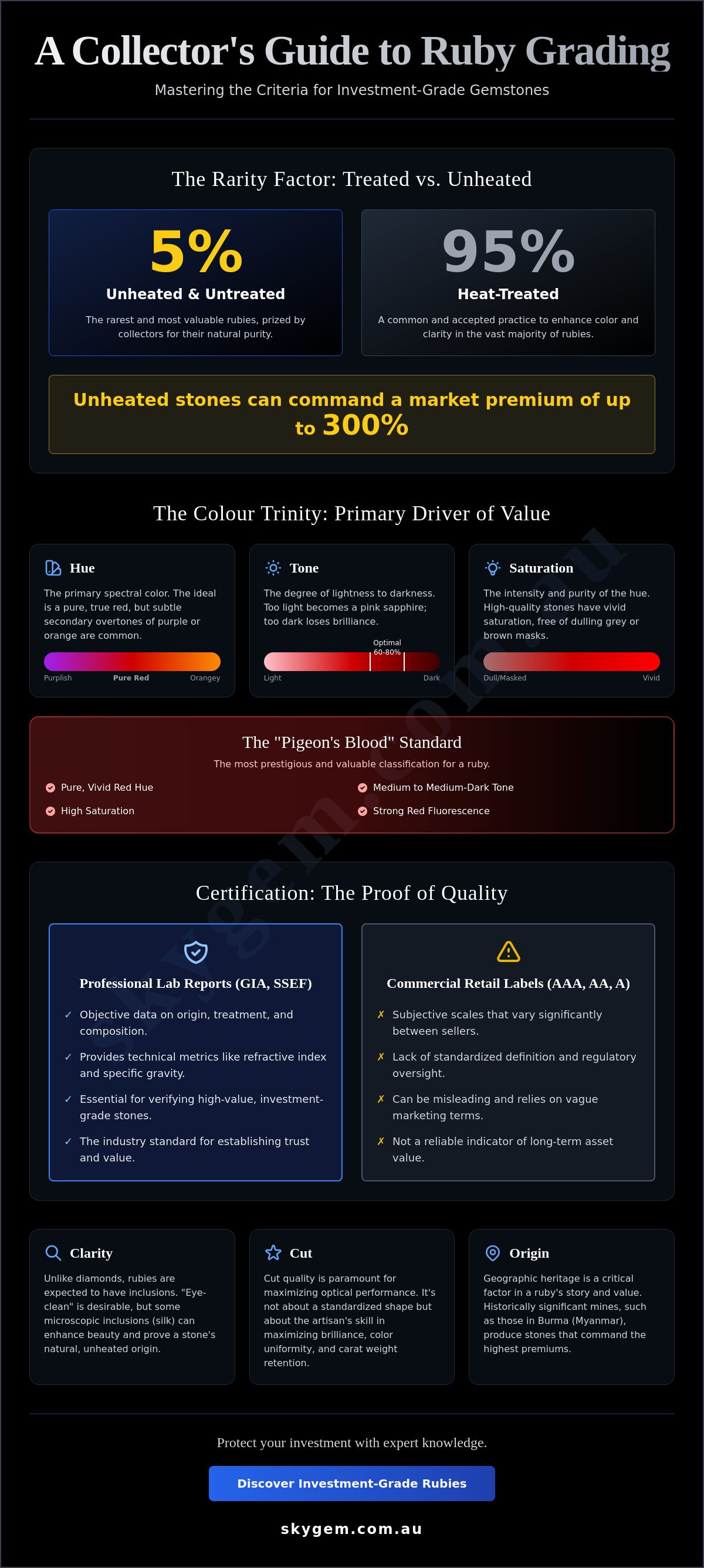
Approximately 95% of the world's rubies are heat-treated, yet the rare 5% of unheated stones now command a market premium of up to 300%. For the professional collector or investor, understanding how are rubies graded for quality is a technical necessity to avoid paying natural prices for stones with undisclosed treatments. You likely recognise that unlike the standardised diamond 4Cs, the valuation of a ruby is a complex synthesis of trace elements, geographic heritage, and light performance.
This guide provides the clarity required to interpret the 2026 GIA gemstone report overhaul with absolute confidence. You'll master the specific criteria used to define the prestigious Pigeon's Blood designation and learn why unheated status acts as a primary driver of long-term asset value. We'll examine the structural impact of inclusions, the nuances of saturation versus hue, and the shifting market dynamics that make geographic origin a critical factor in your selection process.
Key Takeaways
- Understand the technical foundation of corundum grading and why valuation depends on a synthesis of laboratory data rather than a single universal certificate.
- Learn how are rubies graded for quality by mastering the balance of hue, tone, and saturation required to meet the prestigious "Pigeon's Blood" standard.
- Identify the critical differences between "eye-clean" clarity and microscopic inclusions to ensure your selection offers maximum optical performance and brilliance.
- Evaluate the impact of geographic origin and thermal treatments on asset longevity, allowing you to read laboratory reports with professional-level precision.
- Gain practical insights into pairing specific ruby grades with precious metals to enhance the stone's natural aesthetic and ensure structural integrity in bespoke designs.
Understanding the Foundation of Ruby Grading
The ruby is scientifically classified as the red variety of corundum, an aluminium oxide mineral. Its characteristic crimson hue is the result of trace elements of chromium replacing aluminium in the crystal lattice. While diamonds benefit from a globally standardised grading scale, Ruby grading criteria are inherently more complex. There's no single universal certificate because the evaluation of coloured stones requires a synthesis of chemical purity and optical performance that varies between laboratories. To understand how are rubies graded for quality, one must look at the traditional 4Cs: Colour, Clarity, Cut, and Carat weight. However, the weighting of these factors differs significantly from the diamond market.
For those seeking investment-grade natural rubies, the distinction between a laboratory report and a retail label is the first step in protecting value. A professional evaluation acts as a technical audit of the gemstone, ensuring that the aesthetic appeal is backed by structural integrity and verifiable origin.
The Subjectivity of Coloured Stone Evaluation
In the world of rubies, colour is the primary driver of value. While a diamond's worth might plummet due to a single inclusion, a ruby with exceptional saturation can remain highly valuable even with visible internal characteristics. Gemmologists rely on their trained eyes rather than purely digital colourimetry because the way a ruby interacts with light is multidimensional. Grading must occur under standardised D65 North Daylight conditions to ensure the hue, tone, and saturation are recorded accurately. This human-led process allows for the identification of subtle secondary overtones, such as purple or orange, which can shift a stone's market position. Technical precision in lighting prevents the misidentification of tone, which should ideally sit between 60% and 80% for maximum brilliance.
Laboratory Reports vs. Retail Labels
A common point of confusion for buyers is the use of "AAA" or "A" ratings. These are commercial retail scales used by mass-market sellers and have no standardised definition across the industry. One retailer's "AAA" might be another's "A" depending on their internal inventory standards. In contrast, a professional laboratory report from an institution like the GIA or SSEF provides a technical analysis of the stone's physical properties. These reports are essential for high-value stones as they verify origin and treatment status. While a retail label might describe a stone as "fine quality," a technical report provides the data on refractive index, pleochroism, and specific gravity. This data-driven approach allows a project stakeholder to assess long-term viability and resale potential without relying on vague marketing terminology.
- GIA/SSEF Reports: Provide objective data on origin, heat treatment, and mineral composition.
- Retail Labels: Often use subjective scales like AAA/AA that lack regulatory oversight.
- Technical Metrics: Professional reports focus on measurable optical properties and inclusions.
The Critical Role of Colour: Hue, Tone, and Saturation
The evaluation of colour is not merely a visual assessment; it's a technical analysis of how light interacts with chromium at a molecular level. In the professional gemmological landscape, colour is divided into three distinct pillars: hue, tone, and saturation. To understand how are rubies graded for quality, one must view these elements as a set of performance metrics that dictate market desirability. Hue represents the primary red spectral colour, though most stones exhibit secondary overtones. While a pure "true red" is the benchmark, subtle shifts toward purple, orange, or pink are common and significantly influence the final grade.
Tone measures the degree of lightness or darkness within the gemstone. For a ruby to reach its peak value, the tone must sit within an optimal range of 60% to 80%. If the tone is too light, the stone risks being classified as a pink sapphire; if it's too dark, the red becomes "extinct," losing its ability to reflect light and sparkle. To understand how color affects a ruby's value, one must look at the interplay between this depth of tone and the stone's saturation. Saturation, perhaps the most critical element for investors, defines the vividness of the hue. High-quality rubies possess "vivid" saturation, meaning the red is intense and free from grey or brown masks that dull the appearance.
Chromium doesn't just provide colour; it also causes a physical reaction known as fluorescence. This allows the ruby to glow under ultraviolet light, which can make the red appear even more vibrant in natural sunlight. When selecting a stone for a bespoke project, it's useful to compare natural rubies under different lighting environments to see how this internal glow enhances the stone's presence.
The "Pigeon’s Blood" Standard
The "Pigeon’s Blood" designation represents the pinnacle of ruby grading. This isn't just a romantic term; it's a technical standard requiring a specific balance of vivid saturation and medium-dark tone. Historically associated with Mogok rubies, this grade requires the stone to be nearly free of iron. Iron acts as a "quenching" agent that suppresses fluorescence. Without iron, the ruby’s natural glow is unrestricted, creating the "fire" that commands a 100% to 300% price premium over standard fine red stones. In 2026, unheated unheated unheated Pigeon's Blood rubies of significant carat weight remain some of the most sought-after assets in the gemstone market.
Secondary Hues and Market Value
Market preferences often favour a purplish-red hue over an orangey-red one. The purple secondary overtone adds a perceived "richness" to the red, making the stone appear deeper and more regal. Conversely, orange overtones can make a ruby look "warm" but often result in a lower price per carat. The boundary between a light ruby and a pink sapphire is a frequent point of debate in the industry. This distinction is often determined by the laboratory's internal master stones. If the saturation doesn't meet a specific threshold, the stone is downgraded to a sapphire, which significantly impacts its valuation. High saturation is what gives a ruby its "life," ensuring it retains its visual impact even in smaller carat weights.
Evaluating Clarity, Cut, and Carat in Fine Rubies
While colour remains the dominant factor, the technical evaluation of clarity, cut, and carat weight provides the structural context for a stone's value. When considering how are rubies graded for quality, professionals distinguish between inclusions that enhance beauty and those that threaten durability. Unlike diamonds, where microscopic perfection is the benchmark, a ruby is considered exceptional if it's "eye-clean." This means that while a gemmological loupe may reveal internal characteristics, they don't detract from the stone's appearance when viewed at a standard distance. The interplay of these three factors is central to how are rubies graded for quality in a professional laboratory setting, where every decimal point of a carat can represent a significant shift in asset value.
Inclusions: Identifying "Silk" and Fingerprints
The presence of rutile "silk" is often a welcomed characteristic in high-end gemstones. These fine, needle-like inclusions intersect at 60-degree angles, scattering light across the facets to create a velvety "glow" that softens the red hue. Beyond aesthetics, silk serves as a diagnostic marker, proving the stone is a natural ruby rather than a synthetic or glass-filled imitation. However, gemmologists must also look for "fingerprints" or surface-reaching fissures. While some inclusions are benign, fissures can compromise the stone's structural integrity, especially during the setting process. It's also vital to understand how origin and treatments impact a ruby's value, as the type of inclusion often reveals the stone's geographic heritage and thermal history.
The Art of the Cut
The primary goal of a ruby cutter is the retention of weight, as the price per carat increases exponentially at the 2.00 and 5.00-carat milestones. This objective often results in rubies with heavy "bellies" or deep pavilions. While this preserves carat weight, it can lead to "extinction," where large areas of the stone appear black because light isn't reflecting back to the viewer's eye. Conversely, a cut that's too shallow creates "windowing," a transparent area where light leaks through the bottom of the gem, diluting the colour. A well-proportioned cut balances these factors to maximise brilliance while maintaining a significant "face-up" size. This ensures the stone appears as large as its weight suggests without sacrificing the intensity of its red hue. Symmetry and polish serve as final indicators of craftsmanship, where a mirror-like finish enhances the overall lustre and market desirability. For those tracking market trends, our ruby price guide details how these physical attributes correlate with current valuation benchmarks.
The Impact of Treatments and Origin on Gemstone Value
The valuation of a ruby is heavily influenced by its thermal history and geographic source. When determining how are rubies graded for quality, gemmologists prioritise the distinction between natural, unheated stones and those that have undergone thermal enhancement. Heat treatment is a widely accepted industry standard used to dissolve inclusions and intensify red hues. It's a permanent and stable process that makes high-quality colour accessible to a broader market. However, for those viewing gemstones as a long-term asset, unheated rubies represent the pinnacle of rarity.
In the Australian landscape, we've observed that unheated stones often carry a price premium of 50% to 100% over their heated counterparts of similar visual quality. This disparity exists because unheated stones are geological anomalies, possessing "Pigeon's Blood" saturation without human intervention. Investors target these stones because they retain value more effectively during market fluctuations. It's also vital to remain vigilant against unstable treatments like lead-glass filling. Unlike heat, lead-glass filling involves injecting silicate glass into fissures to improve transparency. This treatment isn't permanent and can be damaged by household chemicals or jewellery repairs, rendering the stone virtually worthless in the professional secondary market.
Heat vs. Unheated: A Value Comparison
Choosing between a heated and unheated stone is a balance of stability and rarity. While heated rubies offer excellent performance and durability for daily wear, they lack the "hard asset" status of an unheated gem. Professional laboratory reports will explicitly state "no evidence of heat" or "E" (Enhanced) to clarify this status. If you're looking to secure a stone with maximum long-term viability, you can view our collection of unheated rubies to understand the visual and technical differences between these grading categories.
The Importance of Origin
Geographic origin remains a significant "value-add" in ruby grading. The "Burma" (Myanmar) designation, particularly from the Mogok valley, carries a historical prestige that translates to a significant market premium. These stones are prized for their low iron content and high fluorescence. As supply from Myanmar becomes increasingly constrained, Mozambique and Madagascar have emerged as vital sources of high-quality material. Mozambique rubies often exhibit exceptional clarity and size, providing a reliable and often more ethical alternative to Burmese stones. While origin shouldn't overshadow the primary 4Cs, it acts as a final layer of verification for the stone's pedigree and potential appreciation.
- Burma (Mogok): Highest premium due to historical rarity and intense fluorescence.
- Mozambique: Known for high clarity and larger carat weights; rapidly gaining market share.
- Madagascar: Offers a diverse range of pinkish-red to vivid red hues at competitive price points.
Selecting a Graded Ruby for Bespoke Jewellery
Understanding the technical data within a laboratory report is the first step, but the practical application of that data occurs during the design phase. When you evaluate how are rubies graded for quality, you must consider how the stone's physical properties interact with precious metals and setting styles. A ruby that appears medium-dark on a white background may shift in appearance once it's enclosed in a metal mount. This transition from a loose gemstone to a finished piece of jewellery requires a technical understanding of light return and structural resilience.
The choice of metal is a primary factor in how a ruby's grade is perceived. Platinum and white gold provide a neutral, reflective backdrop that emphasizes the "fire" of a high-fluorescence stone. These metals are ideal for rubies with a pure red or purplish-red hue. Conversely, yellow gold can "warm up" a ruby that sits on the lighter end of the tone scale, potentially making a pinkish-red stone appear more traditionally crimson. By aligning the metal choice with the stone's saturation grade, you ensure the final design achieves its maximum aesthetic potential.
Beyond aesthetics, inclusions play a vital role in the long-term viability of the piece. A stone graded as "Slightly Included" requires a strategic approach to setting. If a fissure is located near the girdle, a technical jeweller will position a prong to protect that specific area from impact. This bespoke approach to setting is why a professional consultation is superior to purchasing loose stones online. It allows for a holistic assessment of how are rubies graded for quality in relation to their intended use, ensuring the stone is secure for decades of wear.
Matching Stone Grade to Ring Style
The architectural profile of the ring should complement the ruby's specific grading metrics. High-saturation rubies with exceptional brilliance are best showcased in solitaire engagement rings, where the focus remains entirely on the stone's optical performance. If you've selected a stone with a smaller carat weight but a high-quality colour grade, a halo setting can be used to increase the apparent face-up size. Integrating these stones into a custom engagement ring design allows us to mask minor cut imperfections, such as a slight window, by using reflective metal surfaces to bounce light back through the pavilion.
The SkyGem & Co. Approach to Quality
Our methodology focuses on the intersection of technical precision and client investment security. We are committed to sourcing natural rubies that are accompanied by verifiable laboratory reports, ensuring every stone meets our rigorous internal standards. By consulting our ruby price guide, clients can align their aesthetic preferences with current market valuations. We act as technical consultants, verifying the data on GIA or SSEF reports to ensure that the origin, treatment status, and clarity are accurately represented. This partnership-focused approach ensures that your selection is not just a purchase, but a permanent and evolving asset.
Securing Long-Term Value in Your Ruby Selection
Mastering the technical nuances of gemstone evaluation ensures your acquisition remains a stable asset. By understanding how are rubies graded for quality through the lens of vivid saturation, unheated status, and geographic origin, you move beyond subjective retail labels into the realm of professional gemmology. The intersection of a stone's chemical purity and its optical performance dictates its longevity in both aesthetic appeal and market value. Protecting your investment requires a reliance on verifiable data from leading laboratories to ensure the stone's pedigree is documented with precision.
At SkyGem & Co., we act as your technical consultants, offering direct sourcing of rare unheated gemstones and expert gemmological consultations to navigate these complexities. Our Melbourne-based boutique specialises in bespoke manufacturing, ensuring your graded ruby is set with the structural precision it deserves. Partnering with a specialist ensures that every inclusion is managed and every facet is optimised for maximum light return. We invite you to view our curated collection of GIA-certified natural rubies to begin your project with a stone of verifiable excellence. We look forward to partnering with you on a design that reflects both technical mastery and timeless beauty.
Frequently Asked Questions
Is a GIA report necessary for every ruby purchase?
A GIA report is essential for any ruby intended as a significant investment or high-value asset. While smaller, commercial-grade stones may rely on reputable jeweller documentation, a laboratory report provides the definitive technical audit of origin and treatment status. This verification is critical for protecting the stone's long-term resale value and ensuring you don't pay natural prices for treated material. It acts as a technical safeguard for the project's financial viability.
Can a ruby with inclusions still be considered high quality?
High-quality rubies frequently contain inclusions, as a perfectly clean stone is a geological rarity. Unlike diamonds, rubies are graded on an "eye-clean" basis, where internal characteristics are acceptable if they don't impede light performance or structural integrity. Certain inclusions, like rutile silk, are actually desirable markers that confirm natural origin and soften the distribution of light across the gemstone's facets. They provide a velvety texture that enhances the stone's aesthetic profile.
How much does heat treatment affect the price of a ruby?
Heat treatment results in a significant price disparity compared to unheated stones of similar visual quality. In the 2026 market, unheated rubies command a premium of 100% to 300% because they represent less than 5% of all world production. While heated stones offer a cost-effective way to achieve vivid colour, they don't carry the same scarcity-driven value as a naturally occurring, unenhanced gem. The unheated status remains a primary driver of capital appreciation.
What is the difference between a ruby and a red spinel in grading?
The primary difference lies in their chemical composition and optical properties, as rubies are corundum while spinels are a separate mineral species. Rubies exhibit pleochroism, showing different colours from different angles, whereas spinels are singly refractive. Understanding how are rubies graded for quality requires distinguishing these refractive indices, as spinels often possess higher clarity but lack the specific chromium-driven glow found in top-tier rubies. A laboratory report is the only way to verify this distinction with absolute certainty.
What does "Pigeon’s Blood" actually mean on a certificate?
The "Pigeon's Blood" designation on a certificate indicates a stone has met a specific technical threshold for vivid red saturation and medium-dark tone. It also signifies a low iron content, which allows for high fluorescence and an internal glow. This isn't a marketing term but a laboratory standard used by institutions like GIA or SSEF to categorise the most elite colour performance in the corundum family. It represents the pinnacle of performance metrics for red gemstones.
Does the origin of a ruby really matter if the colour is perfect?
Geographic origin remains a critical factor in valuation even when two stones appear visually identical. A Burmese ruby from the Mogok region will consistently command a higher price than a stone from Mozambique due to its historical prestige and geological rarity. While colour is the primary driver of beauty, the origin acts as a pedigree that dictates the stone's potential for capital appreciation over time. It serves as a recurring signature of reliability for serious collectors.
How do I know if a ruby is lead-glass filled?
Identifying lead-glass filling requires a professional laboratory report or a microscopic examination for the "flash effect." Under magnification, these stones often show blue or orange flashes within fissures where the glass has been injected. Because this treatment is unstable and significantly lowers the stone's value, it's vital to ensure your documentation explicitly states the ruby is natural and free from glass-filled enhancements. This treatment is generally avoided in premium bespoke jewellery design.
Is an unheated ruby a better investment than a high-grade heated one?
An unheated ruby is generally considered a superior investment because its value is driven by geological scarcity rather than human enhancement. While a high-grade heated stone is a beautiful choice for jewellery, unheated gems act as "hard assets" that are more resilient to market shifts. Knowing how are rubies graded for quality allows you to see that the unheated designation is a primary indicator of long-term viability and resale demand. It represents a permanent and evolving asset for any portfolio.
Disclaimer
This article is for general informational purposes only and may include AI-assisted content. Pricing, specifications, and availability are subject to change. For accurate advice and current information, please contact SkyGem & Co. directly. Nothing in this content constitutes professional or financial advice.