
Getting a Unique Non-Traditional Engagement Ring: The 2026 Design Guide

A ring that captures your personal story shouldn't be a liability that wears down after a few years of daily use. You likely want something that stands out from the standard diamond solitaire, yet you're concerned that choosing an unconventional gemstone or a complex setting might compromise the ring's longevity. Getting a unique non-traditional engagement ring involves more than just picking a favourite colour; it requires a technical understanding of material hardness and bespoke engineering to ensure the piece survives the rigours of daily life.
This guide provides the professional framework for creating a piece that balances striking aesthetics with the rigorous precision required for lifelong wear. We'll explore the physical properties of stones like Australian sapphires and alexandrite, the impact of the mandatory 2024 RJC Code of Practices on ethical sourcing, and the practical steps to design a custom asset. By the end, you'll have a clear path to a high-quality, durable ring that reflects your personal identity without the risk of future regret.
Key Takeaways
- Identify the three core pillars of non-traditional design, including material, geometry, and setting, to move beyond mass-produced jewellery standards.
- Learn how to evaluate gemstone suitability for daily wear using the Mohs scale, specifically focusing on the structural integrity of Australian teal and peach sapphires.
- Discover the engineering requirements for getting a unique non-traditional engagement ring, including the technical balance needed for 'Toi et Moi' and bezel settings.
- Master the bespoke journey by establishing a technical brief that aligns your aesthetic goals with professional budget parameters and stone sourcing.
- Access expert consultation that prioritizes long-term asset viability over fleeting trends through direct collaboration with master jewellers.
What Defines a Unique Non-Traditional Engagement Ring?
Modern jewellery design has moved beyond the rigid expectations of previous generations. While the history and tradition of engagement rings was once defined by a singular focus on the diamond solitaire, current preferences emphasize intentional, personalised assets. Getting a unique non-traditional engagement ring is a process of selecting specific technical and aesthetic elements that deviate from mass-produced standards to tell a personal story.
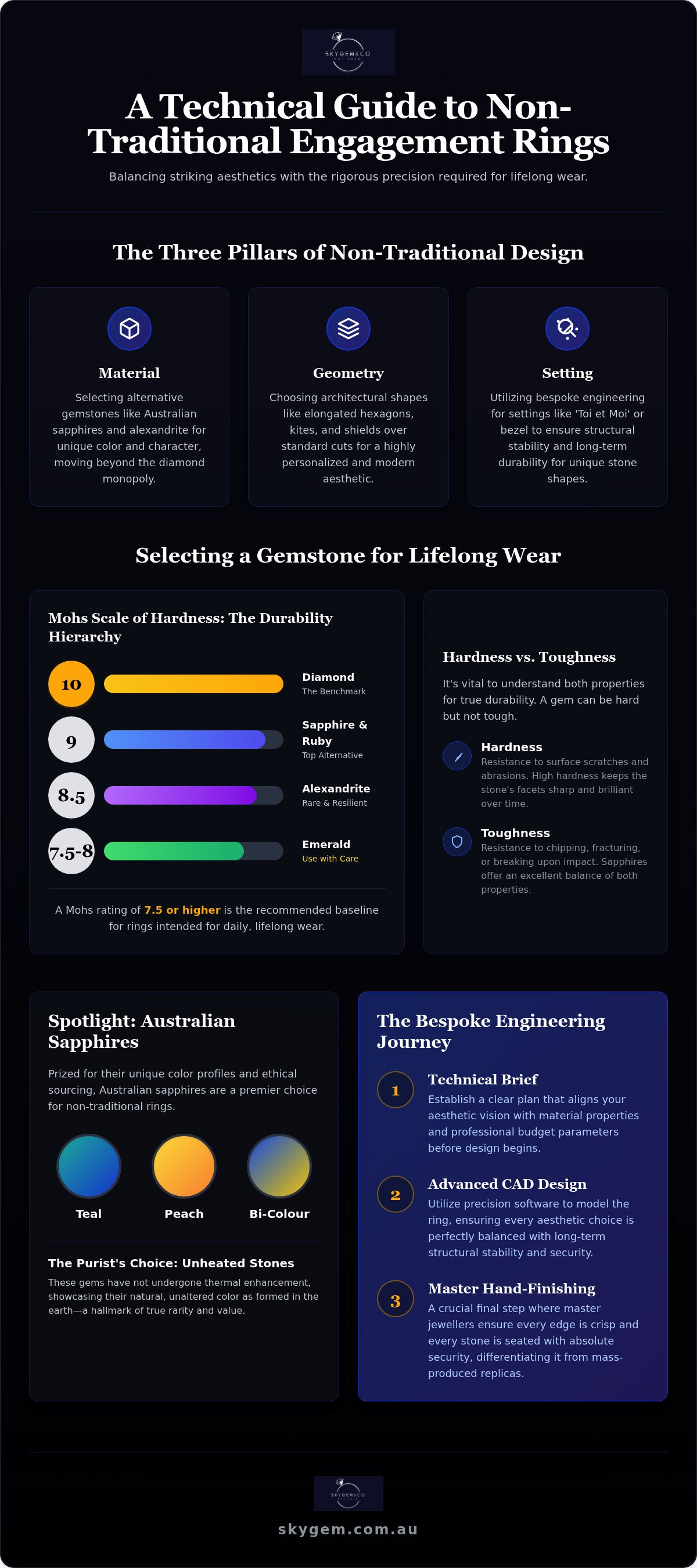
We define non-traditional through three primary pillars: material, geometry, and setting. By 2026, the market has seen a definitive shift where individual expression carries more weight than traditional social signalling. A ring is no longer just a symbol of status; it's a permanent piece of bespoke engineering. To achieve this, you must distinguish between "fashion-forward" designs, which often rely on fleeting trends, and "timeless unique" designs that maintain their structural integrity and visual appeal for decades.
Breaking the Diamond Monopoly
The rise of coloured gemstones has fundamentally changed the design landscape. Australian sapphires, including teal and peach varieties, have become primary focal points for those seeking a distinct palette. These stones provide a level of character that traditional white diamonds often lack. Furthermore, the increased accessibility of lab-grown diamonds has opened doors for larger, more complex unique cuts. Instead of the standard round brilliant, we're seeing a rise in architectural shapes like elongated hexagons, kites, and shields. These geometric choices allow for a highly personalised engagement ring that remains grounded in high-performance materials.
The Role of Bespoke Engineering
A truly unique ring requires the oversight of a technical consultant rather than a simple retail salesperson. Because non-traditional shapes and settings often place different stresses on the metal, bespoke engineering is essential for long-term durability. We utilize advanced CAD design to ensure that every aesthetic choice is balanced with structural stability. This technical precision is what allows for delicate-looking but robust settings. A custom made engagement ring also benefits from hand-finishing. This process differentiates a high-quality unique piece from a mass-produced casted replica, ensuring every edge is crisp and every stone is seated with absolute security.
Beyond Clear Diamonds: Selecting Alternative Gemstones
Selecting a centre stone for a bespoke piece requires a technical evaluation of physical properties. While aesthetics drive the initial interest, the longevity of the asset depends on the mineral's ability to withstand daily friction and impact. Getting a unique non-traditional engagement ring often leads people toward vibrant colours, but these choices must be grounded in mineralogical reality to ensure they remain permanent fixtures on the hand.
The Durability Hierarchy
The primary metric for gemstone resilience is the Mohs scale. The Mohs scale of mineral hardness is a qualitative ordinal scale characterising scratch resistance of various minerals through the ability of harder material to scratch softer material; a rating of 7.5 is the baseline for rings intended for lifelong wear. While a diamond sits at a 10, sapphires and rubies (both varieties of corundum) follow closely at 9. This makes them the most reliable alternatives for 24/7 use.
It's vital to distinguish between hardness and toughness. Hardness prevents surface scratches, while toughness refers to a stone's resistance to chipping or fracturing. Emeralds, for instance, rank between 7.5 and 8 on the Mohs scale, but their natural inclusions can make them more brittle than sapphires. When you choose a stone like an alexandrite or a ruby, you're investing in a material that balances these two physical requirements effectively. This technical foundation prevents the heartbreak of a cracked or dull stone years after the proposal.
Australian Sapphires and Rare Earth Options
Australian sapphires have gained significant traction due to their unique colour profiles. Teal, peach, and bi-colour varieties offer a depth that traditional blue stones lack. For those seeking the pinnacle of rarity, unheated stones are the preferred choice. These gems haven't undergone thermal enhancement to alter their colour, meaning you're viewing the stone exactly as it was formed. This "purist" approach is a hallmark of getting a unique non-traditional engagement ring that values natural authenticity over industrial modification. The shifting hues of alexandrite, which change from green in daylight to purple under incandescent light, provide a dynamic aesthetic that static diamonds cannot match.
Coloured Diamonds: The Best of Both Worlds
If you require the maximum possible hardness but want to move away from white light, coloured diamonds provide a high-performance solution. Both natural and lab-grown coloured diamonds offer a 10 on the Mohs scale while providing intense saturations of yellow, pink, or blue. You can find inspiration for these palettes by exploring our collection of precious gemstones. When evaluating these stones, we focus on the balance between saturation and tone. A stone that's too dark may lose its "pop" in low light, whereas a well-calibrated tone ensures the ring remains vibrant in all environments. If you're ready to explore these technical specifications in person, you might consider viewing our current gemstone inventory to see how different cuts interact with light.
Artistic Settings and Metal Choices for Unique Rings
A distinctive gemstone requires a setting that provides both visual impact and structural security. While the four-prong solitaire remains a standard, getting a unique non-traditional engagement ring often involves exploring more architectural configurations. Bezel settings, for example, offer a complete perimeter of metal that protects the stone's girdle from impact. Tension settings create a 'floating' aesthetic but require precise engineering to ensure the metal exerts enough pressure to hold the gem securely without deformation.
The 'Toi et Moi' style, featuring two primary stones, presents a unique technical challenge. Balancing two distinct shapes, such as a pear-cut sapphire and an emerald-cut diamond, requires a band designed to distribute weight evenly. Without this technical foresight, the ring may rotate uncomfortably on the finger or suffer from uneven stress points. We focus on low-profile designs that keep the centre of gravity close to the skin, enhancing both the wearer's comfort and the ring's overall stability.
The Geometry of the Band
The band's profile significantly alters the ring's final character. A knife-edge band creates a sharp, modern silhouette that catches light differently than a traditional rounded profile. Beyond the shape, textured finishes like hammered or matte surfaces provide a tactile contrast to high-polish gemstones. It's also vital to consider the 'bridal fit' during the initial design phase. We engineer our bespoke bands to ensure they accommodate a future wedding ring without unsightly gaps, ensuring the set remains a cohesive unit.
Securing Non-Traditional Cuts
Non-traditional cuts like marquise, pear, or kite shapes have vulnerable points that are prone to chipping. Custom-made settings are essential here, as standard cast components rarely provide the exact fit needed for these specific geometries. For asymmetrical clusters, a custom engagement ring approach allows for the placement of hidden supports that maintain the 'floating' look while providing a rigid framework. Platinum is often the preferred material for these intricate details due to its density and durability. Unlike 18K gold, which wears down over decades, platinum is a displaced metal that retains its volume, making it the superior choice for long-term security in complex settings.
The Journey to a Bespoke Non-Traditional Ring
Getting a unique non-traditional engagement ring is a methodical process that transforms a conceptual vision into a durable, high-performance asset. This journey is structured to eliminate guesswork, ensuring that every design choice is validated by engineering principles through a sequence of technical milestones. We treat the creation of your ring as a collaborative project where precision is as vital as the aesthetic outcome.
The process follows five distinct stages to guarantee quality:
- Technical Brief and Budget: We define the project's parameters, including metal selection and lifestyle requirements, to establish a stable foundation.
- Stone Sourcing: Utilizing our global network, we identify 'hero' stones like teal sapphires or alexandrite that meet specific saturation and hardness criteria.
- CAD Design: 3D renderings provide visual confirmation and allow for precise adjustments to stone seating and band geometry before any metal is cast.
- Manufacturing: Master jewellers execute the design, focusing on hand-finished details that standard casted replicas cannot achieve.
- Quality Assurance: Every piece undergoes a final certification review to confirm material purity and stone security, ensuring it meets our rigorous internal standards.
The Consultation: Education Over Sales
Your first meeting should prioritize gemstone education and structural limits. While reference images are helpful for aesthetic direction, our role is to translate those visuals into a wearable, long-lasting piece. We discuss how specific cuts interact with light and how different settings protect the stone's girdle. This technical consultation ensures you're not just buying a product, but investing in an asset designed for daily resilience. We focus on the physical properties of your chosen materials so you don't have to worry about future maintenance issues.
Transparency and Certification
Even when selecting non-traditional options, GIA certification remains the gold standard for verifying stone properties. Ethical sourcing is equally critical; we ensure every gem has a clean provenance. As of 2026, compliance with the 2024 RJC Code of Practices is mandatory, requiring rigorous due diligence for coloured gemstones and lab-grown materials. This regulatory adherence is your signature of reliability. For a deeper look at this process, consult our Bespoke Engagement Rings Guide. If you're ready to begin your technical brief, you can book a custom design consultation with our master jewellers to discuss your specific requirements.
Why Technical Precision Defines the SkyGem & Co. Approach
SkyGem & Co. operates at the intersection of structural engineering and high-level jewellery design. We understand that getting a unique non-traditional engagement ring is a significant investment that requires more than just an eye for beauty. It demands a technical consultant who can validate your aesthetic vision against the physical properties of rare minerals and precious metals. By balancing expert consultation with innovative design, we ensure that every piece is a permanent asset rather than a temporary fashion statement.
Our boutique approach provides you with direct access to master jewellers. This transparency is vital when working with complex geometries or non-traditional stone cuts. Instead of dealing with a retail intermediary, you collaborate with the professionals who physically construct your ring. This direct line of communication allows for granular adjustments during the design phase, ensuring that the final product meets both your personal expectations and our rigorous performance metrics. We prioritise the long-term viability of the setting, focusing on how the metal will respond to decades of daily wear.
A Legacy of Craftsmanship
Our history in the regional professional landscape informs our modern, innovative techniques. We combine traditional hand-finishing with advanced CAD modelling to create pieces intended to last for generations. Hand-finishing is a critical differentiator; it allows us to refine edges and seat stones with a level of precision that mass-produced casting simply cannot achieve. This methodical attention to detail ensures that even the most delicate-looking designs possess the structural integrity required for daily use. You can view our ready-to-wear unique collection for immediate inspiration on how these technical standards translate into finished designs.
Your Partner in Design
We act as your technical consultant throughout the entire journey, from the initial brief to the final quality assurance review. Our relationship doesn't end when you leave the studio. We prioritise the ongoing maintenance of your ring by offering professional cleaning and inspection services. This proactive care ensures the structural integrity of the setting remains intact and the gemstones remain secure. Whether you're interested in sourcing rare Australian sapphires or high-performance lab-grown diamonds, we're here to guide you through the technical specifications of getting a unique non-traditional engagement ring. Book a consultation to begin your unique ring journey and discover the difference that precision engineering makes.
Engineering Your Future Heirloom
Creating a piece that reflects your personal identity shouldn't involve a compromise on structural integrity. By prioritising materials with high Mohs scale ratings and utilizing bespoke engineering, you ensure your ring remains a permanent asset. We've explored how the intersection of architectural settings and rare gemstone selection defines the modern standard for 2026. Getting a unique non-traditional engagement ring is a methodical journey that moves from a technical brief to a hand-finished masterpiece.
At SkyGem & Co., we act as your technical consultant to bridge the gap between vision and reality. Our process provides access to GIA certified natural and lab-grown diamonds alongside the professional sourcing of rare Australian and Teal Sapphires. Through expert technical consultations, we validate every design choice for long-term viability. If you're ready to translate your aesthetic goals into a high-performance design, Start Your Bespoke Design Journey at SkyGem & Co. today. We look forward to helping you build a legacy that is as durable as it is distinctive.
Frequently Asked Questions
Are non-diamond engagement rings durable enough for everyday wear?
Non-diamond rings are perfectly suitable for daily wear if the centre stone ranks at least 7.5 on the Mohs scale. Sapphires and rubies are the most resilient alternatives; they possess a hardness of 9. This physical property ensures the gem resists surface scratches and maintains its lustre over decades. You should avoid softer stones like opals or pearls for rings intended for 24/7 use as they lack the necessary structural toughness.
What is the most popular alternative gemstone for an engagement ring in 2026?
Australian Teal Sapphires have emerged as the most sought-after alternative in 2026. Their unique bi-colour properties and deep, oceanic hues offer a level of character that traditional stones cannot replicate. Peach sapphires and alexandrite are also seeing a significant rise in demand due to their colour-shifting capabilities. These gems provide a sophisticated palette for those who prioritise individual storytelling over conventional social signalling.
Do non-traditional engagement rings hold their value?
Value retention is determined by the quality and rarity of the materials rather than the specific design style. High-quality unheated sapphires and GIA certified natural stones are considered permanent assets that maintain their market status. While trends may shift, a well-engineered ring featuring a rare, high-performance gemstone will always possess intrinsic value. The scarcity of specific "hero" stones often makes them highly desirable for collectors and purists alike.
Can I use a lab-grown diamond in a unique, non-traditional setting?
Yes, lab-grown diamonds are an excellent choice for getting a unique non-traditional engagement ring. They are chemically and physically identical to natural diamonds; this means they offer the same level of 10-rated hardness on the Mohs scale. Their relative affordability allows you to invest in larger or more complex architectural cuts, such as elongated hexagons or kites, without compromising on the structural integrity of the final piece.
How long does it typically take to design and manufacture a bespoke ring?
The entire bespoke journey usually spans four to eight weeks from the initial consultation to final delivery. This timeframe includes establishing the technical brief, sourcing the specific gemstone, and creating CAD renderings for your confirmation. Precision manufacturing and hand-finishing require several weeks of dedicated labour to ensure the setting meets our rigorous quality standards. Rare stone searches can sometimes extend this duration depending on the specific saturation and tone requirements.
Is it more expensive to get a unique custom ring than a traditional one?
A custom ring is not inherently more expensive; the total cost is primarily driven by your choice of materials. While bespoke engineering involves a professional design fee, opting for alternative gemstones or lab-grown diamonds can often lead to a more cost-effective outcome than a traditional high-carat natural diamond. The focus is on allocating your budget toward the elements that matter most to you, whether that is metal density or stone rarity.
What is a Toi et Moi ring and why is it considered non-traditional?
A Toi et Moi ring features two primary gemstones set side-by-side, representing the union of two individuals. This style is considered non-traditional because it moves away from the single-stone solitaire standard. From an engineering perspective, these rings require careful balancing to ensure two different stone shapes sit comfortably on the hand. They offer a dynamic aesthetic that allows for the creative pairing of different colours and geometric cuts.
How do I ensure my unique ring won't go out of style?
The best way to ensure longevity when getting a unique non-traditional engagement ring is to focus on technical precision and high-quality materials. Avoid chasing fleeting fashion trends that rely on fragile settings or overly thin bands. A ring grounded in sound engineering principles and classic metal choices like platinum will remain a timeless asset. True uniqueness comes from a design that is built to last, reflecting your personal story rather than a temporary industry fad.
Disclaimer
This article is for general informational purposes only and may include AI-assisted content. Pricing, specifications, and availability are subject to change. For accurate advice and current information, please contact SkyGem & Co. directly. Nothing in this content constitutes professional or financial advice.