
Fine Jewellery Melbourne: The 2026 Buying Guide to Premium Craftsmanship

The most beautiful gemstone in the world will eventually fail if the architectural integrity of its setting isn't engineered for longevity. While many collectors focus solely on the initial visual impact, the technical precision of the build determines whether a piece becomes a permanent asset or a maintenance liability. When searching for fine jewellery melbourne, you're likely looking for more than just a retail transaction. You're seeking a piece that balances aesthetic brilliance with the kind of structural stability required for a lifetime of wear.
It's natural to feel uncertain when navigating the complex choice between natural GIA certified diamonds and lab-grown options, or when trying to verify the ethical origins of an Australian sapphire. You shouldn't have to guess if you're paying for genuine craftsmanship or just a mass-produced setting. This 2026 guide clarifies the technical metrics of premium jewellery, from the impact of new AUSTRAC compliance standards effective July 2026 to the specific properties of unheated gemstones. You'll learn how to identify high-level design that survives the rigours of daily use, ensuring your investment remains as secure as it is stunning.
Key Takeaways
- Identify why 18K gold and platinum are the industry benchmarks for structural durability and long term wear in premium settings.
- Evaluate the technical indicators of superior craftsmanship when selecting fine jewellery melbourne, focusing on gemstone "fire" and setting security.
- Determine whether the immediate availability of ready-to-wear silhouettes or the unique narrative of a bespoke design aligns with your project goals.
- Learn to assess the performance metrics of foundational pieces, including the link fluidity and clasp integrity of diamond tennis bracelets.
- Navigate pricing transparency by understanding how to distinguish between the raw value of precious metals and the technical expertise provided during a professional consultation.
Defining the Standards of Australian Fine Jewellery
Distinguishing between commercial fashion items and genuine fine jewellery is a matter of technical specification. In the professional landscape of fine jewellery melbourne, the term "fine" refers exclusively to pieces constructed from solid precious metals and high-grade gemstones, whether natural or lab-grown. This distinction is critical for long-term value. While fashion jewellery often relies on base metals with thin gold plating, investment-grade pieces use alloys like 18K gold or platinum to ensure the standards of fine jewellery are met. These materials don't just provide a premium finish; they offer the structural integrity required to house valuable stones securely for decades.
The transition from mass-produced fashion to investment-grade pieces marks a shift from consumption to curation. In 2026, the Australian market is increasingly defined by a preference for durability and technical precision over ephemeral trends. This is supported by regional standards that prioritize gemstone traceability and metal purity. Selecting a piece that retains its aesthetic and structural integrity requires an understanding of the physical properties of the materials involved, moving beyond the surface-level appeal of a design to evaluate its underlying engineering.
The Role of Precious Metals in Longevity
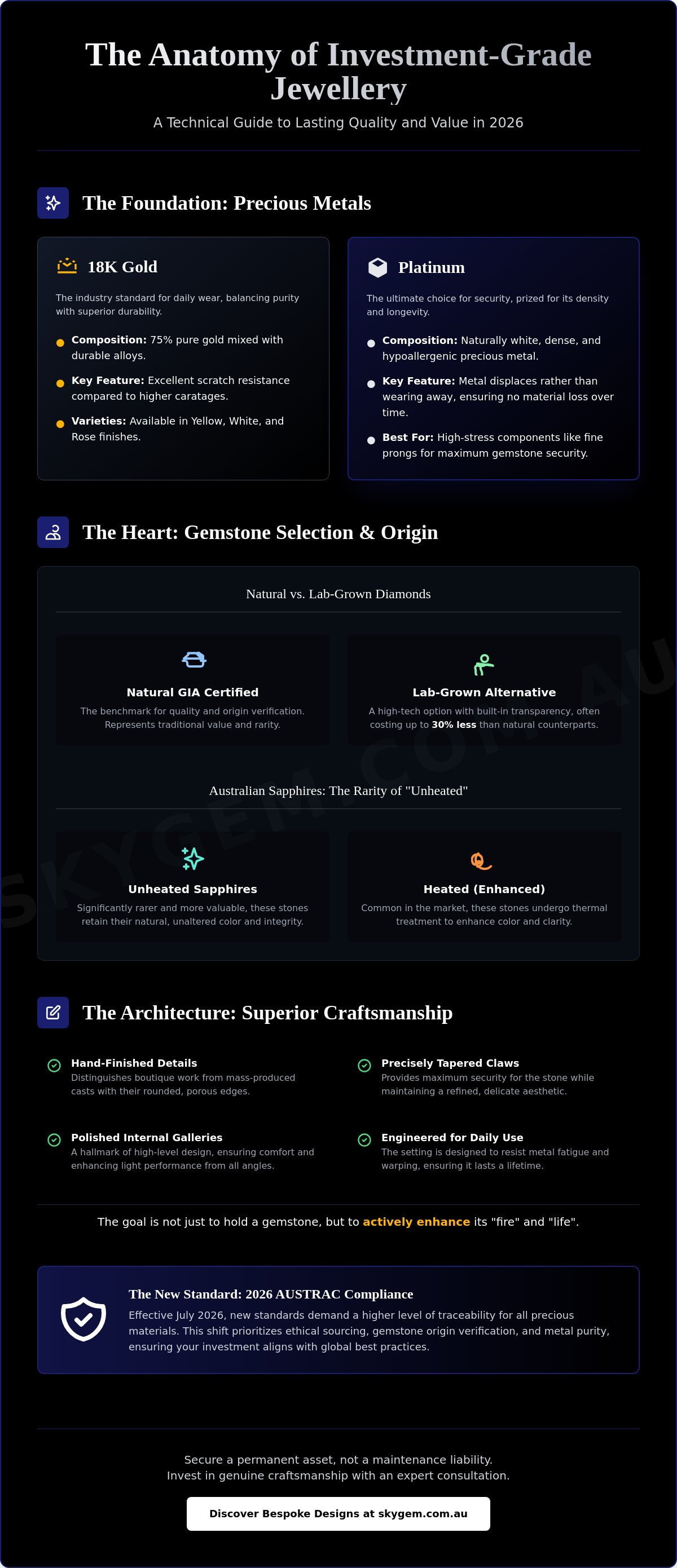
18K gold, available in yellow, white, and rose varieties, consists of 75% pure gold mixed with durable alloys. It's the industry standard for daily wear because it offers superior scratch resistance compared to higher caratages. For those seeking maximum security, 18K white gold and platinum are the preferred choices for complex settings. Platinum is particularly notable for its density and "heft." Unlike gold, which loses microscopic amounts of metal through friction, platinum is malleable and tends to displace rather than wear away. This makes it the superior choice for high-stress components like the fine prongs that hold a central diamond.
Ethical Sourcing and Modern Transparency
The 2026 market demands a high level of traceability and regulatory adherence. For lab-grown diamonds, this transparency is built into the manufacturing process, offering a high-tech alternative that typically costs 30% less than natural counterparts. For natural stones, GIA certification remains the non-negotiable benchmark for quality and origin verification. Australia's reputation for sourcing is particularly strong in the sapphire sector. Whether you're evaluating precious gemstones like teal sapphires or emeralds, verifying the supply chain ensures the piece aligns with both global standards and your own ethical requirements.
The Core Pillars of Quality: Metals, Stones, and Settings
True quality in fine jewellery melbourne isn't found exclusively on a grading report. While the 4Cs provide a baseline for diamonds, they don't fully account for "life"—the specific way a stone interacts with light to produce scintillation and fire. Technical excellence requires an architectural approach where the metal doesn't just hold the gemstone but actively enhances its performance. This involves evaluating the balance and proportion of the piece to ensure it sits flush against the finger, providing comfort without sacrificing structural integrity. Hand-finished details, such as precisely tapered claws and polished internal galleries, distinguish boutique craftsmanship from the rounded, porous edges often found in mass-produced factory casts.
Obtaining expert consultation in fine jewellery is essential for identifying these technical nuances. A well-engineered piece considers the long-term stress on the setting, ensuring the metal won't fatigue or warp under daily use. It's about the intersection of physics and aesthetics; a ring must be robust enough for a lifetime of wear while maintaining a refined, delicate profile. This level of precision ensures the stone remains secure and the aesthetic remains timeless.
Gemstone Selection: Beyond the Surface
The Australian market shows a distinct appreciation for unheated sapphires and rubies. These stones haven't undergone thermal enhancement, making them significantly rarer and more valuable than their heated counterparts. Modern collectors are also moving toward teal and peach sapphires, which offer a unique spectral range compared to traditional royal blue. When evaluating emeralds, it's vital to understand the role of minor oiling. Almost all emeralds contain surface-reaching fissures; the industry standard involves using natural oils to improve clarity without compromising the stone's chemical stability or longevity.
Engineering a Secure Setting
The choice between a prong, bezel, or halo setting should be dictated by your mechanical requirements and lifestyle. Prongs allow for maximum light entry but require periodic inspection to prevent snagging. Conversely, a bezel setting wraps the stone in a protective metal rim, making it the ideal choice for an active lifestyle. A critical yet overlooked feature is the "gallery"—the space beneath the stone. A well-designed gallery allows for easy cleaning and ensures light can enter the pavilion of the stone from multiple angles. You can review our detailed breakdown of precious gemstones to see how different cuts interact with these setting styles. For those ready to begin their journey, exploring a range of technical ring designs can help clarify which structure best suits your needs in the fine jewellery melbourne landscape.
Bespoke vs. Ready-to-Wear: Which Path is Right for You?
The decision between a bespoke commission and a ready-to-wear selection is essentially a choice between technical collaboration and immediate visual verification. In the landscape of fine jewellery melbourne, both paths offer distinct advantages depending on your project's requirements and timeline. Ready-to-wear collections provide the benefit of immediate gratification, allowing you to evaluate the "fire" and scintillation of a stone under various lighting conditions before making a commitment. These pieces utilize proven design silhouettes that have been refined for both aesthetic balance and structural stability, ensuring they meet the high standards set by the Jewellers Association of Australia.
Bespoke design, conversely, functions as a technical partnership. It's the ideal route when a project requires a unique narrative or must be engineered around a specific gemstone's dimensions. The process typically begins with a technical consultation, followed by the development of Computer-Aided Design (CAD) models. These digital blueprints allow for precise adjustments to prong thickness, band width, and gallery height before any metal is cast. While a ready-to-wear piece is available instantly, a custom commission generally requires a timeline of four to eight weeks, covering everything from the initial sketch to the final hand-polish. This methodical approach ensures that the final asset is perfectly tailored to the wearer's physical proportions and lifestyle needs.
When to Choose a Custom Commission
Custom commissions are technically necessary when you're designing around a specific loose gemstone or a significant heirloom. Standard settings are often cast to fit calibrated stone sizes; if your stone has unique depth or length-to-width ratios, a pre-made setting may compromise the stone's security or light performance. By opting for custom-made engagement rings, you ensure the metal is engineered to the exact micron of the stone. This path also allows for specific ergonomic adjustments, such as tapering a band to fit a specific finger shape or accommodating a wedding band to sit perfectly flush against an engagement ring.
Evaluating Ready-to-Ship Collections
Choosing from ready-to-ship collections doesn't mean compromising on boutique quality. The primary advantage is the ability to see the finished interaction between the metal and the gemstone in person. However, it's vital to consider sizing limitations. While plain bands are easily adjusted, complex designs like full-eternity diamond wedding bands or rings with intricate side-stone detailing cannot always be resized without compromising the structural integrity of the settings. When browsing fine jewellery melbourne, always verify the "resize window" for your chosen silhouette to ensure long-term viability.
Essential Pieces: Building a Timeless Fine Jewellery Collection
Building a collection of fine jewellery melbourne isn't merely an exercise in acquisition. It's a technical curation of assets that must perform across various environments. A foundational collection relies on pieces that offer both aesthetic versatility and structural longevity. For instance, the solitaire diamond pendant serves as a primary anchor. Its value is determined not just by the carat weight but by the engineering of the mount. A 4-claw setting is typically the standard for these pieces; it minimizes metal interference while maximizing light entry into the pavilion, which is essential for optimal brilliance.
When evaluating diamond tennis bracelets, the focus shifts to mechanical fluidity. A high-quality bracelet must drape naturally without catching or kinking. This requires precision in the link assembly. Key technical markers of a premium build include:
- Link Articulation: Each segment should move independently without resistance to prevent metal fatigue.
- Clasp Security: A double-locking mechanism is the benchmark for protecting such a significant investment during daily wear.
- Prong Consistency: Uniform claw height and smooth finishing prevent snagging on delicate fabrics and ensure stone security.
The wedding band represents a critical engineering challenge. It must be designed to sit flush with the engagement ring to prevent "rubbing" or metal-on-metal wear. This requires a technical understanding of the engagement ring's gallery height and band width. Without this alignment, the structural integrity of both pieces can be compromised over time. Choosing a band that complements the architectural profile of your existing rings ensures a cohesive and durable set.
The Versatility of Diamond Studs and Pendants
Selecting the correct carat weight for daily wear is a balance of comfort and presence. While larger stones offer more visual impact, the weight must be supported by a robust setting. We recommend exploring our range of natural and lab-grown diamonds to find the right balance of performance and value. Using 18K gold ensures the prongs remain firm, keeping the stone secure through years of movement. For gemstone earrings, consider how studs offer a secure, low-profile option for active lifestyles, whereas drop styles are often better suited for occasions where facial architecture is the primary design focus.
Investing in Colour: Sapphire and Emerald Accents
Diversifying a collection involves moving beyond white diamonds to include vivid gemstones. Australian sapphires, particularly in teal or peach hues, provide a sophisticated contrast to diamond-heavy wardrobes. For those seeking a more contemporary aesthetic, "Toi et Moi" rings allow for the pairing of two distinct stones, such as an emerald and a diamond, in a single architectural setting. This approach allows you to curate a collection of fine jewellery melbourne that balances the rarity of natural rubies with the modern accessibility of lab-grown assets.
Ready to expand your collection? You can browse our ready-to-ship essentials to find pieces engineered for immediate wear and long-term durability.
The Value of Expert Consultation in Fine Jewellery Selection
Selecting a high-value asset requires more than a simple retail transaction. In the competitive landscape of fine jewellery melbourne, a technical consultation serves as a risk-mitigation strategy. A professional consultant acts as a technical partner, focusing on the intersection of performance metrics and aesthetic goals rather than aggressive sales tactics. This approach ensures that you understand the mechanical properties of your chosen piece, from the shear strength of the prongs to the light-refraction capabilities of the gemstone. When you move beyond the sales pitch, you gain the data necessary to make an informed investment that survives the rigours of daily wear.
Transparency in pricing is a non-negotiable component of a professional consultation. You should receive a clear breakdown of how value is allocated between the raw material costs of precious metals and the market value of the gemstones. Understanding the markup on labour versus stones allows you to evaluate the fairness of the proposal. Furthermore, a reputable jeweller views the sale as the beginning of a long-term relationship. This includes establishing a schedule for ongoing maintenance, such as professional cleaning and periodic claw inspections, which are vital for maintaining the structural integrity of the setting over decades.
Before finalizing any purchase, use this technical checklist to verify the quality of the craftsmanship:
- Certification: Ensure the center stone is accompanied by a GIA report or equivalent independent grading.
- Hallmarking: Verify the metal purity marks, such as "750" for 18K gold or "950" for platinum, are stamped clearly.
- Symmetry: Check the alignment of the prongs and the level of the stone to ensure it isn't tilted.
- Finishing: Inspect the internal surfaces of the band and gallery for a high-mirror polish, which indicates attention to detail.
The SkyGem & Co. Technical Standards
Our commitment to an education-first model means we prioritize technical literacy over immediate sales. We provide direct access to natural GIA certified diamonds and unheated sapphires, ensuring every stone meets rigorous performance benchmarks. By focusing on superior setting techniques, we transform raw materials into permanent assets that retain their aesthetic value. This methodical approach ensures that each piece is not just a purchase, but a durable legacy of craftsmanship.
Final Steps to Ownership
Ownership of premium jewellery comes with the responsibility of regular maintenance. We recommend a professional cleaning and safety check every six to twelve months to identify potential metal fatigue before it leads to stone loss. You can browse our curated collection of ready-to-ship essentials for immediate inspiration. For those seeking a more specific architectural outcome, booking a bespoke session allows us to collaborate on a unique vision engineered to your exact specifications.
Securing Your Investment in Premium Craftsmanship
Selecting a permanent asset requires a shift from viewing jewellery as a mere accessory to evaluating it as a high-performance technical build. The longevity of a piece depends on the architectural balance of its setting and the verified quality of its components. By prioritizing 18K gold or platinum and insisting on GIA Certified Diamonds or stones from specialists in unheated gemstones, you ensure your collection remains structurally sound for decades. Whether you choose a refined ready-to-wear silhouette or utilize our bespoke CAD design expertise, the objective is always a piece that maintains its aesthetic integrity under daily wear.
Navigating the landscape of fine jewellery melbourne doesn't have to be a process of uncertainty. When you partner with a technical consultant who values transparency and precision over sales volume, you gain the confidence to build a legacy collection. It's about making informed decisions that prioritize quality over hype. We're here to provide the expertise required to turn a conceptual design into a durable, physical reality.
Design Your Dream Piece: Explore Our Fine Jewellery Collection
We look forward to helping you engineer a piece that perfectly reflects your vision and stands the test of time.
Frequently Asked Questions
What is the difference between fine jewellery and high jewellery?
Fine jewellery is constructed from solid precious metals like 18K gold or platinum and features genuine gemstones, including natural or lab-grown diamonds. High jewellery represents the pinnacle of the craft, often defined by one-of-a-kind artistic themes and exceptionally rare, museum-quality stones. While both categories prioritize premium materials, fine jewellery melbourne is typically engineered for a balance of daily durability and aesthetic value, whereas high jewellery focuses on extreme rarity and complex design narratives.
How can I tell if a diamond is GIA certified?
A GIA certified diamond is accompanied by an official grading report and typically features a microscopic laser inscription on its girdle. You can verify the stone's authenticity by entering the unique certificate number into the GIA online database. This report provides a comprehensive technical breakdown of the stone's performance metrics, including its precise dimensions, clarity grade, and color saturation, ensuring the physical asset matches its documented specifications.
Is platinum or 18K white gold better for an engagement ring?
The choice depends on your requirements for maintenance and weight. Platinum is a naturally white, dense metal that displaces rather than wears away, making it a superior choice for secure, long-term gemstone settings. 18K white gold is an alloy that offers excellent scratch resistance but requires periodic rhodium plating to maintain its bright finish. Both metals are considered industry benchmarks for high-level ring construction and structural longevity.
What are the benefits of choosing lab-grown diamonds for fine jewellery?
Lab-grown diamonds provide the exact chemical, physical, and optical properties of natural diamonds at a more accessible price point. They are produced using advanced technological processes like Chemical Vapor Deposition, allowing for high-clarity stones with verified origins. This makes them an excellent option for those seeking larger carat weights or higher color grades while maintaining a commitment to modern supply chain transparency and technical precision.
How do I determine my ring size accurately for a custom piece?
Accurate sizing requires a professional measurement using a set of metal sizing rings, ideally conducted at different times of the day to account for natural fluctuations. For bespoke projects, the width and internal profile of the band are also considered. A wider band often requires a slightly larger size to ensure ergonomic comfort. This methodical approach prevents the need for invasive resizing that could compromise the architectural integrity of the finished piece.
Can unheated sapphires be used for everyday wear?
Unheated sapphires are exceptionally durable and perfectly suited for daily wear, ranking 9 on the Mohs scale of hardness. The "unheated" designation simply means the stone's color and clarity are entirely natural, making it a rarer asset than stones that have undergone thermal enhancement. Their structural stability is identical to heated varieties, provided the setting is engineered with sufficient metal to protect the stone's crown and pavilion from high-impact contact.
What should I look for in a high-quality tennis bracelet clasp?
A premium tennis bracelet should feature a primary box clasp supplemented by at least one figure-eight safety latch. The mechanism must produce a distinct click when engaged, indicating a precise mechanical fit between the components. This multi-layered security system is a critical technical requirement for fine jewellery melbourne, as it ensures the bracelet remains secure during movement and prevents accidental loss of the diamond line.
How often should I have my fine jewellery professionally inspected?
We recommend a professional safety inspection every six to twelve months to maintain the structural integrity of your pieces. During this session, a technician examines the prongs for signs of metal fatigue and verifies that all stones remain tight within their settings. Regular maintenance is a proactive strategy that identifies potential issues before they lead to stone loss, ensuring the piece remains a permanent and secure asset.
Disclaimer
This article is for general informational purposes only and may include AI-assisted content. Pricing, specifications, and availability are subject to change. For accurate advice and current information, please contact SkyGem & Co. directly. Nothing in this content constitutes professional or financial advice.