
Famous Ruby Engagement Rings: A Guide to Iconic Styles and Technical Excellence

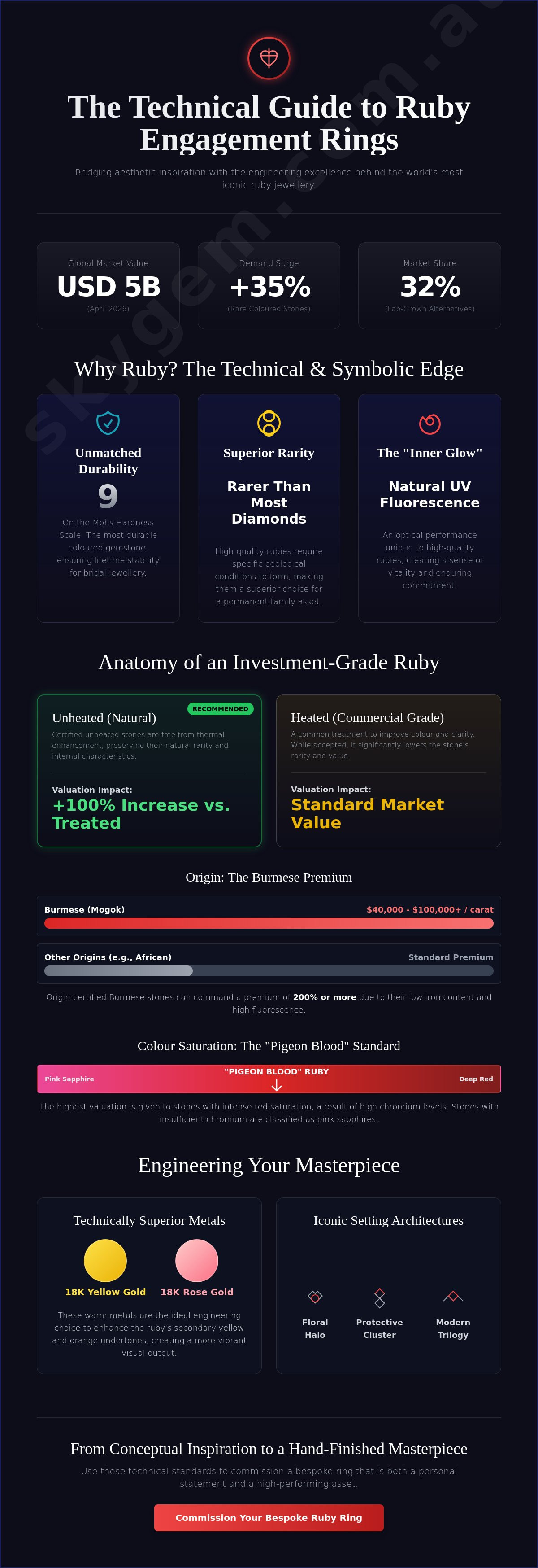
In April 2026, the global ruby market reached a valuation of USD 5 billion, driven by a 35% surge in demand for the rare stones found in famous ruby engagement rings. While most collectors recognize that a ruby's allure lies in its deep crimson hue, it's common to feel overwhelmed by the technical disparity between a commercial heated stone and a rare, unheated "Pigeon Blood" specimen. You might worry about the long-term durability of coloured gemstones or feel uncertain about distinguishing a natural investment from a lab-grown alternative, which now holds a 32% market share.
This guide helps you identify the architectural secrets behind the world's most iconic jewellery and provides the precise technical specifications required to commission your own bespoke masterpiece. You'll gain the confidence to navigate origin premiums, such as the $40,000 to $100,000 per carat range for unheated Mogok stones, ensuring your design is both a personal statement and a high-performing asset. We'll examine legendary celebrity styles alongside the latest 2026 gemmological standards to bridge the gap between aesthetic inspiration and engineering excellence.
Key Takeaways
- Evaluate the technical durability of the Corundum family, acknowledging that a Mohs hardness of 9 provides the stability required for permanent bridal installations.
- Analyze the structural balance of famous ruby engagement rings, from royal Burmese legacies to modern trilogy settings, to define your architectural style.
- Learn to prioritize colour saturation and "unheated" certification, which can increase a stone's valuation by up to 100% compared to treated alternatives.
- Identify why 18K yellow and rose gold are the technically superior metal choices for enhancing the thermal-like warmth of high-end red gemstones.
- Master the transition from conceptual inspiration to a hand-finished bespoke ring through a systematic and solution-oriented design process.
The Symbolic Power of Ruby Engagement Rings
The ruby has long been designated as the "King of Gemstones," a title derived from the Sanskrit word ratnaraj. As a primary member of the Corundum species, it shares its chemical lineage with the sapphire but stands apart due to its intense chromium content. Historically, these stones were reserved for royalty and high-ranking officials, symbolising a level of wealth and authority that surpassed even the clearest diamonds. This historical weight is a primary reason why famous ruby engagement rings continue to influence the high-end market in 2026.
From a technical perspective, the ruby's performance is exceptional. It registers a 9 on the Mohs scale of mineral hardness, making it the most durable coloured gemstone available for daily wear. This structural integrity ensures that a bespoke piece can withstand the rigours of a lifetime without the risk of significant abrasion or fracture. Understanding these ruby gemstone properties is essential for any collector moving beyond commercial-grade stones toward investment-grade assets. While diamonds remain a staple, the shift toward "colour-forward" luxury is evident; 2026 market reports show a 35% increase in the demand for ethically sourced, vibrant gemstones as couples seek to express individuality through architectural jewellery design.
Why Rubies are Surpassing Diamonds in Rarity
High-quality rubies are significantly rarer than white diamonds in nature. While diamonds are found in various grades across multiple continents, a ruby requires specific geological conditions to achieve the necessary red saturation. If the chromium levels are too low, the stone is technically classified as a pink sapphire, a distinction that carries significant weight in gemmological certification and valuation. For legacy-focused clients, this scarcity makes the ruby a superior choice for a permanent family asset that holds its value over decades.
The Psychology of the Red Gemstone
The allure of the ruby is often attributed to its "inner glow," a result of natural UV fluorescence that distinguishes it from similar-looking stones like garnet or spinel. This optical performance creates a sense of vitality and enduring commitment that other minerals cannot replicate. While our precious gemstones collection offers a variety of architectural options, the ruby remains the technical standard for those seeking a balance of protection, power, and passion. It's a choice that reflects a sophisticated understanding of both gemmological science and historical prestige.
Royal Legacies: The Burmese Ruby Influence
The historical prestige of famous ruby engagement rings is inextricably linked to the royal houses of Europe, specifically through the lens of Burmese origin. When Prince Andrew proposed to Sarah Ferguson in 1986, the choice of a Burmese ruby set within a floral diamond halo triggered an immediate shift in the global jewellery market. This wasn't merely an aesthetic preference; it was a technical statement regarding the value of provenance. By selecting a stone from Myanmar, the design adhered to the highest gemmological standards of the era. The choice of 18K yellow gold for the band was a deliberate engineering decision, as the warm metal enhances the ruby's secondary yellow and orange undertones, creating a more vibrant visual output.
Princess Margaret's engagement ring similarly showcased the power of bespoke engineering. Her ring was designed by Antony Armstrong-Jones to resemble a rosebud, honouring her middle name, Rose. This piece serves as a masterclass in how technical design can incorporate personal symbolism without compromising the stone's structural safety. By using a centralised cluster setting, the design provided a protective buffer for the ruby's facets, ensuring the piece remained a durable legacy asset. These historical examples prove that a ruby's value isn't just in its carat weight, but in the precision of its setting and the rarity of its source.
The Rarity of Burmese Origin
The geological conditions found in the Mogok Valley of Myanmar are unique because they produce stones with exceptionally low iron content. This lack of iron allows for a high level of fluorescence, giving the stone its characteristic "glow" even in low-light environments. In today's market, origin-certified stones command a significant premium, often exceeding the price of high-quality African rubies by 200% or more. For those seeking this specific level of rarity, our natural rubies collection provides examples of stones that meet these rigorous provenance standards. Understanding GIA's ruby quality factors is essential when evaluating these assets, as origin remains a primary driver of long-term value retention.
Structural Integrity in Royal Settings
While famous ruby engagement rings often rely on traditional aesthetics, the underlying engineering must prioritise the stone's physical safety. Historical royal settings often utilise a halo of diamonds not just for brilliance, but for mechanical protection. The surrounding diamonds act as a structural perimeter, absorbing impact and preventing the central ruby from coming into direct contact with hard surfaces. This architectural approach also serves to amplify the perceived carat weight by extending the visual boundary of the red hue. The "pigeon's blood" colour standard represents the pinnacle of ruby saturation and tone, characterised by a vivid red with a soft, fluorescent undertone that defines the world's most valuable specimens. If you are considering a similar investment, you might explore our custom design services to ensure your setting provides both aesthetic impact and long-term durability.
Celebrity Ruby Designs: From Trilogy to Vintage Aesthetics
Modern famous ruby engagement rings have transitioned from historical artifacts to high-fashion benchmarks, largely due to high-profile celebrity commissions that prioritise architectural impact. Jessica Simpson's 2010 engagement ring, designed by Neil Lane, remains a definitive reference for the trilogy setting. This piece features a 5-carat central ruby flanked by two pear-shaped diamonds, a configuration that requires meticulous weight distribution to maintain balance on the finger. When engineering such a substantial piece, the stone's height and the depth of the setting are critical factors in ensuring the ring doesn't sit too high, which could lead to snagging or structural stress.
Victoria Beckham's collection represents a different approach, where the ruby is treated as an evolving high-fashion asset. Her ruby engagement ring, an enormous oval-cut stone surrounded by a delicate diamond halo, demonstrates how scale can be managed through precise prong placement and a tapered band. In contrast, Eva Longoria's vintage-inspired ruby halo brought traditional aesthetics back to the mainstream. This design isn't just about the visual "bloom" of the diamonds; it provides a protective perimeter for the ruby's girdle, the most vulnerable part of the stone. For a more avant-garde aesthetic, Katy Perry's "flower" cluster design challenges standard solitaire conventions by using a central ruby as the heart of a floral arrangement, proving that famous ruby engagement rings can successfully blend botanical themes with high-end gemmology.
The Trilogy Setting: Engineering Balance
The trilogy setting, symbolising a couple's past, present, and future, is a technically demanding configuration for rubies. Because rubies have a high specific gravity, a 5-carat stone is physically smaller than a 5-carat diamond, requiring custom-fitted prongs to ensure a secure seat. According to GIA's guide to ruby quality factors, the cut's precision is vital for light return, especially when flanked by high-brilliance diamonds. Engineers must carefully align the facets of the side stones with the central ruby to prevent light leakage and maintain a cohesive visual flow across the three stones.
Vintage vs. Modern Minimalist Rubies
Choosing between a vintage halo and a modern minimalist design involves more than just taste; it's a decision about colour temperature and light management. Ornate halos, like Longoria's, use diamond reflection to brighten the ruby's red hue, whereas sleek solitaires rely entirely on the stone's internal fluorescence. Metal choice plays a decisive role here. While platinum offers a cool, industrial contrast, 18K Rose Gold can warm up a ruby with lighter saturation, making it appear deeper and more valuable. You can compare these architectural variations in our engagement rings collection to see how different metals influence the final photometric output of the stone.
Technical Evaluation: What Defines a World-Class Ruby?
Assessing the technical specifications of a ruby requires a specialised analytical framework that differs significantly from diamond grading. While clarity is the undisputed benchmark for white diamonds, colour saturation is the primary driver of value in the ruby market. Many famous ruby engagement rings feature stones that contain visible internal characteristics, yet their intense red hue secures their status as world-class assets. The most significant value multiplier in 2026 is "unheated" certification. Natural, untreated stones are increasingly rare; they typically command a 100% to 300% price premium over heated alternatives of similar visual appearance.
Clarity in rubies is often defined by the presence of "silk," which refers to microscopic rutile needles. These inclusions are essential because they provide definitive proof of a stone’s natural, unheated origin. In many cases, these features improve the stone's visual performance by diffusing light more evenly across the facets. Because the financial stakes are high, independent laboratory verification from the GIA or SSEF is a mandatory requirement. This ensures the stone's treatment status and origin are accurately documented, distinguishing investment-grade gems from commercial-grade stones that may contain lead-glass fillings or other artificial enhancements.
Colour Grading and Fluorescence
The technical spectrum of red spans from lighter pinkish-reds to the deep, saturated crimson found in the most prestigious specimens. This vibrant colouration is caused by chromium trace elements within the corundum crystal lattice. Chromium also triggers natural fluorescence under ultraviolet light, creating a signature "inner glow" that is visible even in indirect daylight. This effect gives the ruby its characteristic life and distinguishes it from less reactive stones like garnet or spinel. You can review the impact of these variables on current market valuations by accessing our ruby price guide.
The Importance of Cut Proportions
Precision cutting is an engineering tool used to optimise a stone's photometric output. A master cutter can adjust facet angles to "save" colour in lighter rough material or "brighten" a stone that might otherwise appear too dark. Poor proportions often result in a "window," which is an area of low light reflection where the background is visible through the stone. Conversely, an overly deep cut can lead to "extinction," where parts of the stone appear black and lifeless. An unheated ruby is a stone that has undergone no thermal enhancement since its extraction. This natural state is the gold standard for famous ruby engagement rings intended to serve as permanent family legacies.
To secure a stone that aligns with these high-level technical requirements, we invite you to explore our collection of investment-grade natural rubies.
Engineering Your Bespoke Ruby Engagement Ring
The transition from admiring famous ruby engagement rings to commissioning a personal masterpiece requires a structured, solution-oriented approach. While celebrity designs provide a high-level aesthetic conceptualisation, the engineering of a bespoke ring focuses on the intersection of architectural beauty and long-term durability. We don't simply replicate a visual style; we optimize the setting to suit the specific photometric properties of your chosen stone. This process ensures that your investment is not just a fashion statement but a permanent asset capable of withstanding the rigours of daily wear.
Material selection is a critical technical decision that directly influences the ruby's visible performance. We recommend 18K Yellow Gold or 18K Rose Gold for most ruby settings because these metals enhance the stone's warm red hues through subtle colour reflection. In contrast, while platinum offers a modern feel, it can occasionally make a lighter-toned ruby appear cooler or slightly more pink. Our commitment to ethical sourcing ensures that every stone in our collection is procured through transparent supply chains, providing you with the assurance of both quality and compliance with international sustainability standards.
From Concept to CAD
Our design team translates your 2D inspiration into a high-precision 3D CAD model, a phase where we address the structural integrity of the piece. We pay particular attention to the "prong-to-stone" ratio, ensuring that the metal provides maximum security without obstructing the light entry required for optimal fluorescence. This engineering stage allows us to verify that the setting's proportions are balanced, preventing the top-heavy issues often found in larger commercial rings. For a detailed look at how we manage these technical stages, you can explore our custom-made engagement ring process.
The SkyGem & Co. Consultation
A technical consultation is the most effective way to align your aesthetic goals with your budgetary requirements. We provide personalised gemstone sourcing, identifying specific hues and carat weights that mirror the prestige of famous ruby engagement rings while maintaining price-performance efficiency. During this session, we finalize the setting details to maximize both light performance and the durability of the prongs. This collaborative partnership ensures that the final product is a future-proofed asset that reflects your unique taste and our engineering standards. We invite you to book a technical consultation for your bespoke ruby ring to begin the design journey.
Securing Your Legacy with Ruby Excellence
The architectural brilliance found in famous ruby engagement rings is entirely achievable when you apply rigorous gemmological standards to your own design. By prioritising unheated, GIA-certified stones and selecting 18K gold alloys, you ensure your piece functions as both a high-performing asset and a visual masterpiece. Our approach integrates expert GIA-certified gemstone sourcing with a bespoke CAD-driven design process to guarantee structural precision from the initial render. Every ring we create features a hand-finished setting designed for superior durability, ensuring the stone's security for a lifetime of wear.
Whether you're inspired by royal Burmese legacies or modern celebrity trilogies, the transition from concept to reality requires a specialist who understands the intersection of engineering and aesthetics. We focus on the long-term performance of your jewellery, treating each project as a technical consultation rather than a simple transaction. We invite you to explore our collection of natural rubies and start your bespoke journey. We look forward to partnering with you to create a legacy piece that reflects your unique vision and our commitment to technical excellence.
Frequently Asked Questions
Are ruby engagement rings more expensive than diamond rings?
High-quality rubies often command a higher price per carat than white diamonds of comparable grade due to their extreme geological scarcity. In 2026, investment-grade unheated rubies from premium origins like Burma can reach valuations between $40,000 and $100,000 per carat for stones in the 1 to 2-carat range. While commercial heated rubies are more accessible, the top tier of the ruby market remains one of the most expensive sectors in the jewellery industry.
What is the most famous ruby engagement ring in history?
The Burmese ruby ring presented to Sarah Ferguson by Prince Andrew in 1986 is widely considered the most influential in modern history. This specific piece, featuring a vivid red stone surrounded by a ten-diamond floral halo, triggered a global shift toward coloured gemstone engagement rings that lasted throughout the decade. It remains a primary technical reference for designers looking to balance high-saturation colour with traditional diamond accents.
Is a ruby durable enough for an engagement ring I wear every day?
Rubies are exceptionally durable for daily wear, registering a 9 on the Mohs scale of mineral hardness. This rating makes them the second hardest natural gemstone available, surpassed only by diamonds. Because they lack a property called cleavage, they are highly resistant to chipping and breaking. This structural stability ensures that the facets of your ring remain sharp and the stone remains secure over decades of use.
What does 'unheated' mean when buying a ruby?
An 'unheated' ruby is a gemstone that has undergone no thermal enhancement to alter its colour or clarity since its extraction from the earth. Approximately 95% of rubies on the global market are heat-treated to improve their visual appearance. Because unheated stones are geological rarities that retain their natural state, they command a 100% to 300% price premium and are the preferred choice for famous ruby engagement rings intended as investments.
Why are Burmese rubies considered the best in the world?
Burmese rubies are prized for their unique geological composition, specifically a low iron content that allows for intense UV fluorescence. This lack of iron prevents the stone from appearing "flat" and instead creates a vibrant inner glow even in low-light environments. Their historical association with the "pigeon's blood" colour standard makes them the definitive benchmark for luxury and the most sought-after origin for high-end bespoke commissions.
Can I use a lab-grown ruby for a famous-inspired engagement ring style?
Lab-grown rubies are a technically viable and cost-effective alternative for those seeking the aesthetic of famous ruby engagement rings. In early 2026, lab-grown gemstones reached 32% market traction because they possess the same chemical, physical, and optical properties as natural corundum. They offer a sustainable, high-performance option that allows for larger carat weights and perfect colour saturation at a fraction of the cost of mined stones.
How do I care for and clean my ruby engagement ring?
You should clean your ruby ring using warm, soapy water and a soft-bristled brush to remove accumulated oils and debris. While rubies are chemically stable and resistant to most household cleaners, it's best to avoid harsh acids that could damage the metal setting. Professional ultrasonic cleaning is generally safe for untreated rubies, but you should have a specialist verify the stone's integrity every 12 months to ensure the prongs remain secure.
Which metal is best for a ruby engagement ring setting?
18K Yellow Gold or Rose Gold are the technically superior choices for enhancing the natural red saturation of a ruby. These warm metals reflect yellow and orange undertones back through the stone, making the crimson hue appear deeper and more vibrant. While platinum and white gold provide a high-contrast modern look, they can sometimes highlight pinkish secondary tones, which may be less desirable depending on the specific colour grade of your gemstone.
Disclaimer
This article is for general informational purposes only and may include AI-assisted content. Pricing, specifications, and availability are subject to change. For accurate advice and current information, please contact SkyGem & Co. directly. Nothing in this content constitutes professional or financial advice.