
Ethical Sourcing of Rubies: A 2026 Guide to Responsible Luxury

What if the most critical technical specification of a gemstone wasn't its refractive index or its saturation, but the verifiable data trail it leaves behind? You likely recognise that a ruby is an investment in both aesthetic excellence and long-term value. However, with 84% of high-net-worth investors now demanding full transparency according to 2025 industry benchmarks, the shift toward the ethical sourcing of rubies has moved beyond mere marketing sentiment into a rigorous requirement for technical compliance. The challenge lies in distinguishing between vague brand promises and the hard data required for genuine assurance.
We understand that for Australian collectors and professionals, clarity extends beyond the stone itself to include the entire supply chain. This guide provides the technical frameworks you need to verify a ruby’s origin, from blockchain-enabled mine-to-market traceability to the latest RJC certification standards. You'll gain a clear framework for auditing gemstone documentation. We'll examine how to interpret certification jargon and ensure your choice aligns with both your values and the stringent transparency benchmarks now expected in the high-end market.
Key Takeaways
- Understand the technical distinction between "conflict-free" and the holistic framework of ethical sourcing of rubies to ensure your investment aligns with global human rights and environmental standards.
- Learn how to verify a gemstone's provenance by interpreting reports from leading laboratories like GIA and GRS, ensuring the geographic origin is accurately documented.
- Evaluate the comparative ethical and carbon footprints of natural versus lab-grown rubies, considering both environmental data and the socio-economic impact on global mining communities.
- Utilise our practical buyer’s checklist to identify critical treatment disclosures, such as the value difference between unheated and flux-healed stones, before finalising your selection.
- Discover how SkyGem & Co. integrates transparent sourcing into the bespoke design process, providing Australian clients with the technical education required for long-term asset confidence.
What Does Ethical Sourcing of Rubies Actually Mean?
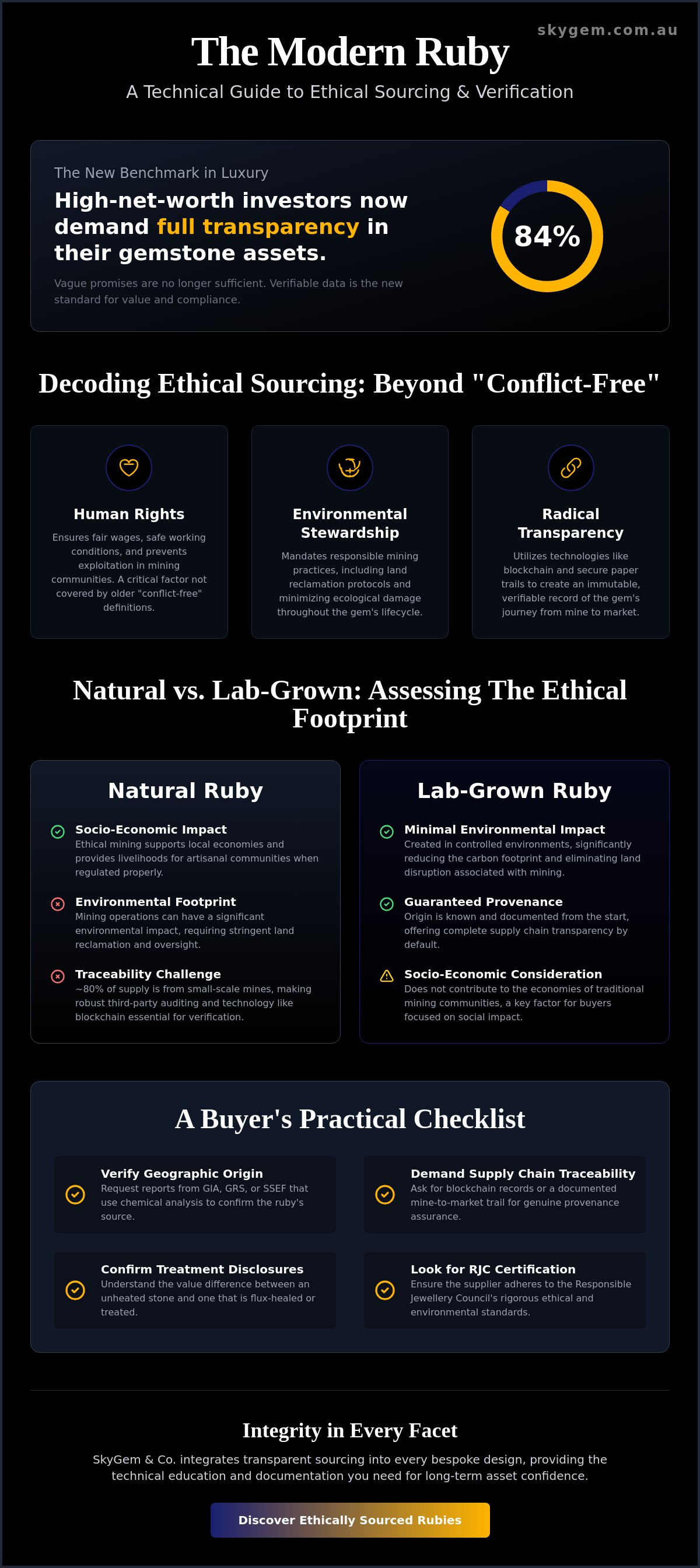
In 2026, the definition of luxury has moved beyond mere aesthetics to include the verifiable integrity of the supply chain. The ethical sourcing of rubies represents a technical intersection of human rights, environmental stewardship, and radical transparency. It's no longer sufficient for a stone to be labelled "conflict-free," a term that historically focused only on the absence of direct military financing. True ethical sourcing addresses the entire lifecycle of the gem, from the initial excavation to the final polish. This shift is critical because the ruby trade has long been obscured by complex, multi-layered supply chains that made tracing a stone's origin nearly impossible for most retailers.
Provenance has become the foundational element of gemstone value. A ruby's worth is now calculated through its physical characteristics and its documented journey. This focus on ethical sourcing of gemstones ensures that the environmental impact is minimised and that the local communities involved in extraction receive fair compensation. Transparency is the only way to mitigate the risks inherent in the global trade, where stones often change hands dozen of times before reaching a showroom.
The Shift Toward Responsible Luxury
Australian fine jewellery consumers are increasingly focused on sustainability and ethical compliance. A 2023 market report indicated that 64% of luxury buyers in major hubs like Melbourne and Sydney prioritised ethical origin over brand heritage. The Responsible Jewellery Council (RJC), established in 2005, has set rigorous standards that now govern a large portion of the global market. Rubies require more scrutiny than diamonds because approximately 80% of the world's supply originates from fragmented artisanal and small-scale mining. These operations are harder to monitor than large-scale diamond pipes, making rigorous third-party auditing essential for any ethically sourced ruby.
The "Pigeon’s Blood" Allure vs. Ethical Reality
The intense market demand for "Pigeon's Blood" rubies can inadvertently incentivise unregulated mining in high-risk areas. When market prices for specific hues spike, it often leads to increased activity in restricted zones where systemic human rights abuses occur. High-value gems from regions like the Mogok Valley have historically faced international sanctions due to their links to oppressive regimes. A "Conflict Ruby" is defined as a gemstone traded to fund regional instability or sourced through systemic human rights violations, highlighting significant gaps in the coloured gemstone industry that the Kimberley Process does not currently address. Choosing stones with clear documentation prevents the market from supporting these harmful practices.
- Human Rights: Ensuring fair wages and safe working conditions for all miners.
- Environmental Stewardship: Implementing land reclamation protocols after mining is complete.
- Transparency: Utilizing blockchain or secure paper trails to verify the stone's path.
The Technicalities of Traceability: Origins and Certification
Determining the geographic origin of a gemstone is the most reliable way to assess its environmental and social impact. For the ethical sourcing of rubies, the location dictates the regulatory oversight and labour standards applied during extraction. A stone's chemical signature acts as a geological passport, allowing major gemmological laboratories like the GIA, GRS, and SSEF to verify its source with high precision. These institutions use advanced laser ablation and mass spectrometry to identify trace elements unique to specific deposits, ensuring that a ruby marketed as "Burmese" or "Mozambican" is authentic to its claim.
Blockchain technology has moved from a theoretical concept to a practical tool in 2026. It provides an immutable digital ledger that records every change of hands from the mine mouth to the retail boutique. This transparency is vital for modern compliance. Several "Green Zones" have emerged as preferred sources for responsible procurement. Mozambique now accounts for approximately 40% of the world's ruby supply, with large-scale operations implementing structured social responsibility programmes. Sri Lanka remains a benchmark for low-impact, traditional mining, while Greenland, which began commercial production in 2017, operates under some of the world's strictest environmental and labour laws.
Deciphering Gemmological Reports
A standard report focuses on the stone's physical properties, such as dimensions and colour grade. However, a Full Provenance Report provides a documented chain of custody and often includes a detailed analysis of the stone's journey. Understanding traceability and certification is critical for high-value acquisitions. Natural ruby selection often requires professional report interpretation to distinguish between simple origin opinions and comprehensive provenance data. Look for terms like "verifiable source" or "documented chain of custody" to ensure the stone meets modern ethical benchmarks.
The Role of Artisanal and Small-Scale Mining (ASM)
Artisanal and Small-Scale Mining (ASM) accounts for roughly 80% of global ruby production. These miners often lack the capital for heavy machinery, which can lead to lower carbon footprints but creates complex challenges for oversight. Ethical jewellers support these communities through direct-source partnerships that bypass exploitative middle-men. Modern ethical mines must now adhere to strict environmental rehabilitation requirements, ensuring that land is restored to its natural state once mining concludes. This focus on long-term sustainability protects local biodiversity and provides economic stability for mining regions. When you evaluate a bespoke gemstone, prioritise stones that support these regulated ASM initiatives.
Natural vs. Lab-Grown Rubies: Assessing the Ethical Footprint
Evaluating the ethical footprint of a gemstone requires a rigorous analysis of both environmental data and socio-economic outcomes. Natural ruby extraction involves physical geological displacement, yet modern Australian-led standards focus on land rehabilitation and transparent supply chains. Conversely, lab-grown rubies, often produced via the Czochralski or Flame Fusion methods, eliminate physical land disturbance but demand massive electrical loads. A single lab-grown gemstone can require between 250 and 750 kWh of energy per carat. If this energy is sourced from coal-heavy grids, the carbon intensity can exceed that of a responsibly managed natural mine. Ethical sourcing of rubies in 2026 prioritises transparent energy reporting for laboratories and strict land-use compliance for mines.
The social impact of this choice is equally complex. While lab-grown stones offer a conflict-free guarantee, they do not support the 40 million people globally who rely on artisanal and small-scale mining. In regions like Mozambique, ruby mining provides the primary economic infrastructure for local education and healthcare. Shifting demand entirely to laboratories risks destabilising these communities. A balanced approach to the ethical sourcing of rubies involves supporting operations that provide fair wages and safe working conditions, ensuring that luxury consumption drives regional development.
The Case for Natural, Unheated Rubies
Unheated rubies represent the pinnacle of natural luxury, accounting for less than 1% of total global production. These stones are prized because they possess the clarity and colour required to bypass traditional thermal enhancement. Because their internal structures remain unaltered, gemmologists use spectral analysis to identify microscopic inclusions that act as a geological fingerprint. This makes provenance verification significantly more reliable. Since 2024, investors have increasingly sought these stones for their scarcity and the robust documentation that accompanies them. You can explore our collection of Unheated rubies for investment-grade quality that maintains its value over decades.
Lab-Grown Rubies: A Sustainable Alternative?
For those prioritising a 100% conflict-free guarantee without the premium price of a natural stone, lab-grown rubies offer a compelling solution. These gems are chemically and physically identical to their natural counterparts. Their ethical value depends heavily on the laboratory's energy source. Leading producers have transitioned to 100% renewable energy to mitigate the high carbon cost of plasma reactors. While lab-grown rubies lack the long-term resale value of natural stones, they provide a technically perfect aesthetic for a fraction of the cost. This makes them a practical choice for contemporary designs where the focus is on architectural beauty rather than asset appreciation.
How to Verify Ruby Provenance: A Buyer’s Practical Checklist
Verifying the provenance of a ruby requires a methodical approach to technical data. By 2026, the global luxury sector has shifted toward radical transparency, meaning buyers have more access to supply chain information than ever before. You can't rely on verbal assurances alone; you need a documented trail that confirms the ethical sourcing of rubies through every stage of the procurement process.
Start with the Gemmological Report. A reputable report from laboratories like the Swiss Gemmological Institute (SSEF), Gübelin, or the Gemological Institute of America (GIA) should explicitly state the geographic origin. This data isn't just for prestige; it's a vital component of risk management. Knowing if a stone originated in Mozambique versus a high-conflict zone is the first step in ethical verification.
- Treatment Disclosure: Demand to know if the stone is unheated or has undergone flux-healing. Flux-healing uses borax or other lead-glass materials to fill fractures, which can compromise the stone's long-term durability and value.
- Sourcing Policy: Confirm the jeweller maintains a written commitment to the Responsible Jewellery Council (RJC). As of 2025, the RJC has over 1,500 members committed to audited ethical standards.
- Supply Chain Documentation: Ask for invoices or certificates of origin that trace the stone back to a specific mine or a regulated regional hub.
Crucial Questions for Your Jeweller
When you consult with a specialist, use this script to gauge their technical oversight: "Can you provide the GRS or GIA report number for this stone so I can verify its origin and treatment history in their online database?" and "What specific ethical protocols do your primary suppliers follow to ensure fair labour practices?" In the 2026 luxury market, "I don't know" is an unacceptable answer that suggests a lack of professional due diligence. Chain of Custody refers to the documented sequence of custody, control, and transfer of a gemstone from its initial extraction at the mine to the final point of sale.
Red Flags to Avoid
Be wary of stones described with vague origins like "Asian" or "African" without a specific country or mine identified. These generalisations often mask a lack of transparency. Avoid rubies sourced from regions under international sanction, such as certain entities in Myanmar, where gemstone sales have historically funded military regimes. Independent laboratory verification is non-negotiable for any high-value investment. Our Bespoke Design Service prioritises fully transparent gemstone procurement to ensure your investment meets the highest ethical standards.
If a deal seems too good to be true, it likely involves undisclosed treatments or unethical labor practices. High-quality, ethically sourced rubies maintain a premium price point because of the rigorous compliance and safety standards required at the source. Prioritise technical accuracy and documented history over a lower price tag to ensure your jewellery remains a lasting asset.
Ready to secure a stone with a verified history? Browse our collection of ethically sourced rubies today.
Bespoke Craftsmanship and Transparent Sourcing at SkyGem & Co.
SkyGem & Co. operates at the intersection of technical excellence and moral responsibility. We treat the ethical sourcing of rubies as a core engineering requirement rather than a secondary consideration. Every bespoke project begins with a rigorous assessment of the gemstone's provenance, ensuring that the supply chain is visible and verifiable. Our specialists act as technical consultants, providing the data necessary for clients to understand the geological and ethical profile of their chosen stone. This technical approach removes the ambiguity often found in the gemstone trade, replacing it with hard data and certified origins.
Education is a fundamental pillar of our service. We don't just sell gemstones; we provide a comprehensive breakdown of the "why" behind every selection. This involves explaining the impact of mining practices on local communities and the environmental protocols followed by our suppliers. By prioritising transparency, we ensure that every client feels confident in the long-term value and integrity of their investment. Our commitment to these standards reflects a broader shift in the 2026 luxury market toward accountability and traceability. We believe that a client who understands the complexities of the supply chain is better equipped to appreciate the true value of their jewellery.
The Bespoke Journey: From Ethical Source to Finished Ring
The journey of a SkyGem & Co. ring starts with the selection of a loose ruby that meets our strict ethical and aesthetic benchmarks. Clients work directly with our designers to match their selected stone with a custom-engineered setting. This collaborative process ensures that the structural integrity of the ring complements the unique characteristics of the ruby. You can Browse our Engagement Ring Collections for inspiration or explore our options for custom-made engagement rings to understand our design and manufacturing protocols. This methodical approach ensures the finished piece is both an architectural achievement and a symbol of responsible luxury.
Commitment to Quality and Compliance
Adherence to the Australian Consumer Law and international ethical standards is central to our operations. We maintain a robust compliance framework that monitors every stage of the procurement process. This dedication to regulatory excellence protects our clients and ensures that the ethical sourcing of rubies remains a consistent reality. We believe that a specialist who understands the Australian regulatory landscape provides a level of security that global corporations often lack. Our local expertise allows us to navigate complex import requirements while maintaining a hands-on approach to quality control.
Our philosophy is straightforward: a truly beautiful ring must have a beautiful history. We reject the idea that luxury can exist in isolation from the people and environments that produce it. A piece of jewellery is a permanent asset, and its value is inextricably linked to the integrity of its origins. We invite you to experience this commitment to excellence firsthand through a personalised viewing of our collection.
Securing Your Investment Through Transparent Provenance
Selecting a ruby in 2026 requires a focus on rigorous verification and geological integrity. The ethical sourcing of rubies is no longer a niche preference; it's a technical requirement for any high-value acquisition. By prioritising GIA or GRS certified gemstones, you ensure that every facet of the supply chain meets international standards for transparency. These certifications provide the granular data necessary to verify a stone's origin and treatment history. Precision matters.
At SkyGem & Co., we specialise in unheated natural rubies, which retain their inherent value and character without the need for high-heat interventions. Our commitment to bespoke Australian craftsmanship means your investment supports local expertise and stringent compliance standards. Choosing a gemstone with a documented provenance protects the long-term viability of your collection and the communities involved in its extraction. We invite you to explore our curated collection of ethically sourced natural rubies and discover the technical precision behind our sourcing process. Your journey toward a responsible luxury asset starts with a partnership built on transparency and technical excellence.
Frequently Asked Questions
Is there a "Kimberley Process" for rubies?
There is no Kimberley Process for rubies as this specific international certification scheme applies exclusively to rough diamonds. Instead, the coloured gemstone industry relies on the OECD Due Diligence Guidance for Responsible Supply Chains, which was updated in 2016 to better encompass minerals from conflict-affected areas. Responsible Australian retailers often utilize third-party audits from the Responsible Jewellery Council (RJC) to verify their supply chains and ensure compliance with international human rights standards.
Are Mozambique rubies considered ethically sourced?
Mozambique rubies are considered ethically sourced when they originate from large-scale, regulated operations like the Montepuez mine, which contributes approximately 40% of the world's ruby supply. These sites often implement community programs and environmental reclamation projects. However, rubies from informal artisanal sectors in the Cabo Delgado region carry higher risks of human rights concerns. You should request documentation that confirms the stone was sourced from a site with independent ESG auditing to ensure its integrity.
Why are unheated rubies more expensive if they are more ethical?
Unheated rubies command a premium primarily because of their extreme rarity, as approximately 95% of all rubies undergo thermal enhancement to improve colour and clarity. While unheated stones represent a more natural state, their price reflects a supply-and-demand imbalance rather than a direct cost of ethical compliance. In the context of the ethical sourcing of rubies, these stones are prized because their high value incentivizes formal, traceable mining practices that are easier to monitor.
Can lab-grown rubies be distinguished from natural rubies?
Lab-grown rubies are chemically identical to natural stones, but they can be distinguished through advanced gemological testing and microscopic analysis. Professionals look for specific growth patterns, such as curved striae in flame-fusion stones or flux inclusions in hydrothermal rubies, which differ from the natural silk or mineral inclusions found in earth-mined gems. Standard testing equipment in Australian labs can identify these synthetic markers with 100% accuracy, ensuring you know exactly what you are purchasing for your project.
What is the most ethical country to source rubies from in 2026?
Greenland is widely regarded as the most ethical source for rubies in 2026 due to its stringent 2017 Mineral Resources Act and high labour standards. These mines operate under strict environmental protections and provide transparent tracking from the mine to the finished gem. While Thailand remains a major cutting hub, sourcing directly from Greenland or small-scale Australian deposits ensures the highest level of regulatory compliance and social responsibility within the current global gemstone market.
Does GIA certification guarantee a ruby is conflict-free?
A GIA report doesn't guarantee a ruby is conflict-free; it provides a technical analysis of the stone's characteristics and a geographic origin opinion. While knowing the origin is a critical step in the ethical sourcing of rubies, the GIA doesn't audit the labour practices or environmental impact of specific mines. To ensure a stone is truly responsible, you must combine a GIA report with a chain-of-custody document or a provenance claim from a certified member of the RJC.
How does ethical sourcing affect the resale value of a ruby ring?
Ethical sourcing significantly enhances the resale value of a ruby ring by providing a documented provenance that modern buyers increasingly demand. Market data from 2024 indicates that gemstones with fully traceable supply chains can command a 10% to 15% price premium on the secondary market. As transparency becomes a standard requirement for luxury assets, stones lacking verifiable ethical credentials may face limited liquidity and lower valuation assessments from professional Australian appraisers during the resale process.
What should I do if a jeweller cannot provide an origin report for a ruby?
If a jeweller cannot provide an origin report or traceability documentation, you should reconsider the purchase or request an independent appraisal from a qualified gemologist. Lack of documentation often indicates a fragmented supply chain where the stone has passed through multiple untracked intermediaries. In the Australian luxury market, a reputable specialist should be able to provide a report from a recognized laboratory, such as the GIA or SSEF, to verify the ruby's geographic source before you commit.
Disclaimer
This article is for general informational purposes only and may include AI-assisted content. Pricing, specifications, and availability are subject to change. For accurate advice and current information, please contact SkyGem & Co. directly. Nothing in this content constitutes professional or financial advice.