
Emerald Rings & Jewellery: The Expert Guide to Selecting the Perfect Green Gemstone

What if the internal "flaws" of a gemstone were actually the most critical data points for determining its long-term structural integrity? While many buyers prioritize carat weight, the complex internal "jardin" of an emerald dictates whether a stone can withstand the physical rigors of daily wear or if it remains prone to cleavage. You likely recognize that finding a precise balance between botanical beauty and structural durability is the primary challenge when investing in high-quality emerald rings jewelry.
It's a valid concern for any serious collector, especially since over 92% of emeralds in the global market undergo some form of clarity enhancement. This guide provides the technical framework you need to evaluate stone treatments and avoid "muddy" specimens that lack true luminous efficacy. You'll learn to navigate the 4Cs with the precision of a technical consultant, ensuring your selection meets the rigorous standards of Australian design and ethical compliance. We'll examine secure setting engineering for Melbourne engagement rings and the specific value benchmarks for various oiling levels within the current A$ market.
Key Takeaways
- Understand why emeralds are emerging as the premier choice for non-diamond engagement rings in 2026, representing a sophisticated balance of rebirth and enduring love.
- Master the technical nuances of emerald quality by prioritising colour saturation and learning why internal inclusions, known as the "jardin," are a celebrated characteristic.
- Learn the essential maintenance protocols required to protect your investment in emerald rings jewelry, specifically regarding thermal shock and impact resistance.
- Discover the strategic advantage of selecting a loose emerald before the setting process to ensure the gemstone’s geometry perfectly aligns with your bespoke design.
- Explore the benefits of a professional consultation in Melbourne to evaluate the structural and aesthetic differences between natural and lab-grown gemstones.
The Allure of Emerald Jewellery: Why This Gemstone Defines Sophistication
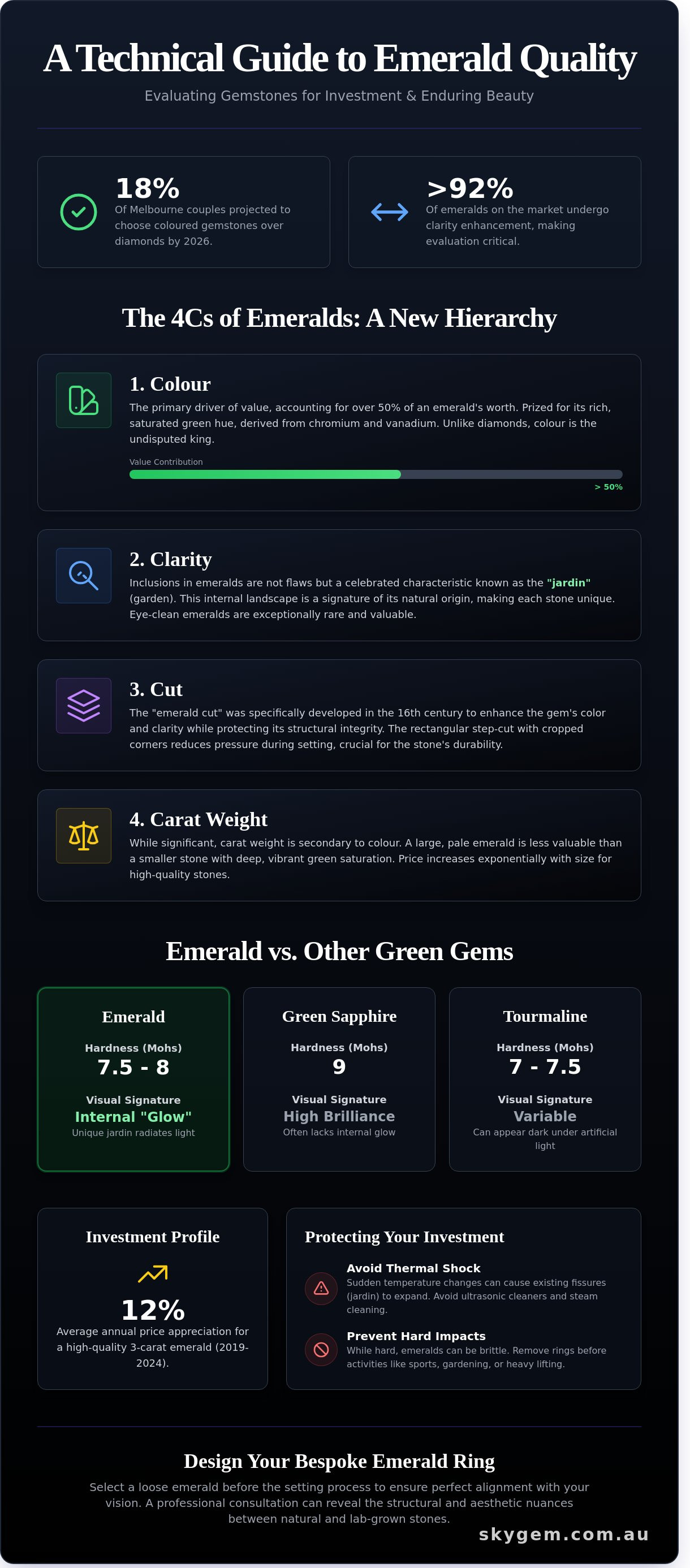
Emeralds have reclaimed their status as the premier selection for non-diamond engagement rings. Market projections for 2026 indicate that approximately 18% of couples in Melbourne are now opting for coloured gemstones over traditional diamonds to anchor their bridal sets. This shift reflects a growing desire for individuality and a connection to heritage. These stones represent rebirth, fertility, and enduring love; qualities that resonate with modern couples seeking depth in their emerald rings jewelry. The rich green hue offers a level of distinction that clear stones cannot replicate, making them a cornerstone of contemporary Australian luxury.
The historical pedigree of these stones is unmatched by almost any other mineral. Cleopatra famously claimed ownership of Egypt's mines in 47 BC to secure her personal supply, establishing the gem as a symbol of royal authority. Today, this legacy continues on Melbourne red carpets at events like the Logies, where high-jewellery emerald pieces are frequently featured as the primary statement accessory. Beyond their aesthetic appeal, natural emeralds retain value with a stability that rivals many traditional assets. A high-quality 3-carat emerald from reputable origins saw an average price appreciation of 12% annually between 2019 and 2024. For those seeking technical details on these properties, this comprehensive guide to emeralds provides an extensive overview of their mineralogical structure and cultural impact.
The Vibrant History of the Green Beryl
Emeralds are a variety of the mineral beryl. Their distinctive hue arises from trace amounts of chromium and vanadium within the crystal lattice. This specific chemical interaction produces the "emerald green" shade that remains unique in the mineral kingdom. The "emerald cut" was originally developed in the 16th century to address the stone's inherent structural vulnerabilities. By utilising a rectangular step-cut with cropped corners, lapidaries reduced the physical pressure on the gemstone during the setting process. This design choice highlights the stone's clarity and colour saturation while ensuring the long-term durability of emerald rings jewelry in daily wear.
Emerald Rings vs. Other Coloured Gemstones
When you compare emeralds to green sapphires or tourmalines, the visual difference is immediately apparent to the trained eye. While sapphires offer a higher hardness of 9 on the Mohs scale, they often lack the internal "glow" or jardin found in high-quality emeralds. Tourmalines can appear darker or lose their vibrancy under the artificial lighting typical of Melbourne's office environments. High-quality emeralds possess a unique refractive profile that makes them appear to radiate light from within. This luminosity is a primary reason why clients frequently select them for bespoke engagement rings. Choosing an emerald is a decision that balances architectural elegance with a proven historical value. It's a choice for those who value performance and aesthetic permanence over temporary trends.
- Chemical Composition: Beryllium aluminium silicate with chromium/vanadium traces.
- Investment Profile: Consistent 10-15% annual growth for investment-grade stones.
- Visual Signature: Distinctive "jardin" inclusions that prove natural origin.
- Cultural Status: The birthstone for May and the traditional gift for 20th anniversaries.
The selection of an emerald requires a technical understanding of clarity and origin. Unlike diamonds, where inclusions are often viewed as flaws, the internal "garden" of an emerald is a signature of its natural formation. This makes every stone entirely unique. For the Melbourne buyer, this means owning a piece of jewellery that cannot be replicated by mass-market manufacturing. It's an investment in a specific geological moment, captured in a vibrant green crystal that has fascinated humanity for millennia.
Evaluating Quality: The 4Cs of Emerald Rings
Selecting high-quality emerald rings jewelry requires a different technical lens than evaluating diamonds. While the 4Cs remain the industry standard, the hierarchy of these factors shifts significantly for coloured gemstones. Colour acts as the primary driver of market value; it often accounts for 50% or more of the stone's final valuation. Understanding how these variables interact is essential for any professional procurement process or personal investment.
Decoding the Emerald Colour Scale
The evaluation of colour involves three distinct components: hue, tone, and saturation. The most coveted emeralds display a vivid green hue, sometimes with a slight bluish secondary tint. If a stone exhibits too much yellow or appears overly grey, its value drops significantly. According to GIA's guide to emerald quality, stones that are too light are classified as green beryl rather than emeralds. Saturation is the intensity or purity of the green hue.
Lighting conditions play a critical role in how these stones perform. In our Melbourne boutique, we utilize 5500K colour-balanced lighting to replicate natural daylight. This ensures you observe the stone's true colour profile without the warm interference of standard halogen bulbs, which can mask yellowish undertones. We focus on stones that maintain their "open" colour even in lower light environments, avoiding "extinction" where the stone appears black in certain areas.
Understanding Emerald Clarity and Treatments
Emeralds are classified as Type III gemstones, which means they almost always contain visible internal characteristics. We refer to these inclusions as the "Jardin," a French term for garden. These mossy, needle-like structures are a hallmark of natural formation and serve as a microscopic map of the stone's origin. A stone that appears perfectly clear to the naked eye at a mid-range price point is a red flag for synthetic materials.
To manage these natural fissures, the industry utilizes stability treatments. Approximately 99% of natural emeralds are treated with colourless cedarwood oil to fill surface-reaching inclusions and improve transparency. This is a standard, reversible process that doesn't compromise the stone's integrity. However, you should be wary of modern "fillers" like hardened resins or lead-glass. These are considered non-standard and can drastically reduce the stone's long-term durability and resale value. If you're looking for technical guidance on selecting a stable stone, you can view our curated collection of ethically sourced emeralds.
- Hue: The primary green colour and any secondary tints.
- Tone: The degree of lightness or darkness, with 60% to 70% being the ideal range for emeralds.
- Saturation: The vividness of the colour, ranging from dull to vivid.
- Stability: The level of oil treatment, typically graded from "Insignificant" to "Significant" on lab reports.
The Impact of Cut and Carat Density
The "emerald cut" was specifically engineered to protect the stone from mechanical stress while maximizing its vibrant green output. A master cutter balances the trade-off between weight retention and light return. If the pavilion is cut too shallow, the light passes straight through, creating a "window" that lacks colour. If it's too deep, the stone becomes "heavy" and dark. Precision faceting ensures that light reflects internally to intensify the saturation.
Carat weight in emeralds doesn't translate to size the same way it does in diamonds. Emeralds have a lower specific gravity of 2.72, compared to a diamond's 3.52. Practically, this means a 1.00-carat emerald will physically appear about 20% larger than a 1.00-carat diamond of the same shape. This lower density allows for a more significant visual impact on the finger for the same weight, making them a high-performance choice for statement jewelry design. We recommend focusing on the millimetre dimensions rather than the carat weight alone to ensure the stone fits your intended setting perfectly.
Emerald Durability: Protecting Your Investment
Emeralds occupy a unique position in the world of gemmology, ranking between 7.5 and 8 on the Mohs scale. While this indicates a high resistance to surface scratching, it's essential to distinguish between hardness and toughness. Most emeralds possess internal inclusions, often referred to as a "jardin," which are intrinsic to the stone’s character. These features are central to emerald quality factors, but they also represent structural pressure points. A sharp impact against a hard surface, such as a stone countertop or a car door, can cause these internal fissures to expand, leading to a chip or a significant fracture.
Thermal shock is another critical risk factor for emerald rings jewelry. Sudden temperature fluctuations can cause the gemstone to expand or contract unevenly, resulting in structural failure. This vulnerability extends to cleaning methods. Never clean emerald jewellery in an ultrasonic or steam cleaner, as the heat and vibrations can remove the natural oils that stabilise the stone. Since approximately 90% of emeralds undergo oil treatment to improve clarity, losing these stabilising agents leaves the stone looking dull and increases its fragility. Professional maintenance, including re-oiling every 3 to 5 years, ensures the stone remains vibrant and secure within its mounting.
Choosing the Right Setting for Daily Wear
Selecting a protective setting is the most effective way to future-proof your investment. Bezel settings, which wrap a continuous 18K gold or platinum rim around the stone's perimeter, offer the highest level of protection against edge impacts. If you prefer a more traditional look, halo settings provide a physical buffer of smaller diamonds that absorb peripheral shocks. The classic "emerald cut" itself is an exercise in functional design; its cropped corners are specifically engineered to eliminate the sharp points most prone to chipping. Platinum is often the preferred metal for prongs due to its superior density and "memory," which ensures the stone stays locked in place even after years of microscopic wear.
Proactive Care for Emerald Jewellery
Daily habits dictate the lifespan of your gemstone. You should remove your ring before engaging in high-impact activities, such as gym sessions or heavy housework, where the risk of mechanical shock is high. Chemicals found in common household cleaners can react with the oils inside the stone, so it's best to take the ring off before washing dishes or applying lotions. Establishing a routine of gentle cleaning at home using only lukewarm water and a soft-bristled brush will prevent the buildup of oils and debris that obscure the stone's brilliance.
Professional oversight is the final pillar of emerald care. You should book a structural check with a Melbourne jeweller at least once every 12 months. During these inspections, a specialist will use high-magnification tools to check for thinning prongs or shifted stones that aren't visible to the naked eye. This proactive approach identifies minor wear before it results in the loss of a stone. By combining a secure setting with regular professional audits, you ensure your emerald rings jewelry remains a durable asset that maintains its aesthetic and financial value for decades.
Designing Your Bespoke Emerald Ring
Selecting loose emeralds before committing to a setting is the most technically sound approach to bespoke design. This method allows for a comprehensive 360-degree inspection of the stone's "jardin," the unique internal inclusions that define an emerald's character. By evaluating the stone unmounted, you can accurately assess its pleochroism and structural integrity without the obstruction of metal prongs. This transparency ensures that the primary investment is sound before the manufacturing process begins.
Matching emerald shapes to hand proportions requires an understanding of visual balance and geometry. An emerald cut, with its long, linear facets, creates a sophisticated architectural look that suits most hand types. For those seeking to elongate the appearance of the fingers, an oval or pear-shaped stone provides a vertical axis that can visually extend the hand by 10% to 15%. Your personal style should guide the choice between the vintage appeal of a cushion cut and the modern, sharp lines of a step-cut stone.
Integrating diamonds into emerald rings jewelry provides a high-contrast environment that amplifies the gemstone's saturation. The timeless halo setting is a functional choice; it creates a protective perimeter around the emerald while increasing the overall brilliance of the piece. A trilogy design, featuring two flanking diamonds, offers a balanced aesthetic that focuses the eye on the central stone. This configuration remains a staple in Melbourne's bespoke market due to its classic proportions and symbolic depth.
Metal selection involves a trade-off between aesthetic warmth and physical durability. 18ct yellow gold is a traditional pairing that complements the yellow-green undertones of many stones, creating a cohesive, warm glow. Conversely, platinum or 18ct white gold provides a crisp, neutral framework that allows the emerald's green to pop with maximum intensity. Platinum is particularly valued for its density and "memory," which provides superior security for the claws holding your gemstone in place over decades of wear.
Sourcing Ethical and High-Quality Stones
Understanding the origin is critical for determining value and long-term appreciation. Colombian emeralds are historically prized for their chromium-rich saturation, while Zambian stones often display a cooler, bluish-green hue and higher clarity levels. Market data from late 2023 shows that Colombian stones of equivalent grade often command a 30% to 45% price premium. SkyGem & Co. prioritises GIA or reputable laboratory certification to ensure every stone meets strict ethical standards and transparency requirements. We maintain a verified supply chain to guarantee that your investment supports responsible mining practices.
The Custom Design Process in Melbourne
The journey from concept to completion is a collaborative technical partnership. We begin with a consultation where our gemmologists help you source a stone that fits your A$6,000 or A$60,000 budget. Using high-resolution CAD software, we create a digital 3D model of your ring, allowing for adjustments to the setting height and prong thickness down to the tenth of a millimetre. Once the digital prototype is approved, our local master jewellers handle the casting and hand-setting in our Melbourne studio. This ensures the emerald rings jewelry we produce are not just beautiful, but engineered to survive the rigours of daily life.
Start your journey by exploring our curated selection of ethically sourced loose emeralds and consult with our design team today.
The SkyGem & Co. Experience in Melbourne
Located in the historic Royal Arcade, a landmark of Melbourne's retail architecture since 1870, SkyGem & Co. provides a sophisticated environment for selecting emerald rings jewelry. We operate through private consultations to ensure every client receives our undivided technical attention. This one-on-one approach allows us to function as consultants rather than mere retailers; we focus on the engineering behind the setting and the specific optical properties of the stone. It's about providing a quiet space where you can evaluate gemstones under professional lighting conditions without the pressure of a traditional showroom.
Local Melbourne craftsmanship offers a level of precision that mass-produced imports cannot match. Off-the-shelf rings often suffer from casting porosity or insufficient metal weight in high-stress areas like the prongs or the base of the shank. At SkyGem & Co., our jewellers prioritise structural durability. By manufacturing locally, we maintain a 100% oversight rate on every component. This ensures your emerald is secure and the metalwork meets rigorous Australian standards for purity and strength. We don't cut corners on the thickness of the band or the security of the setting.
We provide access to both earth-mined and lab-grown gemstones to suit diverse requirements. Our technical team explains the chemical and physical identicality of lab-grown stones, allowing for a transparent decision-making process. We believe an informed client is a satisfied partner. We provide detailed specifications on clarity, treatment, and origin, removing the ambiguity often found in high-end jewellery purchases. Whether you're looking for a stone with a specific refractive index or a particular origin profile, we provide the data you need.
Why Choose SkyGem & Co. for Your Emerald Ring?
Choosing us means gaining access to a highly curated selection of natural emeralds, each vetted for its specific hue and saturation. As a family-owned boutique, we value long-term reliability over short-term sales. Every piece we produce includes a lifetime manufacturing warranty and complimentary professional maintenance. This ensures your investment remains protected against the rigours of daily wear. We've built our reputation on this commitment to quality and service since we first opened our doors.
Start Your Journey Today
You can begin your search by visiting our Melbourne boutique to view our ready-to-wear collection. If you prefer a unique design, our bespoke process involves detailed 3D renders and material selection to meet your exact specifications. Our team is ready to guide you through the technical nuances of emerald rings jewelry to ensure the final product exceeds expectations. Contact us today to begin your bespoke emerald journey and secure a piece of Melbourne-made excellence.
Securing Your Investment in Fine Emerald Gemstones
Selecting high-quality emerald rings jewelry requires a methodical approach to the 4Cs, particularly when assessing the clarity and saturation of a stone's vivid green hue. Since emeralds rank between 7.5 and 8 on the Mohs scale of hardness, ensuring your setting provides structural protection is vital for a piece intended to last generations. Our GIA-trained consultants provide the technical data needed to verify origin and treatment levels, ensuring your acquisition meets international grading standards. We focus on transparency so you can invest with absolute confidence in the stone's long-term performance.
At SkyGem & Co., we combine this analytical rigour with the artistry of bespoke, hand-finished craftsmanship. Located in Melbourne's historic Royal Arcade, our studio offers a specialist service where technical specifications meet architectural beauty. Our consultants guide you through the intersection of gemstone durability and custom design to create a permanent asset. Explore our exquisite collection of Emerald Rings and loose gemstones to begin your journey with a partner dedicated to excellence. We look forward to helping you secure a gemstone that perfectly reflects your unique vision.
Frequently Asked Questions
Is an emerald ring suitable for an engagement ring?
Emeralds are a sophisticated choice for engagement rings, provided the setting prioritises structural protection. While diamonds rate a 10 on the Mohs scale, emeralds sit between 7.5 and 8.0, making them susceptible to impact damage if left exposed. We recommend a bezel or halo setting to safeguard the stone's edges. This ensures the longevity of your emerald rings jewelry investment in the demanding Australian lifestyle.
What is the most expensive cut for an emerald?
The traditional emerald cut remains the most premium and expensive option due to the high percentage of rough material lost during the shaping process. This rectangular step-cut accounts for approximately 50% to 60% of the initial gem weight being removed to achieve optimal clarity and colour saturation. Its elongated facets are designed to highlight the stone's internal depth while minimising the risk of mechanical stress on the crystal structure.
How can I tell if an emerald is real or synthetic?
Identifying an authentic emerald requires a microscopic examination of internal inclusions, often referred to as the Jardin. Synthetic stones, created via hydrothermal or flux-growth methods, typically display uniform internal structures or chevron-shaped growth lines. In contrast, 99% of natural emeralds contain three-phase inclusions consisting of fluid, gas, and solid crystals. For definitive verification, always request a certificate from a laboratory such as the Gemological Institute of America (GIA).
Why do most emeralds have inclusions (the Jardin)?
Inclusions are a natural byproduct of the emerald's violent geological formation, where beryllium, chromium, and vanadium interact under extreme pressure. Over 95% of natural emeralds exhibit these internal characteristics, which experts call the Jardin. These features aren't flaws but are essential markers of the stone's identity. They serve as a geological fingerprint that confirms the gemstone's organic origin and distinguishes it from mass-produced synthetic alternatives.
Do emeralds need to be oiled regularly?
Most emeralds undergo a clarity enhancement process using cedar oil to fill surface-reaching fissures. This isn't a DIY task but a professional maintenance requirement every 3 to 5 years, depending on wear patterns. Exposure to harsh detergents or ultrasonic cleaners can strip these oils, causing the stone to appear cloudy. Maintaining your emerald rings jewelry through professional re-oiling ensures the stone retains its refractive index and vibrant green hue.
Can I wear my emerald ring every day?
You can wear an emerald ring daily if you adopt a conscious maintenance routine. Emeralds are more brittle than sapphires, so it's vital to remove the ring before high-impact activities or exposure to household chemicals. Statistics show that 80% of gemstone damage occurs during manual tasks like gardening or gym sessions. Treating the piece as a fine technical instrument rather than a robust utility item will extend its service life indefinitely.
How much should I expect to spend on a high-quality emerald ring in Australia?
In the Australian market, a high-quality 1-carat emerald ring typically ranges from A$4,500 to A$12,000. Factors such as Colombian origin or "no-oil" certification can push prices for 2-carat specimens beyond A$25,000. These figures reflect current 2024 market benchmarks and include the 10% GST. Investing in a stone with a reputable lab report ensures you're paying for verified performance and long-term asset value.
Disclaimer
This article is for general informational purposes only and may include AI-assisted content. Pricing, specifications, and availability are subject to change. For accurate advice and current information, please contact SkyGem & Co. directly. Nothing in this content constitutes professional or financial advice.