
Durability of 14k vs 18k Gold: The Definitive Guide for Engagement Rings

Selecting the most expensive gold alloy for your engagement ring could be the very factor that leads to a lost diamond years down the line. While 18k gold is prized for its 75% purity, its Vickers hardness of approximately 125 HV makes it significantly softer than 14k gold. Understanding the durability of 14k vs 18k gold is essential for any project involving fine jewellery, as the choice impacts everything from prong security to long-term maintenance costs. It's common to feel conflicted when a higher karat is technically "lesser" in terms of physical resilience, but making an informed decision requires looking past the prestige to the underlying metallurgy.
In this guide, we'll provide the technical data and practical insights you need to choose a metal that aligns with your lifestyle and design preferences. You'll discover how the 150 HV rating of 14k gold offers a stable, high-performance foundation for complex settings like halos or delicate prongs. We'll explore the intersection of aesthetic beauty and structural engineering to ensure your ring maintains its integrity for a lifetime of daily wear.
Key Takeaways
- Identify the fundamental differences between 14k and 18k alloys and why 24k gold is technically unsuitable for the structural demands of an engagement ring.
- Evaluate the technical durability of 14k vs 18k gold through the Vickers Hardness scale to ensure your setting provides maximum security for your centre stone.
- Match your metal choice to your daily activity levels, understanding why 14k is often the preferred engineering standard for delicate or high-set solitaire designs.
- Learn how professional CAD design and precision manufacturing can mitigate the inherent softness of 18k gold by reinforcing high-stress areas of the setting.
- Understand the long-term maintenance implications for both metals, including prong longevity and the distinct ways each alloy develops a surface patina over time.
Understanding Gold Purity: The Karat Scale and Alloy Composition
Gold purity is measured using the karat system, a scale divided into 24 distinct parts. While 24k gold represents 100% purity, it is technically unsuitable for fine jewellery. In its pure state, gold is exceptionally malleable and prone to severe deformation under minimal stress. For an object intended to secure a high-value gemstone, such as an engagement ring, pure gold lacks the necessary structural rigidity. To resolve this, jewellers create alloys by mixing pure gold with base metals like silver, copper, zinc, and palladium. This process creates a material that maintains the aesthetic appeal of gold while providing the hardness required for daily wear.
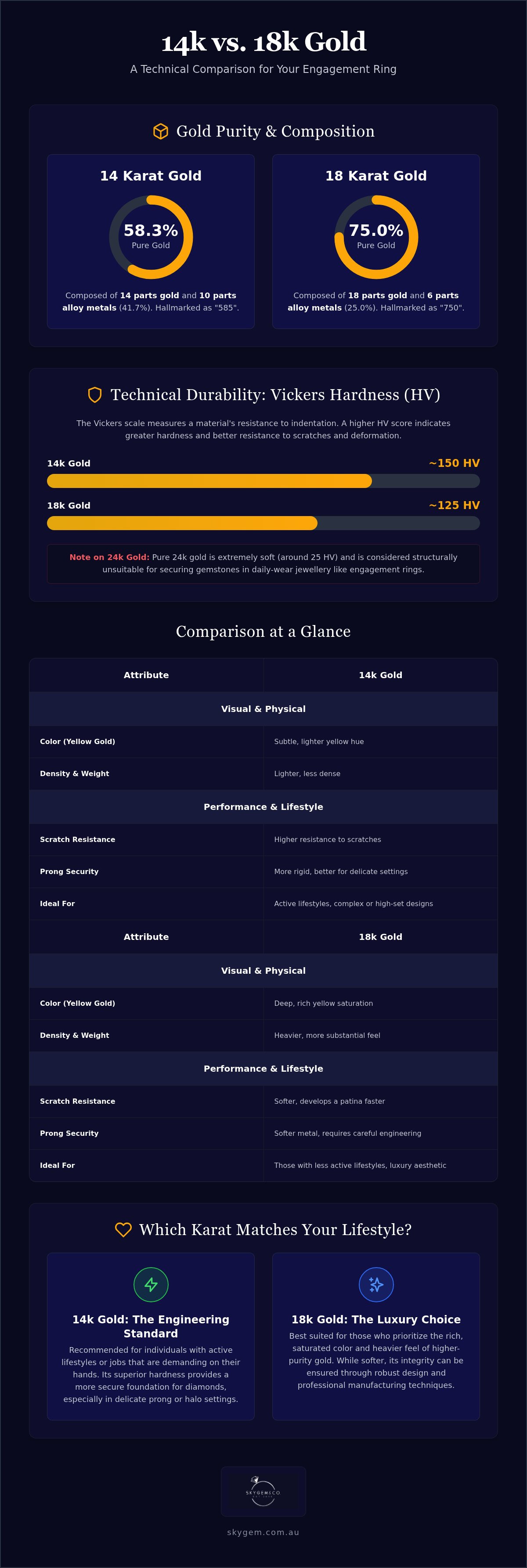
The distinction between 14k and 18k gold lies in the ratio of gold to these reinforcing alloys. 14k gold consists of 14 parts gold and 10 parts alloy, resulting in a 58.3% gold content, often hallmarked as "585". In contrast, 18k gold contains 18 parts gold and 6 parts alloy, equating to 75% purity, hallmarked as "750". This difference in composition is the primary driver behind the durability of 14k vs 18k gold, as the higher concentration of base metals in 14k gold typically results in a more resilient final product.
The Role of Alloy Metals in Structural Integrity
Alloy metals act as a structural lattice that reinforces the softer gold atoms. When we engineer a custom-made engagement ring, the choice of alloy determines the metal's performance metrics. Copper is frequently added to increase hardness and create the warm tones of rose gold. Palladium or nickel are utilised in white gold to bleach the natural yellow hue and enhance wear resistance. Because 14k gold contains roughly 41.7% alloy metals, it possesses a denser crystalline structure than 18k gold. This makes 14k gold more resistant to the bending or warping that can occur during high-impact activities.
14K vs 18k: A Visual and Chemical Comparison
Beyond physical performance, the gold and alloy composition influences the visual profile and weight of the piece. 18k yellow gold exhibits a deep, rich saturation that many clients associate with traditional luxury. 14k yellow gold has a more subtle, pale yellow tone due to its higher silver and zinc content. In white gold, 14k is often naturally whiter than 18k before rhodium plating, as there is less yellow gold to "mask" with white alloys. There is also a perceptible difference in density. 18k gold is significantly heavier than 14k, providing a "substantial" feel on the hand that many find desirable. When evaluating the durability of 14k vs 18k gold, you must weigh this premium tactile experience against the increased hardness of the lower karat option.
Technical Durability: Hardness, Wear Resistance, and the Vickers Scale
While purity defines the market value of a precious metal, the Vickers Hardness (HV) scale defines its physical performance in a lived environment. This industry-standard metric measures a material's resistance to permanent deformation from a concentrated load. When we analyse the durability of 14k vs 18k gold, these HV ratings provide a quantifiable baseline for engineering a secure setting. Standard 14k gold alloys typically achieve a hardness rating of approximately 150 HV. In comparison, 18k gold alloys generally sit lower on the scale, often measuring around 125 HV. This technical gap explains why 14k gold is objectively more resistant to the daily pressures that can lead to bent prongs or warped bands.
It's vital to distinguish between hardness and toughness to understand long-term wear. Hardness refers to a metal's ability to resist surface scratches, while toughness describes its resistance to fracturing or breaking. The Karat indicates the proportion of pure gold, and because pure gold is soft, the higher alloy content in 14k gold creates a more rigid crystalline structure. This rigidity ensures that a ring maintains its circular geometry even when subjected to significant lateral force. For clients who lead active lifestyles, this increased yield strength is a critical factor in preventing the structural failure of a setting.
Scratch Resistance vs. Structural Deformation
Because 18k gold is softer, it is more susceptible to developing a surface patina. This is a collection of microscopic scratches that eventually gives the metal a soft, matte-like appearance. While some appreciate this aged look, it signifies that the metal is more easily displaced. Over several decades, 18k gold bands may experience "thinning" at the base of the shank due to constant friction against hard surfaces. 14k gold maintains its original polished finish for longer and provides a more stable foundation for a solitaire engagement ring, where the entire weight of the gemstone relies on a few delicate points of contact.
The Impact of Manufacturing: Casting vs. Hand-Forging
The method of production can significantly alter the final hardness of any gold alloy. Most commercial rings are produced via lost-wax casting, which results in a relatively porous and soft metal structure. However, technical precision in manufacturing can bridge the gap between karats. Work-hardening occurs when metal is physically manipulated, such as through hand-forging or rolling, which compresses the grain structure and increases the material's yield strength. A hand-forged 18k ring can actually exhibit higher durability than a poorly cast 14k ring. Our consultants can help you select the ideal manufacturing process for your bespoke design based on these technical specifications.
Lifestyle and Design: Matching Gold Karat to Your Daily Routine
Selecting the right metal is a decision that bridges technical specifications with personal lifestyle. When assessing the durability of 14k vs 18k gold, the primary variable is the wearer's daily environment. An office professional may never stress an 18k band to its limit. Conversely, individuals with high-impact hobbies or manual professions require a metal that resists structural deformation under pressure. Understanding these physical limits ensures that the ring remains a permanent asset rather than a maintenance burden.
For high-set solitaire engagement rings, 14k gold is often considered the engineering gold standard. Because the centre stone is elevated, the prongs are more exposed to accidental knocks. The higher Vickers hardness of 14k provides a more rigid grip on the diamond, reducing the risk of a prong pulling back and releasing the stone. While 18k gold remains the luxury choice for bespoke fine jewellery due to its rich colour and high purity, it requires a more cautious approach to daily wear to maintain its structural integrity over decades of use.
When to Choose 14k Gold
14k gold is the optimal choice for designs featuring delicate pavé work or exceptionally thin bands. The increased alloy content provides the necessary stiffness to keep tiny diamonds secure in their micro-settings. It's also a practical choice for those who frequent the gym, enjoy gardening, or engage in manual work, as it resists deep gouges better than softer alloys. From a project management perspective, choosing 14k can be a strategic budget move. It allows more capital to be allocated toward a higher-grade centre stone or a more intricate setting without compromising the ring's longevity.
When 18k Gold is the Superior Choice
18k gold is the superior choice for clients with sensitive skin. The higher gold content means there's a lower percentage of base metals like nickel, which are common triggers for contact dermatitis. This biocompatibility makes it a reliable choice for daily, long-term wear. It's also the traditional preference for heirloom pieces intended to house high-value natural diamonds. The weight and prestige of 75% purity align with the investment value of these stones. For a deeper technical dive into these properties, you can consult The Definitive Guide to Gold Jewellery to understand how purity influences long-term craftsmanship and value.
The Long-Term Perspective: Maintenance, Patina, and Resizing
When evaluating the durability of 14k vs 18k gold over several decades, the primary concern for many clients is whether 18k gold is "too soft" for a lifetime of wear. While we established that 18k gold has a lower Vickers hardness, it remains a highly viable choice for fine jewellery. The difference lies in how each metal ages. 18k gold tends to displace rather than chip, leading to the development of a unique, desirable patina. This soft, matte-like finish is often prized by collectors of high-end jewellery as a sign of authenticity and history. 14k gold, being more rigid, maintains its high-polish shine for longer periods but can develop deeper, more jagged scratches if subjected to harsh impacts.
Resizing and repairs represent another technical divergence. 18k gold is more ductile and malleable, which often makes it easier for a master jeweller to manipulate during resizing or restoration. This ductility allows the metal to be stretched or compressed with less risk of stress fractures compared to the more brittle 14k alloy. However, every professional polishing session involves a factor known as metal loss. Because polishing works by removing a microscopic layer of metal to level out scratches, 18k gold may experience slightly more volume loss over a 50-year period than 14k gold. We recommend a conservative approach to refinishing to preserve the structural mass of your custom-made engagement ring.
Rhodium Plating and White Gold Maintenance
Both 14k and 18k white gold require periodic maintenance in the form of rhodium plating. Because gold is naturally yellow, white gold alloys always retain a slight warm tint. As the rhodium plating wears thin through daily friction, the underlying metal becomes visible. 18k white gold will show a more pronounced "yellowing" effect due to its 75% gold content. 14k white gold, with its higher concentration of white base metals, often appears whiter for longer. Establishing a professional cleaning and plating schedule every 12 to 18 months is essential for maintaining the pristine aesthetic of either alloy.
Structural Checks: Preventing Stone Loss
The softer nature of 18k gold means that prongs may require more frequent technical intervention. Over time, the tips of the prongs can flatten or pull away from the gemstone, a process known as "tipping." While 14k gold prongs are more resistant to this movement, they can become brittle after decades of wear. We advise clients to perform a simple "tap test" at home. If you hear a faint clicking sound when tapping the side of your ring, the stone is loose. Regular professional inspections are the most reliable way to ensure your engagement ring maintains its structural integrity. If you notice any thinning at the base of the band or sharp edges on your prongs, it is time for a technical assessment.
To ensure your fine jewellery remains secure and radiant for generations, we invite you to consult with our technical specialists for a comprehensive maintenance review.
Making the Choice: SkyGem & Co.’s Technical Approach to Bespoke Design
Selecting a metal for your jewellery is a decision that balances aesthetic desire with engineering necessity. At SkyGem & Co., we act as technical consultants to ensure your design isn't just beautiful, but structurally sound for decades of wear. When we evaluate the durability of 14k vs 18k gold, we look at the specific geometry of your chosen setting. A delicate trilogy ring with fine prongs requires a different structural approach than a heavy, wide-banded solitaire. By leveraging advanced Computer-Aided Design (CAD), we can strategically reinforce high-stress areas in 18k gold settings, providing the necessary wall thickness to compensate for the metal's natural malleability.
Your choice of centre stone also influences the metal selection. Whether you're opting for Natural GIA Certified Diamonds or high-performance lab-grown diamonds, the setting must provide a secure housing. For larger, high-value stones, the added rigidity of a 14k gold head can offer peace of mind. However, for those who prefer the prestige of 18k gold, our bespoke manufacturing process focuses on precision. We ensure that every prong is engineered to provide maximum surface contact with the diamond's girdle, mitigating the risks associated with softer alloys. For a comprehensive look at this process, explore our guide to Bespoke Engagement Rings.
The SkyGem Bespoke Consultation Process
Our consultation process begins with a lifestyle assessment. We don't just ask about your style; we ask about your daily environment. If your routine involves high-impact activities, we'll likely recommend 14k gold for its superior resistance to bending. A key differentiator in our workshop is the emphasis on hand-finishing. This stage induces work-hardening, a physical process that compresses the metal's grain structure. By hand-forging and finishing our pieces, we increase the material's density beyond what is achievable in standard lost-wax casting. This technical step significantly enhances the durability of 14k vs 18k gold, making our 18k settings more resilient than mass-produced alternatives.
Final Verdict: 14k vs 18k
For most Australian engagement ring buyers, the "sweet spot" depends on the intersection of design and lifestyle. 14k gold is the pragmatic choice for active individuals and intricate, pavé-heavy designs that require maximum stiffness. 18k gold remains the premier choice for those seeking a richer colour, higher purity, and a hypoallergenic surface for sensitive skin. There is no objectively "wrong" choice, only a choice that is more or less suited to your specific project requirements. We prioritise transparency and education, ensuring you understand exactly how your chosen metal will perform over time. To begin the journey of creating a piece that stands the test of time, book a consultation to design your bespoke piece with our expert team.
Securing a Lifetime of Brilliance: Your Path Forward
Engineering a ring that withstands the rigors of daily life requires a deep understanding of the durability of 14k vs 18k gold. While 14k gold provides a harder crystalline structure ideal for active lifestyles, 18k gold offers a prestigious, hypoallergenic finish with a rich saturation of colour. The final decision rests on the intersection of your personal aesthetic and your daily routine. Precision ensures longevity. By selecting the right alloy and prioritising technical manufacturing, you ensure your setting remains a permanent asset for generations.
At SkyGem & Co., we specialise in bridging the gap between high-level engineering and aesthetic design. Our expert CAD design and hand-finished craftsmanship allow us to reinforce high-stress areas, providing structural integrity regardless of your chosen karat. Located in the historic Royal Arcade, we invite you to experience a professional consultation tailored to your unique project requirements. Whether you are selecting from our curated range of GIA-certified natural diamonds or lab-grown diamonds, our team acts as your dedicated technical partner.
Explore our Bespoke Engagement Ring Services and take the first step toward a design that balances technical excellence with timeless beauty. We look forward to helping you create a piece that truly lasts.
Frequently Asked Questions
Is 18k gold better than 14k gold for an engagement ring?
Neither alloy is objectively superior, as the ideal choice depends on your specific lifestyle and design requirements. 18k gold is prized for its high purity and rich colour saturation, making it a premier choice for heirloom pieces. Conversely, the durability of 14k vs 18k gold often favours 14k for those with active routines, as its higher alloy content provides greater resistance to structural deformation and daily wear.
Can I see the difference between 14k and 18k yellow gold?
There is a perceptible visual difference between the two alloys in their yellow gold form. 18k yellow gold exhibits a deep, rich, and "buttery" hue due to its 75% gold content. 14k yellow gold has a more subtle, paler tone because it contains a higher proportion of silver and zinc alloys. This aesthetic distinction often influences clients who prefer a traditional, high-saturation look for their bespoke settings.
Does 14k gold tarnish faster than 18k gold?
14k gold is theoretically more prone to tarnishing than 18k gold because it contains a higher percentage of base metals like copper and silver. These metals can react with oxygen and chemicals in the environment over long periods. In high-quality jewellery-grade alloys, this reaction is minimal. Regular professional cleaning and proper storage effectively mitigate any risk of surface discolouration for either karat choice.
Is 18k gold more expensive to repair than 14k?
Repair costs for 18k gold are typically higher than for 14k gold, primarily due to the increased cost of the raw material. When a jeweller performs tasks like resizing or retipping prongs, they must use matching 18k gold solder and laser wire. Since 18k gold contains 75% pure gold compared to 58.3% in 14k gold, the material component of the repair invoice reflects this market value difference.
Which gold karat is best for someone with sensitive skin or allergies?
18k gold is the recommended choice for individuals with sensitive skin or known metal allergies. Its higher purity level means there's a smaller percentage of base metals, such as nickel or zinc, which are common triggers for contact dermatitis. This increased biocompatibility makes 18k gold a safer, more comfortable option for long-term daily wear without the risk of skin irritation over time.
Will 14k gold prongs hold a diamond more securely than 18k?
14k gold prongs generally offer higher security for a centre stone because the metal is harder and more rigid. With a Vickers hardness of approximately 150 HV, 14k gold is less likely to pull back or deform if the ring is accidentally knocked against a hard surface. While 18k gold prongs are secure, they may require more frequent technical inspections to ensure they haven't shifted or thinned through decades of wear.
Does 18k gold scratch easily?
18k gold does scratch more easily than 14k gold due to its lower position on the Vickers hardness scale. Because it's a softer alloy, it will develop a surface patina of fine microscopic scratches more quickly through contact with hard surfaces. Many clients appreciate this aged look as a sign of authenticity, but those who prefer a permanent high-polish finish may find 14k gold more suited to their aesthetic preferences.
Can you mix 14k and 18k gold jewellery together?
You can certainly wear 14k and 18k gold together, but you should be mindful of physical friction between the pieces. If a 14k band and an 18k band are worn on the same finger, the harder 14k alloy will slowly wear down the softer 18k metal over time. To preserve the structural integrity of both items, we recommend ensuring they don't constantly rub against one another during daily movement and activity.
Disclaimer
This article is for general informational purposes only and may include AI-assisted content. Pricing, specifications, and availability are subject to change. For accurate advice and current information, please contact SkyGem & Co. directly. Nothing in this content constitutes professional or financial advice.