
Convincing My Partner to Invest in a Quality Gemstone

A gemstone can complement a portfolio, but it shouldn’t be treated as a dependable or readily accessible source of returns. When you’re convincing your partner to invest in a quality gemstone, focus on the stone’s quality, rarity and documented authenticity: observed annual average price increases of 5-8% in recent years vary by gemstone type and aren’t a forecast of future performance.
It’s reasonable to ask whether a gemstone can offer more than aesthetic appeal. Its potential value depends on its characteristics and buyer demand, while resale conditions, valuation differences and the time it takes to find a buyer all shape the investment case.
This article explains how colour, cut, size, treatments and rarity affect quality, and how a gemstone might fit into a broader portfolio. It also outlines risks to discuss together, so you can weigh potential long-term value against liquidity, documentation and the possibility of loss.
Key Takeaways
- Use a recognised gemological report to understand whether a stone is natural, what treatments it has undergone and, where reported, its geographic origin.
- Compare colour, cut, clarity and rarity rather than assuming a larger gemstone is automatically a better choice.
- Consider how a gemstone could complement other assets, while recognising that its value depends on quality, buyer demand and the time available to hold it.
- Build resale risk into the conversation: according to the Florida Attorney General's Office, buyers may pay retail and later need to sell at wholesale, and gemstones can be difficult to resell quickly.
- Distinguish an investment decision from choosing jewellery for personal meaning, then explore suitable options such as solitaire, halo or trilogy engagement rings with SkyGem &.
1. Why invest in gemstones?
A gemstone’s potential investment case rests on authenticity, documented rarity and buyer demand. A 2021 Forbes report highlighted authenticity and documented rarity as primary drivers of long-term capital appreciation. Observed annual average price increases of 5-8% in recent years vary by gemstone type, so they shouldn’t be treated as a forecast or assured return. That distinction helps keep a conversation grounded in evidence rather than expectation.
Certification helps turn a visual impression into a documented description. Recognised laboratories include the Gemological Institute of America (GIA), Gübelin Gem Lab and the Swiss Gemmological Institute (SSEF). A gemological report can state whether a stone is natural, identify treatments and, where assessed, report geographic origin. These details matter because a treated sapphire and an untreated sapphire may be valued differently.
For a considered purchase, match the report to the exact stone. Check that identifying details, such as weight and measurements, correspond to the gemstone being offered. Read the treatment disclosure carefully, including whether the report records heating or another treatment. A certificate describes findings; it doesn’t promise a future resale price or prove that every buyer will value the stone in the same way.
An independent assessment adds another perspective. Arrange for a qualified gem expert with suitable laboratory equipment to determine authenticity, rather than relying only on sales language. Keep the report, invoice and written description together. If a report names a treatment, retain that disclosure with the stone’s records, even if ownership changes later.
When buying from a jeweller or online in Australia, clear product descriptions and records of what was offered and purchased are important. Keep the listing or written description, invoice and any gemstone report. These provide a concrete basis for comparing the item you receive with the sale description.
For purchases or sales in Australia, GST and import-duty treatment depends on the transaction, including whether the stone is bought locally, imported or later resold. Keep invoices and import records together, and separate the original purchase documents from any later sale records.
For storage, insurance and appraisal, keep the gemstone secure, limit unnecessary handling, retain its documentation and arrange insurance where possible. An independent appraisal can record identifying features and support an insurance discussion. Update the records if the stone is recut or its condition changes.
These steps help frame a balanced case for convincing my partner to invest in a quality gemstone: assess the stone first, then consider its role alongside other assets. A report, treatment disclosure and complete purchase record make the discussion more specific, while stocks and other investments differ in how their value is measured and accessed.
2. Gemstone rarity, quality, colour, size, cut, and clarity
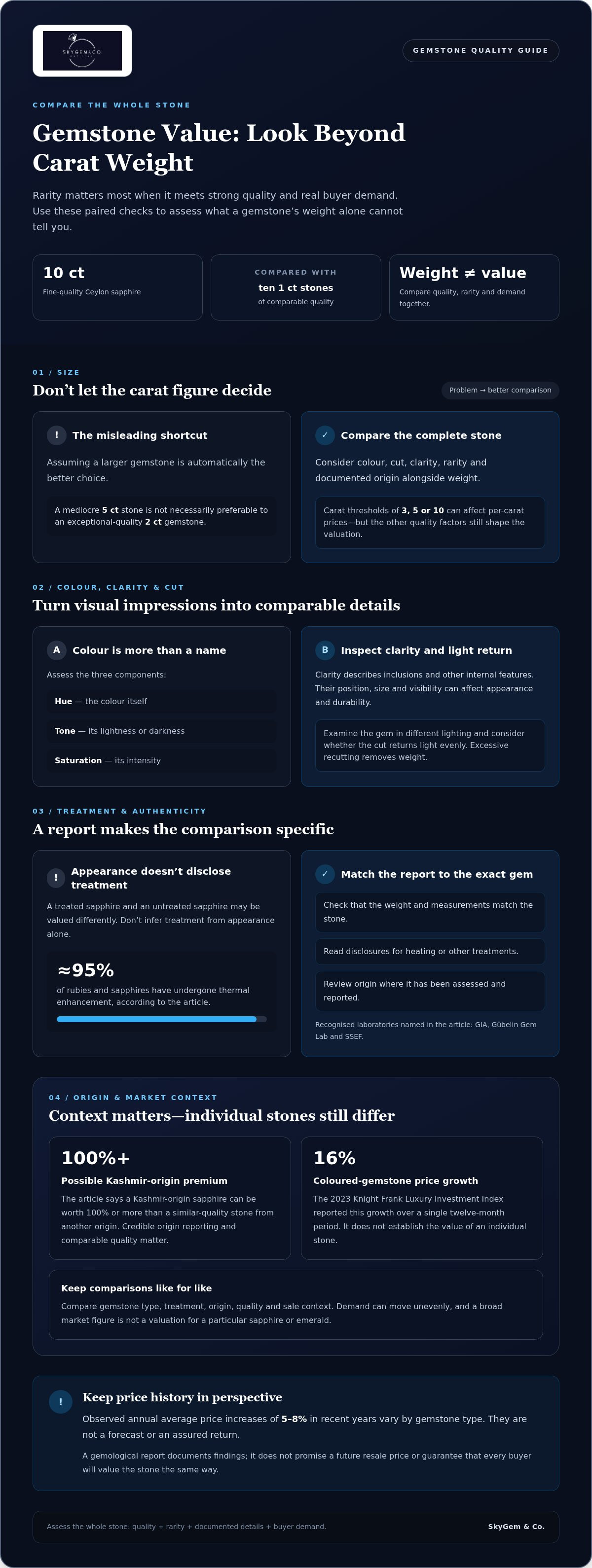
Rarity matters most when it meets strong quality and real buyer demand. A fine-quality 10-carat Ceylon sapphire is rarer than ten 1-carat stones of comparable quality. Larger weight alone doesn’t create an advantage: a 2-carat gemstone of exceptional quality may be preferable to a mediocre 5-carat stone. Compare the whole stone, not its carat figure in isolation.
Assess colour through hue, tone and saturation. Hue describes the colour itself, tone its lightness or darkness, and saturation its intensity. For a sapphire, ruby or emerald, these qualities affect visual appeal and influence how buyers compare stones. Preferences vary, so a recognised grading description helps make the discussion more consistent.
Clarity describes inclusions and other internal features, while transparency affects how clearly light passes through a gem. Inclusions can influence appearance and durability, depending on their position, size and visibility. Examine the stone in different lighting, then consider whether its cut returns light evenly. A well-proportioned cut can improve colour display, but excessive recutting removes weight.
Investment-focused examples commonly emphasise natural-coloured, untreated stones, with cutting as the exception. Treatment disclosure is therefore central to comparison. Approximately 95% of rubies and sapphires have undergone thermal enhancement, making an untreated example rarer. A report should distinguish a natural stone from a treated one, rather than leaving buyers to infer treatment from appearance.
Origin can also influence demand, but it doesn’t replace quality assessment. A Kashmir-origin sapphire can be worth 100% or more than a similar-quality stone from another origin. That premium relies on credible origin reporting and comparable quality. Carat thresholds of 3, 5 or 10 can affect per-carat prices, although colour, cut and clarity still shape the complete valuation.
Rare-coloured-gemstone demand can move unevenly. The 2023 Knight Frank Luxury Investment Index reported 16% price growth for coloured gemstones over a single twelve-month period. That broad figure doesn’t establish what an individual sapphire or emerald is worth. Compare like with like: gemstone type, treatment, origin, quality and sale context must align.
Australian prices for sapphires, rubies and emeralds are specific to each stone, not set at a single typical rate. Colour, clarity, cut, weight, treatment and documented origin all affect the asking price and help shape comparisons between stones.
For a practical comparison, record each stone’s colour description, weight, cut, clarity, treatment and origin documentation in one place. Then discuss which qualities matter most to both partners, and whether rarity or appearance is driving the decision.
3. Gemstones as portfolio diversification and value preservation
A gemstone can diversify a portfolio by adding a physical asset whose value depends on different factors from company shares. Colour, rarity, origin and collector demand influence gemstone prices, while shares reflect business performance and market sentiment. This difference can broaden exposure, but it doesn’t remove investment risk or make a gemstone a substitute for liquid assets.
Historical results show why value preservation shouldn’t be assumed. Rubies increased in value by over 8% per year over the last 25 years, while diamond values have declined since the 2008 financial crisis. Tanzanite prices reportedly crashed in 2014. These contrasting examples show that results vary by gemstone type, market conditions and timing.
Resale is another practical distinction. The Florida Attorney General’s Office warns that gemstones are not liquid investments and usually cannot be resold quickly at a profit. It also cautions that buyers may pay retail prices and later need to sell at wholesale prices. A potential gain on paper therefore doesn’t establish how much cash a sale will provide or when.
Compare gemstones with gold and shares by asking what role each asset serves. Gold is a physical store of value; shares represent ownership in companies and can be bought or sold through financial markets. Gemstones are compact physical assets, but finding a buyer and agreeing on value can take time. Each asset has different valuation and liquidity characteristics.
Cutting or recutting can change a stone’s presentation, but it doesn’t automatically add value. A skilled cut may improve symmetry or light return, while recutting removes material and changes carat weight. The sapphire example in the research illustrates how recutting can alter a stone’s commercial position. Compare its documented weight and condition before and after any work.
Setting a loose gemstone in jewellery can make it wearable, but the setting doesn’t guarantee higher resale value. Daily wear can reduce a gemstone’s value by 20% or more if the stone requires recutting. If portfolio value is the priority, weigh the personal benefit of wearing the stone against handling, damage and resale considerations.
For a measured approach, treat gemstones as one part of a broader portfolio, not as its liquid reserve. Consider the stone’s likely buyer, documented origin, resale route and holding period before allocating funds. The Florida Attorney General’s Office advises buyers to find out the cash liquidation value, which may be much lower than expected.
These distinctions can help couples decide whether gemstones diversify their existing stocks, shares or gold holdings, or simply add a valued personal asset. Review the role, resale constraints and market history together before deciding how much importance to place on potential appreciation.
4. Gemstone investment and the risks of treating gems as investments
A gemstone’s rarity doesn’t make a profit certain. The Florida Attorney General’s Office warns that few consumers profit from gemstone or commodity investments, often because they lack enough information to make informed decisions. Its warning applies to the investment case, not to a stone’s personal or aesthetic value. Couples should separate those objectives before committing funds.
Treatment is one point that can materially affect comparisons. An unheated ruby can command three to five times the price of a treated ruby with the same visual grade. Heat-treated gemstones can carry a 30% to 50% lower price premium than unheated specimens. These comparisons don’t establish a particular stone’s value, but they show why treatment disclosure matters when assessing rubies.
Ask what “untreated” means in the report. A gemological report should identify whether the stone is natural and record any treatments found, such as heating. Its description should match the stone being considered, including its identity and characteristics. Don’t treat “natural” and “unheated” as interchangeable: natural describes origin, while unheated describes treatment status.
Other risks include subjective valuations, limited resale options and misleading investment pitches. The Florida Attorney General’s Office notes that people may assess the same gemstone differently. It also reports that thousands of consumers fall victim to gemstone investment schemes each year. Pressure to buy immediately or claims of assured profit should prompt a pause and independent research.
Before buying, compare the stated quality and price rationale with independent information on gemstone grading and realistic market values. The Florida Attorney General’s Office advises buyers to research these factors independently. Keep the sale terms, report and invoice together. Record any claims about treatment, origin or resale in writing, so both partners can review the same evidence.
Financial planning makes the discussion more practical. Agree on the purchase amount, intended holding period and how the asset fits household goals. Use funds that aren’t needed for near-term expenses, and don’t treat a gemstone as a replacement for accessible savings. Consider how a potential loss would affect shared plans before deciding whether the purchase is affordable.
Compare like with like, rather than assuming diamonds, alexandrite and rubies follow the same market pattern. For each stone, record its report, treatment, valuation basis and expected resale route. Ask what evidence supports the asking price and what conditions could change demand. A valuable gemstone is still a specialised asset, not a guaranteed source of return.
For a responsible conversation, put the evidence and household plan side by side: report and treatment disclosure, independent research, purchase terms, available funds and intended ownership period. This gives both partners a clear basis for deciding whether the risks suit their financial priorities.
5. Gemstone investment and wealth preservation
Gemstones have served as investments for more than 5,000 years, but longevity alone doesn’t prove future value. Their compact physical form can help preserve wealth across generations, especially when documentation remains with the stone. Yet a beautiful coloured gem isn’t automatically a reliable store of value. Buyers need to distinguish collecting, personal enjoyment and financial objectives before choosing.
Scarcity can support value when buyers continue to seek a particular stone. Paraiba tourmaline prices have increased by more than 1000 percent since its discovery in the late 1980s. That history reflects a specific gem and market, not a template for every coloured stone. Rarity, quality, supply and sustained demand all shape whether a stone retains appeal.
Tanzanite illustrates how supply events can affect a market. Retail prices reportedly rose sharply in 2010 after Tanzania acted to prevent smuggling and ban exports of large rough. Such changes may influence availability and buyer interest, but they don’t establish what an individual stone will sell for. A dealer’s valuation and a future buyer’s offer can differ.
Time horizon matters. Diamonds are considered interesting investments with a horizon of at least 20 years, while gemstone investors commonly plan longer ownership rather than quick resale. Before buying, couples can write down when they might need the funds and whether holding the stone fits that plan. A gemstone shouldn’t be treated like readily accessible cash.
For a measured start, consider one cornerstone stone in a primary category, then add others gradually. This keeps the decision focused on a specific gem’s quality, documentation and intended role. Re-evaluate the stone every few years against long-term goals, market positioning and household priorities. The review can show whether the original rationale still applies.
Preservation also depends on care. Store investment-grade gemstones securely, protect them from unnecessary handling, retain their reports and insure them where possible. If a stone becomes part of jewellery, wearing it may increase its personal value while exposing it to damage. Keep identifying records and condition details together to support future appraisal or ownership decisions.
In Australia, discuss wealth preservation in practical terms: what the stone represents, how long you intend to hold it, and how it fits alongside accessible savings and other assets. A purchase may serve aesthetic and financial interests, but those purposes shouldn’t be confused. Its clearest value may be as a carefully documented collectible, held for the long term rather than relied on for immediate liquidity.
SkyGem &: Solitaire Engagement Rings
SkyGem & offers Solitaire Engagement Rings, Halo Engagement Rings and Trilogy Engagement Rings for couples choosing a piece to wear and enjoy. If your discussion shifts from a gemstone’s potential portfolio role to an engagement ring, compare the settings and consider how each design presents its centre stone. SkyGem & also offers Lab-Grown Diamonds, giving couples another option when selecting a ring. Keep the distinction clear: jewellery can carry personal meaning, but that alone doesn’t establish its resale value or make it a suitable investment. Turn to SkyGem & when you’re ready to explore engagement ring options and weigh design preferences together. Contact SkyGem & to discuss your ring choices.
Make the Next Decision Together
If you’re thinking about convincing my partner to invest in a quality gemstone, make the next step a shared decision, not a sales target. Agree on what matters most: a stone’s personal meaning, its place in your financial plans, or both. Then discuss the evidence and trade-offs openly, leaving room for either partner to say yes, no or not yet.
If the decision is also about an engagement ring, SkyGem & Co. offers Solitaire Engagement Rings, Halo Engagement Rings and Trilogy Engagement Rings. Compare settings and designs while keeping a jewellery purchase distinct from a financial investment. Treat future appreciation as a possibility, not a promise, and choose only when the decision suits your shared priorities.
Start a conversation about gemstone choices with SkyGem & Co. when you’re ready to explore the next step together.
A thoughtful decision is one you can both stand behind, whatever you decide.
Frequently Asked Questions
Why invest in gemstones?
A gemstone may suit someone who values collecting or wearing a tangible asset, provided that purpose remains worthwhile without expected appreciation. Before deciding, ask yourselves: would we still want this stone if its resale value stayed unchanged? If the answer is yes, personal enjoyment can be part of the decision. If the purchase only makes sense through future returns, treat that as a reason to reassess your shared expectations.
What does a buyer need to know before investing in a gemstone?
Agree on the purpose, spending limit and conditions that would make either partner pause. Write those down before comparing stones. For example, you might decide not to proceed if the description changes, the documentation doesn’t match the item, or the purchase would interfere with another shared goal. This simple framework helps both partners take part without turning the conversation into a contest over who is more persuasive.
Which gems are worth considering as investments?
Ruby, sapphire and emerald are commonly considered investment-grade gemstone categories, but a category alone can’t determine whether a particular purchase suits you. Start by choosing which type genuinely interests you, then compare individual candidates on consistent terms. Avoid selecting a stone only because its name sounds prestigious or a seller describes it as rare. Your choice should reflect both partners’ priorities and the evidence for that specific stone.
What makes a gemstone high quality, and how are the 4Cs assessed?
The 4Cs offer a useful comparison framework, but they shouldn’t be applied identically to every gemstone. For a practical assessment, choose a candidate and write down how each relevant characteristic affects your preference. Then compare it with another stone of the same type, rather than using a diamond grading description as a direct substitute. The result is a clearer record of trade-offs, not a guarantee of value.
Do gemstones hold their value or appreciate over time?
No purchase decision should rely on appreciation as its only justification. Ask what evidence supports the current valuation, who produced it and what purpose it serves. An insurance replacement figure, for example, answers a different question from a buyer’s offer. Keeping those figures distinct helps prevent an estimate made for one purpose from being mistaken for money you could receive in a sale.
How liquid is the Australian resale market for investment-grade gemstones?
There isn’t one dependable resale timetable for every gemstone in Australia. Before buying, identify the likely sale route and consider what information a prospective buyer would need to assess the stone. You can also discuss a practical scenario together: if you needed to sell sooner than planned, would you accept waiting or changing your expectations? That conversation makes liquidity a household decision, not just a market term.
What are the risks of investing in gemstones, including treatments, synthetics and misrepresentation?
One risk is confusing a stone’s appearance with its material identity. A synthetic gemstone is laboratory-created, while a simulant imitates another gem’s appearance without being the same material. Ask for the item’s identity and treatment status to be described precisely in writing, and compare that wording with its supporting documentation. Be cautious of claims that use impressive terminology but don’t clearly explain what the stone is.