
Common Ruby Treatments to Avoid: A Guide to Gemstone Integrity

A ruby that appears flawless under showroom lights can lose 95% of its resale value the moment it encounters a standard jeweller's torch or a mild acidic cleaning solution. For many Australian buyers, the anxiety of unknowingly purchasing a lead-glass composite stone is a valid concern that stems from a lack of transparency in the retail sector. You're looking for a gemstone that functions as a durable, future-proof asset, yet the industry often hides behind vague descriptors that obscure a stone's true structural condition. Identifying common ruby treatments to avoid is the first step in ensuring your investment possesses the engineering integrity required for everyday wear and long-term capital growth.
We understand that the shift from "natural" to "enhanced" can be confusing when technical data isn't clearly presented. This guide will provide you with the technical specifications needed to distinguish between stable thermal enhancements and unstable chemical fillers that compromise a stone's longevity. You'll gain a clear understanding of how these treatments impact Australian insurance valuations and which laboratory certifications provide the necessary compliance for a secure transaction. We'll move from high-level risks to granular details on fracture filling and beryllium diffusion so you can make a decision based on hard data rather than marketing hype.
Key Takeaways
- Understand the technical distinction between standard enhancements and structural modifications, recognizing that less than 1% of rubies qualify as truly natural and unheated.
- Identify the common ruby treatments to avoid, such as lead glass filling and beryllium diffusion, which significantly compromise both the gemstone's durability and its long-term investment value.
- Evaluate the structural integrity of your selection by comparing stable heat-treated stones against composite rubies to ensure suitability for daily wear and Australian environmental conditions.
- Learn to interpret independent lab reports from authorities like the GIA to identify critical red flags and ensure full transparency in gemstone certification.
- Future-proof your heirloom jewellery by prioritising unheated rubies that maintain resale liquidity and structural excellence over temporary aesthetic enhancements.
Understanding Gemstone Enhancement: Why Rubies are Treated
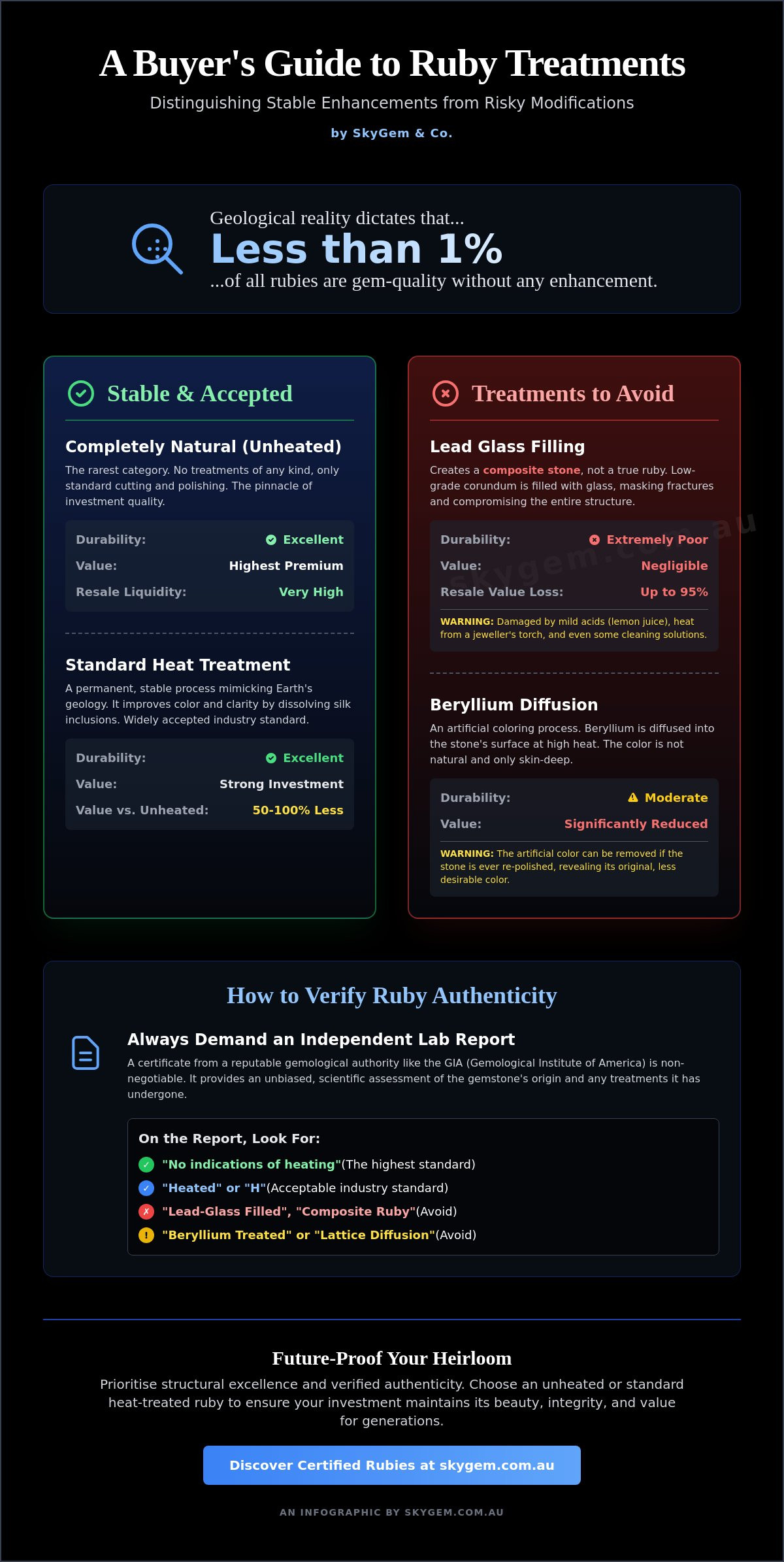
In the professional gemmological field, a ruby treatment refers to any post-mining process, excluding standard lapidary work like cutting and polishing, designed to improve the stone's visual characteristics. Understanding the necessity of these processes starts with geological reality. Data from major mining operations suggests that less than 1% of rubies recovered globally possess the saturation and clarity required to be sold as "natural" without any enhancement. For the remaining 99%, various methods are used to reach commercial standards. While some methods are part of a transparent supply chain, others represent common ruby treatments to avoid due to their negative impact on the stone's long-term integrity.
The fundamental chemistry of a ruby involves the corundum crystal lattice, primarily composed of aluminium oxide. When trace elements like chromium are present, the crystal takes on its red hue. Treatments often target these trace elements or internal inclusions to modify the stone's appearance. Traditional thermal modification, which is a key part of Ruby gemstone treatments documented for centuries, interacts with this chemistry by dissolving silk inclusions or shifting the oxidation state of trace elements like iron. This creates a clearer, more vibrant stone that remains chemically stable.
The Spectrum of Industry-Accepted Enhancements
Traditional heat treatment is widely accepted because it is permanent and stable. It essentially mimics the high-pressure, high-temperature environment found deep within the Earth's crust. Because the result doesn't degrade over time, these stones are perfectly suitable for the daily rigours of engagement rings. However, the market places a significant value premium on certified unheated stones. In the Australian market, an unheated ruby can command a price 50% to 100% higher than a heated stone of comparable colour and size, reflecting its extreme geological rarity.
Stability vs. Artificial Improvement
Stability is the primary metric for assessing the quality of an enhancement. A stable treatment remains unchanged for generations; it won't fade when exposed to sunlight or crack during standard jewellery repairs. Transparency is a regulatory requirement in the Australian jewellery sector. Under Australian Consumer Law, retailers must disclose specific enhancements, particularly those that are not permanent. Artificial colour improvement and fracture filling often mask structural flaws that compromise the stone's durability. These are common ruby treatments to avoid for clients looking for a high-quality loose ruby that will maintain its value and physical integrity over decades of wear.
Significant Treatments to Avoid: Lead Glass Filling and Beryllium Diffusion
While some thermal enhancements are standard in the gemstone industry, certain processes fundamentally compromise the stone's chemical structure and long-term stability. These are the most common ruby treatments to avoid if you seek a stone that retains its value and physical integrity over decades of wear. Understanding these methods is essential for any buyer looking to invest in a piece that won't degrade under normal conditions.
The Danger of Lead Glass-Filled Rubies
Lead glass filling is arguably the most deceptive practice in the modern market. Since 2004, when these stones began appearing in large volumes, they've been sold as "natural rubies" despite being technically classified as composites. The process involves taking low-grade, opaque corundum and leaching out mineral impurities with acid, leaving a fragile "sponge" of ruby. This framework is then filled with high-refractive index lead glass to create the illusion of clarity.
These stones are incredibly unstable and sensitive to everyday environments. Because lead glass reacts poorly to acidic substances, a single drop of lemon juice can etch the surface and ruin a glass-filled stone permanently. They also cannot survive standard jewellery repairs. A jeweller's torch will cause the glass to liquefy and leak out, while ultrasonic cleaners often shatter the glass bonds within the stone. These stones hold almost no resale value and are prone to clouding within a few years of purchase.
Beryllium Diffusion and Surface-Only Colour
Beryllium or lattice diffusion involves heating a ruby to temperatures exceeding 1,800°C while introducing foreign elements into the crystal structure. First identified by major gemological labs in 2001, this treatment forces beryllium atoms into the lattice to alter the stone's hue, often turning brownish stones into vibrant reds. This isn't a surface coating, but it frequently creates a "rind" effect where the colour is concentrated near the exterior.
- Recutting risks: Because the colour penetration may be shallow, repolishing or recutting the gem can reveal a pale or unsightly core.
- Value disparity: Diffused stones typically trade at a 75% to 90% discount compared to rubies that achieved their colour through natural geological processes.
- Detection: Identifying these stones requires advanced lab equipment like LIBS (Laser Induced Breakdown Spectroscopy) to find the trace beryllium.
Temporary fixes like fracture filling with resins and surface coatings also present significant durability issues. Resins tend to discolour or dry out over a 2 to 5 year period, leaving the stone looking dull and fractured. When sourcing natural rubies, we prioritise stones that maintain their integrity without these invasive and temporary modifications, ensuring the gem remains a permanent asset.
Comparing Durability and Value: Heat-Treated vs. Composite Rubies
Understanding the structural integrity of a gemstone is vital for long-term wear. While traditional heat treatment is an industry standard, composite rubies represent one of the primary common ruby treatments to avoid due to their fragile nature. A natural ruby ranks 9 on the Mohs scale of hardness. In contrast, a composite ruby is a hybrid of low-grade corundum and lead glass. This glass component often accounts for 20% to 45% of the stone's total weight, significantly lowering its resistance to chemicals and thermal shock. For a ring worn daily in the Australian climate, this difference is the gap between a lifelong heirloom and a stone that may shatter during a simple cleaning.
Why Traditional Heat Treatment Remains the Standard
Traditional thermal enhancement involves heating stones to temperatures between 1,200 and 1,600 degrees Celsius. This process is stable; the resulting colour and clarity improvements are permanent and won't fade under UV exposure. Because the crystal lattice remains intact, these stones are suitable for bespoke jewellery that requires daily durability. For clients seeking high-quality loose rubies, a heated stone offers a practical balance of aesthetic appeal and relative affordability compared to rare, unheated specimens. It's a standardised practice that maintains the stone's status as a genuine precious gem.
The Precipitous Drop in Resale Value
Composite rubies lack financial liquidity. Most reputable Australian auction houses and secondary market retailers refuse to trade in lead-glass filled material because it's classified as a manufactured product rather than a natural gemstone. These stones carry a resale value that often drops to near zero the moment they leave the showroom. From an insurance perspective, many Australian providers won't cover composite stones under standard jewellery schedules. This is because their status as common ruby treatments to avoid makes them nearly impossible to repair or replace accurately. A "cheap" A$400 composite ruby is ultimately more expensive than a A$3,500 heated ruby because the latter retains its asset value over decades.
Maintenance for composite stones is a technical minefield. Standard ultrasonic cleaning or a jeweller's torch during a simple resizing can cause the lead glass to leak or shatter. Even household acids like lemon juice can etch the surface of a glass-filled stone, leading to a permanent loss of brilliance. SkyGem & Co. prioritises natural gemstone integrity by sourcing stones that withstand the rigours of everyday life. We act as technical consultants for our clients, ensuring your selection remains a permanent asset rather than a temporary purchase. Our focus on engineering excellence means we only provide gemstones that meet strict durability and compliance standards for the Australian market.
How to Verify Ruby Authenticity: Reading Lab Reports and Asking Questions
Ensuring the integrity of a gemstone purchase requires more than a visual inspection. It demands a rigorous, evidence-based approach that prioritises technical data over aesthetic appeal. Independent certification from reputable laboratories, such as the Gemological Institute of America (GIA), serves as the primary safeguard against common ruby treatments to avoid. These reports provide a forensic breakdown of the stone's history, ensuring that the asset you purchase meets strict compliance standards for natural origin and stability.
A professional jeweller acts as a technical consultant throughout this process. They should provide a full guarantee of treatment disclosure, backed by third-party verification. Relying on "in-house" certificates often leads to a conflict of interest; only an unbiased, external lab can provide the precision required for high-value acquisitions in the Australian market.
Identifying Red Flags in Gemstone Reports
The "Comments" section of a gemstone report is where the most critical data is stored. You must look for specific alphanumeric codes that indicate the level of intervention. Terms like "H(a)" suggest minor heat treatment with insignificant residue, while "H(b)" indicates significant residues within fractures. A report that simply states "Natural Ruby" without a dedicated section for treatments is incomplete and should be viewed as a high-risk document. Precision in documentation is non-negotiable for long-term value retention.
GIA defines a "Composite Ruby" as a manufactured product composed of lead glass and ruby, which carries significantly lower value and durability than a natural gemstone. This classification is a major warning sign. Beyond the paperwork, visual cues can often reveal low-grade treatments. Under 10x magnification, look for "flash effects" (blue or orange light reflections) or spherical gas bubbles trapped within the stone. These are definitive indicators of lead-glass filling, a process that compromises the stone's structural engineering.
Essential Questions for Your Jeweller
Engaging with a jeweller requires a direct, no-nonsense dialogue. You should treat the consultation like a technical briefing for a major project. Start with these specific enquiries:
- "Has this stone been lattice diffused or fracture-filled?" Diffusion involves high-heat chemical penetration that only colours the surface, while filling masks structural flaws with unstable materials.
- "What is the specific stability rating of this treatment?" Some treatments are temporary and can degrade when exposed to common household chemicals or even lemon juice.
- "Can this ring be safely resized or cleaned in an ultrasonic cleaner?" Glass-filled stones will shatter or "sweat" the filler when exposed to the heat of a jeweller's torch or the vibrations of professional cleaning equipment.
A reputable specialist will provide transparent answers and technical documentation for every stone in their inventory. If you are looking for high-quality, verified stones, you can explore our range of ethically sourced loose rubies to find a gem that meets these rigorous standards.
Selecting an Heirloom-Quality Ruby: The SkyGem & Co. Standard
SkyGem & Co. operates on a foundation of technical excellence and radical transparency. We understand that a bespoke engagement ring is a multi-generational asset, not a temporary purchase. This requires a ruby that maintains its physical and aesthetic properties for decades without the risk of sudden degradation. By educating our clients on the specific common ruby treatments to avoid, we ensure every selection meets a rigorous standard of structural durability. Our approach mirrors the precision of high-level engineering; we provide the granular data and provenance necessary for an informed, high-stakes investment.
We believe that luxury is found in authenticity. Our philosophy moves away from aggressive sales tactics, focusing instead on a solution-oriented partnership with our clients. We act as technical consultants, guiding you through the complexities of gemstone chemistry and market value. This ensures the ruby you select today remains a stable and appreciating asset for your descendants.
Our Commitment to Integrity
We implement strict sourcing protocols that eliminate any gemstone subjected to unstable or deceptive enhancements. Our inventory focuses on natural, unheated rubies that possess inherent crystalline strength. During a one-on-one consultation, we deconstruct the 4Cs of your specific stone, providing a technical breakdown of its inclusions and origin. This level of detail protects you from the long-term risks associated with lead-glass filling or beryllium diffusion, which are common ruby treatments to avoid if you value longevity. You can view our current acquisition of high-integrity loose rubies to begin your selection process with a stone that meets our 100% transparency mandate.
Bespoke Design for High-Integrity Gemstones
A premium gemstone requires a setting that balances architectural aesthetics with functional protection. Our Melbourne-based workshop designs bespoke mounts that shield the ruby's facets while maximising light entry for optimal chromatic performance. We provide expert guidance on metal selection, often pairing the deep reds of a Burmese ruby with 18ct yellow gold to enhance warmth, or using platinum to complement the cool undertones of a "pigeon's blood" stone. Our custom engagement rings are engineered to withstand the rigours of daily wear. We focus on future-proofing every design, ensuring the setting remains a permanent and secure home for your gemstone. This holistic approach ensures that the human impact of your jewellery—its sentiment and history—is backed by hard data and superior craftsmanship.
Securing Your Legacy with High-Integrity Gemstones
Selecting a ruby is a significant investment that requires technical oversight and a commitment to material excellence. You've learned that lead glass filling and beryllium diffusion are common ruby treatments to avoid because they fundamentally compromise the stone's durability and long-term resale value. For a gemstone to serve as a generational asset, it's vital that it maintains its structural integrity without the use of invasive fillers that degrade over time. We recommend insisting on GIA or independent Australian laboratory certification for every purchase. These reports provide the necessary data to verify a stone's natural origin and treatment status with absolute precision.
At SkyGem & Co., we specialise in unheated and ethically sourced rubies that meet rigorous standards for quality and transparency. Our team acts as technical consultants to ensure your selection is both beautiful and future-proof. Whether you're seeking a loose stone or a bespoke heirloom-quality piece, our design service integrates engineering precision with architectural aesthetics. We provide GIA and independent certification to ensure your project remains a permanent and evolving asset.
Explore our collection of natural, high-integrity rubies at SkyGem & Co. and invest with the confidence that comes from expert verification.
Frequently Asked Questions
Is heat treatment in rubies considered a "bad" treatment to avoid?
Heat treatment isn't inherently bad and is applied to approximately 95% of rubies entering the global market. It's a stable, permanent process that enhances colour and clarity by dissolving silk inclusions. While unheated rubies are rarer and more valuable, standard heat treatment doesn't compromise the stone's structural integrity or its suitability for daily wear in Australian jewellery designs.
Can I tell if a ruby is glass-filled just by looking at it?
Identifying glass-filled stones with the naked eye is difficult, but you can often spot them under 10x magnification. Look for the "flash effect," which appears as blue or orange light reflecting off the internal fractures filled with lead glass. Since glass-filling is one of the common ruby treatments to avoid for investment purposes, checking for these telltale flashes is a vital technical step during inspection.
What happens if a lead glass-filled ruby is exposed to household chemicals?
Exposure to common acidic substances like lemon juice or vinegar can cause the lead glass filler to etch and dissolve within 30 minutes. This chemical reaction leaves the ruby looking cloudy, pitted, or white as the filler material breaks down. Because the glass is less stable than the corundum, even mild cleaning agents used in Australian households can permanently ruin the gemstone's transparency.
Does GIA certify treated rubies, and what should I look for on the report?
GIA provides identification reports for all rubies and will explicitly detail the presence and type of any enhancements. Look at the "Results" and "Treatment" sections of the report for specific terminology like "Lead-glass filled" or "Beryllium diffused." These reports offer essential compliance data, ensuring you don't mistake a heavily treated stone for a natural, untreated specimen during a commercial transaction.
Why is a natural unheated ruby so much more expensive than a heated one?
Natural unheated rubies command a higher price because they represent less than 1% of the world's ruby supply. Industry data from 2023 indicates that unheated rubies often sell for 3 to 5 times the price of heated counterparts of similar quality. This premium is driven by extreme rarity and the prestige of owning a stone that achieved its vivid red colour without human intervention.
Are lab-grown rubies better than heavily treated natural rubies?
Lab-grown rubies are technically superior to heavily treated natural stones in terms of durability and structural integrity. A lab-grown ruby has a Mohs hardness of 9 and contains no unstable fillers. Heavily treated stones, particularly those with lead glass, are among the common ruby treatments to avoid because they're prone to cracking and chemical damage, making them unsuitable for long-term use in engagement rings.
Can a jeweller fix a ruby that has been damaged due to unstable treatments?
Damage to stones with unstable treatments is usually permanent and cannot be repaired by traditional methods. If the glass filler in a ruby melts or discolours during a routine repair involving a jeweller's torch, the stone's appearance is destroyed. Most Australian workshops won't accept these stones for resizing or retipping because the risk of the gemstone crumbling or losing its colour is too high.
Is beryllium diffusion permanent, and does it affect the stone’s value?
Beryllium diffusion is a permanent treatment that alters the stone's colour at a molecular level, but it significantly lowers the market value. Rubies treated with beryllium typically trade at 20% to 40% less than those that have undergone standard heat treatment. While the colour won't fade, the treatment must be disclosed under Australian consumer law, as it involves adding external elements to the crystal lattice.
Disclaimer
This article is for general informational purposes only and may include AI-assisted content. Pricing, specifications, and availability are subject to change. For accurate advice and current information, please contact SkyGem & Co. directly. Nothing in this content constitutes professional or financial advice.