
Colour Variations in Peach Sapphires: A Technical Guide to Hues and Saturation

Why do two seemingly identical gemstones command vastly different market positions when placed side by side? While the visual appeal of a champagne or salmon hue is subjective, the technical colour variations in peach sapphires are governed by precise levels of trace elements and specific light interaction. Choosing a stone based on a fleeting glance under showroom lights often leads to disappointment when that same gem appears washed out in a domestic environment. You deserve a gemstone that maintains its integrity across every setting.
We understand that articulating the difference between a soft apricot and a true Padparadscha can feel like a significant linguistic challenge. This guide provides the technical framework you need to master peach sapphire grading, ensuring you can select a specimen that meets your aesthetic and investment criteria. We will examine the specific chemistry behind hue and saturation, the impact of metal settings on light return, and how to identify high-quality unheated specimens for your next bespoke project.
Key Takeaways
- Understand how peach sapphires are classified within the corundum family to better appreciate their unique position among fancy gemstones.
- Identify how the chemical balance of chromium and iron dictates the specific colour variations in peach sapphires, from soft apricot to deep salmon tones.
- Learn the precise gemological criteria that separate standard peach specimens from the prestigious and rare Padparadscha classification.
- Assess how environmental lighting and your choice of precious metal will influence the stone's perceived saturation and prevent a washed-out appearance.
- Determine the ideal relationship between eye-clean clarity and carat weight to ensure your selected gemstone remains a vibrant focal point in bespoke jewellery.
Defining the Peach Sapphire Colour Spectrum
Peach sapphires represent a sophisticated niche within the broader corundum family. Unlike the singular intensity of a ruby or the depth of a traditional blue gem, these stones are classified as fancy sapphires. This designation covers any Sapphire mineral variety that falls outside the standard blue spectrum. Because they occupy a space between pink and orange, they're technically complex and offer a level of individuality that's rare in more uniform gemstones.
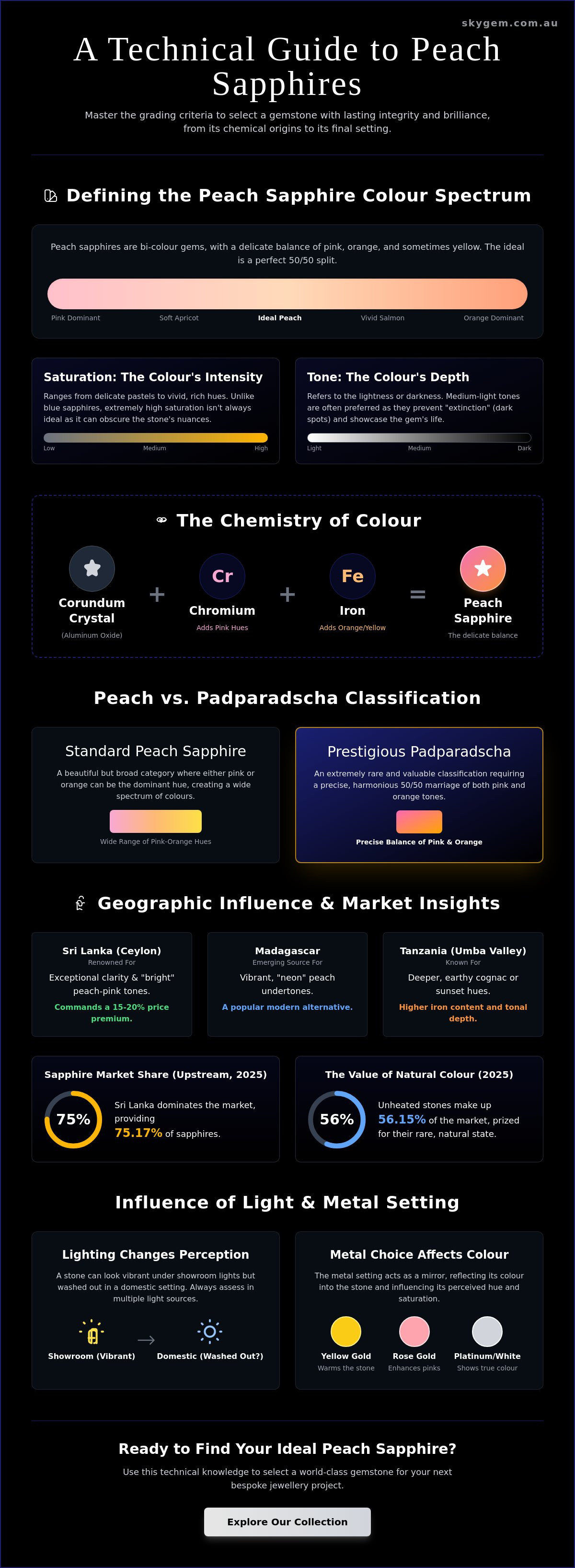
The colour variations in peach sapphires are the result of a delicate chemical interplay within the crystal. They aren't monochromatic. Instead, they're bi-colour or multi-tonal by nature, often displaying a shifting balance of pink, orange, and occasionally yellow. This inherent complexity makes them a versatile choice for custom-made engagement ring designs where a unique, organic aesthetic is the priority. Understanding this spectrum is the first step in moving beyond simple colour labels toward a technical appreciation of gemstone quality.
The Role of Secondary Undertones
Identifying secondary modifiers is a critical step in technical grading. A yellowish modifier can add a warm, champagne-like glow, whereas a brownish undertone often results in a "muddy" appearance that reduces the stone's overall brightness. These modifiers dictate how light travels through the crystal lattice and how the gem interacts with its environment. While some collectors prefer the warmth of a gold-leaning stone, others seek the crispness of a pure pastel. The ideal peach balance is defined as a 50/50 split of pink and orange.
Saturation vs. Tone in Peach Varieties
Saturation refers to the intensity of the colour, ranging from a delicate pastel peach to a vivid apricot. While high saturation is usually prized in blue sapphires, peach varieties require a careful look at tonal depth. If the tone is too dark, the stone may suffer from extinction, which are dark areas where light fails to reflect back to the eye. Medium-light tones often showcase peach hues better than dark tones because they allow the subtle pink and orange nuances to remain visible rather than being masked by shadows. This transparency is vital for maintaining the stone's "life" and ensuring it doesn't look flat when set into a natural sapphire jewellery piece.
The Chemistry of Colour: Trace Elements and Origin
The visual profile of a sapphire isn't an accidental trait; it's a direct result of trace elements trapped within the crystal lattice during formation. In the case of peach varieties, the primary driver is the presence of chromium and iron. Chromium is the same element responsible for the red in rubies and the pink in pink sapphires. When it exists in minute quantities within the alumina structure, it provides the "cool" pink base that defines many peach specimens. However, the true colour variations in peach sapphires emerge when iron enters the equation.
Iron acts as the warming agent, introducing yellow and orange wavelengths into the stone's light absorption pattern. The specific ratio between chromium and iron determines whether a stone leans toward a soft champagne or a deep, vibrant apricot. This chemical balance is extremely delicate. If the iron concentration is too high, the stone may lose its pinkish charm and shift toward a standard orange or yellow sapphire. This intersection of pink and orange is what gemologists look for when evaluating the rare Padparadscha sapphire classification, where the hue must be a perfect marriage of both colours without one dominating the other.
Geographic Influence on Peach Hues
Geology plays a significant role in how these trace elements are distributed. Sri Lanka, which provides 75.17% of the sapphires in the upstream market as of 2025, is renowned for producing stones with exceptional clarity and "bright" peach-pink tones. These Ceylon specimens often command a 15-20% price premium over stones of equivalent quality from Madagascar. Madagascar has recently become a source for stones with "neon" peach undertones, offering a modern alternative to the traditional pastel. In contrast, the Umba Valley in Tanzania is known for deeper, more earthy variations, where the iron influence often creates cognac or sunset-hued stones with higher tonal depth.
The Significance of Unheated Natural Colour
Preserving these delicate chemical balances in their natural state is increasingly rare. As of 2025, unheated stones make up 56.15% of the sapphire market, a figure that has been steadily decreasing. Heat treatment is frequently used to "stabilise" colour or remove unwanted blue or silk undertones, but it can often strip away the subtle nuances that make a peach sapphire unique. Because of this, unheated precious gemstones in the peach category command a significant premium, often 30% to 50% higher than heated counterparts of similar appearance.
Choosing an unheated specimen ensures that the colour you see is exactly as it was formed in the earth, offering a level of authenticity that's highly valued in the Australian market. If you're looking for a stone with a specific chemical pedigree, browsing our collection of natural sapphires can help you find a specimen that retains its raw, unenhanced beauty.
Peach vs. Padparadscha: Navigating Gemstone Classification
The distinction between a high-grade peach sapphire and a certified Padparadscha is often the most contentious topic in fancy sapphire trading. While both fall within the same colour family, a Padparadscha is defined by a specific, narrow range of pinkish-orange hues. The name itself is derived from the Sinhalese word for "lotus flower," implying a delicate, sunset-like glow that is neither purely pink nor purely orange. According to GIA's guide to sapphire color and quality, this classification is prestigious and rare, requiring independent laboratory verification to confirm the stone meets strict saturation and tone requirements.
For many collectors, "peach" is a more accurate and practical description. The colour variations in peach sapphires offer a broader spectrum that includes tones which may be slightly too yellow, too brown, or too saturated to qualify as Padparadscha. This doesn't diminish their beauty; it makes them more accessible. While unheated Padparadschas over 2 carats have reached prices between $12,000 and $25,000 per carat in the 2026 market, high-quality peach specimens offer a similar aesthetic profile at a significantly lower entry point. This price delta reflects the extreme scarcity of the Padparadscha label rather than a deficit in the physical properties of the gemstone itself.
Market Terms: Champagne, Apricot, and Salmon
While gemological reports use standard colour descriptors, the trade uses more evocative terms to categorise these stones. Champagne sapphires exhibit dominant yellow or brownish undertones with just a hint of peach, making them ideal for those seeking a neutral, earthy palette. Apricot sapphires lean heavily into orange saturation, often appearing golden or honey-like under warm lighting. Salmon sapphires sit at the deeper end of the spectrum, displaying intense pink-orange tones with high saturation. Understanding these colour variations in peach sapphires is essential when briefing a jeweller for a custom-made engagement ring.
Comparing Peach Sapphires to Morganite
Peach sapphires are frequently compared to morganite due to their visual similarity, yet they're fundamentally different in performance. Sapphire sits at a 9 on the Mohs scale, making it significantly more durable than morganite, which ranks between 7.5 and 8. For a daily-wear engagement ring, this hardness is vital for resisting the abrasions that eventually dull softer stones. Sapphires also possess a higher refractive index. This means they "sparkle" with more brilliance and fire than beryl-based morganite, which can often look flat or "sleepy" in certain lighting conditions.
The Influence of Light and Metal on Colour Perception
The aesthetic performance of a gemstone isn't static. Metamerism is a critical consideration for peach sapphires, as it describes the phenomenon where a stone's colour appears to change under different light sources. Unlike blue sapphires which remain relatively consistent, the colour variations in peach sapphires often shift noticeably between natural daylight and indoor incandescent lighting. In the cool blue of morning light, a stone might lean toward a crisp, pastel pink. By evening, under warm domestic lamps, that same gem can transform into a rich, golden apricot. This dynamic nature is part of the stone's allure, but it requires careful evaluation before a final selection is made.
In midday sun, the intense luminosity can overwhelm a stone's saturation, leading to a "washed out" appearance where the subtle pink and orange nuances disappear. This effect is particularly prevalent in lighter-toned specimens with high transparency. Additionally, as a doubly refractive mineral, sapphire exhibits pleochroism. This means the crystal displays different colours when viewed from different angles. A master cutter will orient the stone to ensure the most desirable hue is visible through the table, but you'll still notice shifts in shade as the stone moves on the hand. Brilliant cuts increase scintillation and can dilute colour through light dispersion, while step cuts, such as emerald or baguette shapes, tend to concentrate and showcase the stone's true saturation.
Pairing Metal Colours with Peach Undertones
The choice of precious metal acts as a technical filter for the stone's colour. Rose gold is an exceptional companion for salmon or apricot stones because the copper content in the alloy reinforces the pink and orange undertones. Conversely, yellow gold pulls out the warmth in champagne variations, creating a cohesive, vintage aesthetic. If you prefer the stone's hue to stand alone, platinum or white gold provides a neutral, high-contrast backdrop. These "white" metals prevent the surrounding material from bleeding into the stone's colour, making the peach hue "pop" with greater clarity. Choosing the wrong metal can inadvertently mask the very nuances you're trying to highlight.
The Impact of Setting Style on Light Return
Setting architecture dictates how much light enters the pavilion of the gem. For lighter peach sapphires, open-basket settings are often the superior choice because they allow maximum light entry from the sides and back, preventing the stone from looking dark or "dead." Bezel settings, while offering excellent protection, can deepen the perceived tone by restricting side light. This can be a strategic choice if you want to make a pale stone look more saturated, but it can also introduce unwanted shadows. If you're seeking a balance between protection and brilliance, our team specialises in custom engagement rings designed to optimise the specific light requirements of your chosen gemstone.
Experience the interplay of light and colour for yourself by exploring our curated selection of natural sapphires to find the perfect match for your design.
Selecting Your Ideal Peach Sapphire for Bespoke Jewellery
Selecting a gemstone requires a shift from theoretical knowledge to technical application. Because of their lighter tone and high transparency, clarity is the most significant factor when evaluating colour variations in peach sapphires. Inclusions that might remain hidden within the deep saturation of a traditional blue sapphire are often immediately visible in a peach specimen. Aiming for an eye-clean classification ensures that the stone's internal architecture doesn't disrupt light return or create unwanted shadows that can dull the gem's natural vibrancy. This clarity is the foundation upon which the stone's brilliance is built.
Carat weight also plays a significant role in how colour is perceived. Larger crystals provide a longer light path, which generally results in a more concentrated and stable hue. While a 1-carat stone might appear as a delicate, airy pastel, a 3-carat specimen with the same chemical composition often displays a much deeper apricot or salmon tone. It's a delicate balance; larger stones carry a higher risk of extinction if the cut isn't perfectly proportioned to the stone's specific refractive index. We recommend prioritising a precision cut that maintains edge-to-edge brilliance, even if it results in a slightly smaller face-up size.
The Bespoke Design Process
The technical consultation at SkyGem & Co. acts as a collaborative partnership. We utilise advanced CAD to simulate how your chosen peach sapphire will interact with various metal colours and accent stones before any metal is cast. This is a vital step for a bespoke engagement ring, as it allows us to visualise the temperature of the stone against your skin tone. We focus on matching the warm or cool undertones of the gem to the wearer, ensuring the final piece feels like a natural extension of their personal aesthetic.
Investment and Longevity
The market for fancy sapphires is currently navigating significant supply constraints. With the supply of fine-quality unheated specimens from Madagascar down by approximately 70% for stones over 5 carats as of 2026, these gems are increasingly positioned as permanent assets. While blue sapphires still account for 53.21% of the market as of 2025, the demand for unique peach hues is rising among buyers seeking an alternative to traditional diamonds. To ensure the long-term viability of your investment, regular maintenance is required. Light-coloured sapphires can lose their life if oils and debris accumulate on the pavilion facets, so professional cleaning is recommended to keep the stone's light return at its peak.
If you're ready to find a specimen that perfectly balances technical quality with aesthetic appeal, you can book a consultation to view our loose peach sapphires. Our team is dedicated to helping you navigate the complexities of gemstone grading to find the ideal centrepiece for your next project.
Securing Your Investment in Exceptional Colour
Selecting a gemstone that balances aesthetic appeal with technical durability requires more than a cursory glance at a showroom tray. By understanding how trace elements and light interaction dictate the colour variations in peach sapphires, you're better equipped to identify a specimen that retains its vibrancy in every environment. Whether you're drawn to the warmth of an apricot hue or the crispness of a pastel pink, the priority remains sourcing unheated, GIA-standard stones that offer genuine long-term value.
Our role is to act as your technical consultant, utilising bespoke CAD design to ensure your chosen sapphire is set in a way that maximises its unique refractive properties. We specialise in sourcing high-quality Australian and international coloured gems, providing the precision required for a permanent asset. We invite you to explore our curated collection of natural peach sapphires and bespoke settings to begin your design journey. With the right technical foundation, your bespoke jewellery will remain a vivid testament to your personal style for decades to come.
Frequently Asked Questions
Is a peach sapphire the same as a Padparadscha sapphire?
No, they aren't the same. While both gemstones occupy the same colour family, Padparadscha is a specific, laboratory-certified classification for a narrow range of pinkish-orange hues. Most peach sapphires don't meet the rigorous saturation and tone criteria required for this prestigious label. Choosing a peach sapphire allows for a broader range of beautiful sunset tones at a more accessible price point.
Do peach sapphires fade or change colour over time?
Natural, unheated peach sapphires are colour-stable and don't fade under normal light exposure. The corundum crystal structure is exceptionally durable, ensuring that the stone's chemical balance remains permanent. If your stone appears to have lost its vibrancy, it's usually due to a buildup of surface oils or debris on the pavilion facets rather than an actual change in the gem's internal colour.
Which metal colour is best for a peach sapphire engagement ring?
The ideal metal depends on which secondary undertones you want to emphasise. Rose gold is a popular choice because it reinforces the pink and orange warmth within the stone. Yellow gold enhances the golden tones of champagne varieties. If you want the peach hue to remain crisp and distinct, platinum or white gold provides a neutral contrast that prevents the metal's colour from bleeding into the gem.
Are peach sapphires more expensive than blue sapphires?
Generally, peach sapphires are more affordable than traditional blue sapphires of similar quality. While blue stones continue to lead the market in demand and price, peach varieties offer exceptional value for those seeking a unique aesthetic. However, unheated peach specimens with high clarity and saturation are becoming increasingly sought after, which is steadily narrowing the price gap between these and more common colours.
Can I get a lab-grown peach sapphire?
Yes, lab-grown peach sapphires are a viable option for those prioritising high clarity and specific saturation at a lower cost. These stones possess the same chemical and physical properties as their natural counterparts. We offer both lab-grown diamonds and sapphires to ensure our clients can choose the material that best aligns with their project's technical requirements and ethical preferences.
How do I clean my peach sapphire ring to keep the colour bright?
Regular cleaning is vital because lighter-coloured stones show surface grime more readily than darker gems. Use warm water with a mild, lint-free detergent and a soft brush to gently clean behind the setting. Removing oils from the pavilion ensures that light can enter and reflect through the stone without obstruction, which is essential for maintaining the gem's brilliance and perceived colour intensity.
What is the best cut for a peach sapphire to show its colour?
Precision cuts that avoid "windowing" are the best choice for showcasing the colour variations in peach sapphires. While brilliant cuts increase scintillation, step cuts like emerald or radiant shapes often concentrate the colour more effectively. A well-proportioned cut ensures that light is reflected back to the eye rather than leaking through the bottom of the stone, which preserves the gem's true saturation.
Are peach sapphires durable enough for everyday wear?
Yes, they're exceptionally durable. Sapphires rank 9 on the Mohs scale, making them significantly harder than other popular peach-coloured stones like morganite. This hardness means they're highly resistant to the scratches and abrasions that occur during daily activities. They're an ideal choice for engagement rings and other bespoke jewellery intended for long-term, frequent use without the risk of losing their polish.
Disclaimer
This article is for general informational purposes only and may include AI-assisted content. Pricing, specifications, and availability are subject to change. For accurate advice and current information, please contact SkyGem & Co. directly. Nothing in this content constitutes professional or financial advice.