
Champagne vs Cognac Diamonds Explained: Colour, Character and How to Choose

What separates a champagne diamond from a cognac diamond? The names can sound like precise grades, but they’re descriptive terms for an overlapping spectrum of brown diamond colours. A clear look at champagne vs cognac diamonds explained starts with this distinction: neither name defines a separate diamond type, and photographs or lighting can make two stones look more alike or more different than they do side by side. Formal grading uses gemological colour descriptions rather than these trade names.
There’s no universal rule that makes one colour better. What matters is the particular stone’s appearance and how it works with your design. This guide explains how the terms are commonly used, how to compare a diamond’s hue, tone and saturation, and what to look for in images and grading documentation. It also explains how to assess the stone alongside a setting, while treating natural or lab-grown origin as a separate consideration. These steps can help you describe what you like and make a more considered choice for a bespoke design.
Key Takeaways
- Champagne and cognac are descriptive names for brown diamonds, and their use can vary across the trade.
- Compare hue, tone and saturation to describe the colour you prefer more precisely than a label alone.
- Lighting and nearby materials can affect how a diamond appears, so compare stones or images under similar viewing conditions where possible.
- With champagne vs cognac diamonds explained, you can assess a stone’s appearance and design fit without treating one colour as inherently better.
- Coordinate the diamond’s visible colour with its setting and the finished piece to turn a preference into a considered design.
Champagne vs cognac diamonds: what do these colour names mean?
Champagne and cognac are commonly used to describe brown diamonds, but the terms don’t have one fixed meaning across the jewellery trade. In broad terms, “champagne” often suggests a lighter or warmer brown, while “cognac” tends to suggest a deeper, richer impression. A particular stone may sit between the two descriptions or not fit either one neatly.
These labels communicate an overall look, not a precise specification of hue, tone or saturation. One seller might use “champagne” for a diamond with a golden cast, while another may apply it more broadly. Formal gemological grading uses grading terminology rather than relying on these evocative trade names. For general context on diamond properties, see Diamond characteristics and grading.
Treat the names as a starting point when narrowing your preference, not as strict categories. Ask yourself what you see in the individual stone: is it light or deep, golden or more neutral, softly coloured or strongly saturated? Those observations are more useful for comparing diamonds and planning a design than the label alone.
What makes a diamond look champagne-coloured?
A champagne description commonly suggests a lighter brown appearance, sometimes with golden, yellowish or muted undertones. A golden cast can make one stone feel softly warm, while a more neutral brown may look understated. Because the label doesn’t guarantee a particular shade, consider the diamond itself: note its lightness, undertone and how clearly its colour shows beside the setting.
What does cognac mean when describing a diamond?
Cognac commonly evokes a deeper brown, sometimes with reddish or amber undertones. The word is still subjective, and sellers may use it differently. It doesn’t tell you exactly how dark or warm a particular diamond will look, so compare the stone’s appearance rather than assuming all diamonds described as cognac are alike.
In practice, these terms help communicate an aesthetic direction. “Champagne” may be a useful shorthand if you prefer a lighter, golden impression; “cognac” may help describe a preference for a deeper, more concentrated brown. Neither label replaces a direct assessment of the diamond, and neither is inherently a mark of better quality.
Why champagne and cognac diamonds can look different in real life
A colour name can’t capture every feature that affects a diamond’s appearance. Two stones carrying the same label may differ in hue, tone and saturation. Lighting, the way the diamond is cut and the materials around it can also affect the impression. That’s why one photograph or a short description may not show how a diamond will look in a finished piece.
To make champagne vs cognac diamonds explained useful when you’re comparing options, describe the colour you actually see. For example, you might prefer a light brown with a golden cast, or a deeper brown that looks more concentrated. This gives you clearer terms for comparing stones and discussing a design.
How hue, tone and saturation shape the colour impression
Hue is the apparent colour family, such as brown with a golden, yellowish or reddish cast. Tone describes how light or dark the colour appears. Saturation refers to the strength of the colour, from muted to more concentrated. These qualities work together: a diamond may look warm and light, or darker but less saturated. Neither combination establishes a fixed grade or a boundary between champagne and cognac.
That’s why two diamonds with the same trade label can look noticeably different side by side. The GIA grading of fancy color diamonds explains factors used to assess fancy-colour appearance, including hue, tone and saturation. These terms can help you describe what appeals to you, even when a seller’s colour description is broad.
Why lighting, cut and setting change what you see
Lighting affects perceived colour. A diamond viewed indoors may seem warmer or darker than it does in daylight, and a photograph can be influenced by the lighting and display used to capture it. When possible, compare stones under similar conditions and look at more than one view. Don’t make a decision from a single image if you can assess the diamond more fully.
Cut and size also contribute to the overall impression. The way a diamond is proportioned and viewed can affect how its colour reads, but no cut is automatically best for every brown diamond. The setting matters as well: yellow-toned metal may reinforce a warm impression, while a contrasting metal can make the diamond’s colour stand out differently. Judge the stone and setting together, not as separate choices.
A diamond’s colour description tells you about its appearance; its natural or lab-grown origin is a separate consideration. Both origin and colour can inform a selection, but one doesn’t define the other. For more on the origin distinction, explore lab-grown diamonds. If you’re developing a ring design, an expert consultation can help translate your preferred colour and setting into a cohesive bespoke direction.
Champagne vs cognac diamonds: compare colour, mood and design fit
A side-by-side comparison can help make the names easier to interpret, as long as you treat them as descriptions rather than fixed specifications. “Champagne” often suggests a lighter brown impression, while “cognac” commonly points to a deeper one. Trade usage varies, and individual stones may sit between these impressions or combine several qualities.
A side-by-side guide to the two colour descriptions
| Visual quality | Champagne impression | Cognac impression |
|---|---|---|
| Lightness | Often perceived as lighter, though the actual tone varies. | Often perceived as darker or more concentrated, without a fixed threshold. |
| Warmth | May suggest a golden or softly warm cast. | May suggest a richer brown, sometimes with amber or reddish nuances. |
| Overall character | Can feel subtle or softly luminous in a design. | Can create a more pronounced colour presence. |
| Where descriptions overlap | A stone may combine lighter and deeper areas, or its appearance may not fit neatly under either label. Descriptions vary across the trade. | |
These impressions are useful for communicating style, not establishing a formal boundary. A diamond’s report uses grading terminology rather than treating “champagne” or “cognac” as an official grade. The label alone also can’t tell you whether a stone suits a particular piece. When comparing options, keep descriptive colour language separate from documented grading information and assess each diamond on its own appearance.
Which colour impression may suit your preferred design?
Start with the effect you want the finished jewellery to have. A lighter or golden-looking stone may suit a softer, understated design. A deeper-looking diamond may work if you want its colour to be more prominent. These are style prompts, not rules. The setting’s shape, metal and surrounding details can change the balance, so consider the complete design rather than choosing by colour name alone.
For example, a restrained setting may keep attention on a warm, lighter impression, while a more detailed design could make a deeper brown feel integrated rather than dominant. Either colour can work across different aesthetics; neither is inherently superior. Your preference and the stone’s appearance in the proposed setting should guide the choice.
As you compare, consider three things: whether you prefer a lighter or deeper impression, whether the undertone works with the setting materials, and whether the stone supports the mood you want the finished piece to express. Describing those preferences is more useful than relying on a label as a shortcut. Colour names alone don’t determine a diamond’s quality, grading or design suitability. The strongest choice is the individual stone that aligns with your goals.
How to assess a champagne or cognac diamond before choosing
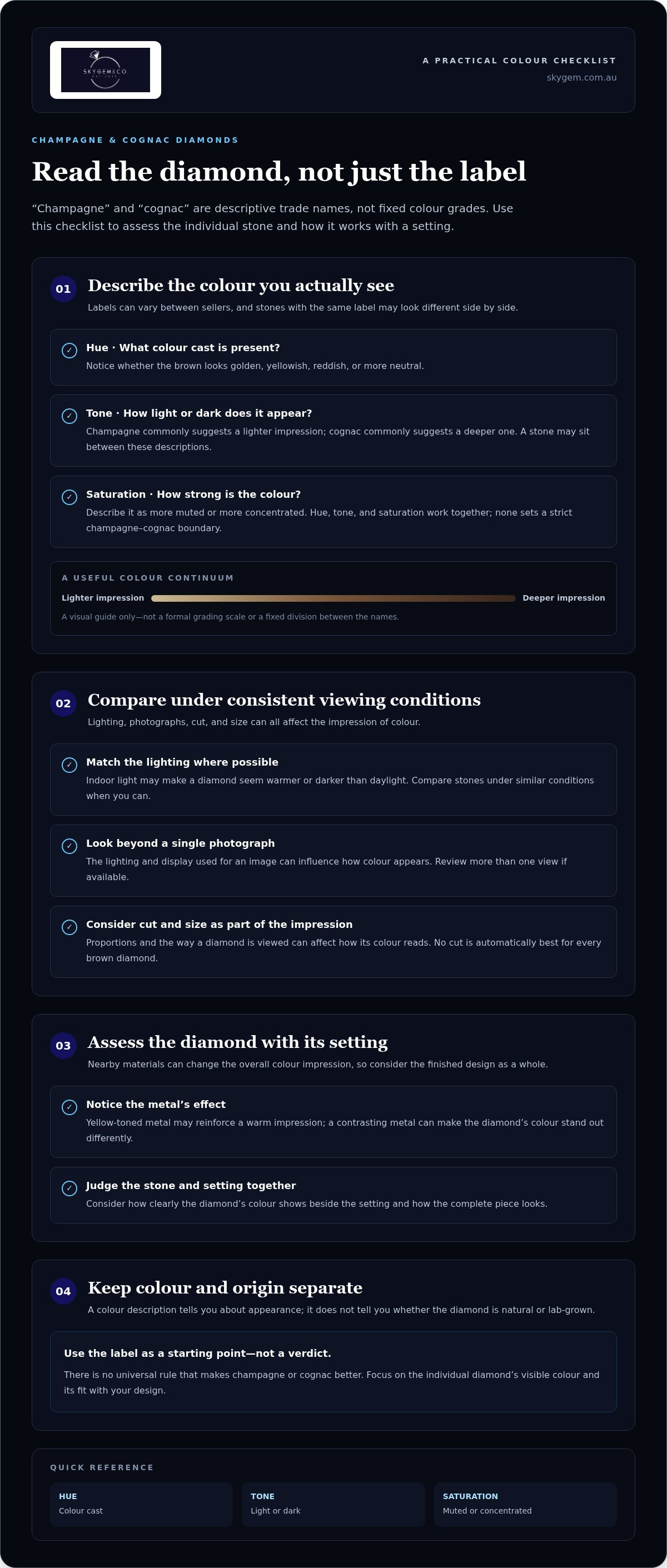
A consistent assessment is more reliable than deciding from a colour name or a single photograph. First clarify the design you want, then assess the diamond’s visible colour and its documentation. Finally, consider how the stone will look in the setting. This sequence helps separate personal preference from formal grading details while keeping the intended piece in view.
A practical viewing checklist for comparing colour
Before comparing stones, define what you want the finished piece to express. Assess each diamond under comparable conditions, recording what you see rather than relying only on its label. Then consider how the colour will sit within the proposed design. Keeping these steps in order makes it easier to compare options fairly.
- State your design preferences. Decide whether you’re drawn to a lighter or deeper impression, a golden or more neutral cast, and a subtle or more prominent colour presence. Include the setting’s shape and metal in your thinking.
- Compare colour consistently. View actual stones, or clear images of them, under similar lighting and at a similar viewing distance where possible. Note the visible hue, tone and saturation instead of relying only on “champagne” or “cognac.” If comparing photographs, use images made under comparable conditions rather than assuming different lighting will show colour faithfully.
- Assess the stone in its design context. Consider how the diamond’s colour appears beside the intended setting and surrounding details. A stone that appeals on its own may create a different effect once paired with the metal and design elements.
What grading documentation can and cannot tell you
Documentation serves a different purpose from a descriptive colour name. “Champagne” and “cognac” are trade terms, so don’t assume either will appear as a formal grade on a report. Grading terminology depends on the organisation and report type. When you need documented information about a stone, refer to the details stated in its report rather than treating a marketing label as a grade.
Read the report in context. Identify the grading organisation and review the colour description exactly as written, rather than translating it into a familiar trade name. A description that refers to brown colour, for example, may not use the words “champagne” or “cognac.” Those labels can still help you communicate an aesthetic preference, but they shouldn’t replace the report’s terminology or be treated as a complete assessment of quality or suitability.
If a report’s wording is unfamiliar, consult the grading organisation’s explanation of its terminology. Then compare the documented description with the diamond’s appearance under consistent viewing conditions where possible. This brings together the recorded information and your design priorities without assuming a report can predict every visual impression.
In short, champagne vs cognac diamonds explained as a selection process means clarifying your design intent, making a fair visual comparison and reading documentation on its own terms. An expert consultation can help translate your preferences into a considered bespoke design.
Turn a champagne or cognac colour preference into a bespoke design
Comparing these colour descriptions is most useful when it helps you clarify what you want your jewellery to look and feel like. Let the individual stone’s appearance and your design intent guide the decision rather than treating “champagne” or “cognac” as a specification. Bespoke design brings the diamond, setting and finished piece together as a considered whole.
How a consultation connects stone character with ring design
In a design consultation, describe the colour character that appeals to you, the style of jewellery you have in mind and the priorities that matter most. You might consider how prominent the centre stone should feel, the shape of the setting, or whether you want the finished ring to look understated or distinctive. These preferences give the design process a practical starting point.
SkyGem & Co. offers bespoke design and manufacturing, from initial CAD design to final stone setting. The setting can be planned in relation to the diamond’s visible colour rather than selected in isolation. That’s where champagne vs cognac diamonds explained becomes useful: it turns a broad colour preference into a more specific conversation about the appearance and character you want the ring to express.
- Describe the colour impression you’re drawn to, including its warmth and depth.
- Share the jewellery style and setting details that suit your taste.
- Consider the finished piece as a whole, including how the setting will frame the stone.
When to explore natural or lab-grown coloured diamonds
Origin and colour are separate considerations. Natural and lab-grown diamonds can be considered by origin, while colour remains a distinct part of the design brief. If you’re exploring naturally coloured stones more broadly, the natural coloured diamonds page provides a relevant starting point. Lab-grown diamonds are another option to consider as you shape your preferences.
Focus on the appearance you value and the design you want to create. A colour description can help communicate your direction, but the final design should respond to the individual stone and your priorities, not an assumed boundary between two labels. This approach leaves room for a piece that feels cohesive and personal.
If you’d like to develop your colour preference into a bespoke design, schedule an expert consultation with SkyGem & Co.
Shape your colour preference into a ring design
Turn what you’re drawn to into a design brief that feels personal. The value of having champagne vs cognac diamonds explained is not choosing a label for its own sake, but finding language for the colour character and overall effect you want. Bring those preferences together with your priorities for the ring, including its style, setting and budget.
In an expert consultation, those details can guide a bespoke engagement ring design and manufacturing process. SkyGem & Co. offers natural GIA-certified and lab-grown diamonds, with origin considered separately from colour. The design conversation can focus on shaping a ring around your preferences, without assuming that a particular colour description defines the finished piece.
You don’t need every design decision settled before taking the next step. A consultation can help clarify what matters most and turn your ideas into a practical direction for a ring that reflects your style.
Frequently Asked Questions
Are champagne and cognac diamonds the same thing?
They’re commonly used to describe brown diamonds, and the terms can overlap. When comparing two stones, note what you see instead of relying on the names. Record which looks lighter and whether either has a warmer or more concentrated impression. This makes the comparison about the stones themselves, not just their labels.
Is champagne a formal diamond colour grade?
No, “champagne” isn’t automatically a formal grade. Keep the seller’s description separate from the report’s exact wording. Note the grading organisation and use its guidance to interpret the document, since terminology can differ between organisations and report types. Sharing the report wording alongside your visual preference helps keep the technical description and design conversation clear.
Can a cognac diamond be natural or lab-grown?
Yes, a cognac-coloured diamond may be natural or lab-grown. Consider origin separately from colour rather than treating the colour name as evidence of how the diamond was created. Review the documentation for the stone and identify which origin considerations matter to you alongside colour, shape and the intended design.
Do champagne and cognac diamonds look different in every setting?
No. The result depends on the particular stone and design. Consider how the diamond sits within the chosen setting and whether the surrounding details support the look you want. Compare the stone with the setting concept rather than assessing it in isolation, so you can judge the complete piece.
Does a darker cognac diamond mean it is better quality?
No. Darkness alone can’t establish overall quality or suitability. Separate your visual preference from the stone’s documented characteristics: decide whether you like its appearance, then review the available grading information for other details relevant to your choice. Keeping visual impressions and documented information distinct helps prevent colour intensity from becoming a substitute for a fuller assessment.
What should I look for in a champagne or cognac diamond grading report?
Check that the document identifies the stone you’re considering, then note the grading organisation, report type and exact recorded descriptions. Keep the wording for comparison with the diamond’s listing or design notes. If a term is unclear, use the issuing organisation’s explanation rather than guessing at its meaning. The report can provide a reference point for discussing the stone without treating a trade description as report language.
Are champagne and cognac diamonds suitable for an engagement ring?
They can be, if the wearer likes the individual stone and it works with the ring design. Consider practical preferences such as the ring’s profile, the setting style and how prominent you want the centre stone to look. Design references can help clarify those priorities. A bespoke design consultation can then turn them into a cohesive engagement ring brief.
Disclaimer
This article is for general informational purposes only and may include AI-assisted content. Pricing, specifications, and availability are subject to change. For accurate advice and current information, please contact SkyGem & Co. directly. Nothing in this content constitutes professional or financial advice.