
Caring for an Alexandrite Ring: The Expert Guide to Maintaining Rare Brilliance

With natural alexandrite accounting for less than 0.01% of all gemstones mined in 2025, your ring is far more than a standard accessory; it is a high-performance asset of immense geological rarity. It's natural to feel a sense of caution when maintaining such a significant investment. Whether you worry about accidental abrasions or the safety of modern cleaning technology, properly caring for an alexandrite ring requires a methodical approach that respects both its 8.5 Mohs hardness and its complex optical properties.
You shouldn't have to guess which household products are safe for your most precious pieces. This guide delivers professional techniques to clean, protect, and preserve the mesmerising colour-change properties of your jewellery for generations. We will outline a reliable at-home cleaning routine, identify environmental risks that threaten the stone's brilliance, and explain how to determine the right schedule for expert maintenance. By following these technical standards, you ensure your alexandrite remains a permanent and evolving asset in your collection.
Key Takeaways
- Understand how the 8.5 Mohs hardness rating of chrysoberyl ensures your stone can withstand the rigours of daily wear while remaining susceptible to specific impact risks.
- Master the professional 'gentle immersion' technique for safely caring for an alexandrite ring using standard household materials without risking damage to the stone's optical properties.
- Implement the 'Last On, First Off' protocol to shield your jewellery from the corrosive effects of perfumes, lotions, and harsh chemicals that can dull its colour-change effect.
- Learn the critical indicators of metal fatigue and prong wear that necessitate an annual professional inspection to ensure the ongoing security of your gemstone.
- Recognise the specific maintenance requirements for investment-grade unheated alexandrite to maintain its market value and structural integrity over decades.
Understanding Alexandrite’s Durability: The Chrysoberyl Standard
Alexandrite is a rare and remarkable variety of the mineral chrysoberyl, a species defined by its exceptional structural integrity. When assessing the long-term viability of a gemstone, we look to Alexandrite’s Durability: The Chrysoberyl Standard to understand how it performs under pressure. With a rating of 8.5 on the Mohs scale of mineral hardness, it is one of the most resilient natural materials available for fine jewellery. This high ranking places it just below sapphires and rubies, ensuring that the stone can resist the micro-abrasions caused by common dust and environmental contact.
While hardness measures a stone's resistance to scratching, toughness refers to its ability to withstand fracturing or chipping upon impact. Alexandrite possesses excellent toughness and lacks distinct cleavage, meaning it doesn't have internal planes of weakness where it might easily split. These technical specifications make the stone a premier choice for bespoke engagement rings intended for daily wear. However, effectively caring for an alexandrite ring involves more than just relying on its mineral strength; it requires an understanding of how its physical properties interact with your environment.
The Science of Colour-Change Stability
The legendary colour-change effect is a fundamental characteristic of the stone's crystal lattice. It is not a surface treatment or a coating that can be "washed away" or degraded over time. Traces of chromium within the crystal structure absorb light in a specific way that creates the famous "emerald by day, ruby by night" phenomenon. Although the effect is permanent, surface grime or oil buildup from hand creams and skin oils can interfere with light refraction. This accumulation creates a film that dulls the optical shift, making the stone appear muddy or less vibrant than its original state.
Hardness vs. Brittleness in Daily Use
Even the most resilient gems remain susceptible to mechanical shock. A high Mohs rating doesn't mean the stone is invincible. While it's difficult to scratch, it can still chip if it strikes a hard surface at a precise angle. Common household surfaces like granite countertops, stainless steel appliances, and heavy car doors pose the greatest risks. When compared to other precious gemstones, alexandrite is incredibly hardy, yet a sharp blow can cause damage to the facets or the setting. Consistency is key when caring for an alexandrite ring, as maintaining the stone's physical condition is the only way to ensure its rare brilliance remains intact for decades.
Safe Cleaning Methods for Your Alexandrite Ring
Maintaining the optical performance of a rare gemstone requires a deliberate and non-invasive approach. While the stone's hardness protects it from scratches, its brilliance is often obscured by the daily accumulation of lipids and environmental particulates. Caring for an alexandrite ring at home shouldn't involve aggressive chemicals; instead, it relies on a structured "gentle immersion" method that preserves both the stone and the integrity of the metal setting.
The Gentle At-Home Cleaning Ritual
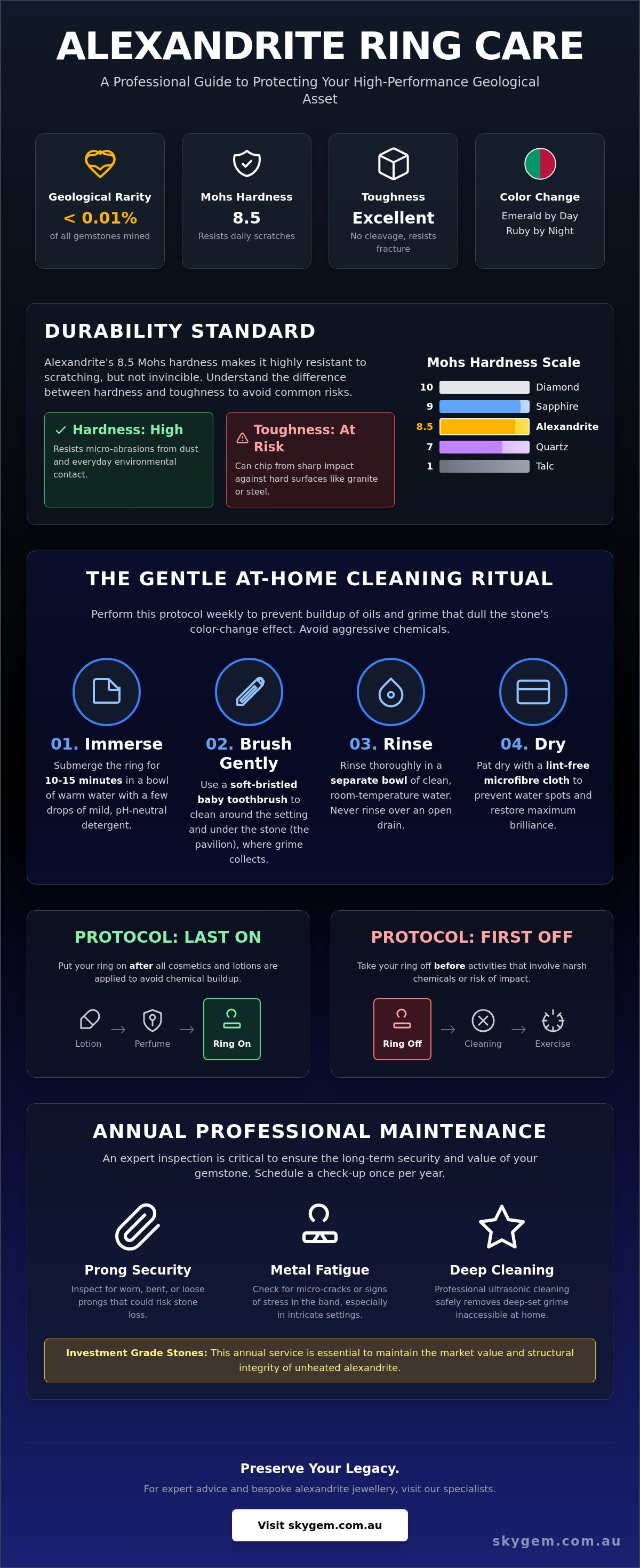
For rings worn on a daily basis, we recommend performing this cleaning protocol once every week or fortnight. This prevents the buildup of films that can dampen the stone's colour-change efficiency. To begin, you'll need a small bowl of warm water, a mild pH-neutral detergent, and a soft-bristled baby toothbrush. It's a straightforward process that yields immediate results.
- Step 1: Submerge the ring in the soapy solution for ten to fifteen minutes. This period of immersion softens organic oils and loosens debris without the need for mechanical force.
- Step 2: Use the soft toothbrush to gently clear the pavilion, which is the underside of the stone where grime typically accumulates. Ensure you don't use medium or hard bristles, as these can eventually cause micro-scratches on softer metal alloys.
- Step 3: Rinse the jewellery thoroughly in a separate bowl of clean, room-temperature water. Never rinse your ring directly over an open drain; using a separate basin eliminates the risk of accidental loss.
After rinsing, dry the piece with a lint-free microfibre cloth. This final step is vital to prevent water spots and mineral deposits from forming on the facets, which can interfere with light entry and exit. If you're considering a new acquisition, you can view our technical specifications for alexandrite gemstones to understand how different cuts respond to light.
Why Ultrasonic and Steam Cleaners Pose a Risk
While industrial cleaning tools are common in the jewellery sector, they're not always appropriate for every gemstone. According to GIA’s guide to alexandrite, these stones are generally stable, yet mechanical cleaning methods introduce unnecessary variables. High-frequency vibrations in ultrasonic cleaners can exacerbate hidden inclusions or internal "feathers" in natural stones, potentially causing a fracture to expand under the surface.
Steam cleaners present a different set of challenges altogether. The rapid temperature shift, known as thermal shock, can lead to structural failure in stones with specific internal characteristics. Before subjecting your ring to these methods, always seek a professional inspection to confirm the stone's internal stability. For most owners, the manual immersion method remains the safest and most effective strategy for caring for an alexandrite ring throughout its lifespan.
Protecting Alexandrite from Chemical and Environmental Stress
While alexandrite is physically robust, it remains a component of a complex mechanical assembly. Most owners focus solely on the gemstone, yet caring for an alexandrite ring requires equal attention to the metal that secures it. We advocate for the 'Last On, First Off' rule. This protocol dictates that your jewellery should be the final item you put on after applying cosmetics and the first item you remove upon returning home. Perfumes, hairsprays, and lotions contain volatile organic compounds and oils that create a stubborn film on the stone's surface, eventually dampening its colour-change performance.
Environmental exposure extends beyond cosmetics. Chlorine, commonly found in swimming pools and household cleaning agents, is particularly detrimental to gold alloys. It initiates a process known as stress corrosion cracking, which can lead to the sudden failure of prongs or the ring's shank. Similarly, salt water acts as a mild abrasive and can leave corrosive residues in the tight crevices of a high-quality engagement ring setting. We recommend removing your jewellery before swimming, gardening, or engaging in high-impact gym sessions where the risk of metal-on-metal contact is high.
Household Chemicals and Metal Integrity
Standard household cleaners often contain bleach or ammonia, both of which are aggressive towards the alloys used in fine jewellery. Repeated exposure to these substances can leach the base metals from gold, making the prongs brittle and prone to snapping. This structural degradation is often invisible to the naked eye until the stone becomes loose. To maintain the long-term security of your investment, always wear protective gloves if you must keep your ring on during cleaning, though total removal is the superior strategy.
Managing Thermal Shock Risks
A significant but often overlooked threat to gemstone stability is thermal shock. This occurs when a material undergoes a rapid and extreme change in temperature, leading to uneven expansion or contraction within the crystal lattice. According to GIA's guide to alexandrite durability, while chrysoberyl is generally stable, sudden spikes can be problematic. Moving your hand from a freezing environment into a bowl of very hot water, for instance, can induce internal stress. This is especially risky for stones with existing microscopic inclusions. During extreme weather conditions or when moving between temperature-controlled environments, it's best to keep the ring against your skin or stored in a padded pouch to allow for a gradual thermal transition.
Professional Maintenance and Storage Strategies
While consistent at-home cleaning preserves immediate clarity, professional maintenance serves as the structural audit required for long-term viability. Caring for an alexandrite ring involves an annual technical assessment to identify microscopic wear that the naked eye cannot detect. Over time, the constant friction of daily contact leads to metal fatigue, particularly in the prongs and the under-bridge of the setting. A professional jeweller uses high-magnification loupes to examine the tension of each claw, ensuring the gemstone remains securely seated within its bespoke environment. If you require a technical assessment of your current setting, explore our specialist jewellery repair and maintenance services.
The Importance of Annual Prong and Setting Checks
Stability is not a permanent state. The metal prongs that secure your stone are subject to "work hardening" and gradual thinning through contact with harder surfaces. Many owners rely on the 'tap test', holding the ring to their ear and tapping the shank to listen for a rattle. This is an insufficient diagnostic tool. A stone can be dangerously loose without making an audible sound if it is held in place by dirt or skin oils. A professional inspection includes a comprehensive tightening of the setting and an assessment of the metal’s structural integrity, preventing the catastrophic loss of the gemstone.
Safe Storage to Prevent Surface Abrasions
Storage is a critical component of caring for an alexandrite ring that many collectors overlook. Because alexandrite has a Mohs hardness of 8.5, it occupies a specific position in the hierarchy of mineral durability. It is hard enough to scratch softer stones like opals or pearls, yet it can be easily abraded by diamonds, which sit at the top of the scale with a rating of 10. To prevent cross-contamination and surface scratches, follow these storage protocols:
- Utilise a fabric-lined jewellery box with dedicated, individual compartments.
- Avoid placing multiple rings in a single pouch, as the stones can grind against one another during transport.
- For high-value alexandrite gemstones, consider a dedicated jewellery safe that maintains a stable, room-temperature environment.
Professional polishing is another essential service that restores the original lustre of the setting. Beyond aesthetics, polishing removes the micro-scratches that trap the household chemicals and oils discussed in previous sections. This process should be performed sparingly by a technician who understands how to maintain the precise geometry of the ring's design without removing excessive metal volume. By combining disciplined storage with periodic expert intervention, you ensure the ring remains a permanent asset in your collection.
Long-Term Care for Bespoke Alexandrite Jewellery
Caring for an alexandrite ring is a commitment to preserving an asset that occupies a unique position in the 2026 luxury landscape. With natural alexandrite accounting for less than 0.01% of all gemstones mined in 2025, these pieces are increasingly viewed as hard assets that provide a significant store of value. As global demand for top-tier specimens surged by 22% in the 24 months leading up to the first quarter of 2026, the importance of maintaining the stone's physical condition has never been higher. While the global gemstone market is projected to grow at a compound annual growth rate of 6.6% through 2036, the intrinsic value of your specific stone depends on its continued physical perfection and the quality of its colour-change effect.
A comprehensive long-term care plan must include regular insurance valuations and the meticulous storage of certification documents. Your GIA certificate is the definitive proof of your stone's natural origin and any treatments it may have undergone. In a market where lab-grown alternatives produced via the Czochralski method are increasingly common, this documentation serves as the technical foundation of your ring's provenance. We recommend updating your valuations every two to three years to reflect the diminishing yields from traditional sources, such as the Hematita mine in Brazil, where production has dropped to 12% of its 2012 levels as of early 2026.
Maintaining Unheated and Rare Specimens
Unheated alexandrite represents the pinnacle of geological rarity. These stones require an even more conservative approach to maintenance than their treated counterparts. Because unheated specimens have not been subjected to artificial stabilising processes, they are often more sensitive to the chemical stressors and thermal shocks discussed in previous sections. Preserving the original state of these stones is essential for maintaining their investment-grade status. This level of care is particularly vital for bespoke engagement rings, where the setting is specifically engineered to protect the unique geometry of a one-of-a-kind natural stone.
The SkyGem & Co. Commitment to Quality
Our role extends beyond the initial design; we act as technical consultants for the entire lifespan of your jewellery. Whether your ring requires a deep professional cleaning to restore its optical shift or a structural restoration of the prongs, our team provides the expert precision necessary for handling such rare material. We understand that an alexandrite ring is a modern heirloom, a fusion of technical excellence and aesthetic beauty that tells a story across generations. To ensure your collection continues to reflect this standard of excellence, we invite you to consult with our specialists for ongoing maintenance. Explore our curated collection of alexandrite gemstones to see the standard of brilliance we strive to protect.
Preserving the Longevity of Your Geologic Asset
Protecting the structural and optical integrity of your jewellery is a continuous process of technical management rather than a series of isolated tasks. By implementing a disciplined at-home cleaning protocol and remaining vigilant against environmental stressors like thermal shock and chemical exposure, you maintain the stone's rare colour-change performance. Effective caring for an alexandrite ring ultimately relies on a partnership between the owner and a qualified technician to address the subtle effects of metal fatigue and prong wear over time.
As GIA certified diamond and gemstone specialists, we provide the technical precision required for high-level maintenance and restoration. Our team utilises expert CAD design and meticulous hand-finishing to uphold the standards of specimens sourced from reputable global suppliers. To ensure your ring remains in peak condition, Book a Professional Maintenance Consultation with our experts today. Your alexandrite is a permanent and evolving asset; with the right professional oversight, it'll continue to exhibit its mesmerising brilliance for generations to come.
Frequently Asked Questions
Can I wear my alexandrite ring every day?
Yes, you can wear an alexandrite ring daily because it possesses a Mohs hardness rating of 8.5, making it highly resistant to scratches and abrasions. This durability is comparable to sapphire and ruby, which are standard for everyday use. You should still remove the ring during high-impact activities like gym sessions or heavy manual labour to protect the metal prongs and prevent accidental chips from sharp blows.
Is it safe to use an ultrasonic cleaner for alexandrite?
While alexandrite is technically stable enough for ultrasonic cleaning, we recommend caution for natural stones with internal inclusions. High-frequency vibrations can expand existing microscopic feathers or fractures within the crystal lattice. If you are caring for an alexandrite ring that is a rare natural specimen, the manual "gentle immersion" method remains the safest standard for long-term preservation.
How often should I have my alexandrite ring professionally cleaned?
We recommend a professional cleaning and structural inspection at least once every twelve months. This visit isn't just for aesthetics; it allows a technician to check for metal fatigue and prong thinning that occurs through daily wear. A professional deep clean removes compressed debris from the pavilion that at-home brushing cannot reach, ensuring the stone's colour-change properties remain fully visible.
Does alexandrite change colour because of heat or light?
Alexandrite changes colour based on the spectral composition of the light source, not the temperature of the environment. The chromium within the stone reacts differently to the blue-green wavelengths of daylight versus the red-rich wavelengths of incandescent light. While heat doesn't cause the colour shift, extreme temperature spikes should be avoided to prevent thermal shock, as discussed in our guide to environmental stress.
Can hand sanitiser damage my alexandrite ring?
Alcohol-based hand sanitisers won't damage the alexandrite stone itself, but frequent exposure can dull the lustre of the metal setting. Over time, the chemicals can leave a residue film that obscures the stone's facets, requiring more frequent cleaning. It's best to remove your ring before applying sanitiser or wait until your hands are completely dry before putting it back on to maintain the metal's finish.
What should I do if my alexandrite stone feels loose in the setting?
If you notice any movement or hear a rattle, stop wearing the ring immediately and store it in a padded pouch. A loose stone indicates that the prongs have either thinned or shifted, and continued wear significantly increases the risk of the gemstone falling out. You should take the piece to a professional for a tension check and potential retipping of the claws to secure the asset.
How should I store my alexandrite ring when travelling?
When travelling, store your ring in a dedicated, fabric-lined pouch or a separate compartment within a travel jewellery case. This prevents the ring from coming into contact with other pieces, which could lead to metal scratches or impact damage. Never place the ring loosely in a bag or pocket; the friction against other hard objects can compromise the polished surface of the setting and the stone.
Can alexandrite be scratched by other jewellery?
Yes, although alexandrite is very hard, it can be scratched by diamonds, which are the only natural material higher on the Mohs scale. Conversely, your alexandrite can scratch softer gemstones like emeralds, opals, or pearls. This is why separate storage is a critical part of caring for an alexandrite ring, as it eliminates the risk of cross-contamination between stones of varying hardness levels.
Disclaimer
This article is for general informational purposes only and may include AI-assisted content. Pricing, specifications, and availability are subject to change. For accurate advice and current information, please contact SkyGem & Co. directly. Nothing in this content constitutes professional or financial advice.