
Burmese vs African Ruby Origin: A Technical Comparison for Fine Jewellery

The most expensive gemstone in your collection might not be the one with the most brilliance, as the prestigious "Burma" label often commands a premium that transcends visual performance. You've likely felt the pressure to prioritize heritage over technical specifications, especially when navigating the complex debate of burmese vs african ruby origin. It's common to feel concerned about overpaying for a legacy name when modern African deposits offer such exceptional transparency and saturation.
This technical comparison clarifies how the geological transition from marble-hosted Mogok stones to basalt-hosted deposits in Mozambique affects fluorescence and long-term investment value. You'll gain a clear understanding of how iron levels influence the "Pigeon Blood" aesthetic and why the GIA's 2026 grading standards have added a significant premium to verified provenance. We'll examine the data behind unheated rubies and the crystalline differences that define these two regions, giving you the confidence to choose a stone that meets the rigorous standards of bespoke jewellery design.
Key Takeaways
- Understand the fundamental chemical differences between marble-hosted and basalt-hosted deposits, which determine a gemstone's specific iron and chromium levels.
- Evaluate the technical trade-offs of burmese vs african ruby origin by comparing the iconic fluorescence of Mogok stones with the superior crystalline transparency found in Mozambique.
- Learn why unheated status and top-tier certifications from the GIA or SSEF are essential for preserving the long-term value of an investment-grade ruby.
- Distinguish between the traditional "Pigeon Blood" aesthetic and modern brilliance to determine which visual profile best complements your custom engagement ring design.
- Gain insights into current supply constraints in Myanmar and how ethically sourced African rubies have become a reliable choice for contemporary fine jewellery projects.
The Geological Divide: Marble-Hosted vs High-Iron Rubies
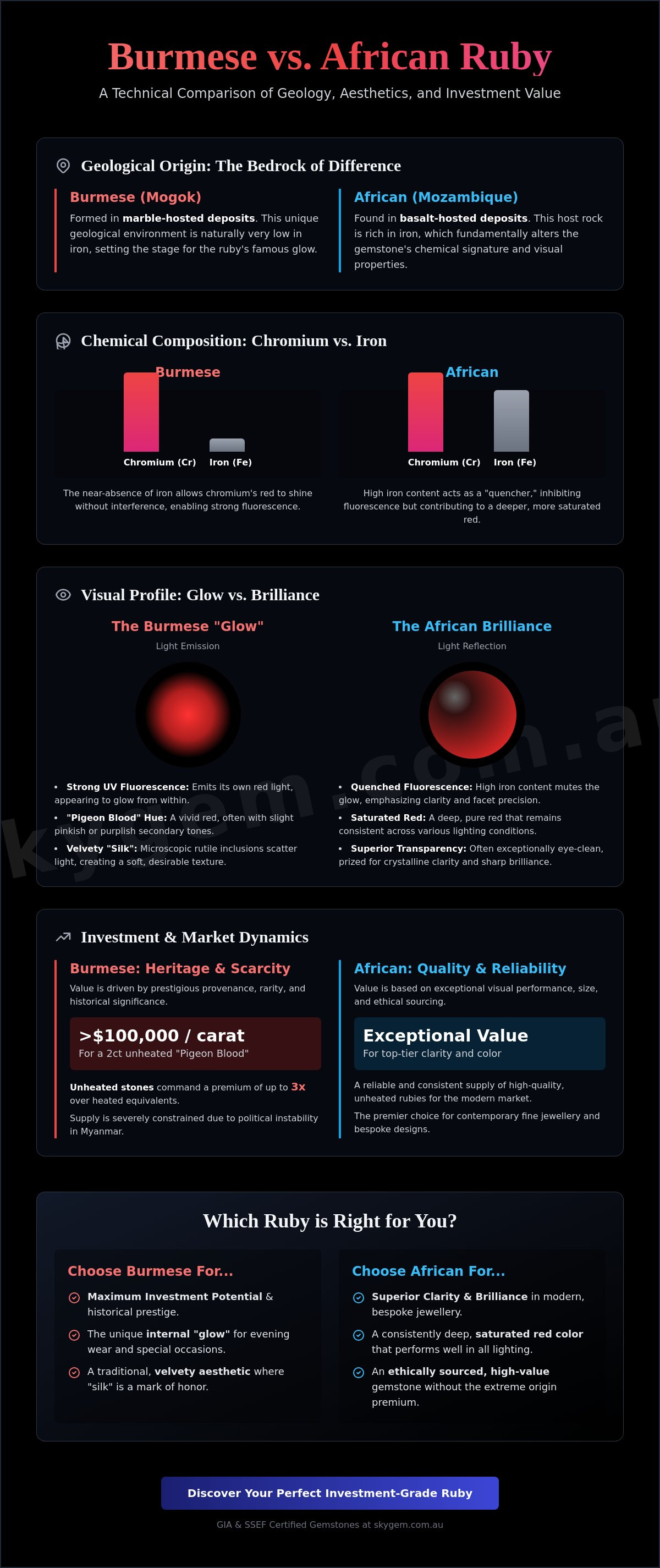
Geography dictates the chemical composition of a gemstone long before it reaches a lapidary's wheel. Evaluating burmese vs african ruby origin requires an understanding of the host rock where the crystals formed millions of years ago. Origin is more than a label; it defines the chemical "DNA" of the gemstone. Burmese rubies, particularly those from the Mogok region, are marble-hosted. This specific environment is naturally low in iron, which allows the chromium content to dominate the stone's visual profile. In contrast, African rubies from Mozambique are typically found in amphibolite or basalt-related deposits. These geological environments are rich in iron. This creates a fundamentally different chemical signature that alters how the gemstone interacts with light, as iron acts as a "quencher" for fluorescence.
The Role of Chromium and Iron
The interplay between chromium and iron is the defining factor in a ruby's appearance. Chromium is the trace element responsible for the vivid red hue we associate with high-quality corundum. While chromium provides the colour, iron acts as a modifier. In Burmese stones, the near-absence of iron ensures that chromium can perform without interference. The result is a vibrant, "open" red. Because African rubies contain higher iron levels, they often exhibit a deeper, more saturated red that remains consistent across various environments. Understanding Ruby gemstone origins helps collectors realize that African stones provide a level of lighting stability that marble-hosted stones sometimes lack. Low iron levels in Burmese stones allow for maximum UV fluorescence, which is the technical driver behind the legendary Mogok "glow."
Fluorescence: The Secret to the Burmese Glow
Fluorescence is a physical phenomenon where UV light excites the chromium atoms within the crystal lattice. In a low-iron environment, this energy is released as visible red light. It effectively makes the stone its own light source. This "internal glow" is distinct from the external light reflection seen in most other gemstones. While African rubies are prized for their exceptional clarity and brilliance, the iron content often "quenches" this fluorescent reaction. For those selecting natural rubies for evening wear, the Burmese glow offers a unique aesthetic advantage. Under the UV components of evening light, a marble-hosted ruby appears to illuminate from within. A high-iron African stone relies more on its facet arrangement to return light to the eye. The geological divide between burmese vs african ruby origin is essentially a choice between light emission and light reflection.
Burmese Rubies: The Legacy of Mogok and Pigeon Blood
The Mogok Stone Tract in Myanmar remains the most prestigious provenance in the world of corundum, serving as the historical benchmark for the "Pigeon Blood" designation. This specific trade grade describes a vivid red hue with a fluorescent component that distinguishes it from other sources. When evaluating burmese vs african ruby origin, the Mogok stone is defined by its unique light dispersal. Unlike the high-clarity stones found elsewhere, Burmese rubies often contain "silk," which consists of microscopic rutile inclusions. These needles scatter light across the facets, creating a soft, velvety texture that enhances the stone's internal glow. This characteristic is a primary reason why collectors often prioritize the Burmese "look" over sheer transparency.
Visual Characteristics of Mogok Stones
Mogok rubies frequently exhibit a slightly pinkish or purplish secondary undertone, a result of the specific chromium-to-iron ratio found in marble-hosted deposits. While modern buyers often seek eye-clean stones, finding a large, untreated Burmese ruby without visible inclusions is exceptionally rare. The industry acknowledges that the "silk" is not a flaw but a signature of origin that contributes to the stone's depth. As noted in the New York Times on the ruby market, the demand for these legacy stones persists even as supply shifts toward newer African deposits. This scarcity ensures that a 2-carat unheated "Pigeon Blood" ruby can reach values exceeding $100,000 per carat in 2026.
Investment Value and Scarcity
The financial premium for Burmese origin is significant. In 2026, an unheated Burmese ruby can be three times more expensive than a heated equivalent. This price gap is driven by a nearly non-existent supply from Mogok due to ongoing political instability, making existing stones highly sought-after assets. For any serious acquisition, a report from a top-tier laboratory like the GIA, GRS, or SSEF is non-negotiable to confirm geographic origin and the absence of heat treatment. These documents provide the necessary validation for the investment-grade natural rubies that define the upper echelon of the market. If you're considering an acquisition for a bespoke project, reviewing a technical ruby price guide can help you understand the current market volatility and the impact of provenance on total value.
- Unheated Burmese stones (1.0 to 3.0 carats) are valued between $50,000 and $100,000+ per carat as of early 2026.
- Political sanctions and mining halts in Myanmar have restricted the flow of new material, increasing the rarity of verified Mogok stones.
- The "no heat" designation remains the gold standard, with unheated stones commanding a 3x price premium over heated alternatives.
- New GIA grading standards launched in January 2026 have added a 15-20% value premium to stones with verified provenance.
African Rubies: The Modern Excellence of Mozambique
Mozambique has emerged as the primary rival to Burmese dominance, fundamentally shifting how collectors view the burmese vs african ruby origin debate. The Montepuez deposit, discovered in 2009, now provides the majority of the world's high-quality rubies. These stones typically form in amphibolite rock, a geological environment that differs significantly from the marble-hosted deposits of Myanmar or the basalt-hosted deposits of Thailand. This unique origin results in a chemical profile that balances moderate iron levels with high chromium. It creates what gemmologists call the "Electric Red" phenomenon, where the stone maintains a vivid, high-saturation hue without the excessive "quenching" found in older basaltic sources. It's a technical triumph of nature that offers a different kind of beauty.
Transparency and Crystalline Quality
The hallmark of a Mozambique ruby is its exceptional crystalline transparency. Unlike Mogok stones, which rely on microscopic rutile "silk" to disperse light, African rubies are often remarkably eye-clean. This lack of internal obstruction allows for superior light return, making them a preferred choice for a solitaire engagement ring. While Burmese stones are prized for their soft, internal glow, Mozambique rubies are valued for their crisp, diamond-like brilliance. The crystalline nature of a Montepuez stone provides a sharp visual performance that contrasts sharply with the diffused, velvety glow of a Mogok specimen. This clarity is particularly beneficial in modern jewellery designs that prioritize clean lines and geometric precision.
Value Proposition of African Origin
Choosing an African origin often allows you to secure a larger, more transparent stone for a more practical investment. While the historical prestige of Burma remains, as detailed in A Collector's Guide to Burmese Rubies, Mozambique rubies offer a compelling combination of aesthetics and availability. In early 2026, ethically-certified rough ruby auctions from Mozambique reached record averages of $59.43 per carat for mixed-quality lots, reflecting the high market confidence in this region. For those seeking natural rubies that are both unheated and ethically traceable, Mozambique provides a consistent supply of investment-grade material. This origin has become the "Smart Buy" for the 68% of Millennial and Gen Z investors who prioritize ethical sourcing alongside technical excellence. It's a modern standard that values performance over historical hype.
Comparison Framework: Colour, Clarity, and Investment
The technical evaluation of burmese vs african ruby origin hinges on more than just geographic prestige; it's a balance of performance metrics that define the stone's longevity and visual impact. While both origins sit at a 9 on the Mohs scale, making them suitable for daily wear in engagement rings, their internal architecture differs. Burmese stones often rely on microscopic "silk" to achieve their iconic soft texture. African rubies, conversely, typically exhibit higher crystalline clarity. This difference in inclusion patterns means that while a Burmese stone might offer a unique "glow," an African stone often provides superior structural integrity and light return in high-tension settings like a solitaire or trilogy ring.
The "Unheated" status is the most critical technical specification for any high-end acquisition in 2026. In the current market, an unheated Burmese ruby can be three times more expensive than a heated equivalent of the same size. For African stones, the price jump for unheated status is also significant, though the entry point remains more accessible for larger carats. Verification through a top-tier laboratory is essential. The GIA's updated January 2026 standards now include expanded provenance services, which have added a 15-20% value premium to stones with a confirmed geographic origin. You should never finalize a purchase without a report from the GIA, SSEF, or GRS that explicitly confirms the absence of thermal treatment.
Origin vs. Beauty: The Professional Perspective
Provenance should never be a substitute for visual performance. A top-tier Mozambique ruby with exceptional transparency and "Electric Red" saturation will often outperform a mediocre, heavily included Burmese stone in a side-by-side technical comparison. It's vital to view these gemstones under various lighting conditions, as the low-iron Burmese stones react differently to UV light than the more stable, high-iron African variants. To better understand how these technical variables impact your budget, you can consult our detailed ruby price guide, which outlines the current carats-per-dollar ratios for both origins.
Factors Influencing Long-Term Value
Long-term viability is driven by a combination of scarcity and market demand. While the supply from the Mogok region remains almost non-existent due to political instability, the steady production from Mozambique's Montepuez mines offers a reliable source for high-quality, ethically-certified stones. This availability doesn't diminish their value; rather, it makes them the practical choice for modern bespoke jewellery. Investors are increasingly focusing on "Smart Buys" where technical perfection meets ethical traceability. Choosing a stone with a blockchain-backed "birth certificate" is becoming a standard requirement for the modern collector.
If you are ready to secure a gemstone that balances historical prestige with modern technical excellence, you can browse our curated selection of investment-grade unheated ruby specimens to find the perfect centrepiece for your design.
The Bespoke Choice: Sourcing the Perfect Ruby
Selecting a gemstone for a bespoke project requires a precise synthesis of geological data and aesthetic vision. The decision between burmese vs african ruby origin often comes down to the specific lighting environments and design requirements of the final piece. While the technical data points to African stones as the leaders in crystalline transparency, the historical romance of a Mogok stone remains a powerful motivator for many collectors. Our procurement process at SkyGem & Co. focuses on identifying unheated, ethically mined rubies that meet the rigorous standards of high-level jewellery design. This approach ensures that the technical precision of the gemstone matches the structural integrity of the bespoke setting.
The procurement of investment-grade rubies is increasingly influenced by the "Clean Gem" movement. With a significant portion of modern investors now driving the demand for ethically sourced stones, the traceability of Mozambique rubies offers a distinct advantage. Because the supply from Myanmar is currently restricted by political instability and sanctions, sourcing a verified Burmese stone requires extra documentary diligence. We act as technical consultants throughout this process, helping you navigate the complexities of origin certification while ensuring the stone's physical properties align with your long-term goals. Every acquisition is a partnership aimed at the long-term success of the project.
Designing for the Ruby's Origin
The chemical "DNA" of a ruby dictates the most effective metal pairing for a custom setting. Burmese rubies, characterized by their low iron content and pinkish-red "glow," harmonize exceptionally well with 18K yellow or rose gold. These warmer metals amplify the soft, velvety texture created by the stone's internal silk. In contrast, the high-saturation "Electric Red" of Mozambique rubies is often best showcased in platinum or white gold. These neutral, bright metals provide a sharp contrast that highlights the stone's superior crystalline brilliance and light-return. You can explore how various metal choices impact the visual profile of these gemstones by viewing our range of engagement rings.
Final Recommendation for Buyers
The final choice depends on your primary objective for the piece. You should choose a Burmese stone if you value historical provenance, the unique phenomenon of UV fluorescence, and a soft, traditional aesthetic. It represents a legacy that is becoming increasingly scarce. Alternatively, you should choose an African origin if your design requires modern clarity, larger carat weights, and exceptional value-for-quality. Regardless of the geographic source, a technical consultation is essential to verify the stone's unheated status and ensure it possesses the necessary certifications for long-term viability. Balancing these technical variables allows you to create a piece that is both a visual masterpiece and a stable asset.
Defining Your Legacy in Corundum
Understanding the technical nuances of burmese vs african ruby origin allows you to move beyond marketing terminology and focus on measurable performance. The geological distinction between marble-hosted and amphibolite-hosted deposits dictates whether a stone will exhibit the iconic fluorescent "glow" or a crisp, modern brilliance. Regardless of provenance, the long-term value of your acquisition is anchored by its unheated status and the precision of its certification. We act as technical consultants for our clients, specializing in unheated, rare gemstones that meet the highest industry standards.
Our experts provide detailed gemological consultations to ensure every selection aligns with your project's technical requirements. In our Melbourne boutique, we craft bespoke designs that respect the unique physical properties of each stone, ensuring its viability as a permanent asset. Finding the perfect ruby doesn't have to be a journey of uncertainty when you have access to verified data and expert sourcing. We invite you to explore our curated collection of natural unheated rubies and begin the process of creating a truly exceptional piece of fine jewellery.
Frequently Asked Questions
Is a Burmese ruby always more expensive than an African ruby?
Burmese origin usually commands a significant premium due to historical prestige and extreme scarcity, but price is ultimately determined by the specific combination of colour, clarity, and treatment status. While unheated Burmese rubies reached record values in 2025, a top-tier Mozambique stone with exceptional transparency will often cost more than a heavily included or heated Burmese specimen. The technical trade-off between burmese vs african ruby origin means you're often choosing between a legacy name and superior crystalline clarity.
What does 'Pigeon Blood' mean in ruby grading?
"Pigeon Blood" is the highest trade colour grade, characterized by a vivid, fluorescent red with a specific saturation and hue. While historically associated with the Mogok region in Myanmar, laboratories now apply this designation to any ruby that meets the rigorous colour and fluorescence standards, including high-quality African stones. It represents a technical benchmark for visual performance rather than a specific geographic location, though it remains most synonymous with the Burmese aesthetic.
Can you tell the difference between Burmese and African rubies with the naked eye?
Experienced observers can often distinguish the two by their reaction to light and their internal characteristics. Burmese rubies typically exhibit a soft, velvety "glow" due to microscopic silk inclusions and strong UV fluorescence. African rubies from Mozambique usually appear more crystalline and transparent, offering a sharper brilliance that relies on light reflection rather than internal emission. This difference in light dispersal is a primary factor when comparing burmese vs african ruby origin for a bespoke design.
Why is the iron content in a ruby so important?
Iron acts as a "quencher" for fluorescence, which directly impacts how a ruby reacts to ultraviolet light. High iron levels, which are common in African deposits, stabilize the colour across different lighting conditions but reduce the stone's ability to glow. Low iron levels in Burmese rubies allow chromium to fluoresce freely, creating the vibrant internal light that defines the Mogok aesthetic. This chemical difference is the fundamental driver behind the visual divide between the two origins.
Are African rubies considered 'investment grade'?
African rubies from Mozambique are firmly established as investment-grade assets when they possess "no heat" status and high transparency. As of early 2026, the market shows a strong preference for these ethically sourced stones, with unheated Mozambique rubies competing directly with Burmese specimens in the global auction market. Their long-term viability is supported by steady production and the high demand for stones with proven, blockchain-backed traceability.
Do all rubies require heat treatment?
Not all rubies require heat treatment, though approximately 90% of the stones on the market have undergone this process to improve colour and clarity. Unheated rubies are significantly rarer and command a substantial price premium, often doubling or tripling the value of a heated equivalent. In 2026, the "no heat" designation remains the gold standard for collectors seeking long-term value, as it confirms the stone's natural beauty hasn't been artificially enhanced.
How does origin affect the durability of a ruby ring?
Origin doesn't change the base hardness of the gemstone, as all rubies are a 9 on the Mohs scale, but it does influence the internal inclusion patterns. The "silk" in Burmese rubies can sometimes provide a toughening effect that resists cleavage, while the high clarity of African rubies ensures fewer structural weak points. Both origins are exceptionally durable and suitable for daily wear in engagement rings, provided the setting is designed to protect the stone's edges.
What certification should I look for when buying a ruby?
You should always prioritize reports from top-tier laboratories such as the GIA, SSEF, or GRS. These institutions provide independent verification of geographic origin and confirm the absence of heat treatment. Following the new GIA standards launched on January 1, 2026, a verified provenance report is essential to secure the 15-20% value premium associated with high-quality stones. These documents are non-negotiable for anyone acquiring a ruby for investment purposes.
Disclaimer
This article is for general informational purposes only and may include AI-assisted content. Pricing, specifications, and availability are subject to change. For accurate advice and current information, please contact SkyGem & Co. directly. Nothing in this content constitutes professional or financial advice.