
Burmese Ruby Engagement Ring: The Ultimate Buyer’s Guide to Rarity and Colour

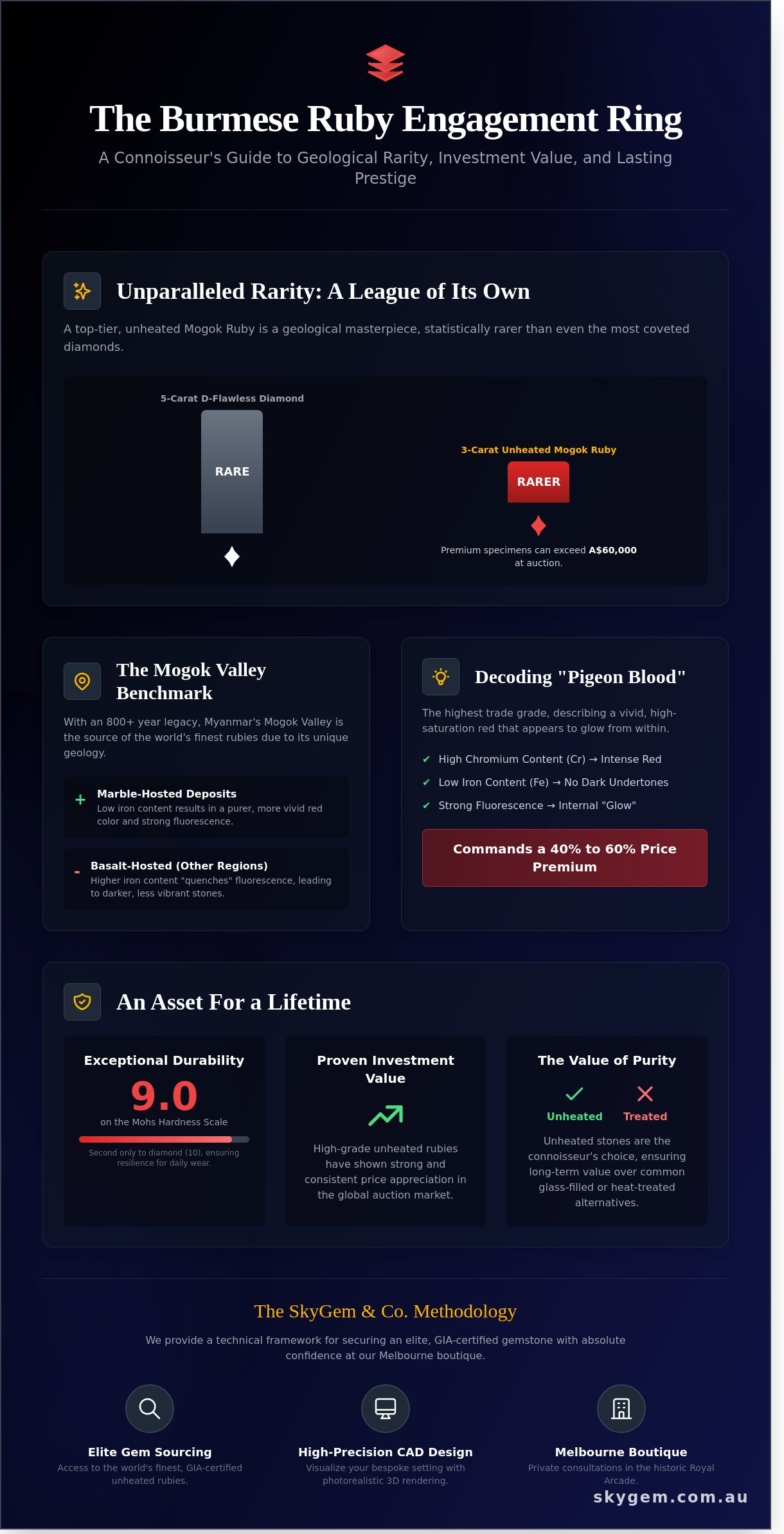
A top-tier, unheated Mogok ruby is statistically rarer than a five-carat D-flawless diamond. While typical retail stores often stock treated stones with glass-filled fractures, a genuine Burmese ruby engagement ring represents a pinnacle of geological rarity that few collectors ever witness in person. You likely understand that an investment of this calibre, which can easily exceed A$60,000 for a premium three-carat specimen at an Australian auction, requires a level of technical scrutiny far beyond standard consumer jewellery standards. It's natural to feel wary of subjective marketing terms like "Pigeon Blood" when laboratory reports don't always align with high-street claims.
This guide provides the gemmological data and sourcing logic you need to secure a GIA-certified, unheated stone with absolute confidence. We'll examine the specific fluorescence and trace elements that define the Mogok Valley's output; we will also explain how to design a bespoke setting that ensures the structural protection of your asset. You'll gain a clear framework for identifying true value and assessing the elite gemstone market with the authority of a technical specialist.
Key Takeaways
- Understand why the Mogok Valley origin remains the global benchmark for geological rarity and unparalleled colour saturation in fine gemstones.
- Demystify the "Pigeon Blood" grading system to identify rubies with the optimal chromium content and superior internal fluorescence.
- Learn to distinguish between heat-treated and unheated specimens to ensure your burmese ruby engagement ring maintains its long-term investment value.
- Explore the architectural considerations of bespoke design, focusing on how different settings can enhance the stone’s unique optical properties and structural integrity.
- Gain insight into the SkyGem & Co. methodology for sourcing rare stones and utilizing high-precision 3D CAD rendering at our boutique in Melbourne’s Royal Arcade.
The Prestige of the Burmese Ruby Engagement Ring
The Burmese ruby has long held the title of "King of Gemstones" due to its unparalleled saturation and historical prestige. For couples seeking a legacy piece, a natural ruby engagement ring represents a pinnacle of gemstone acquisition. The Mogok Valley in Myanmar remains the ultimate benchmark for quality. This specific origin is critical because the unique geological conditions found in Myanmar produce stones with a vibrancy that other regions simply cannot replicate. High-quality Burmese rubies exceeding 2 carats are statistically rarer than D-flawless colourless diamonds. While a one-carat diamond is a standard market commodity, a ruby of similar weight and calibre represents a significant find in the global gemstone trade.
The Heritage of the Mogok Valley
Mining in the Mogok region dates back over 800 years, establishing a legacy that spans centuries of royal acquisition. The technical superiority of these stones stems from their marble-hosted deposits. Unlike rubies found in basaltic rocks, Mogok stones typically contain very low iron levels. This chemical composition allows for higher levels of fluorescence and a more vivid red. You can explore more about these Ruby gemstone properties to understand how chromium and iron levels dictate value. Historically, these stones were reserved for the elite, appearing in the crown jewels of European and Asian monarchs alike, confirming their status as a permanent store of value.
Why Choose Ruby Over Diamond?
A burmese ruby engagement ring offers a distinct aesthetic that deviates from traditional white-stone settings. While diamonds are often chosen for their neutral sparkle, rubies symbolise deep passion and resilience. Durability isn't a concern for daily wear. Rubies sit at 9.0 on the Mohs scale, making them the second hardest natural mineral used in jewellery. In the Australian market, there's a measurable shift toward unique, investment-grade pieces. Some key reasons for this transition include:
- Rarity: Authentic Burmese stones are becoming increasingly difficult to source in sizes above 1.5 carats.
- Investment Value: High-grade rubies have historically shown strong price appreciation in the Australian auction market.
- Durability: The 9.0 Mohs hardness ensures the stone withstands the rigours of a lifetime of wear.
- Personalisation: A coloured gemstone allows for a more bespoke design compared to a standard diamond solitaire.
Data from 2023 shows an increasing number of buyers in Melbourne and Sydney opting for coloured gemstones over traditional solitaires. This trend reflects a desire for assets that hold intrinsic value while serving as a highly personal statement of style. Choosing a ruby isn't just a stylistic preference; it's a commitment to a gemstone with a rich, 800-year history of excellence.
Understanding Pigeon Blood Ruby Rings and Colour Grading
The term "Pigeon Blood" represents the highest trade grade for ruby colour. It describes a vivid, high-saturation red that appears to glow from within due to a unique chemical composition found primarily in the Mogok Valley. This specific hue is the most coveted choice for a burmese ruby engagement ring, often commanding a premium of 40% to 60% over other red stones.
Chromium is the chemical element responsible for this intense red. In Burmese deposits, chromium levels are exceptionally high while iron levels remain remarkably low. This specific ratio allows the stone to achieve a "pure red" that lacks the brownish or overly dark undertones found in rubies from other regions. According to GIA's guide to ruby quality, colour is the single most important factor determining a ruby's value, followed closely by clarity and origin.
A common misconception is that every red ruby from Burma qualifies as Pigeon Blood. In reality, only a small fraction of mined stones meet the strict saturation and tone requirements set by international gemological laboratories. Many Burmese rubies exhibit pinkish or purplish secondary hues; while beautiful, these don't reach the prestigious "Pigeon Blood" status.
The Science of Fluorescence
The internal glow of a Burmese ruby isn't an optical illusion. Because these stones have low iron content, the chromium atoms can react freely with ultraviolet light. Iron typically acts as a "quencher" that absorbs energy, but in its absence, the stone reflects a fiery red light. Fluorescence is the stone’s ability to emit visible light when stimulated by UV.
This reaction makes the stone appear more vibrant in natural Australian sunlight than it might under standard indoor lighting. While a Thai ruby might look "flat" or overly dark in high-noon sun, a Burmese stone with strong fluorescence will appear to be illuminated from its core. If you're comparing stones, you should view loose Burmese rubies in multiple lighting environments to see this effect in action.
Secondary Hues and Saturation
When evaluating a burmese ruby engagement ring, look for the balance between the primary red and any secondary tints. Most rubies contain a hint of purple or pink. A slight purplish secondary hue is often considered a hallmark of Burmese origin and can actually make the red appear richer. However, if the stone leans too heavily toward pink, it may be classified as a pink sapphire rather than a ruby, which significantly affects the price per carat.
Saturation refers to the intensity or "brightness" of the colour. High-saturation stones maintain their vividness even in low-light conditions. When inspecting a stone, avoid cool-toned LED shop lights which can artificially enhance blue or purple tones. Instead, use a neutral D65 daylight lamp or step near a window to see the true saturation. In the current Australian market, a 1.00-carat Pigeon Blood ruby with high saturation can easily exceed A$15,000, reflecting its rarity and technical excellence.
Natural vs. Treated: The Value of Unheated Rubies
Roughly 95% of rubies reaching the global retail market have undergone some form of heat treatment to improve their clarity and colour saturation. This thermal process mimics the natural heat of the earth, dissolving certain inclusions and intensifying the red hues. While this practice is an accepted industry standard, an unheated burmese ruby engagement ring remains the absolute gold standard for Australian collectors and investors. It represents a stone that achieved its vivid beauty entirely through geological forces over millions of years.
Professional gemmologists identify unheated stones by looking for "silk." These are microscopic, needle-like inclusions of rutile that intersect at 60-degree angles. If a ruby is heated to extreme temperatures, these delicate needles melt or dissolve. Seeing intact silk under a 10x loupe or microscope is a primary indicator that a ruby is completely natural and untreated. You can view technical examples of these characteristics in SkyGem’s loose ruby collection, where we showcase stones that meet these rigorous natural criteria.
The Impact of Heat Treatment on Value
Pricing for unheated stones reflects their extreme rarity. You'll typically see a price premium of 50% to 100% or more compared to heated counterparts of similar size and visual quality. For instance, a high-quality 2-carat heated ruby might retail for A$18,000; however, an unheated equivalent with the same dimensions can easily exceed A$35,000. It's a significant jump that reflects the stone's status as a finite geological asset.
We advise clients to be particularly wary of "glass-filling" or "fracture-filling." This low-grade treatment involves infusing poor-quality stones with lead glass to hide massive structural flaws. These stones are unstable and don't hold their value. SkyGem exclusively sources ethical, high-grade stones that pass strict durability tests for daily wear. We focus on long-term performance rather than temporary aesthetic fixes.
Certification: GIA, GRS, and SSEF
When you're acquiring a burmese ruby engagement ring, an independent lab report is non-negotiable. It serves as your technical guarantee of origin and treatment status. Labs like the GIA (Gemological Institute of America), GRS (GemResearch Swisslab), and SSEF are the global authorities for coloured gemstones. These reports provide a definitive statement on whether a stone is "Heated" or "No indication of heating."
A certificate also confirms the geographic origin. Because Burmese rubies command the highest prices in the Australian market, the report must explicitly state "Burma" or "Myanmar" to justify the investment. We maintain total transparency through our inventory of GIA certified gemstones, ensuring every client has the data required to make an informed decision. This documentation isn't just a piece of paper; it's a verification of the stone's future-proof value.
Designing Your Bespoke Ruby Engagement Ring
Engineering a burmese ruby engagement ring requires a sophisticated understanding of light performance and structural integrity. Unlike diamonds, rubies rely on internal reflections to project their deep red hues; therefore, the architecture of the setting must prioritise light entry. You'll need to decide between three primary silhouettes. A solitaire focuses entirely on the stone's clarity and colour. A trilogy design uses two side stones to create a balanced, architectural frame, typically following a 1:2:1 size ratio. A halo setting surrounds the ruby with smaller stones, which can increase the perceived surface area of the centre gem by approximately 25 to 30 percent.
Claw placement is a vital technical consideration. While four claws offer a minimalist aesthetic and allow roughly 15 percent more lateral light entry, six claws provide superior security for high-value Burmese stones. Positioning these claws at the "corners" of an oval or cushion cut ensures the stone remains stable during daily wear while protecting the vulnerable girdle of the gem. If you're ready to start the technical drafting of your piece, you can explore custom engagement ring design in Melbourne to consult with a specialist.
Metal Selection: Gold vs. Platinum
The choice of metal acts as a colour catalyst for your ruby. 18K Yellow Gold remains the traditional preference because the gold's natural warmth complements the secondary orange or pink undertones found in many Burmese stones. Platinum or 18K White Gold offers a high-contrast, clinical look that makes the red appear more vivid and distinct. In the Australian market, rose gold has seen a 20 percent rise in bespoke commissions since 2022. It creates a seamless blend with the stone, which enhances the perceived saturation but can sometimes soften the visual boundaries of the ruby's cut.
Accent Stones and Contrast
High-grade white diamonds in the D-F colour range are the most effective companions for a ruby. This stark colour difference creates a visual "pop" that highlights the ruby's saturation. A halo effect is particularly useful for stones under 1.50 carats, as it provides a luminous border that makes the centre stone appear larger. To manage your total investment, integrating lab-grown diamond accents is a practical solution. This allows you to allocate more of your budget toward a higher-quality Burmese ruby while maintaining the brilliance and durability of a diamond-set band.
Ready to create a legacy piece? Book a design consultation with our Melbourne team to begin your bespoke journey.
Sourcing and Crafting at SkyGem & Co. Melbourne
SkyGem & Co. operates from our boutique in Melbourne’s historic Royal Arcade, established in 1892. We function as a Trusted Specialist, bridging the gap between technical gemology and architectural jewellery design. Our approach prioritises ethical sourcing and transparent data for every burmese ruby engagement ring we commission. We treat each project as a technical consultation, ensuring the final piece is a permanent asset that meets rigorous Australian standards for durability and craftsmanship.
The Bespoke Journey
- Step 1: Selection from the Vault. Your journey begins with a private viewing of loose Burmese rubies. We provide high-resolution photometric data and physical inspections so you can evaluate colour saturation and internal characteristics under controlled lighting.
- Step 2: Technical Design and CAD. Our experts translate your requirements into a 3D CAD rendering. This stage allows us to verify structural integrity and precise proportions before we commence the casting process.
- Step 3: Melbourne Hand-Finishing. Local artisans hand-finish every setting in our Melbourne workshop. This ensures that your bespoke engagement ring isn't just a purchase, but a precision-engineered piece of Australian-led design.
Lifetime Care and Maintenance
Maintaining the luminous efficacy of a high-quality ruby requires consistent technical oversight. We recommend professional cleaning and prong inspections every six months to identify potential wear before it compromises the stone's security. This proactive maintenance schedule is essential for high-end jewellery assets exposed to daily wear.
You can maintain your ring’s brilliance at home using pH-neutral soapy water and a soft-bristled brush. Avoid harsh chemicals that might interact with the metal alloy's thermal properties or surface finish. Choosing a local specialist ensures you have immediate access to technical support and compliance checks. We're dedicated to the long-term performance of your ring, offering a partnership that extends well beyond the initial design phase. Contact us today to book a consultation and begin engineering your perfect burmese ruby engagement ring.
Securing Your Investment in Rare Gemstone Artistry
Selecting a burmese ruby engagement ring is a decision rooted in both aesthetic preference and technical precision. Statistics from leading gemological laboratories indicate that fewer than 1% of all rubies recovered globally are natural, unheated specimens of this calibre. This extreme rarity makes the verification of origin and colour grading essential for long-term value. We provide GIA and GRS certified rubies to guarantee that "Pigeon Blood" designations meet the strictest international standards for saturation and hue. These stones aren't just ornaments; they're tangible assets with a finite supply from the Mogok region.
Designing a bespoke piece requires a partnership that balances architectural integrity with the gemstone's unique optical properties. As specialists in unheated gemstones, we focus on stones that retain their natural fluorescence and structural stability without artificial enhancement. Our approach treats every commission as a technical consultation, ensuring your design is future-proofed for generations. You'll find our expert team within Melbourne's historic Royal Arcade, which has stood as a hallmark of local luxury since 1870.
We invite you to experience these rare treasures in person. Book a Bespoke Consultation at our Melbourne Boutique to start crafting your unique piece. Your vision deserves the precision and heritage that only a dedicated specialist can provide.
Frequently Asked Questions
Is a Burmese ruby more expensive than a diamond?
High-quality Burmese rubies often command a higher price per carat than white diamonds of comparable size and quality. For example, a 2-carat unheated Burmese ruby can reach prices exceeding A$50,000, while a GIA-certified G VS1 diamond of the same weight might retail for approximately A$35,000. This price premium reflects the extreme rarity of Mogok-sourced stones compared to the global diamond supply.
What does "Pigeon Blood" actually mean in ruby grading?
"Pigeon Blood" is a technical trade term used by labs like GRS or SSEF to describe the most vivid, saturated red rubies with a distinct blue undertone. This specific hue traditionally originates from the Mogok Valley and exhibits strong red fluorescence under UV light. To qualify for this grade, the stone must show no visible secondary tints like orange or purple when viewed in natural daylight.
Can I use a Burmese ruby for an everyday engagement ring?
A burmese ruby engagement ring is an excellent choice for daily wear because rubies rank at 9 on the Mohs scale of mineral hardness. This rating makes them the second hardest natural gemstone after diamonds, providing high resistance to scratching and abrasion. While they're durable for daily life, we recommend an annual professional inspection to ensure the structural integrity of the setting remains secure.
Why is an unheated ruby more valuable than a heated one?
Unheated rubies are more valuable because approximately 95% of all rubies on the market undergo heat treatment to improve color and clarity. A natural, untreated stone that possesses exceptional color is a geological rarity that collectors prize for its purity. In the Australian market, an unheated Burmese ruby typically commands a 50% to 100% price premium over its heat-treated counterparts of similar visual quality.
How can I tell if my ruby is actually from Burma (Myanmar)?
Origin determination requires advanced spectroscopic analysis and microscopic examination of internal inclusions by an independent laboratory. Burmese rubies typically contain "silk" or fine rutile needles that intersect at 60 and 120 degree angles, which is a diagnostic feature of the region. You should always request a certificate from a reputable body like GIA or GRS that explicitly states the geographical origin as Myanmar.
Does SkyGem & Co. offer GIA-certified rubies?
SkyGem & Co. provides GIA-certified rubies for all significant centre stones to ensure full transparency and investment security. Our inventory focuses on stones that meet rigorous Australian compliance standards for ethical sourcing and technical grading. Every burmese ruby engagement ring we produce comes with comprehensive documentation, including detailed laboratory reports that verify the stone's dimensions, treatment status, and weight.
What is the best metal for a ruby engagement ring?
18ct yellow gold and platinum are the superior choices for ruby settings due to their durability and aesthetic compatibility. Yellow gold enhances the warm, rich tones of the red corundum, while platinum offers maximum security for the gemstone through its superior tensile strength. For Australian clients, 18ct gold is the industry standard for high-end bespoke jewellery, offering a balance of 75% gold purity and structural resilience.
How do I clean my ruby engagement ring safely?
You can safely clean your ruby at home using warm water and a few drops of mild, pH-neutral detergent. Use a soft-bristled toothbrush to gently remove debris from behind the setting, then rinse thoroughly with clean water and dry with a lint-free cloth. Avoid ultrasonic cleaners if the stone has any surface-reaching fractures, as the vibrations can occasionally compromise the stone's stability over time.
Disclaimer
This article is for general informational purposes only and may include AI-assisted content. Pricing, specifications, and availability are subject to change. For accurate advice and current information, please contact SkyGem & Co. directly. Nothing in this content constitutes professional or financial advice.