
Birthstones: The Ultimate Guide to History, Meanings, and Gemstone Quality

What if the gemstone you've selected for a daily-wear anniversary piece is technically unsuitable for the rigours of the Australian lifestyle? While the tradition of birthstones dates back to the breastplate of Aaron in 1400 BC, modern consumers often struggle with conflicting historical lists and a lack of transparency regarding stone treatments. You likely want a piece that carries deep personal significance, but you also need the assurance that your investment won't fracture or lose its lustre due to poor structural integrity.
We understand that commissioning a bespoke piece involves balancing aesthetic appeal with engineering precision. This guide serves as your technical consultant, offering a definitive list of birthstones while detailing the specific Mohs hardness, refractive index, and durability markers required for long-term wear. You'll discover the rich history and symbolic meanings of every stone, alongside professional advice on identifying high-quality specimens. We'll move from the geological origins of these minerals to practical maintenance strategies, giving you the confidence to select a gemstone that remains a permanent asset in your collection.
Key Takeaways
- Trace the historical lineage of birthstones from ancient religious artefacts to modern traditions to understand their enduring symbolic value.
- Learn to evaluate gemstone quality beyond simple colour by applying a technical framework that prioritises saturation, tone, and the 4Cs.
- Identify which gemstones possess the necessary Mohs hardness rating to ensure long-term durability and structural integrity in daily-wear bespoke jewellery.
- Discover the "Bespoke Advantage" by accessing ethically sourced loose stones that offer superior quality and rarity compared to standard Australian retail options.
The Origins and Evolution of the Birthstone Tradition
Birthstones represent a curated selection of gemstones, each uniquely assigned to a specific month of the year. This practice is not merely a modern marketing construct; it has deep-rooted foundations in ancient history. Scholars trace the lineage of this tradition back to the Breastplate of Aaron, a religious garment described in the Book of Exodus that featured twelve distinct gems representing the twelve tribes of Israel. By the 1st century, the Jewish historian Flavius Josephus established a formal connection between these twelve stones and the months of the year. You can explore the detailed History of birthstones to see how these early religious associations transitioned into secular customs.
Originally, the custom involved owning all twelve stones and wearing a different one each month to harness its perceived seasonal power. The shift toward wearing a single stone based on one's specific birth month didn't gain widespread traction until the 18th century in Poland. The most significant milestone in the industry occurred in 1912. During this year, the National Association of Jewellers met in Kansas to create a standardised list. This provided a definitive framework for the jewellery industry, ensuring consistency across global markets while respecting historical precedents. This 1912 list remains the primary reference point for birthstones today, though it has seen minor updates to reflect modern availability.
Traditional vs. Modern Birthstones
The distinction between traditional and modern lists often creates confusion for consumers. Traditional charts typically feature opaque stones like turquoise or bloodstone, which were highly valued in ancient civilisations. The modern list favours transparent, faceted gems such as diamonds, rubies, and sapphires. This evolution reflects shifts in gemstone availability and a consumer preference for high-clarity materials that offer superior light performance. Some months, such as June and October, offer multiple options to accommodate different price points and aesthetic preferences, ensuring that a high-quality gemstone solution is accessible for every project.
The Cultural Significance of Gemstone Lore
Beyond their aesthetic value, birthstones carry a legacy of protective and healing properties. Ancient Vedic texts and Western astrological traditions link specific gems to planetary alignments and zodiac signs, suggesting that wearing one's birthstone can enhance personal energy or provide spiritual protection. In the Australian market, birthstone jewellery remains the premier choice for personalised gifting. It accounts for a substantial portion of the custom jewellery sector because it bridges the gap between technical material value and emotional resonance. These pieces serve as a permanent, future-proof connection to an individual's identity and heritage.
Evaluating Gemstone Quality: A Technical Framework for Birthstones
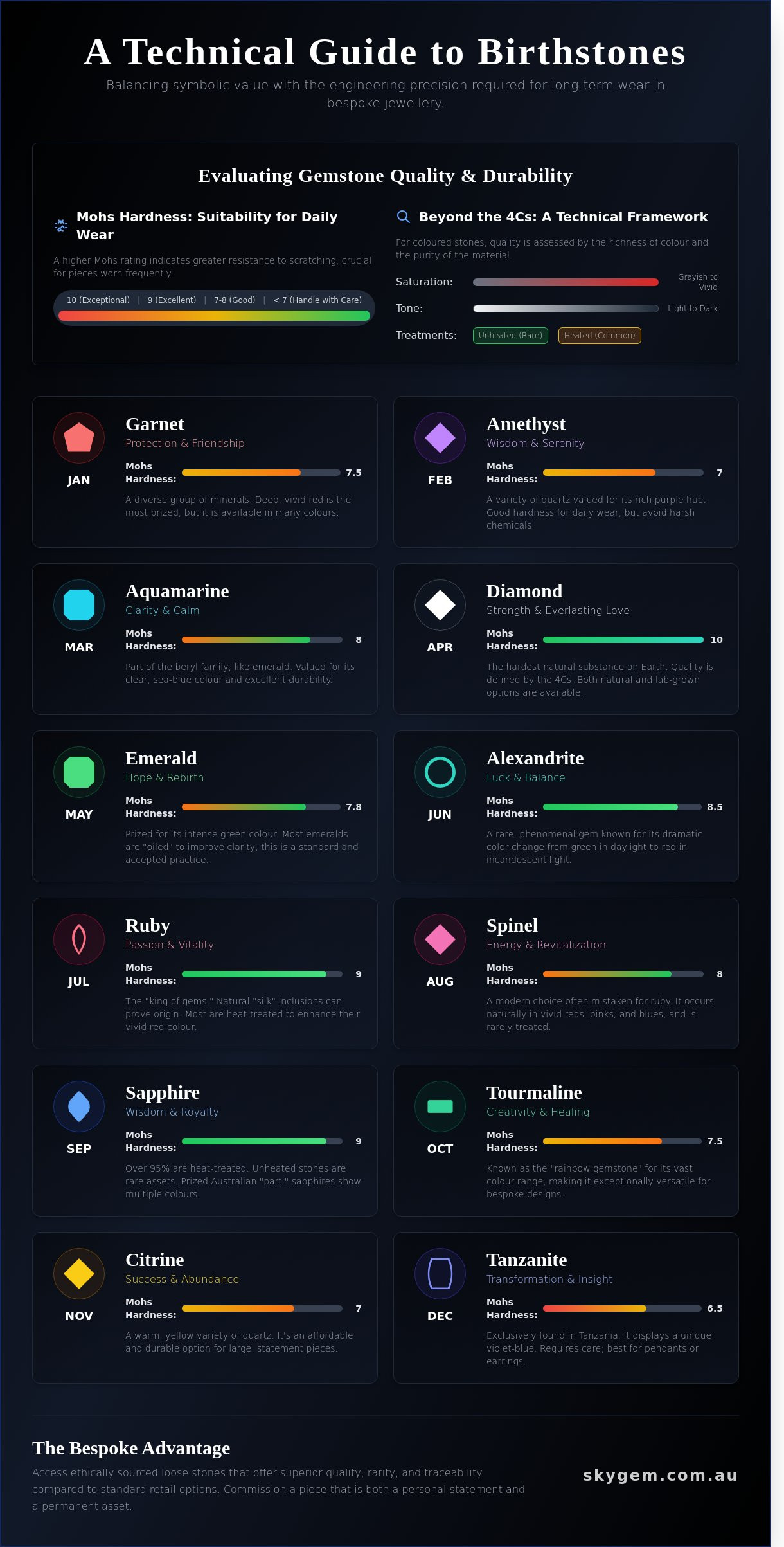
While the 4Cs (Carat, Colour, Clarity, and Cut) provide a baseline for diamonds, coloured birthstones require a more nuanced technical framework. Evaluating a sapphire or emerald isn't just about spotting a flaw; it's about the physics of light within the crystal structure. Professional graders focus on saturation and tone rather than just the basic hue. Saturation refers to the intensity of the colour, ranging from "brownish/grayish" to "vivid." Tone describes the lightness or darkness of the stone. A ruby with vivid saturation and a medium-dark tone often commands the highest price per carat in the Australian market.
Natural inclusions, often called "fingerprints," help distinguish natural stones from lab-grown counterparts. For instance, "silk" (fine rutile needles) in a ruby indicates a natural origin, while curved growth lines suggest a flame-fusion synthetic. Technical data from the USGS guide to gemstones confirms that these internal characteristics are vital for mineral identification. Origin also acts as a primary value driver. An Australian sapphire from the Central Queensland Highlands is prized for its durability and unique "parti" colouring. These stones often fetch 25% to 40% more than stones from less reputable sources due to their ethical traceability and distinct geological signature.
The Value of Natural and Unheated Specimens
Heat treatment is standard for 95% of sapphires to improve colour. An unheated specimen is a rarity that represents the pinnacle of purity. For emeralds, "oiling" with cedar oil is common practice to fill surface-reaching fissures. Rubies treated with lead-glass filling are significantly less valuable and less durable. A GIA report will clearly state "no indications of heating," which is the gold standard for investment-grade birthstones. When choosing the April birthstone, natural diamonds offer a traditional asset, while lab-grown diamonds provide a high-clarity alternative for those on a stricter A$2,000 to A$5,000 budget.
Sourcing Beyond the Standard Grade
Standard grading often misses the "life" of a stone. A boutique jeweller looks for "eye-clean" stones where inclusions don't interfere with light return. We focus on "fire" (dispersion) and "brilliance" (reflected white light) to ensure the stone performs well under various lighting conditions. If you're looking for a specific specimen, you can explore our curated selection of loose gemstones to see these technical specifications in practice. Choosing a stone with a well-proportioned cut ensures that light doesn't "leak" out the back, maintaining the stone's vividness for decades.
The Complete Birthstone Calendar: Meanings and Varieties
Selecting birthstones involves more than just identifying a colour; it requires a technical understanding of mineralogy and historical context. The modern list, standardised in 1912, provides a reliable framework for choosing gems that balance aesthetic appeal with long-term durability. For those seeking verified data on specific mineral properties and heritage, the GIA birthstone guide serves as the definitive global resource for gemstone identification. Understanding these materials as technical assets ensures that your selection remains a permanent and evolving part of your collection.
The Quarter One Gems: January to March
January begins with Garnet, a group of silicate minerals often misunderstood as being exclusively deep red. While Pyrope and Almandine are common, high-performance varieties like the vivid green Tsavorite or the bright orange Spessartite offer superior refractive indices for bespoke designs. February features Amethyst, the premier purple variety of quartz. With a Mohs hardness of 7, it's a practical choice for reliable daily wear. March brings Aquamarine, a beryl variety that evokes the clarity of the sea. Its calming blue hues are sought for their high transparency and sophisticated, architectural brilliance.
The Precious Powerhouses: April to July
April is defined by the Diamond, the only gemstone composed of a single element: carbon. It's the hardest known natural substance, making it the ultimate symbol of eternal strength. You can view our natural GIA certified diamonds to explore stones that meet the highest Australian standards of light performance and structural integrity. May's Emerald, another member of the beryl family, is prized for its lush green "jardin" or internal inclusions, which require specific care to maintain. June offers Alexandrite, a rare chrysoberyl famous for its 100% colour change from green in daylight to red under incandescent light. July features the Ruby, the red variety of corundum. To appreciate the true depth of this stone, discover the allure of unheated natural rubies that haven't undergone thermal enhancement, preserving their rare, natural saturation.
The Late Year Luminaries: August to December
September's Sapphire extends beyond the classic cornflower blue. In Australia, there's a significant rise in demand for teal and peach sapphires sourced from the Central Queensland gemfields, offering a unique local aesthetic. October highlights Opal, Australia's national gemstone, which accounts for approximately 95% of the world's precious supply. Tourmaline serves as a versatile alternative, available in a "rainbow" of chemical compositions. November focuses on Topaz and Citrine, stones that project warmth and abundance. December concludes the birthstones calendar with Tanzanite, found only within a 4-kilometre strip in the Merelani Hills, and Zircon. It's vital to distinguish Zircon from synthetic cubic zirconia; natural Zircon is the oldest mineral on Earth, with some crystals dated to 4.4 billion years old.
Durability and Design: Selecting Birthstones for Bespoke Jewellery
Selecting birthstones for a bespoke piece requires more than an appreciation for colour; it demands a technical understanding of mineral durability. The Mohs Scale of Hardness serves as the primary benchmark for Australian jewellers when determining a stone's suitability for daily wear. This scale measures a mineral's resistance to scratching, which is a critical factor for rings that encounter abrasive surfaces.
For engagement rings intended for lifetime wear, we recommend stones with a Mohs rating of 9 or higher. Diamonds, sapphires, and rubies are the only birthstones that consistently withstand the mechanical stresses of daily activity. If you select a softer stone like an emerald (7.5 to 8) or an opal (5.5 to 6.5), the design must compensate for the material's vulnerability. A bezel setting provides a protective metal perimeter that shields the stone's edges, whereas a traditional prong setting exposes the girdle to potential impact and chipping.
Metal choice also influences the perceived quality and hue of the gemstone. 18K yellow gold is an excellent pairing for warm-toned stones like peridot or citrine, as it enhances their natural saturation. Conversely, platinum or 18K white gold provides a neutral, high-lustre backdrop that maintains the crisp "fire" of a diamond or the cool, oceanic depth of an aquamarine. These decisions impact both the aesthetic outcome and the long-term structural integrity of the piece.
Designing Birthstone Engagement Rings
Modern bespoke design often incorporates the "Toi et Moi" style, where two distinct birthstones are set together to represent a partnership. This approach allows for a sophisticated interplay of different gem cuts and geometries. For those preferring a traditional diamond centre, birthstones can be integrated as hidden accents within the bridge or the inner circumference of the band. This subtle technical detail adds personal value without compromising the ring's external profile. Start your custom engagement ring journey with our Melbourne-based design team to explore these configurations.
Maintaining the Brilliance of Your Gemstones
Long-term maintenance is critical for preserving the optical performance of your jewellery. Porous stones, including pearls, turquoise, and opals, require specific protocols because they absorb oils and chemicals that can cause permanent discolouration. You should avoid ultrasonic cleaners for these varieties. The high-frequency vibrations can cause internal fractures or "crazing" in stones with high water content. We recommend a professional setting check every 12 months to ensure prongs remain secure and to clear any debris that might obscure the stone's pavilion.
Sourcing Exceptional Birthstones with SkyGem & Co.
SkyGem & Co. operates as a technical consultancy for fine jewellery, prioritizing gemstone education over traditional sales tactics. When selecting birthstones, our approach ensures that every client understands the specific optical properties and durability metrics of their chosen mineral. We maintain a strict protocol for ethical sourcing, verifying the provenance of every stone to meet Australian standards for consumer protection and trade integrity. This methodology provides a transparent framework for acquiring high-value assets that maintain their performance over time.
The Bespoke Design Process
Our bespoke workflow begins with the procurement of loose stones that typically bypass retail display windows. This "Bespoke Advantage" grants access to a higher tier of gem quality, focusing on specific gravity, refractive index, and clarity characteristics. Once a stone is selected, our designers utilize high-precision CAD software to create a digital prototype, ensuring structural integrity before the final hand-finishing in our workshop. Every significant gemstone is verified by independent laboratories such as the GIA or GSL; this provides a technical guarantee that your selection is a verified natural asset. It's a process that transforms a simple gift into a legacy piece designed for multi-generational durability.
Why Sourcing Matters
The distinction between boutique procurement and mass-market inventory lies in the granularity of the selection process. While mass-produced jewellery often utilizes commercial-grade parcels, SkyGem & Co. sources individual stones based on their unique performance data and luminous potential. We ensure your gemstone is a conflict-free, natural asset by adhering to the Kimberley Process and local ethical guidelines. This commitment to transparency means you receive a stone with a documented history rather than an anonymous commodity. For those seeking immediate options, you can browse our ready-to-wear fine jewellery collection to see the results of our rigorous selection criteria.
Expert consultants work within your specific A$ budget to maximize the aesthetic and technical value of your purchase. Whether you're marking a milestone or investing in a family heirloom, our team provides the engineering precision required for high-end jewellery. We invite you to book a consultation today to begin the technical journey of creating your custom birthstone piece.
Investing in Your Bespoke Gemstone Legacy
Selecting birthstones for high-end jewellery involves balancing historical significance with rigorous technical standards. We've detailed how GIA grading systems and the Mohs scale of mineral hardness provide the necessary framework for choosing stones that offer both aesthetic brilliance and structural integrity. By prioritising unheated sapphires and rubies, collectors secure specimens that retain their natural chemical composition and long-term market value within the Australian landscape.
Our Melbourne-based bespoke design studio specialises in translating these technical specifications into permanent assets. Whether you're seeking GIA Certified Natural Diamonds or rare, unheated coloured gemstones, our team provides the engineering expertise required for a sophisticated finish. We don't just supply materials; we act as technical consultants to ensure your piece meets the highest benchmarks of quality and compliance. Every stone is vetted for its geological profile and ethical provenance to guarantee a result that's as durable as it's beautiful.
Book a Bespoke Consultation to Find Your Perfect Birthstone at skygem.com.au. Let's begin the process of crafting a precision-engineered piece that reflects your unique narrative and stands the test of time.
Frequently Asked Questions
What are the two birthstones for March?
March's primary birthstones are aquamarine and bloodstone. Aquamarine, a variety of beryl with a Mohs hardness of 7.5 to 8, serves as the modern standard for this month. Bloodstone, or heliotrope, represents the traditional alternative. While aquamarine dominates the Australian retail market, bloodstone remains a niche choice for collectors seeking historical significance. Both gems offer distinct aesthetic profiles for high-end bespoke jewellery applications.
Is a birthstone ring durable enough for an engagement ring?
Durability depends entirely on the specific gemstone's Mohs scale rating. For daily wear in an engagement ring, we recommend stones with a hardness of 9 or higher, such as sapphires or rubies. Emeralds, while popular, often contain internal inclusions that make them prone to fracturing under 50 kilograms of pressure. If you choose a softer birthstone, ensure it's set in a protective bezel mount to mitigate mechanical stress.
Why do some months have three different birthstones?
Multiple birthstones exist because the official list has been updated four times since 1912 by organisations like the American Gem Trade Association. These additions, such as adding tanzanite to December in 2002, provide consumers with more price points and colour options. For example, June offers pearl, alexandrite, and moonstone. This variety allows for greater flexibility when selecting birthstones for custom projects within the Australian jewellery sector.
Can I use a lab-grown diamond as an April birthstone?
You can certainly use a lab-grown diamond as an April birthstone because it's chemically, physically, and optically identical to a mined diamond. Lab-grown options currently trade at roughly 70% to 80% less than their natural counterparts in Australia. This cost-effectiveness allows for a higher carat weight or superior clarity grade within the same project budget. Both types of diamonds achieve a 10 on the Mohs scale, ensuring long-term performance.
What is the rarest birthstone in the world?
Alexandrite is widely considered the rarest birthstone due to its unique chrysoberyl chemistry that causes a distinct colour change. High-quality natural specimens from Brazil or East Africa can exceed A$45,000 per carat for stones over one carat. Its scarcity is driven by the specific geological conditions required for chromium to replace aluminium in the crystal lattice. This rarity makes it a significant investment piece for Australian collectors and investors.
How do I know if my birthstone is a natural, unheated gem?
You can verify if a gem is natural and unheated by requesting a certificate from an independent laboratory like the Gemmological Association of Australia. Approximately 95% of sapphires on the market undergo thermal enhancement to improve colour and clarity. A formal laboratory report uses microscopic analysis to identify "silk" inclusions, which prove the stone hasn't reached the 1,500 degree Celsius threshold required for heat treatment.
Which birthstone is the most expensive?
Diamonds and rubies consistently rank as the most expensive birthstones based on price-per-carat benchmarks. While a flawless white diamond is costly, a top-tier "pigeon blood" ruby can fetch over A$1.5 million at auction. Within the Australian context, rare pink diamonds from the now-closed Argyle mine have historically seen price increases of 500% over the last two decades. Value is ultimately dictated by the 4Cs and provenance.
Can I wear a birthstone that is not from my birth month?
You can wear any birthstone regardless of your birth month. While tradition links specific gems to months, modern jewellery design prioritises personal preference and colour harmony. Many Australians choose stones based on their technical properties or skin tone compatibility rather than historical calendars. Selecting a stone from a different month doesn't impact the gem's physical performance or its durability in a bespoke setting.
Disclaimer
This article is for general informational purposes only and may include AI-assisted content. Pricing, specifications, and availability are subject to change. For accurate advice and current information, please contact SkyGem & Co. directly. Nothing in this content constitutes professional or financial advice.