
Bezel vs Prong Setting: Pros and Cons for Your Engagement Ring (2026 Guide)

Choosing between a bezel and a prong setting is more than a matter of style; it's a critical engineering decision that affects the structural integrity of your gemstone. While prongs are celebrated for their classic silhouette, the most secure configuration for a high-value stone might actually be the one that completely encases its perimeter. Understanding the bezel vs prong setting pros and cons is essential for anyone investing in bespoke jewellery in 2026, especially as gold prices have increased by over 70% since early 2025. This surge makes the choice of metal-heavy designs a significant factor in your total project budget and long-term asset protection.
We recognize the anxiety that comes with selecting a setting. You want the maximum brilliance possible, yet the fear of a loose stone or a damaged prong is a valid concern for your daily lifestyle. This guide provides a technical and aesthetic comparison to help you navigate these trade-offs with quiet confidence. We'll evaluate how each setting impacts light performance, maintenance requirements under current standards, and which configuration best suits modern favorites like lab-grown diamonds or Australian sapphires.
Key Takeaways
- Identify the fundamental mechanical differences between the light-optimising architecture of prongs and the protective, continuous metal rim of a bezel setting.
- Evaluate the bezel vs prong setting pros and cons to determine whether your daily activities require high-impact security or the classic brilliance of an elevated stone.
- Learn how to match specific gemstone types, such as Australian sapphires or lab-grown diamonds, to the setting that best enhances their unique physical properties.
- Understand how technical CAD design and 3D prototyping allow you to visualise the structural integrity and aesthetic balance of your bespoke ring before it is cast.
- Gain professional insights into the long-term maintenance and cleaning requirements necessary to ensure the permanent viability of your fine jewellery.
Understanding the Fundamental Differences Between Bezel and Prong Settings
Selecting the right setting is the most critical structural decision in the design of a bespoke engagement ring. This choice acts as the interface between the gemstone and the wearer's daily environment, dictating both the ring's silhouette and its long-term durability. At its core, the debate involves two distinct engineering philosophies. A prong setting utilizes slender metal claws that elevate the stone, while a bezel setting creates a continuous metal rim that encircles the entire perimeter. When evaluating the bezel vs prong setting pros and cons, you must consider how these configurations affect the height of the ring and its vulnerability to external impacts.
A prong setting typically results in a higher profile, allowing the gemstone to sit prominently above the band. This design maximizes light exposure but also increases the risk of the ring catching on fabrics or hard surfaces. Conversely, a bezel setting offers a lower, more integrated profile. This streamlined approach is often favored for its modern, minimalist aesthetic and superior protection. For those interested in the broader technical context of these methods, Understanding Gemstone Settings provides an encyclopedic overview of the traditional techniques used to secure precious materials in metal.
The Anatomy of a Prong Setting
The primary function of a prong setting is to secure the gemstone at its girdle using calculated tension. This method is highly versatile and compatible with virtually every gemstone shape, from round brilliants to fancy cuts. Common configurations include the four-prong setting, which offers a squared-off appearance and high visibility, and the six-prong setting, which provides a more rounded look and a redundant layer of security. For stones with sharp points, such as pear or marquise cuts, V-prongs are utilized to protect the vulnerable tips. The ultimate goal of this architecture is to achieve a "floating" effect, where the metal is minimized to prioritize the gemstone's natural fire and brilliance.
The Mechanics of a Bezel Setting
A bezel setting functions as a mechanical lock. The craftsman carefully pushes a rim of metal over the edge of the gemstone, ensuring it's held firmly in place without the need for tension-based claws. You can choose between a full bezel, which surrounds the entire stone, or a partial bezel, which leaves sections of the girdle exposed for a unique visual rhythm. This setting is the most protective option available in modern jewellery, shielding the stone's edges from chips and preventing it from snagging on clothing. It represents a shift from traditional elevated elegance toward a contemporary, sleek design that aligns with the "chunky" band trends observed in 2026.
The Prong Setting: Maximising Brilliance and Timeless Appeal
The prong setting remains the industry standard for those seeking maximum light performance. By elevating the gemstone above the band, prongs allow light to enter from multiple angles, including the pavilion and the crown. This increased exposure facilitates superior refraction and reflection; these are the fundamental drivers of brilliance and fire. When navigating the bezel vs prong setting pros and cons, it's clear that the choice often hinges on whether you prioritise maximum light return or total physical protection. The prong's open architecture provides an "airy" aesthetic, making the gemstone appear larger than its actual carat weight by exposing more of its surface area.
This configuration is also highly practical for long-term care. Because the stone is not fully enclosed, professional ultrasonic cleaning can reach the underside of the pavilion more effectively. Regular inspections are simpler for a technician, as the entire girdle is visible, allowing for a thorough assessment of the stone's security without removing the setting. When you evaluate the bezel vs prong setting pros and cons, consider that the prong setting's ease of maintenance can lead to better long-term stone health through consistent cleaning.
Advantages of Prong Settings for Diamonds
The timeless appeal of a solitaire engagement ring is largely due to its reliance on prongs to showcase a central stone. For high-quality, GIA certified diamonds, this setting acts as a spotlight, emphasising the "Ideal" or "Excellent" cut grades that define premium gems. According to the Gemological Institute of America's guide on Popular Engagement Ring Settings, prongs are the most common choice for their ability to balance security with visibility. Beyond optics, a skilled setter can strategically place prongs to mask minor natural inclusions near the stone's edge, effectively enhancing the perceived clarity of the piece.
Potential Drawbacks to Consider
While prongs offer unmatched sparkle, they possess inherent structural vulnerabilities that require ongoing attention. The slender metal claws are susceptible to thinning over years of mechanical wear, and a single significant impact can shift a prong, compromising the stone's stability. The elevated profile also introduces a "snagging" factor, where the ring may catch on delicate fabrics or knitwear. To mitigate these risks, we recommend professional check-ups every 6 to 12 months to ensure the integrity of the metal. If you are uncertain which configuration aligns with your lifestyle, exploring our collection of ready-to-ship rings can provide a tactile comparison of these design trade-offs.
The Bezel Setting: Unmatched Protection and Contemporary Design
The bezel setting represents the most protective configuration available in modern jewellery design. By creating a continuous wall of precious metal around the stone, it shields the gemstone's girdle, which is its most vulnerable point. When weighing the bezel vs prong setting pros and cons, the bezel's primary engineering advantage is its mechanical security. Unlike prongs, which exert pressure at specific points, a bezel provides a uniform, 360-degree hold. This makes it an ideal choice for protecting gemstones with fragile edges or those prone to chipping, such as emeralds or certain cuts of Australian sapphires. It's a structural "insurance policy" built directly into the ring's architecture.
The aesthetic is distinctly contemporary and sleek. It offers a flush, integrated surface that feels like a natural extension of the band, rather than an addition sitting on top of it. This low-profile design ensures the stone sits as close to the finger as possible, which significantly reduces the overall height of the piece. For those interested in the technical nomenclature used by professionals to describe these structures, the International Gem Society offers a detailed Guide to Gem Setting Terminology. This resource clarifies the physical properties that distinguish a well-executed bezel from a standard mounting.
Why Bezel Settings Suit Modern Lifestyles
The most immediate benefit for active individuals is the total elimination of snagging. If you're a healthcare professional wearing surgical gloves or an athlete with an active training schedule, a bezel ring won't catch on equipment or delicate fabrics. It's effectively a "set and forget" solution. While prongs require frequent inspections to ensure they haven't thinned or moved, the solid metal rim of a bezel is incredibly resilient to daily impacts. Furthermore, the surrounding metal can actually enhance the visual presence of the stone. By extending the outer circumference with a polished rim, a bezel can make a diamond appear larger than its actual carat weight.
Trade-offs in Sparkle and Cleaning
Navigating the bezel vs prong setting pros and cons requires an honest assessment of your priorities regarding light performance. Because the metal rim covers the pavilion and girdle, light entry is restricted to the crown of the stone. This can slightly reduce the "fire" or rainbow-like flashes compared to an open prong setting. Cleaning also presents a unique challenge. Dirt and skin oils can accumulate in the minute gap between the stone and the metal rim, and these areas are harder to reach than the open underside of a prong. This is why custom-made engagement ring design is so vital. A professional designer ensures the bezel is engineered with precision, keeping the metal thin enough to remain elegant while providing the necessary structural integrity to protect your investment.
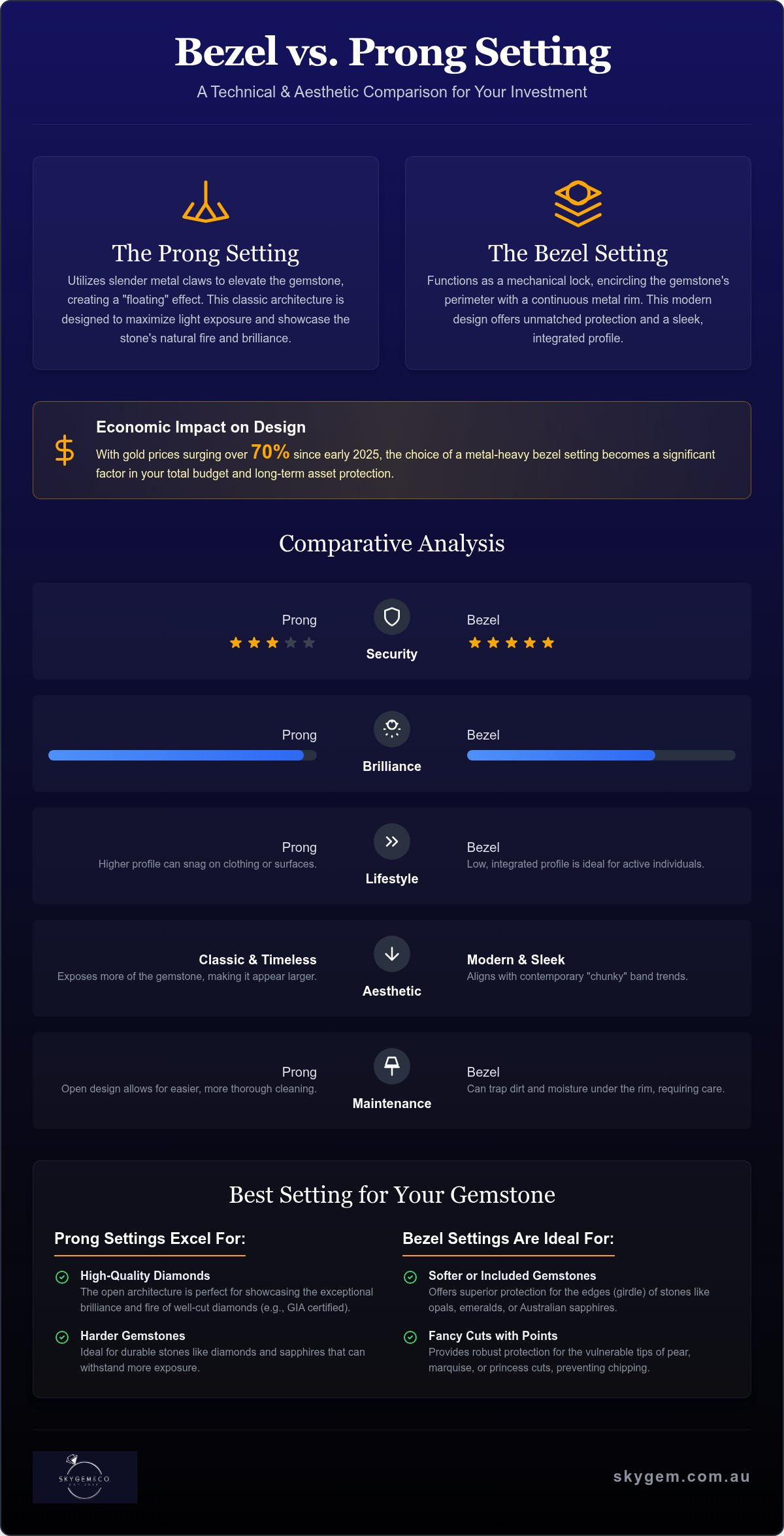
Comparative Analysis: Lifestyle, Gemstone Choice, and Maintenance
A technical evaluation of the bezel vs prong setting pros and cons reveals that the optimal choice depends heavily on the wearer's daily environment and the physical properties of the chosen gemstone. While prongs offer a classic silhouette, they introduce mechanical vulnerabilities that a bezel simply eliminates. This comparison is particularly relevant in 2026, as the cost of precious metals has increased significantly, making the long-term durability of your setting a key factor in protecting your investment. The following table provides a direct performance comparison across four critical metrics.
| Feature | Prong Setting | Bezel Setting |
|---|---|---|
| Security | Moderate; requires periodic inspection | Maximum; provides a structural lock |
| Sparkle | Optimised via multi-angle light entry | Refined; focuses light through the crown |
| Snag-Risk | Higher due to elevated profile | Zero; flush finish prevents catching |
| Maintenance | Periodic re-tipping of metal claws | Occasional surface polishing |
Lifestyle matching is a practical necessity. Healthcare workers, who frequently use surgical gloves and hand sanitizers, often find that prongs can tear latex or accumulate chemical residue. For these professionals, a bezel setting is the superior technical solution. Conversely, office-based professionals may prefer the traditional brilliance of a prong setting, where the risk of mechanical impact is lower. When selecting a prong configuration, platinum remains the gold standard. Its density ensures that when the metal is hit, it displaces rather than wearing away, providing a more secure hold over time than white gold.
Matching the Setting to the Gemstone
The physical properties of your gemstone should dictate its housing. For example, Australian sapphires often possess unique colour zoning that is beautifully framed by the clean lines of a bezel. This setting also protects the girdle of the stone from the accidental chips that can occur with daily wear. Softer stones, such as emeralds, almost always require a bezel to shield their vulnerable edges from impact. In contrast, natural rubies benefit from prong settings that highlight their deep saturation and allow light to penetrate the pavilion, enhancing their internal glow.
Long-term Maintenance and Viability
Over a ten-year period, the maintenance profiles of these settings diverge. Prongs will eventually require "re-tipping," a process where new metal is added to the worn claws to maintain their grip. A bezel setting is more resilient; it typically only requires light polishing to remove surface scratches from the metal rim. Bespoke hand-finishing significantly extends the life of any setting type. By ensuring the metal is compressed and hardened during the manufacturing process, we reduce the rate of wear. If you're ready to explore these options further, you can start your bespoke design journey with a consultation focused on technical precision.
Engineering Your Ideal Setting: The Bespoke Consultation Process
At SkyGem & Co., we treat every engagement ring as a unique engineering project rather than a simple retail transaction. The final decision in the bezel vs prong setting pros and cons debate is best resolved through technical visualisation. We utilise advanced CAD design and 3D prototyping to allow you to see the exact proportions of your ring before any metal is cast. This process ensures that the setting height is tailored specifically to your finger and daily comfort, balancing the structural requirements of the stone with the practicalities of your lifestyle. Whether you are housing a lab-grown or natural diamond, the digital model confirms that the weight distribution and balance of the piece are mathematically sound.
The role of the master jeweller is critical in the final execution of the design. Hand-setting a gemstone requires a nuanced understanding of metal tension and displacement. Unlike mass-produced items where stones are often forced into pre-cast seats, our bespoke approach involves cutting a precise "seat" for your specific gemstone. This ensures the stone remains secure for the long term, regardless of whether you have chosen the open brilliance of prongs or the industrial security of a bezel.
Why Custom-Made Settings Surpass Mass-Produced Options
There is a significant difference in metal density between a hand-finished bespoke ring and a mass-cast alternative. Hand-forging and professional finishing compress the metal, making it more resistant to the thinning and warping that often leads to loose stones. This technical advantage is especially important for prong settings, where the integrity of the slender claws is the only thing protecting your investment. We also offer granular customisation of prong shapes, such as delicate claw, rounded, or modern tab styles, to align with your aesthetic preferences. For those choosing a bezel, we optimise light return through strategic under-drilling. This technique involves creating a small aperture beneath the stone to allow for easier cleaning and better light circulation, mitigating some of the traditional trade-offs associated with enclosed settings.
Your Next Steps with SkyGem & Co.
We invite you to a private consultation at our Melbourne boutique to view these setting styles in person and discuss the bezel vs prong setting pros and cons with a technical expert. Seeing the physical difference in profile height and light performance is often the final step in making a confident decision. You may also experiment with different configurations using our online ring builder to see how various metals and stone shapes interact with these settings. Our commitment to you includes total transparency regarding material sourcing and a promise of lifelong craftsmanship support, ensuring your ring remains a durable and timeless asset.
Securing Your Legacy with Technical Precision
Selecting the right setting is a pivotal moment in the creation of your engagement ring, bridging the gap between aesthetic desire and mechanical reality. We've explored how this process involves a careful evaluation of the bezel vs prong setting pros and cons, balancing the unparalleled brilliance of an open prong architecture with the superior protection of a continuous metal rim. Whether you prioritise the classic silhouette of a solitaire or the modern, low-profile security of a bezel, the final decision should align with your professional environment and long-term maintenance expectations.
As a family-owned boutique with on-site expertise, SkyGem & Co. acts as your technical consultant throughout this journey. We specialise in GIA Certified Diamonds and premium gemstones, ensuring every stone is housed in a setting engineered for both beauty and stability. Our commitment to your project extends beyond the initial design, as we provide lifetime cleaning and maintenance support for all bespoke pieces to ensure their ongoing viability. We invite you to Book a Bespoke Design Consultation with SkyGem & Co. to begin engineering a ring that reflects your unique narrative. we look forward to helping you create a piece that remains as durable as it is brilliant.
Frequently Asked Questions
Is a bezel setting more secure than a prong setting?
A bezel setting is the most secure mounting available in modern jewellery design. It provides a continuous metal rim that mechanically locks the gemstone in place, offering 360-degree protection. This configuration shields the vulnerable girdle from chips and eliminates the risk of a single prong bending or thinning, which is a common structural vulnerability in traditional claw settings.
Do bezel settings make diamonds look smaller?
A well-engineered bezel can actually increase the perceived diameter of a gemstone. While the metal rim covers the stone's edges, the added circumference of the polished metal acts as a visual extension of the surface. While it lacks the "floating" effect of prongs, the integrated look creates a sleek, substantial presence that many find more modern and impactful.
How often do I need to have my prong setting checked by a jeweller?
Professional inspections should occur every 6 to 12 months to ensure long-term stone security. These routine check-ups allow a jeweller to verify that the tension remains consistent and that the metal hasn't thinned due to mechanical wear. Addressing minor issues early prevents the risk of stone loss, especially for high-profile rings that encounter frequent daily impacts.
Can I change my prong setting to a bezel setting later?
Resetting your gemstone into a new bezel mounting is a standard procedure during a bespoke redesign. This process involves a complete reconstruction of the ring's head to accommodate the specific mechanical requirements of a bezel. It's a popular choice for those whose lifestyles have become more active or for individuals seeking to modernise an heirloom piece through technical refinement.
Which setting is better for an active lifestyle or healthcare worker?
The bezel setting is the superior technical solution for healthcare workers and individuals with active lifestyles. Its low-profile, flush design prevents the ring from snagging on surgical gloves, knitwear, or gym equipment. By encasing the stone, it also minimises the accumulation of residues, ensuring the piece remains practical and hygienic for demanding professional environments.
Do bezel settings cost more than prong settings?
Bezel settings typically require a higher initial investment in both craftsmanship and metal volume. Creating a hand-rolled bezel that perfectly fits the unique dimensions of a gemstone is a more labour-intensive engineering task than using pre-cast prong mountings. When evaluating the bezel vs prong setting pros and cons, the reduced long-term maintenance costs of a bezel often balance the initial expenditure.
Will a 6-prong setting make my diamond look rounder than a 4-prong setting?
A 6-prong configuration effectively enhances the circular silhouette of a round brilliant diamond. In contrast, a 4-prong setting tends to give the stone a slightly squared-off or "boxy" appearance. The additional prongs provide a more redundant safety system while maintaining the symmetry required for traditional solitaire designs, though they do cover slightly more of the stone's surface.
Is it harder to clean a diamond in a bezel setting?
Cleaning a bezel-set stone requires more targeted attention because the metal rim restricts access to the pavilion. While prongs allow for easy rinsing of the underside, dirt and skin oils can accumulate in the minute gap between the bezel wall and the gemstone. Regular professional maintenance or the use of an ultrasonic cleaner ensures these areas remain free of debris, maintaining the stone's optical performance.
Disclaimer
This article is for general informational purposes only and may include AI-assisted content. Pricing, specifications, and availability are subject to change. For accurate advice and current information, please contact SkyGem & Co. directly. Nothing in this content constitutes professional or financial advice.