
Best Metal for a Ruby Ring: A Professional Guide to Colour and Durability

Could the wrong choice of mounting actually diminish the visual grade of a high-quality gemstone by making its saturation appear muddy or overly dark? For many Australian collectors, investing in a ruby is a significant technical decision, as high-grade stones can command prices exceeding A$12,000 per carat in the current market. It's natural to feel concerned that a poor metal selection might obscure the stone's natural fluorescence or fail to secure it over time. Choosing the best metal for a ruby ring involves more than just personal preference; it requires a calculated look at how light interacts with different precious alloys.
We understand that you're looking for a balance between engineering excellence and aesthetic impact. This guide will clarify the performance differences between 18ct gold and platinum, specifically addressing durability and colour reflection. You'll discover how to enhance a ruby's unique hue while ensuring the setting meets the rigorous demands of daily wear. We'll move from the optical properties of metal to the practicalities of prong security, providing a complete framework for your next acquisition.
Key Takeaways
- Understand the optical interaction between corundum and various precious alloys to ensure your metal choice enhances rather than diminishes the ruby’s natural saturation.
- Evaluate why 18k yellow gold remains a premier technical standard and the best metal for a ruby ring when seeking to amplify traditional warmth and heritage.
- Compare the long-term durability and maintenance requirements of platinum against the high-lustre finish of rhodium-plated white gold for modern settings.
- Discover how the copper content in rose gold can be strategically utilised to complement the specific pinkish-red secondary hues found in certain ruby varieties.
- Identify the essential structural specifications, including prong style and basket design, required to optimise light entry and ensure lifelong security for your gemstone.
The Optical Interaction: How Metal Choice Influences Ruby Colour
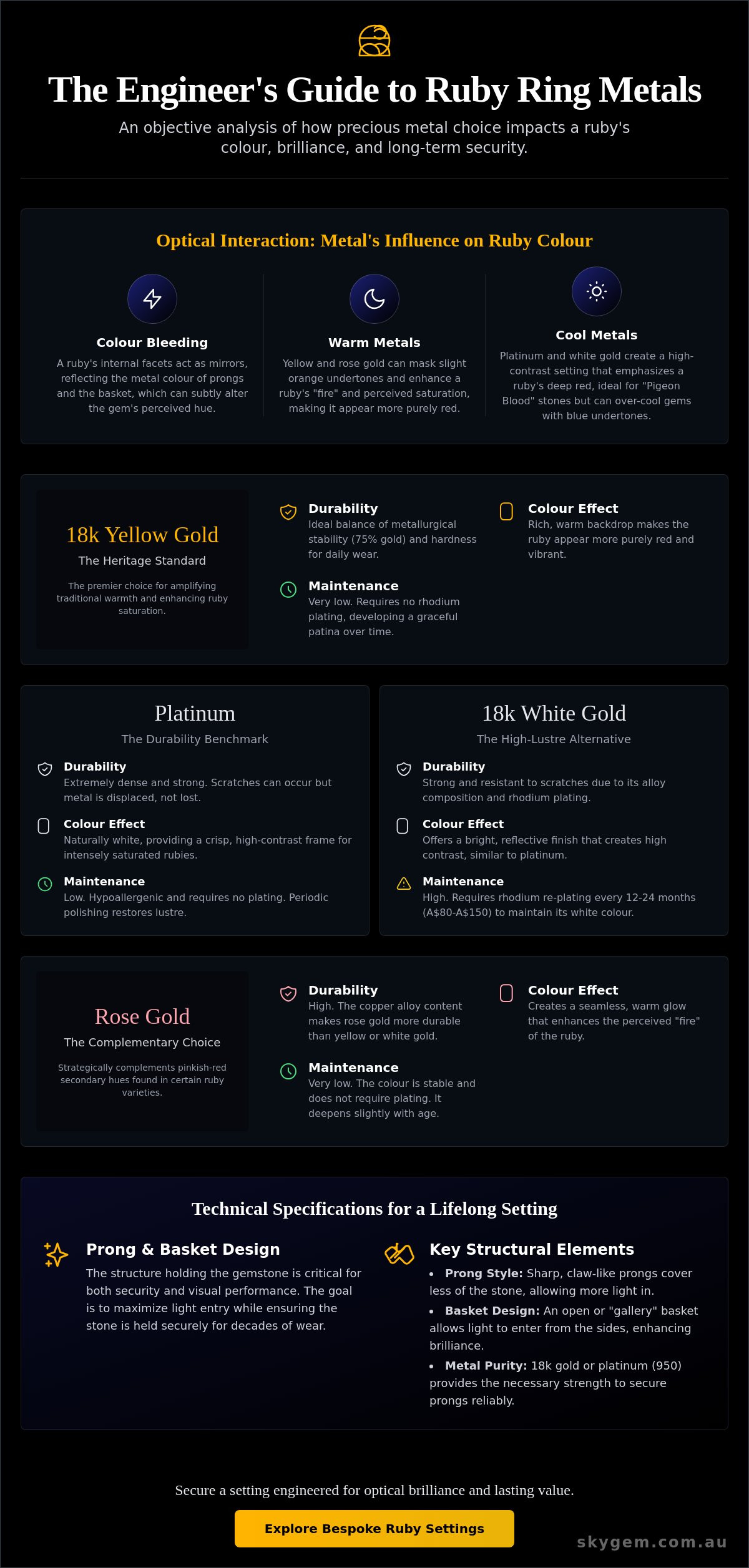
The selection of a setting involves more than structural integrity; it is a technical exercise in optical physics. Rubies, a primary variety of the mineral corundum, possess a high refractive index ranging from 1.76 to 1.77. This high index means the environment surrounding the stone significantly dictates its visual performance. When determining the best metal for a ruby ring, a specialist must account for how light reflects off the metal surface and permeates the gemstone. This phenomenon, known as "colour bleeding," occurs because the internal facets of a ruby act as miniature mirrors, picking up the metallic tint of the prongs and the underlying basket.
The physical properties of rubies, specifically the presence of chromium trace elements, define their primary red hue. Most natural specimens found in the Australian market exhibit secondary undertones, typically classified as either purplish or orangey. A stone with a 15% purplish secondary hue reacts differently to white gold than one with a slight yellowish tint. Professional designers use chromatic contrast to manipulate these perceptions, ensuring the saturation appears balanced and the stone achieves maximum brilliance against its frame.
Warm Metals and Ruby Saturation
Yellow and rose gold serve as effective tools for correcting or enhancing specific tonal profiles. In 18k yellow gold, the 75% gold content provides a rich, warm backdrop that can mask slight orange undertones, making the ruby appear more purely red. Rose gold, with its copper alloys, creates a seamless glow for stones with earthy or warm profiles. This choice often increases the perceived "fire" of the gemstone. The metal reinforces the long-wavelength light reflected from within the corundum structure, which is particularly effective for stones that lack intense natural saturation.
Cool Metals and Chromatic Contrast
White metals like platinum or 18k white gold provide a crisp, industrial frame that emphasises the depth of the red. This creates a high-contrast environment, which is the technical standard for showcasing "Pigeon Blood" rubies. These stones, characterised by a specific level of saturation and fluorescence, thrive in cool settings that don't compete with their natural vibrancy. One risk involves "cooling" the stone too much. A white metal setting can occasionally make a ruby with strong blue undertones appear overly dark or excessively purplish. Selecting the best metal for a ruby ring requires a direct assessment of the stone's specific chromaticity under 5500K daylight equivalent lighting to ensure the metal doesn't dull the stone's natural life.
Yellow Gold: The Traditional Choice for Natural Rubies
Yellow gold has remained the historical gold standard for setting rubies for centuries. This preference isn't merely aesthetic; it's rooted in the psychological association between high-purity gold and the regality of the "King of Gemstones." When considering the best metal for a ruby ring, 18k yellow gold offers a technical advantage by enhancing the saturation of natural rubies. The warm spectrum of the metal reinforces the red primary hues of the stone, making the gem appear more vibrant than it might in a cooler-toned setting. Unlike white gold, yellow gold requires no rhodium plating to maintain its appearance. This eliminates the long-term maintenance cycle of re-plating, which can cost between A$80 and A$150 per treatment in the Australian market. For clients seeking a low-maintenance, permanent solution, yellow gold provides a consistent finish that ages gracefully, developing a soft patina that many collectors believe adds character to heritage pieces.18k vs. 14k Yellow Gold for Ruby Settings
Choosing between 18k and 14k gold involves a calculated trade-off between purity and structural hardness. 18k gold contains 75% pure gold, resulting in a deep, buttery hue that defines high-end bespoke jewellery. While 14k gold is harder because it contains 58.3% pure gold mixed with stronger alloys, it lacks the rich colour density required to truly elevate a premium ruby. For everyday engagement rings, 18k yellow gold is the preferred professional standard. It offers the ideal balance of metallurgical stability and aesthetic richness. According to GIA's guide to ruby durability, rubies are a 9 on the Mohs scale, which means the surrounding metal must be robust enough to secure a stone that will likely outlast its setting. 18k gold provides this security while ensuring the metal doesn't look "washed out" against the intense red of the gemstone.Aesthetic Pairings: Vintage and Heirloom Styles
Yellow gold is the foundational element for Art Deco and Victorian-inspired designs. In these intricate settings, the metal acts as a warm frame that softens the architectural lines of the ring. One specific technical benefit of using yellow gold is the way the prongs interact with the stone. When finished correctly, yellow gold prongs tend to disappear into the ruby’s edge, creating a seamless visual transition that makes the stone appear larger. Yellow gold represents the safest choice for rubies that exhibit a warm secondary hue, as the metal's natural yellow tones complement rather than clash with orange or brownish undertones. This compatibility ensures that the gemstone's natural characteristics are celebrated rather than corrected. If you're looking for a piece that balances heritage with modern engineering, exploring a custom-made engagement ring in MelbourneWhite Metals: Platinum vs. White Gold for Modern Ruby Rings
Selecting the best metal for a ruby ring requires a technical understanding of how white alloys interact with a gemstone's natural saturation. While both platinum and 18k white gold provide a sophisticated, cool-toned backdrop, their metallurgical properties and maintenance profiles differ significantly. Platinum offers a natural grey-white hue that remains consistent, whereas 18k white gold relies on a rhodium finish to achieve its signature mirror-like brilliance. This distinction is critical when designing bespoke engagement rings that must balance immediate aesthetic impact with decades of structural reliability.
Platinum: The Ultimate in Security and Luxury
Platinum is the preferred choice for high-value ruby settings due to its extreme density and durability. It's approximately 40% heavier than 18k gold, providing a reassuring weight that signals premium quality. From an engineering perspective, platinum's greatest asset is its displacement property. Unlike gold, which loses microscopic amounts of metal when scratched, platinum simply shifts. This makes it the most secure option for the delicate prongs that hold a gemstone in place.
It's also 95% pure, making it naturally hypoallergenic for clients with sensitive skin. Over time, the metal develops a "patina," a soft matte finish caused by tiny surface scratches. While some appreciate this aged look, it can slightly reduce the visual contrast against the stone. Referencing the GIA Ruby Quality Factors is helpful here; a ruby with lower transparency might benefit from the high-shine of gold, while a vivid, high-clarity stone often looks exceptional against the understated elegance of platinum.
18k White Gold: The Bright Alternative
18k white gold is a versatile alloy consisting of 75% pure gold mixed with white metals such as palladium or silver. To achieve a crisp, bright white finish, the piece is electroplated with rhodium. This plating is exceptionally reflective, which serves to highlight the deep reds of a ruby more intensely than the slightly darker tone of platinum. This makes it a popular choice for halo engagement rings where the metal needs to blend seamlessly with surrounding diamond accents.
The trade-off for this brilliance is a long-term maintenance schedule. Rhodium plating typically wears thin every 12 to 24 months, revealing the warmer, yellowish tone of the underlying gold. In the Australian market, professional re-plating services are a standard part of jewellery care, but the cumulative cost over 20 years can eventually exceed the initial price gap between gold and platinum. Despite this, 18k white gold remains a strong candidate for the best metal for a ruby ring when the design prioritises maximum light return and a lightweight feel.
- Platinum: Best for security, longevity, and hypoallergenic needs.
- 18k White Gold: Best for immediate brilliance, diamond-heavy designs, and initial cost-efficiency.
Creative Alternatives: Rose Gold and Two-Tone Ruby Settings
While traditional platinum and white gold remain industry standards, selecting the best metal for a ruby ring involves balancing aesthetic warmth with structural performance. Rose gold has shifted from a niche trend to a staple in Australian bespoke design, with market data indicating a steady rise in preference for pink-toned alloys since 2021. This choice isn't purely stylistic; it's a technical decision based on the gemstone's specific hue and the wearer's skin tone. By deviating from monochromatic white metals, you can create a piece that feels both contemporary and deeply personal.
Rose Gold: A Soft Frame for Vibrant Stones
Rose gold contains a high copper content, typically around 20% to 22% in an 18k alloy, which creates a warm glow that complements rubies with strong pinkish undertones. This metal choice softens the visual transition between the stone and the setting, making it an ideal choice for fine jewellery that prioritises a romantic aesthetic. Designers must ensure the rose gold hue doesn't saturate the stone's natural colour. For rubies with a medium-light tone, the copper-rich alloy enhances the stone's internal fire without the stark contrast of white metals. It's a youthful, trendy option that has become a favourite for those looking to move away from traditional yellow gold.
Two-Tone Designs: Strategic Metal Placement
Two-tone settings allow for a sophisticated blend of performance and style. A common technical configuration involves using 18k yellow gold prongs on a white gold or platinum band. This "yellow prongs" technique prevents the "colour bleed" that can occur when a red stone is set in white metal, which can sometimes make the ruby appear cooler or slightly purple. Conversely, a white gold head on a rose gold band maintains the stone's crisp red profile while allowing the band to match a warm-toned wardrobe. Achieving this requires precision laser welding to ensure the bond between the two different alloys is permanent and seamless. This approach bridges the gap between different jewellery collections, allowing the ring to pair effortlessly with both silver and gold accessories.
The best metal for a ruby ring should also account for the wearer's daily lifestyle and wardrobe. Rose gold and two-tone designs are particularly effective for matching diverse skin tones. Warm metals suit those with olive or golden complexions, while the white metal components in a two-tone ring provide a neutral balance. This versatility makes mixed-metal settings a practical choice for long-term wear, as they don't lock the wearer into a single metal palette for their other accessories.
Technical Considerations for a Lifelong Ruby Setting
Selecting the best metal for a ruby ring involves more than matching colours. It requires a deep understanding of structural integrity and stone security. A four-prong setting offers a minimalist aesthetic, yet a six-prong configuration provides a critical safety net if one prong catches on a garment. Claw prongs are generally preferred for rubies as they cover less of the stone's surface area than rounded beads, allowing more of the deep red hue to remain visible from multiple angles.
The "basket" or under-gallery design dictates how much light enters the pavilion of the gemstone. For rubies, which often exhibit natural fluorescence, maximizing light entry from the sides is essential for vibrancy. A well-engineered basket doesn't just hold the stone; it acts as a light well. We recommend a minimum shank thickness of 1.8mm for rings intended for daily wear. Rings thinner than 1.5mm often suffer from "out-of-round" deformation within 24 months of regular use, especially when using softer 18k gold alloys.
Prong Security and Metal Hardness
Platinum prongs provide superior security because the metal is tenacious. It doesn't chip or snap when struck; instead, the metal displaces. 18k white gold is harder due to its alloy content, but it's more prone to stress fractures over a decade of wear. While a ruby sits at 9 on the Mohs scale, the metal setting is significantly softer, requiring a design that protects the gemstone from high-impact contact. Most gold settings require professional re-tipping every 7 to 10 years to prevent stone loss, whereas platinum may only require occasional burnishing to maintain its structural grip.
The SkyGem & Co. Approach to Bespoke Ruby Rings
Our team views every project as a technical consultation rather than a simple transaction. We focus on future-proofing your investment by selecting materials that meet strict Australian standards for durability and performance. By crafting custom engagement rings that balance beauty and engineering, we ensure your ruby remains secure for a lifetime. We invite you to book a professional consultation at our Melbourne studio to discuss the technical specifications and material options for your gemstone project. Our goal is to provide a solution-oriented approach that respects both the architectural aesthetics of the piece and the rigours of your lifestyle.
Securing the Legacy of Your Ruby Investment
Selecting the best metal for a ruby ring involves more than aesthetic preference; it requires a technical understanding of how different alloys interact with a gemstone's 9.0 Mohs hardness and its internal crystalline structure. High-purity 18k yellow gold provides the ideal chromatic backdrop for natural rubies, while platinum's high density ensures the structural integrity of the setting over decades of wear. Our approach focuses on the intersection of engineering precision and gemstone performance, ensuring every bespoke piece serves as a durable, long-term asset.
Skygem is a specialist in natural and unheated rubies, operating as an Australian-owned boutique dedicated to professional education and transparency. We provide expert consultations for bespoke designs, guiding you through the technical specifications of metal selection to achieve optimal light return and security. Whether you're seeking a traditional setting or a modern platinum mounting, our solutions meet the rigorous standards of the Australian jewellery landscape.
Explore our collection of natural rubies and bespoke settings at Skygem to begin your design journey. We're ready to help you create a piece that combines technical excellence with timeless character.
Frequently Asked Questions
Is platinum or gold better for a ruby engagement ring?
Platinum is the technically superior choice for a ruby engagement ring because its high density provides better security for the gemstone. While 18k gold is a traditional industry standard, platinum's structural integrity means prongs won't wear down as quickly over a 15 year period. This makes it a reliable long-term solution for protecting a high-value investment.
Will yellow gold make my ruby look more orange?
Yellow gold enhances the warm secondary tones in a ruby, which can make stones with orange or brown modifiers appear more pronounced. For rubies with a high chromium content, the 75% gold purity in 18k yellow gold creates a classic contrast that deepens the red. If your stone has cooler, purplish undertones, yellow gold is an effective way to neutralise those hues for a warmer appearance.
Does white gold need more maintenance than platinum?
White gold requires more frequent technical maintenance because it needs rhodium plating every 12 to 24 months to maintain its bright finish. Platinum is naturally white and doesn't require replating, though it does develop a duller patina over time. From a long-term engineering perspective, platinum is the best metal for a ruby ring if you prefer a low-intervention maintenance schedule.
What is the most durable metal for an everyday ruby ring?
Platinum is the most durable precious metal for daily wear due to its unique displacement properties. Unlike gold, which loses microscopic amounts of metal when scratched, platinum simply shifts its volume without losing mass. This makes it an ideal choice for the rigorous Australian lifestyle, ensuring the setting remains secure for 365 days of the year.
Can I use rose gold for a ruby ring if the stone is very dark?
Rose gold is a sophisticated pairing for dark rubies, as the copper content in the alloy complements stones with high saturation levels. You'll find this combination creates a monochromatic look that's popular in modern architectural jewellery design. It's important to ensure the ruby has a high clarity grade, as the pinkish metal can sometimes highlight internal inclusions in darker gems.
How does metal choice affect the price of a ruby ring?
Metal choice significantly impacts the final cost, with platinum typically commanding a 30% to 50% premium over 18k gold in the Australian market. This price difference isn't just about the raw material cost; it reflects the higher density of platinum and the specialised labour required for casting. Choosing 14k gold can reduce the initial capital outlay while still providing a durable setting for the stone.
Is 18k gold better than 14k gold for a ruby setting?
18k gold is the preferred choice for high-end ruby settings because its 75% gold content offers a richer colour and greater prestige. 14k gold contains only 58.3% gold and is technically harder, which can be an advantage for scratch resistance in high-impact environments. For most professional-grade jewellery, 18k gold provides the best balance of luxury and structural performance for the best metal for a ruby ring.
What metal is best for a ruby if I have sensitive skin?
Platinum is the safest choice for sensitive skin because it's naturally hypoallergenic and 95% pure. Many white gold alloys used in Australia contain nickel, which causes allergic contact dermatitis in approximately 15% of the population. Selecting platinum or high-karat yellow gold ensures your ring meets high dermatological safety standards and remains comfortable for decades of wear.
Disclaimer
This article is for general informational purposes only and may include AI-assisted content. Pricing, specifications, and availability are subject to change. For accurate advice and current information, please contact SkyGem & Co. directly. Nothing in this content constitutes professional or financial advice.