
Best Diamond Cut for Maximum Sparkle: The 2026 Brilliance Guide

A diamond with a "D" color and "IF" clarity can still appear lifeless if the technical execution of its facets is flawed. Many buyers mistake a high price tag or a prestigious shape for guaranteed brilliance, only to find their investment lacks the expected fire under real-world lighting. It's a common frustration to feel overwhelmed by technical GIA reports while fearing you'll choose a stone that simply doesn't perform.
We understand that selecting the best diamond cut for maximum sparkle requires looking beyond the basic 4Cs and into the precise mathematics of light return. This 2026 brilliance guide provides the technical clarity you need to evaluate a diamond's performance with confidence. We'll examine the specific proportions that define an "Excellent" cut, explain the 2026 GIA updates regarding fluorescence, and show you how to balance technical specifications to ensure your diamond remains a high-performing asset. By the end of this guide, you'll know exactly which metrics on a certificate translate to the most impressive visual result.
Key Takeaways
- Identify the technical reasons why the Round Brilliant remains the best diamond cut for maximum sparkle, utilizing its 58-facet geometry to optimize light refraction.
- Distinguish between a diamond’s silhouette and its cut quality to ensure you are investing in optical performance rather than just a specific shape.
- Learn to interpret GIA grading reports with technical precision, focusing on the specific proportions that eliminate light leakage and maximize fire.
- Compare the brilliance of various fancy shapes, such as ovals and pears, to understand how elongated facets influence light return and scintillation.
- Understand the identical physics of light performance across natural and lab-grown stones to make a confident choice based on value and aesthetic preference.
Understanding the Science of Diamond Sparkle
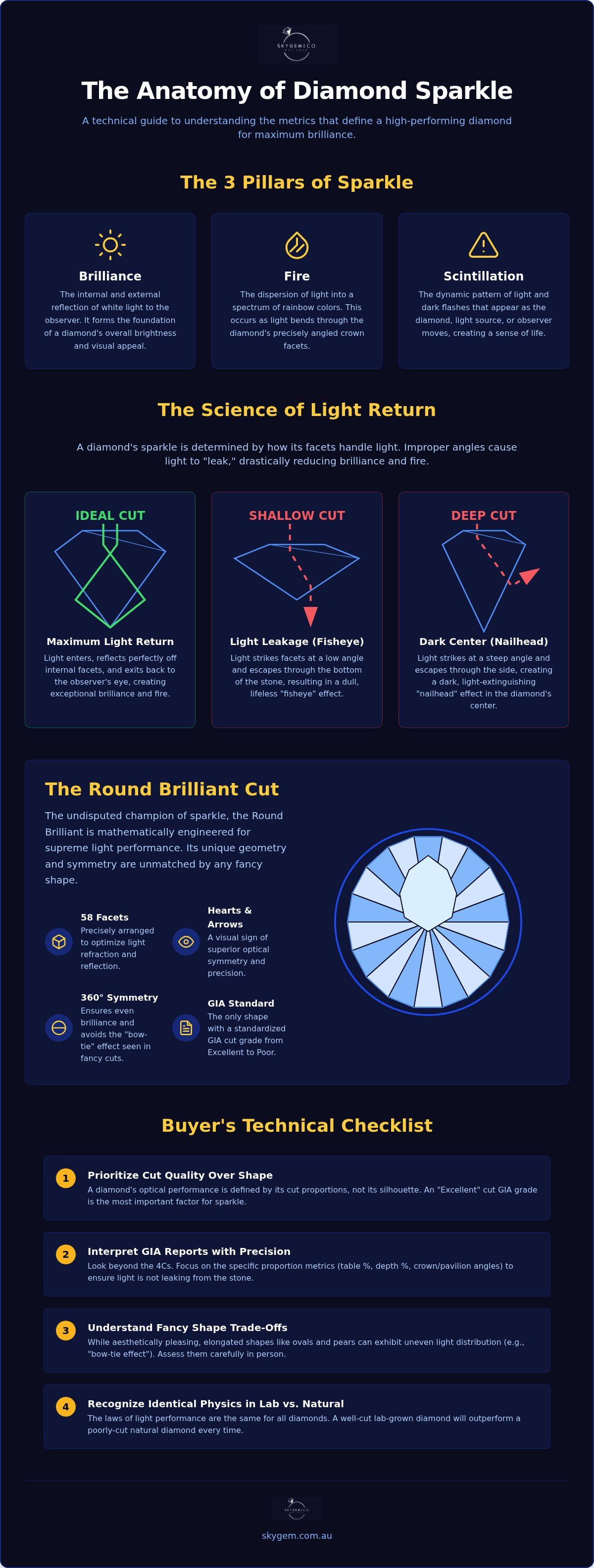
Sparkle isn't a singular optical event. It's a complex interaction of physics that occurs when light enters the crown of a stone. While many consumers focus on the carat weight or size of the rock, the technical precision of the facets determines whether that stone appears vibrant or remains dull. Achieving the best diamond cut for maximum sparkle relies on three distinct optical phenomena: brilliance, fire, and scintillation. Each plays a specific role in the stone's overall light performance and visual impact.
Brilliance, Fire, and Scintillation Defined
Brilliance refers to the internal and external white light reflected to the observer. It's the foundation of a diamond's brightness. Fire, however, is often overlooked by casual buyers. It represents the spectral dispersion of light into a spectrum of rainbow colours. When light travels through the diamond's crown facets at precise angles, it slows down and bends, separating into its component wavelengths. A detailed review of Understanding Diamond Cut illustrates how the evolution of faceting has sought to master these light paths. Scintillation adds the final layer of visual interest. It's the pattern of light and dark areas that flash as the diamond, the light source, or the observer moves. A well-proportioned stone balances these three elements to create a harmonious visual rhythm.
How Light Travels Through a Diamond
The path of light through a diamond is governed by the laws of refraction and total internal reflection. For a diamond to exhibit maximum sparkle, light must enter through the table, reflect off the pavilion facets, and return through the crown to the eye. This process is highly dependent on the "critical angle." If the facets are not angled correctly, light will pass straight through the diamond rather than reflecting back up. The human eye perceives sparkle most intensely when there's a high contrast between the bright flashes and the dark shadows of scintillation.
When a stone is cut too shallow, light strikes the pavilion at a low angle and exits through the bottom, creating a "fisheye" effect. Conversely, a stone cut too deep causes light to strike the opposite pavilion facet at an angle that allows it to escape through the side, resulting in a dark center known as a "nailhead." Light leakage is the failure of a diamond to reflect light back to the observer due to improper facet angles, which directly diminishes the stone's brilliance and fire. Whether you are evaluating natural white diamonds or lab-grown white diamonds, the physics of light return remain identical. Selecting the best diamond cut for maximum sparkle means prioritising these technical proportions over raw carat weight.
The Round Brilliant Cut: The Uncontested King of Brilliance
While various shapes offer unique aesthetic appeal, the round brilliant cut remains the industry standard for light performance. It's mathematically engineered to produce the highest possible levels of brilliance and fire. This specific geometry was refined over decades to ensure that nearly all light entering the stone is reflected back through the crown. For those seeking the best diamond cut for maximum sparkle, the round brilliant is currently the only shape that offers a standardized GIA cut grade, providing a reliable benchmark for technical quality. This standardization ensures that buyers can rely on a consistent scale of "Excellent" to "Poor" when evaluating a stone's potential for light return.
The Anatomy of 57 Facets
The standard round brilliant consists of 57 facets, or 58 if the culet is included. These facets are divided into the table, crown, and pavilion, each serving a distinct purpose in GIA's explanation of sparkle. The crown facets act as windows that collect light, while the pavilion facets function as mirrors that reflect it. When these facets are aligned with extreme precision, they produce the "Hearts and Arrows" pattern. This phenomenon is a visual indicator of superior optical symmetry, ensuring that light is balanced across the entire diameter of the stone. Without this level of alignment, even a high-clarity diamond will appear patchy or dark in certain areas.
Why Round Diamonds Outperform Fancy Shapes
Round diamonds possess a distinct advantage over fancy shapes due to their 360-degree symmetrical perimeter. This circular design allows light to enter and exit with uniform consistency, regardless of the angle of observation. Elongated shapes often suffer from "bow-tie" effects or uneven light distribution, but a well-cut round stone maintains a steady wall-to-wall brilliance. Additionally, the round cut's ability to return a high percentage of white light often makes the stone appear whiter and larger than its actual carat weight suggests. This makes it an ideal choice for a solitaire engagement ring where the diamond is the primary focal point.
For many collectors, the round brilliant is the best diamond cut for maximum sparkle because it masks body colour and minor inclusions more effectively than step-cut shapes. If you're ready to see how these proportions translate to real-world brilliance, you can explore our collection of GIA certified natural diamonds to find a stone that meets these rigorous technical standards.
Fancy Cuts Comparison: Sparkle Beyond the Round
While the round brilliant remains the benchmark for light return, fancy shapes offer unique optical signatures that appeal to specific aesthetic preferences. It's essential to distinguish between brilliant-cut facets and step-cut facets when evaluating these shapes. Brilliant cuts, such as ovals and cushions, feature triangular and kite-shaped facets designed to maximize light dispersion. In contrast, step-cut shapes like emeralds prioritize clarity and lustre over raw brilliance. For those exploring alternatives to the round, identifying the best diamond cut for maximum sparkle involves understanding how different facet arrangements manipulate light within the stone's specific silhouette.
There is often a technical trade-off between a diamond's surface area and its light intensity. Elongated shapes typically offer a larger visual footprint than a round diamond of the same carat weight. However, this increased spread can sometimes result in slightly lower light intensity at the center. In 2026, oval diamonds have secured a significant market share of approximately 11.6%, reflecting a growing preference for shapes that combine a larger appearance with high levels of scintillation. Choosing the right fancy shape requires a balance between the desired "look" on the finger and the stone's ability to maintain wall-to-wall brilliance.
Radiant and Cushion Cuts: The Crushed Ice Effect
Modern modified cushion and radiant cuts often exhibit what gemologists call a "crushed ice" appearance. This effect is created by a high number of small, overlapping flashes of light rather than the larger, chunky reflections seen in antique cuts. Radiant cuts are engineered specifically to be the most brilliant of the square and rectangular shapes, utilizing a complex facet pattern that effectively masks minor inclusions. This intricate geometry makes them an excellent choice for lab-grown white diamonds where high-performance sparkle is the primary goal. The "crushed ice" look provides a dense, energetic scintillation that remains vibrant even in lower lighting conditions.
Oval, Pear, and Marquise: Elongated Brilliance
Elongated shapes like ovals, pears, and marquises are prized for their ability to lengthen the appearance of the finger while providing substantial light return. A critical technical consideration for these shapes is the "bow-tie" effect. This is a dark shadow across the center of the stone caused by light escaping through the bottom of the diamond. While nearly all elongated cuts have a slight bow-tie, a superior cut minimizes this shadow to ensure the center remains bright. Evaluating symmetry is non-negotiable for asymmetrical shapes like the pear. The shoulders and wings must be perfectly balanced to prevent uneven light distribution. When selected with technical precision, these shapes can rival the round brilliant, making them a strong contender for the best diamond cut for maximum sparkle in bespoke designs.
Beyond Shape: Why Cut Quality and Proportions Matter Most
While many buyers prioritise colour and clarity, these factors contribute primarily to a stone's rarity and transparency rather than its light performance. Cut is the engine of a diamond. It's the only one of the 4Cs that is influenced by human craftsmanship rather than nature. Even a diamond with a flawless clarity grade can appear dark or lifeless if its facets aren't angled to reflect light. To secure the best diamond cut for maximum sparkle, you must move beyond the silhouette of the stone and scrutinise the technical data found on a grading report. High-performance diamonds are the result of rigorous mathematical precision, where every facet serves as a calculated mirror for light return.
The Impact of GIA Cut Grading
For round brilliant diamonds, the GIA Cut Scale is the most reliable tool for assessing optical quality. This scale ranges from Excellent to Poor, evaluating how successfully a stone interacts with light to create brightness, fire, and scintillation. You shouldn't settle for anything less than an Excellent cut grade if your goal is maximum brilliance. While a "Very Good" grade might seem sufficient on paper, these stones often exhibit subtle light leakage that reduces their "wow" factor in real-world lighting. GIA technicians use sophisticated modelling to ensure that an Excellent grade represents a stone with superior light handling across all environments.
The Ideal Proportions Checklist
Identifying the best diamond cut for maximum sparkle requires looking at the specific percentages and angles listed on a GIA certificate. These proportions determine how light travels through the stone before being reflected back to your eye. When these numbers fall outside the "sweet spot," the diamond's performance suffers. Key metrics to monitor include:
- Table Percentage: For round diamonds, look for a table between 54% and 57%. This ensures the top facet is large enough to admit light without sacrificing the crown area needed for fire.
- Depth Percentage: A range of 60% to 62.5% is ideal. Stones outside this range risk the "fish-eye" effect if too shallow or the "nail-head" effect if too deep.
- Crown and Pavilion Angles: These are the most critical relationships. A crown angle of 34 to 35 degrees paired with a pavilion angle of approximately 40.6 to 40.8 degrees creates the perfect internal reflection.
Polish and symmetry also play a supporting role in the final light show. Polish refers to the smoothness of the facet surfaces, while symmetry evaluates the alignment and shape of those facets. If the symmetry is off, light will be misdirected, resulting in "dead" spots within the stone. Our technical consultants can help you interpret these metrics to find a stone that outperforms its paper grade. If you're ready to select a stone with these precise specifications, you can browse our GIA certified natural diamonds to find your perfect match.
Selecting Your Sparkling Diamond at SkyGem & Co.
Selecting a diamond with superior light performance is a collaborative process that requires both technical data and visual verification. At SkyGem & Co., we act as technical consultants rather than traditional retailers, assisting you in interpreting the nuances of a GIA report to identify the best diamond cut for maximum sparkle. Lighting environments play a critical role in how a stone performs; a diamond that appears vibrant under showroom spotlights may behave differently in natural overcast light or dim candlelight. We encourage viewing stones in various environments to ensure the scintillation remains consistent and the fire is visible across all conditions.
Natural vs. Lab-Grown: Does Sparkle Differ?
The physics of light refraction and total internal reflection are identical for both natural and lab-created stones. Because lab-grown diamonds are chemically and optically equivalent to their natural counterparts, they respond to a high-quality cut in the exact same manner. As of January 2026, the price divergence in the market means that lab-grown options offer a strategic advantage for those prioritising performance. The budget savings allow buyers to allocate resources toward a premium "Excellent" cut grade rather than compromising on proportions to reach a specific carat weight. Regardless of the stone's origin, we recommend only choosing stones with GIA or IGI certification to ensure the technical metrics are verified by an independent laboratory.
Bespoke Settings to Enhance Light Performance
The setting is often the most overlooked factor in a diamond's brilliance. Even the best diamond cut for maximum sparkle can be hindered by a setting that restricts light access. In mass-produced jewellery, prongs are often bulky and poorly positioned, covering significant surface area and creating internal shadows. Our expertise in custom made engagement rings allows us to engineer settings that prioritise light exposure. By strategically placing minimal prongs and adjusting the height of the gallery, we ensure that light enters the pavilion from multiple angles, maximising the stone's natural fire.
For those seeking to amplify the overall visual impact, a halo setting can be a powerful tool. By surrounding the centre stone with smaller, high-performance diamonds, we create a combined wall of light that boosts the overall scintillation of the piece. This bespoke approach ensures that the setting functions as a technical asset to the diamond rather than a physical barrier. Whether you are selecting a solitaire or a complex trilogy design, the goal is always to create a structural environment where the diamond's mathematical precision can be fully realised.
Securing Your Investment in Brilliance
Identifying the best diamond cut for maximum sparkle requires a shift from viewing a stone as a simple accessory to evaluating it as a high-performance optical instrument. The true secret to brilliance lies in the specific crown and pavilion angles recorded on a GIA certificate rather than just the diamond's silhouette. Balancing brilliance, fire, and scintillation ensures your stone remains vibrant across all lighting environments. It's a process where technical precision meets aesthetic design to create a lasting asset.
At SkyGem & Co., we specialise in solitaire and bespoke designs that prioritise these exact metrics. Whether you're selecting GIA certified natural diamonds or ethically sourced gemstones, our role is to act as your technical consultant throughout the selection process. We ensure every facet is aligned for optimal light return and every setting is engineered to minimise light blockage. We invite you to Book a Bespoke Consultation with SkyGem & Co. to Find Your Perfect Diamond. You deserve a stone that performs with quiet confidence and technical reliability.
Frequently Asked Questions
Which diamond cut has the most sparkle?
The Round Brilliant cut is scientifically engineered to be the best diamond cut for maximum sparkle. Its 58-facet structure is designed to reflect nearly all light that enters the stone back to the observer's eye. This symmetrical geometry ensures a superior balance of brilliance and fire that fancy shapes struggle to match with the same consistency.
Is a Cushion cut more sparkly than an Oval cut?
An Oval cut typically exhibits higher brilliance than a Cushion cut due to its elongated brilliant-cut facet pattern. While modern modified Cushions produce a dense "crushed ice" scintillation, Ovals offer a larger surface area and more distinct light return. The choice often depends on whether you prefer the broad flashes of an Oval or the energetic, needle-like sparkle of a Cushion.
Do lab-grown diamonds sparkle as much as natural diamonds?
Lab-grown diamonds possess the exact same refractive index and dispersion levels as natural diamonds, meaning they sparkle identically. Because they're physically and chemically the same, a lab-grown stone with an "Excellent" cut grade will perform exactly like a natural stone of the same quality. The sparkle is a result of the cut's technical precision, not the stone's origin.
What is the "bow-tie effect" in diamond cuts?
The bow-tie effect is a dark, butterfly-shaped shadow that appears across the centre of elongated diamonds like ovals, pears, and marquises. It occurs when light passes through the stone and is not reflected back to the eye. While most elongated cuts have a slight bow-tie, a superior cut minimises this shadow to maintain a bright, even appearance across the entire stone.
How does the setting affect a diamond’s sparkle?
A setting can significantly impact light performance by either facilitating or obstructing light entry into the diamond's pavilion. Bulky prongs or heavy metal surrounds can create internal shadows and reduce brilliance. Selecting a bespoke setting with minimal, strategically placed prongs ensures the best diamond cut for maximum sparkle isn't hindered by its structural environment.
What GIA cut grade should I look for for maximum brilliance?
You should always prioritise a GIA "Excellent" cut grade to ensure the highest level of light performance. This grade confirms that the diamond's proportions, symmetry, and polish have been lab-verified to produce optimal brightness and fire. Settling for a "Very Good" grade often results in subtle light leakage that diminishes the stone's overall vibrancy in real-world lighting.
Does a higher clarity grade mean more sparkle?
A higher clarity grade doesn't inherently increase a diamond's sparkle. Clarity refers to the absence of internal inclusions, whereas sparkle is determined by the precision of the facet angles. As long as a diamond is "eye-clean," the cut quality will have a far more significant impact on the stone's visual performance than moving from a VS2 to a VVS1 clarity grade.
Can a poorly cut diamond be "fixed" to sparkle more?
A poorly cut diamond can be recut to improve its proportions and sparkle, but this process involves a significant loss of carat weight. Most retailers don't offer this service because the cost of labour and the reduction in size often outweigh the value gained in brilliance. It's almost always more cost-effective to invest in a high-quality cut from the outset.
Disclaimer
This article is for general informational purposes only and may include AI-assisted content. Pricing, specifications, and availability are subject to change. For accurate advice and current information, please contact SkyGem & Co. directly. Nothing in this content constitutes professional or financial advice.