
Australian Sapphires: The 2026 Reference Guide to Local Gemstones

The most durable and ethically sound choice for a modern heirloom isn't found in a traditional overseas mine, but within the volcanic basalt of the East Australian Margin. While the global market historically prioritised uniform blues, savvy collectors in 2026 are pivoting toward the unique geological complexity of australian sapphires. You've likely noticed that sourcing a gemstone with a transparent, documented lineage is becoming harder as international supply chains grow more complex. It's frustrating to encounter 'inky' stones that lose their brilliance in low light, or to feel uncertain about whether a premium price tag reflects a stone's natural state or an undisclosed treatment.
We believe that selecting a gemstone requires a balance of aesthetic preference and technical rigour. This reference guide bridges that gap by providing a comprehensive analysis of colour zoning, pleochroism, and the current 2026 standards for heat treatment disclosure. You'll gain the specific knowledge needed to distinguish between a standard commercial grade stone and an investment-quality teal or parti sapphire. We'll examine the precise geological factors that define these local gems and provide a clear framework for choosing a stone that meets both your design vision and your standards for ethical provenance.
Key Takeaways
- Understand the geological composition of corundum and the role of iron and titanium trace elements in defining the unique colour spectrum of local volcanic deposits.
- Discover how modern precision cutting techniques have evolved to showcase the unique multi-coloured brilliance of australian sapphires.
- Learn to apply technical grading standards to your selection, focusing on the 'eye-clean' benchmark as the professional standard for high-clarity stones.
- Evaluate the ethical advantages of local sourcing, where strict environmental regulations and land rehabilitation ensure a transparent and sustainable supply chain.
- Gain practical insights into bespoke jewellery design, including the specific metal pairings required to optimise the visual performance of teal and deep blue gemstones.
What Are Australian Sapphires? Origins and Geological Profile
Australian sapphires are a high-density variety of the mineral corundum, chemically identified as Al2O3. Unlike stones from many other global sources, these gemstones formed within volcanic environments where basaltic magmas transported them to the earth's surface. The distinct colour spectrum of australian sapphires, ranging from deep royal blues to vibrant teals and yellows, results from specific trace elements. Iron and titanium concentrations within the crystal lattice determine the final hue, with higher iron levels contributing to the rich, dark tones often associated with local deposits.
The geological history of these stones spans millions of years, while the human history of the industry dates back to 1851. This 173-year legacy established Australia as a primary global supplier during the 20th century. Geologists categorise these deposits into two distinct types. Primary deposits remain trapped within volcanic rock, whereas secondary or alluvial deposits occur where weathering and erosion have washed the stones into ancient riverbeds. Understanding these Sapphire mineral properties is essential for technical evaluation and long-term investment planning.
The Major Mining Regions: Queensland and New South Wales
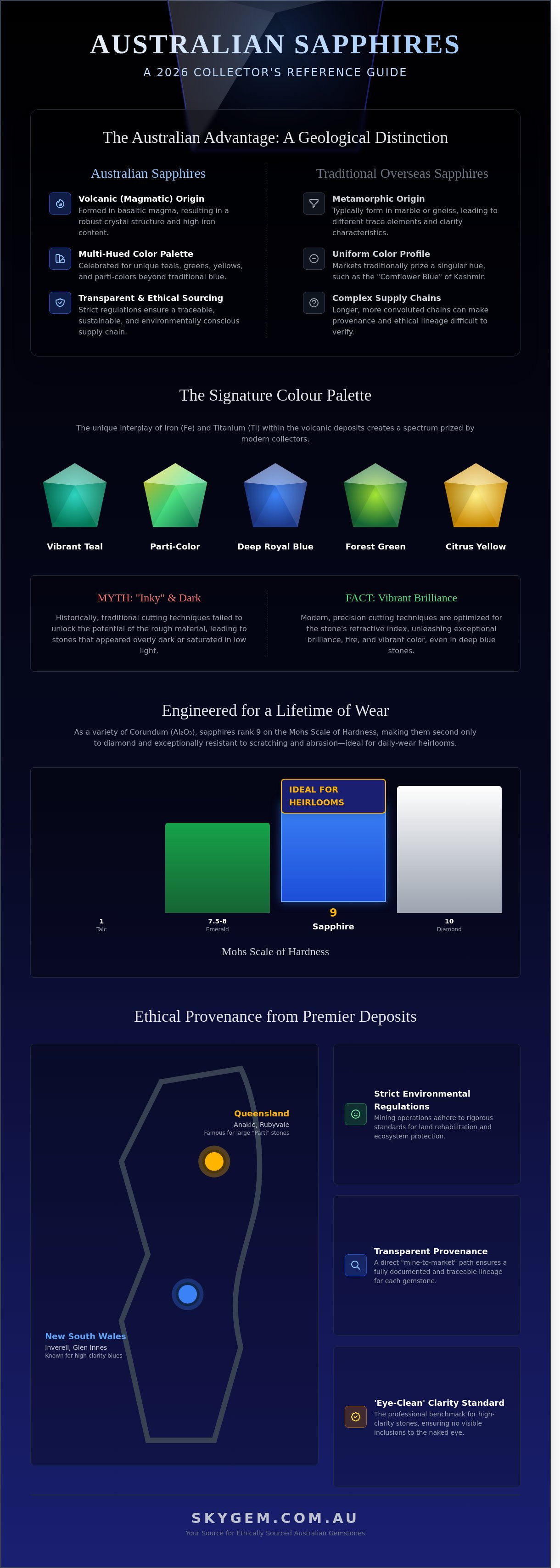
The Central Queensland Gemfields, encompassing the Anakie, Sapphire, and Rubyvale districts, represent one of the world's most significant sapphire-bearing areas. This region is famous for producing large, multi-coloured "parti" stones that display distinct yellow and green zones. Conversely, the New England region of New South Wales, particularly around Inverell and Glen Innes, is known for producing blue stones with higher clarity. Australian deposits are magmatic in origin, which differs fundamentally from the metamorphic deposits found in Sri Lanka or Kashmir. This volcanic heritage results in a more robust crystal structure and unique internal "silk" patterns that act as a geological signature of the continent.
Corundum and the Mohs Scale of Hardness
Durability is a critical specification for any gemstone intended for daily use. Sapphires possess a hardness of 9 on the Mohs scale, making them the second hardest natural substance after diamonds. This high rating ensures the stone resists scratching and maintains its lustre over decades of wear. While loose sapphires are exceptionally resilient, other coloured stones like emeralds or morganite typically rank between 7.5 and 8, making them more prone to chipping and surface abrasion. The trigonal crystal structure of corundum facilitates a high refractive index which dictates how light bends and reflects within the gemstone's pavilion. This structural integrity makes australian sapphires an ideal choice for engagement rings and high-performance jewellery that requires longevity without compromise.
The Unique Colour Palette of Australian Sapphires
Australian sapphires are globally recognised for a diverse spectral range that extends far beyond the singular blue associated with other regions. While traditional markets once prioritised a uniform royal blue, contemporary collectors value the complex interplay of secondary hues found in local deposits. This multi-coloured characteristic is a direct result of the specific trace elements present during the crystal's formation millions of years ago. Unlike the "cornflower" stones of Kashmir, Australian specimens often exhibit a sophisticated blend of deep navy, forest green, and citrus yellow.
Historically, a misconception existed that australian sapphires were "inky" or overly saturated to the point of appearing black. This aesthetic limitation was largely a failure of traditional cutting standards rather than the raw material itself. Modern precision faceting, which prioritises optimal light return and extinction management, has successfully mitigated this issue. By adjusting pavilion angles to suit the stone's refractive index, lapidaries now unlock the vibrant, deep blues that define high-grade local material. For a detailed technical analysis of these properties, the Geological Profile of Australian Sapphires provides essential data on crystal structure and absorption.
The Queensland fields, particularly around the Anakie and Rubyvale regions, produce some of the world's most vivid yellow and green specimens. These stones are prized for their high clarity and "electric" saturation, which remains stable under various lighting conditions. You can explore these variations within our loose gemstones collection to see how these colours translate into high-performance jewellery assets.
The Rise of Teal and Mermaid Sapphires
Teal sapphires represent a precise equilibrium of blue, green, and yellow. Often referred to as "mermaid" sapphires when they lean towards a sea-foam green, these stones are currently the leading choice for modern engagement rings. Their popularity stems from their versatility and the unique iron content within Australian basaltic soil. This chemical signature produces a saturation level that's difficult to replicate in metamorphic deposits found in other global regions. It's a robust choice for those seeking a balance between traditional elegance and contemporary design.
Understanding Parti Sapphires: Nature's Bi-Colour Wonder
Parti-colouring is a phenomenon where distinct colour zoning occurs within a single crystal. This usually manifests as a sharp transition between yellow and blue sections. Because the distribution of these zones is entirely organic, no two australian sapphires of this variety are identical. This provides a high degree of exclusivity for those commissioning a custom-made engagement ring. To fully appreciate a Parti sapphire, it's best viewed under natural light. This allows the internal "flash" of different colours to become visible as the stone moves, revealing the true complexity of its internal architecture.
Technical Grading: Clarity, Cut, and Heat Treatment
Grading australian sapphires requires a technical framework distinct from the rigid 4C's used in the diamond industry. While diamonds demand a microscopic "flawless" standard, sapphires are evaluated based on being "eye-clean." This industry standard dictates that a stone is high quality if no inclusions are visible to the naked eye at a distance of approximately 15 centimetres. Microscopic inclusions, often referred to as "silk," are common in Type II gemstones; these internal features can actually verify a stone's natural origin and geographic provenance without compromising its structural integrity or visual appeal.
The precision of the cut directly dictates the stone's "life" and light return. Poorly executed facets lead to "extinction," where portions of the gem appear black and lifeless because light leaks out the back of the pavilion. High-quality Natural Sapphire specimens are engineered to maximize internal reflection. This ensures the vibrant blues, greens, and yellows are projected back to the viewer with maximum intensity. A well-cut stone will show consistent colour across the entire face, avoiding the dull zones that plague mass-produced commercial cuts.
Heat Treatment: Industry Standard vs. Unheated Gems
The majority of stones found in the market undergo "standard heat," a stable, permanent process where gems are heated to temperatures between 800°C and 1,800°C. This technique dissolves silk and improves colour saturation. SkyGem maintains a strict technical policy against "diffusion" or "lead-glass filling," which are invasive treatments that compromise the stone's long-term value. Truly unheated australian sapphires represent less than 7% of gem-quality yields. These rare specimens command a price premium of 30% to 50% because they possess exceptional colour and clarity in their raw, geological state.
Selecting the Right Shape for Maximum Brilliance
Traditional oval and round brilliant cuts remain the standard for maximizing carat weight retention from the rough crystal. However, the rise of "Parti" sapphires has increased the demand for emerald and baguette cuts. These step-cut geometries are technically superior for showcasing distinct colour zoning, such as a sharp transition from yellow to deep teal. Buyers should be cautious of "windowing," a defect where the pavilion is cut too shallow. This results in a transparent "hole" in the centre of the stone where light passes straight through rather than reflecting the gem's primary hue. A stone with a window loses its colour depth and feels "empty" when viewed from the top.
The Ethical Advantage: Traceability and Sustainability
Australian sapphires offer a transparent alternative to gemstones sourced from high-conflict regions. The Australian mining sector operates under some of the most stringent environmental and labour laws globally, including the Mining Act 1992 in New South Wales and the Mineral Resources Act 1989 in Queensland. These legislative frameworks ensure that every carat is extracted under rigorous ethical standards, protecting both the workers and the land. Unlike many international jurisdictions, Australian law mandates that mining companies lodge a financial bond for land rehabilitation before a single shovel hits the ground. This ensures that once extraction is complete, the landscape is restored to its original state or repurposed for agriculture.
The "Mine to Market" model is a cornerstone of the local industry. This direct chain of custody allows suppliers to track a gemstone from the specific paddock where it was found to the final setting in a ring. This level of oversight eliminates the risks associated with "blood diamonds" or stones that fund illicit activities. Our commitment to transparency at SkyGem & Co. reflects this national standard, providing clients with the assurance that their purchase supports a clean, regulated supply chain.
Supporting the Local Australian Economy
Purchasing local gems sustains approximately 2,500 small-scale artisanal miners across regional hubs like Inverell and the Central Queensland Highlands. This investment maintains a specialized ecosystem of Australian gemmologists and master cutters who ensure the technical excellence of the national industry. Choosing australian sapphires creates a tangible connection to the rugged landscape of the outback, adding a layer of provenance that mass-produced international stones lack. It turns a piece of jewellery into a story of local craftsmanship and heritage.
Certification and Authenticity
High-value australian sapphires require independent validation to confirm their market value and physical properties. We recommend seeking reports from reputable laboratories such as the Gemmological Association of Australia (GAA) or the Gemological Institute of America (GIA). A valid certificate must detail the stone's origin, precise dimensions, and treatment status, specifically noting if the sapphire is "unheated" or has undergone standard thermal enhancement. Professional valuations are a technical necessity for insurance purposes, providing a legal record of the stone's replacement value in A$.
Secure a gemstone with a verified history by browsing our curated selection of ethically sourced Australian sapphires today.
Designing Fine Jewellery with Australian Sapphires
Designing with australian sapphires requires a technical understanding of how light interacts with specific mineral inclusions and iron-rich chemical profiles. When you embark on the custom design process, the choice of metal acts as a functional frame that dictates the stone's perceived saturation. For instance, 18ct yellow gold provides a warm architectural contrast that enhances the secondary green and yellow hues often found in teal or parti-coloured stones. Conversely, platinum or 18ct white gold offers a neutral, high-lustre backdrop that allows deep, velvety blues to maintain their cool temperature without visual interference. Our bespoke engagement ring services focus on this structural harmony, ensuring the setting supports the gemstone's long-term durability and optimal light performance.
Successful custom design hinges on the "face-up" appearance of the stone. Because many local gems are cut to retain weight from the original rough, they may exhibit unique colour zoning. We recommend viewing stones under both natural and incandescent light sources before finalising a setting. This ensures the finished piece meets your performance expectations in all environments. It's a collaborative process where engineering excellence meets personal aesthetic.
Sapphire Engagement Rings: A Modern Alternative
Sapphires have become the primary alternative to diamonds in the Australian market, representing approximately 35% of non-traditional engagement ring selections as of 2024. Their rating of 9 on the Mohs scale ensures they withstand the rigours of daily wear. To maximise brilliance, we often pair australian sapphires with a diamond halo or tapered side stones. This creates a high-contrast aesthetic where the diamond's fire complements the sapphire's deep tonal density. For those seeking a minimalist approach, our Solitaire Engagement Rings highlight the clean lines and unique colour zoning inherent in local stones.
Caring for Your Sapphire Jewellery
Maintaining the lustre of your jewellery involves simple yet consistent technical care. For daily maintenance, a solution of mild detergent and warm water effectively removes surface oils that can dull the stone's refractive index. While these gemstones suit active Australian lifestyles, they require professional structural check-ups every 12 months to ensure the integrity of the claws. We advise against using ultrasonic cleaners for stones with specific liquid or crystal inclusions; high-frequency vibrations can potentially stress these natural internal features. A soft toothbrush is generally the safest tool for clearing debris from behind the setting.
The design process is a partnership between the client and the technician. We invite you to book a design consultation to explore how these iconic gemstones can be integrated into a high-performance, architectural piece of jewellery that serves as a permanent asset.
Investing in the Future of Australian Gemstone Excellence
The 2026 market for australian sapphires represents a sophisticated convergence of geological rarity and rigorous ethical standards. These stones aren't just aesthetic choices; they're verifiable assets backed by transparent supply chains and strict local mining regulations. Whether you're drawn to the unique dichroism of a Queensland parti sapphire or the deep saturation of a New South Wales blue, the technical specifications ensure long-term durability. Our bespoke design boutique, located in Melbourne's historic Royal Arcade, provides the technical framework to transform these raw materials into permanent heritage pieces. We prioritize precision in cut geometry and clarity grading to maximize each stone's refractive index. By choosing a locally sourced gemstone, you're investing in a piece that meets the high-performance standards required for modern fine jewellery. Our expert gemmological consultations offer the data-driven insights necessary for a confident acquisition. Every stone in our inventory undergoes a thorough technical assessment to ensure it meets our criteria for brilliance and structural integrity. You'll find that our commitment to local sourcing and transparent pricing in A$ provides the stability needed for such a significant acquisition.
Explore our curated collection of loose Australian Sapphires and discover the perfect centrepiece for your next project. We're ready to help you secure a gemstone that reflects both your values and your vision.
Frequently Asked Questions
Are Australian sapphires considered high quality compared to Ceylon sapphires?
Australian sapphires offer superior durability and unique colour profiles that distinguish them from Ceylon varieties. While Ceylon stones are famous for cornflower blue, Australian deposits in Central Queensland and New South Wales produce 70% of the world's commercial-grade sapphire. Modern lapidary techniques allow these local stones to achieve a high-level brilliance that rivals any international source. They're a robust, technically sound choice for those seeking a gemstone with a traceable and ethical supply chain.
Why do some Australian sapphires look almost black?
High iron concentrations within the crystal lattice cause some specimens to appear overly dark or inky. This chemical makeup absorbs significant light, resulting in a deep navy that can look black in low-light environments. Approximately 65% of stones from the Inverell region exhibit this characteristic. Expert cutters now use precise angles to optimize light return; this ensures the blue hues remain visible and vibrant even in highly saturated stones.
What is a Parti sapphire and why are they unique to Australia?
A Parti sapphire is a gemstone that displays two or more distinct colours, typically yellow, green, and blue, within a single crystal. This phenomenon occurs due to localized changes in chemical impurities during the stone's formation over 150 million years ago. Australia is the primary global source for these bi-colour stones, producing the vast majority of the world's supply. Their uniqueness lies in the fact that no two stones are identical, making them a signature Australian gemstone.
Can I use an Australian sapphire for an engagement ring?
Australian sapphires are an excellent choice for engagement rings because they rank 9 on the Mohs scale of hardness. This technical rating means they're highly resistant to scratching and daily wear, second only to diamonds. Choosing an Australian sapphire ensures a durable centre stone that withstands the rigors of a lifetime. Local demand for these stones has increased by 30% since 2022 as more couples seek sustainable and unique alternatives to traditional diamonds.
Do all Australian sapphires undergo heat treatment?
Not every stone is treated, but roughly 80% of Australian sapphires undergo thermal enhancement to improve clarity and colour saturation. This industry-standard process mimics the earth's natural volcanic heat at temperatures between 800 and 1,500 degrees Celsius. It's a permanent and stable treatment that reputable sellers must disclose at the point of sale. Unheated natural stones are rarer and typically command a price premium of 40% to 60% over treated equivalents.
How can I tell if my sapphire is truly from Australia?
You can verify the origin of your gemstone by requesting a certificate from a recognized laboratory like the Gemmological Association of Australia. These reports use microscopic analysis to identify fingerprint inclusions and trace element profiles unique to Australian volcanic deposits. Since 2024, many local miners have also adopted blockchain-based tracking systems. This provides a digital ledger of the stone's journey from the Anakie or New England fields directly to the showroom.
Are teal sapphires more expensive than traditional blue sapphires?
Teal sapphires have seen a significant price surge, often matching or exceeding the cost of traditional cornflower blue stones in the current market. In 2026, high-quality teal specimens from Queensland fields can retail for A$3,500 to A$6,500 per carat. This reflects a 45% increase in valuation over the last five years. The price depends on the perfect 50/50 balance of blue and green, a specific aesthetic that's increasingly sought after by modern designers.
What metal best complements an Australian teal sapphire?
18ct yellow gold is the most effective metal for complementing the green undertones of an Australian teal sapphire. The warm hue of the gold creates a logical contrast that makes the teal's aquatic tones appear more vibrant and saturated. For those preferring a contemporary aesthetic, platinum or 18ct white gold highlights the cooler blue flashes within the stone. Data from local jewellers indicates that 55% of teal sapphire commissions currently utilize yellow gold settings for maximum visual impact.
Disclaimer
This article is for general informational purposes only and may include AI-assisted content. Pricing, specifications, and availability are subject to change. For accurate advice and current information, please contact SkyGem & Co. directly. Nothing in this content constitutes professional or financial advice.