
Art Deco Style Ruby Rings: The 2026 Guide to Bespoke Design and Selection

A century-old antique might be the least secure environment for a high-value gemstone. While the aesthetic of the 1920s is iconic, original vintage pieces often suffer from microscopic structural fatigue and worn settings that compromise the safety of the stone. Commissioning a bespoke art deco style ruby ring allows you to capture that precise geometric artistry while utilizing modern engineering for superior durability. You likely want to honor the vintage soul of the era without inheriting the mechanical vulnerabilities of an aged piece.
This guide provides the technical framework required to select a high-performance natural ruby and design a setting that meets 2026 standards for precision. We'll analyze why platinum has become the optimal material choice over gold, which recently crossed $4,550 per ounce, and how to evaluate the 150% premium commanded by unheated stones. You'll gain an understanding of "pigeon blood" color metrics and why a custom-engineered approach offers better structural integrity than a historical artifact. From gemstone physics to mathematical symmetry, we'll help you develop a piece that functions as a permanent asset.
Key Takeaways
- Identify why the industrial, linear geometry of the 1920s remains the ideal framework for showcasing the vivid saturation of "Pigeon Blood" rubies.
- Understand the physical properties of Corundum and how specific factors like silk inclusions impact the light performance and long-term value of your stone.
- Discover why commissioning a bespoke art deco style ruby ring provides superior structural integrity compared to aged antiques that often suffer from microscopic metal fatigue.
- Compare the performance metrics of platinum and 18K white gold to determine which alloy offers the optimal weight and maintenance profile for a lasting asset.
- Explore the technical stages of the bespoke design process, including the procurement of unheated, natural rubies through a global network of reputable suppliers.
Defining the Art Deco Aesthetic in Ruby Jewellery
The transition from the Edwardian era to the Art Deco style represented a fundamental shift in both engineering and aesthetic philosophy. While the preceding years favoured organic, flowing curves and delicate floral motifs, the 1920s and 1930s embraced the "Machine Age." This era prioritised industrial, linear geometry and mathematical precision. An art deco style ruby ring isn't merely a decorative accessory; it's an architectural statement. It reflects the confidence of modernism through bold, tiered structures and repetitive patterns that mirror the skyscrapers of the time.
Choosing a ruby as the central component in these designs is a deliberate technical decision. The "Pigeon Blood" red hue, characterised by its vivid saturation and slight purplish undertone, provides the ultimate chromatic contrast against the monochromatic metals typical of the period. This intense red serves as a stable focal point that anchors the surrounding geometric complexity. When you select natural rubies for these designs, you're investing in a stone that can hold its own against the sharp, rigid lines of a Deco setting.
The Power of High-Contrast Design
Contrast is the primary driver of visual impact in Art Deco design. Designers utilize white metals like platinum to frame the stone, allowing the deep red hue to stand out with greater intensity. In traditional pieces, black onyx or enamel was frequently used to create sharp, dark borders that defined the edges of the gemstone. Modern bespoke design improves upon this historical foundation by using precision CAD to ensure every facet and border is perfectly aligned. This technical approach maximises the interplay between light and shadow, ensuring the ruby's colour is the undisputed hero of the piece.
Symmetry and Geometry: The Deco Signature
Symmetry is non-negotiable in this aesthetic. The style frequently incorporates step-cut gemstones, such as emerald or baguette cuts, to emphasise clean lines and industrial repetition. When engineering an art deco style ruby ring, the central ruby requires a perfectly balanced halo or shoulder accents to maintain the visual weight. If the proportions are off by even a fraction of a millimetre, the piece risks looking cluttered rather than sophisticated. Maintaining strict mathematical ratios ensures the ring retains its architectural profile. This precision prevents the "costume" look often found in mass-produced replicas, resulting in a piece with genuine structural and aesthetic longevity.
The Technical Anatomy of a Premium Ruby
Selecting a gemstone for a bespoke art deco style ruby ring requires an understanding of the physical properties that define corundum. With a rating of 9 on the Mohs scale, rubies are second only to diamonds in terms of hardness. This high level of durability makes them an ideal choice for rings intended for daily wear, as they resist the surface scratching and abrasion that can dull softer stones over time. When evaluating potential stones, we focus on the "Big 3" technical factors: colour saturation, clarity, and the presence of silk inclusions.
While clarity is essential, rubies are rarely eye-clean. Fine, needle-like inclusions known as "silk" are often present. In many cases, these inclusions are a desirable technical marker because they verify the stone is unheated. To ensure you're acquiring an asset with long-term viability, always insist on a report from a reputable lab like the GIA. These documents provide a transparent analysis of premium ruby quality, confirming the stone's origin and treatment status before you commit to a design.
Decoding Ruby Colour and Saturation
Colour is the primary driver of a ruby's valuation. The industry standard for excellence is "Pigeon Blood" red, a vivid, highly saturated hue with a slight purplish modifier. In the 2026 market, a ruby with this specific certification can be valued 40% higher than a standard fine red stone. Secondary hues significantly impact the final aesthetic; a purplish tint often complements the cool tones of platinum, whereas a pinkish modifier might soften the overall look. High chromium content also causes fluorescence, giving the stone an internal glow that improves its performance in various lighting environments.
Treatment Transparency: What Buyers Must Know
Understanding the distinction between heated and unheated stones is critical for any serious collector. Heat treatment is a standard industry practice used to improve colour and clarity, but unheated rubies are significantly rarer. Currently, unheated stones command a 150% to 300% premium over their heated counterparts because they represent a more stable investment. You should strictly avoid glass-filled rubies, as these treatments compromise the stone's structural integrity and are not suitable for high-end bespoke jewellery.
If you're looking for a stone that retains its value through market fluctuations, focusing on untreated, natural specimens is the most reliable strategy. You can view a curated selection of these investment-grade stones in our Natural Rubies Collection. Choosing a certified, unheated stone ensures your art deco style ruby ring functions as both a visual masterpiece and a secure financial asset. For those ready to begin the design process, our specialists can help you procure a stone that meets these rigorous technical standards.
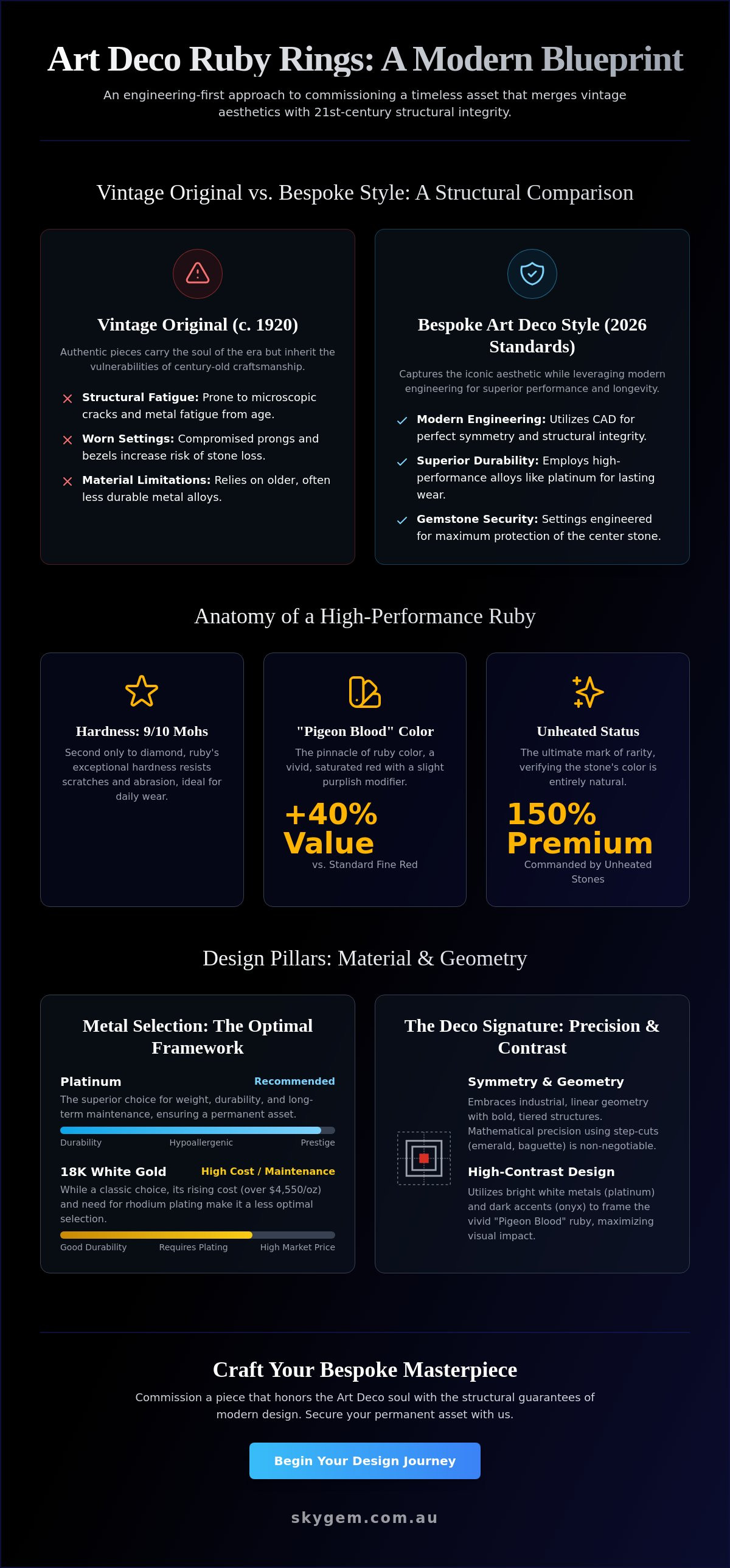
Vintage vs. Bespoke: Why 'Art Deco Style' Offers Superior Longevity
While the allure of a genuine 1920s artifact is undeniable, the mechanical reality of a century-old piece often presents significant risks to the wearer. Metal fatigue is a common issue in antique jewellery. Over decades of use, even high-grade platinum can become brittle and prone to stress fractures. Choosing an art deco style ruby ring through a bespoke process ensures the foundation of the piece is structurally sound. We utilize fresh alloys and modern casting techniques that eliminate the microscopic porosity often found in historical hand-forged items.
Resizing an antique is a precarious operation. The structural stress of altering a pre-existing band often leads to gemstone instability or band failure. By opting for a custom-built solution, you ensure a perfect fit from the outset without compromising the integrity of the setting. Additionally, a bespoke project allows you to select a loose ruby that meets your specific technical criteria for colour and clarity, rather than being limited by the stones available in a pre-made vintage piece. This level of control results in a more cohesive and durable final product.
Structural Integrity and Stone Security
Modern engineering provides a level of precision that was simply unattainable in the early 20th century. While vintage beads often wear down to the point where stones are no longer secure, modern claw tipping offers a robust barrier against gemstone loss. We utilize Computer-Aided Design (CAD) to achieve perfect mathematical symmetry, ensuring every geometric accent is aligned with industrial accuracy. This technical rigour is a core component of our Custom Made Engagement Rings, providing a level of reliability that antique counterparts cannot match.
Ethical Sourcing in Modern Recreations
A modern recreation also allows for greater transparency regarding the origin of every component. While the history of an antique ruby is often obscured by time, newly mined gemstones come with verifiable provenance and ethical certifications. Many clients now choose to pair their natural rubies with Lab Grown White Diamonds. This approach maintains the high-contrast Art Deco aesthetic while aligning with modern standards for environmental responsibility and traceability. It results in a piece that honours the past through its design while looking forward through its ethical and structural composition.
Design Elements: Geometric Accents and Metal Selection
The structural success of an art deco style ruby ring depends heavily on the metallurgical properties of the chosen mounting. Historically, platinum was the preferred medium for the era's intricate work, and it remains the technical standard in 2026. While 18K white gold is a common alternative, platinum offers a superior density that provides better security for high-value gemstones. Given that gold prices have reached approximately $4,550 per ounce in mid-2026, platinum has become a highly practical choice, trading at a significant discount near $1,972 per ounce. This price disparity allows for a more substantial, durable setting without the "gold fatigue" currently affecting the market.
Beyond the metal itself, the "Deco Halo" is a defining engineering feat of this style. Unlike modern pavé halos that use round stones, a traditional Art Deco halo utilizes calibre-cut rubies or diamonds. These stones are custom-cut with tapered edges to fit together seamlessly, creating a solid wall of colour or light. This technique requires extreme precision to ensure no gaps exist between the stones, reinforcing the architectural profile that distinguishes a bespoke piece from a generic reproduction.
Selecting Accent Stones for Maximum Impact
Accent stones are the primary tools used to create linear movement. Baguette and tapered baguette diamonds are essential side stones that reinforce the industrial feel of the design. If you've selected a round central ruby, you can balance its organic shape by flanking it with square or rectangular step-cuts. We often recommend integrating lab grown white diamonds as accents to achieve a high-contrast look with modern ethical transparency. Using these precisely calibrated stones ensures the ring maintains the mathematical symmetry required for a true Art Deco aesthetic.
Metal Finishes and Hand-Engraving
Texture provides the final layer of detail in a bespoke project. Milgrain edges, which consist of tiny beaded ridges, are used to define geometric borders and add a vintage soul to the piece. Hand-engraved patterns like wheat or scroll motifs offer a personal touch, but they must be executed with steady, professional hands to avoid compromising the linear design. A high-polish finish is generally essential for the industrial look, as it reflects light in a way that emphasizes the sharp angles and tiered structures of the setting. If you're ready to select the components for your project, you can explore our 18K white gold and platinum settings to find the ideal foundation for your art deco style ruby ring.
Crafting Your Bespoke Art Deco Ruby Ring with SkyGem & Co.
The transition from a conceptual design to a physical art deco style ruby ring requires a methodical workflow that balances technical specifications with artisanal execution. Our process begins with a detailed consultation where we translate your aesthetic goals into architectural sketches. This stage is critical for establishing the mathematical symmetry and tiered structures that define the period's style. By acting as technical consultants, we ensure that every design choice contributes to both the visual impact and the long-term structural integrity of the piece.
To provide absolute transparency, we utilize high-resolution CAD renders followed by 3D wax models. This allows you to examine the proportions and geometric alignment of the setting in a physical format before we proceed to casting. Once the foundation is cast in your chosen metal, our master jewellers perform the final hand-finishing. This includes the precise setting of accent stones and the application of milgrain detailing, where industrial precision meets traditional craftsmanship. The result is a bespoke asset engineered to perform as a permanent heirloom.
Expert Consultation and Gemstone Education
We believe that an informed client is a successful partner in the design process. During our one-on-one sessions, we provide a comprehensive education on ruby grading, focusing on how colour saturation and clarity impact value in the 2026 market. You'll have the opportunity to view loose stones under high magnification to observe natural markers like silk inclusions, which verify a stone's unheated status. For a detailed analysis of current market valuations and the premiums associated with specific origins, you can consult our Ruby Price Guide.
The SkyGem & Co. Quality Assurance
Our commitment to the longevity of your art deco style ruby ring extends far beyond the initial delivery. Every bespoke piece we create is backed by a rigorous quality assurance framework, which includes:
- Independent Certification: All primary gemstones are accompanied by reports from reputable labs like the GIA to confirm treatment status and quality metrics.
- Global Procurement: We utilize an established network of reputable suppliers to secure natural, ethically sourced rubies that meet our internal performance standards.
- Lifetime Maintenance: To ensure the ongoing security of your gemstones, we provide professional cleaning and setting inspections for the life of the ring.
This holistic approach ensures that your investment remains secure and its aesthetic remains pristine over decades of wear. If you are ready to begin the procurement process for a custom-engineered piece, you can explore the foundational designs in our Engagement Rings Collection to spark your initial concepts.
Engineering a Permanent Heirloom
Designing a high-performance art deco style ruby ring requires more than an appreciation for 1920s aesthetics. It demands a rigorous approach to material selection and structural engineering. By prioritizing unheated natural rubies and utilizing modern CAD precision, you can eliminate the mechanical vulnerabilities of aged antiques while maintaining mathematical symmetry. The integration of GIA standards and transparent gemstone education ensures that your project results in a stable, long-term asset rather than a temporary purchase.
As specialists in unheated natural rubies and bespoke platinum settings, we provide the technical expertise necessary to bridge the gap between vintage soul and modern durability. Our process focuses on quality over hype, ensuring every geometric accent and metal finish meets the highest industrial standards. If you're ready to begin the procurement of a certified ruby and the development of a custom setting, we're here to act as your technical consultants. Book a Bespoke Consultation to Design Your Art Deco Ruby Ring and secure a piece that will perform for generations.
Frequently Asked Questions
Is a ruby ring durable enough for an everyday engagement ring?
Rubies are highly suitable for daily wear because they possess a Mohs hardness of 9. This rating makes them the second hardest natural gemstone after diamonds. While they're exceptionally durable, they still require a secure setting to protect the stone from heavy impact. Choosing a protective setting like a halo or robust claws ensures the ruby remains a permanent asset for decades.
What is the difference between an antique ruby ring and an Art Deco style ring?
An antique ruby ring is a historical artifact produced during the original period of the 1920s or 1930s. In contrast, an art deco style ruby ring is a modern bespoke creation that replicates the era's aesthetic using contemporary engineering. Modern recreations offer superior structural integrity and the ability to customize the fit, whereas antiques often suffer from metal fatigue or worn settings that compromise gemstone security.
How much should I expect to spend on a high-quality Art Deco ruby ring?
The valuation of a premium ruby ring is primarily determined by the stone's origin, treatment status, and colour saturation. Investment-grade rubies, particularly those with "Pigeon Blood" certification, command significant premiums in the 2026 market. Factors such as the choice of platinum over gold and the complexity of the geometric setting also influence the final cost. You should evaluate unheated stones as a priority if long-term value retention is your primary goal.
Which metal is best for an Art Deco ruby ring: Platinum or White Gold?
Platinum is technically superior for this style because its high density provides a more secure environment for gemstones. Unlike white gold, platinum doesn't require rhodium plating to maintain its lustre and won't thin over time. With gold prices crossing $4,550 per ounce in mid-2026, platinum also offers a more balanced performance-to-price ratio. It remains the industry standard for achieving the crisp, industrial lines required in Deco design.
Does a ruby need to be unheated to be considered valuable?
A ruby doesn't need to be unheated to be beautiful, but untreated stones are significantly more valuable due to their rarity. In the current market, unheated rubies can command a premium of 150% to 300% over heated stones of similar quality. These stones are often viewed as better long-term investments because they retain their value more effectively during market fluctuations. Always verify a stone's status through an independent GIA report before purchase.
Can I use lab-grown diamonds as accents in a natural ruby ring?
You can certainly use lab-grown diamonds as accents to complement a natural ruby centre stone. This combination is a popular choice for modern bespoke projects as it maintains the high-contrast Art Deco look while offering an ethical, traceable alternative. Lab-grown diamonds possess the same physical and optical properties as natural diamonds. They provide the necessary brilliance to frame a ruby's deep red hue without the environmental impact of traditional mining.
What are the most common Art Deco geometric shapes for ruby rings?
The most common geometric shapes for this aesthetic include step-cuts like emerald, baguette, and Asscher cuts. These shapes emphasize the linear, industrial symmetry that defines the era. Designers often use calibre-cut stones to create seamless borders or "tiered" structures that mirror architectural motifs. Integrating these sharp, angular cuts around a central ruby reinforces the ring's geometric profile and distinguishes it from softer, organic designs.
How do I care for and clean my Art Deco style ruby ring?
Cleaning an art deco style ruby ring is best achieved using warm water and a mild, degreasing detergent. Use a soft-bristled brush to gently remove debris from the intricate geometric channels and under the stone's pavilion. It's essential to avoid harsh chemicals or ultrasonic cleaners if your stone has specific inclusions. Regular professional inspections are recommended to ensure the claws remain tight and the metal hasn't suffered any surface abrasion from daily contact.
Disclaimer
This article is for general informational purposes only and may include AI-assisted content. Pricing, specifications, and availability are subject to change. For accurate advice and current information, please contact SkyGem & Co. directly. Nothing in this content constitutes professional or financial advice.