
Are There Hidden Costs When Designing a Custom Ring?

Bespoke fine jewellery should never involve financial guesswork, yet clients frequently ask: are there hidden costs when designing a custom ring? The reality is that unexpected expenses rarely stem from the bespoke process itself. Instead, budget creep is almost always the result of ambiguous project scopes, unitemised estimates, and omitted technical specifications that leave essential fabrication stages unaccounted for.
It is completely reasonable to feel apprehensive about surprise charges for 3D CAD modelling, design revisions, intricate gemstone setting, or fluctuating precious metal markets. You shouldn't have to wonder whether essential aftercare, like rhodium plating or structural resizing, will trigger ongoing financial surprises down the track. In this guide, we unpack the transparent truth behind custom manufacturing, providing a rigorous framework to audit every quote before you commit. We will examine what reputable jewellers include as standard, outline the exact technical variables that justify an additional charge, and show you how to collaborate with a bespoke designer with absolute confidence.
Key Takeaways
- Determine the real answer to whether are there hidden costs when designing a custom ring by auditing digital CAD renders, iteration allowances, and setting charges upfront.
- Understand how bespoke manufacturing eliminates retail showroom markups by directing your budget straight into certified gemstone quality and metal mass.
- Evaluate the structural performance and cost-efficiency of platinum versus 18ct gold alloys to prevent unexpected durability issues over time.
- Factor in long-term lifecycle maintenance, such as periodic rhodium plating and claw servicing, before finalising your setting architecture.
- Apply a consultative audit checklist to lock in an itemised, fixed-price manufacturing agreement before bench work begins.
Understanding Bespoke Ring Pricing: Custom Design vs Ready-to-Wear
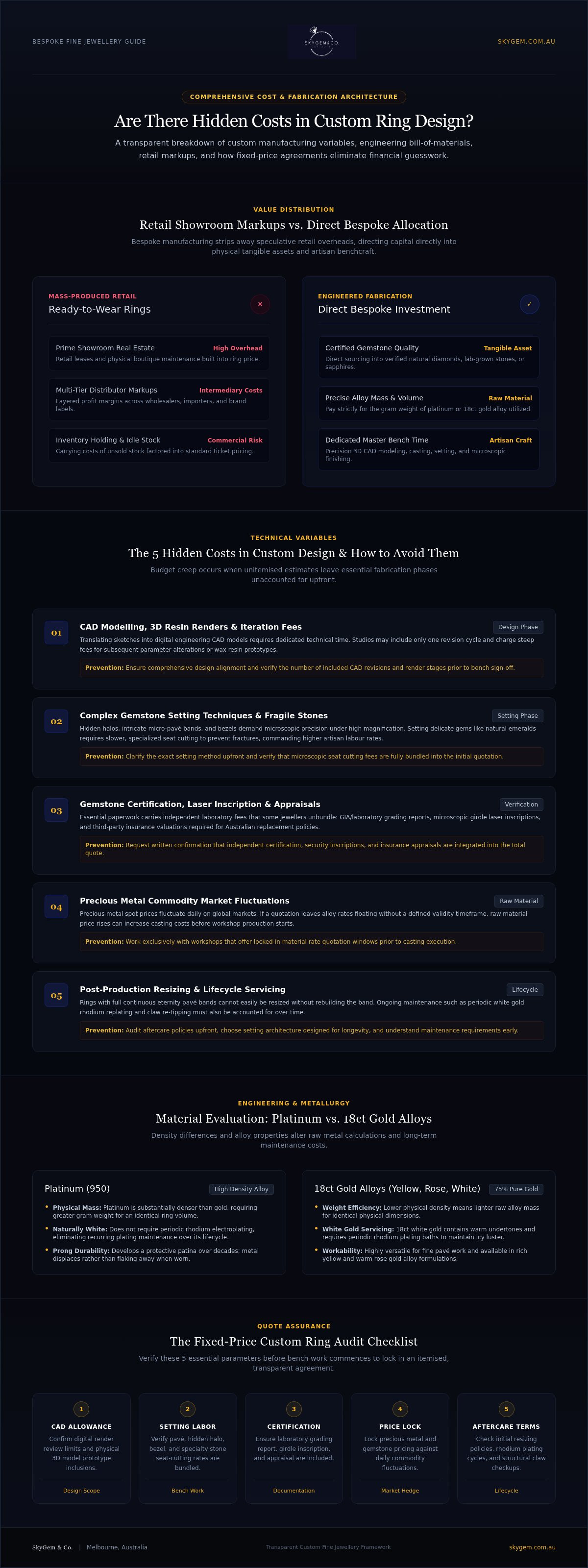
A persistent misconception in luxury retail suggests that commissioning a bespoke piece inevitably costs more than purchasing off the shelf. In reality, mass-produced rings carry substantial hidden commercial overheads, including prime showroom leases, multi-tier distributor markups, and inventory holding costs. When clients ask whether are there hidden costs when designing a custom ring, they are often surprised to learn that tailored manufacturing strips away these speculative markups. Instead of paying for a brand name's retail footprint, your investment funds tangible assets: certified gemstone quality, precise alloy mass, and dedicated bench time.
The Mechanics of a Custom Fine Jewellery Quote
An authentic bespoke quotation functions as a transparent, engineering-style bill of materials. The primary component is your centre stone, whether you select an ethical Australian sapphire, a laboratory-grown diamond, or a certified natural diamond. Direct sourcing bypasses intermediary markups, ensuring capital goes straight into gemological merit. The secondary component is alloy volume, determined by the physical density of the ring architecture. When comparing precious metals, understanding jewelry materials helps explain why dense platinum settings require different raw material calculations than 18ct gold alloys. The remaining component covers specialized bench labour: 3D digital modelling, precision casting, and micro-pavé setting.
Where Unplanned Costs Typically Creep into Early Estimates
Budget creep typically happens when buyers mistake an exploratory ballpark figure for a binding, fixed-price agreement. Early figures are broad approximations. If the initial design brief leaves claw styles, band widths, or structural tolerances vague, subsequent revisions will alter the manufacturing scope. Precious metal spot prices also fluctuate daily on international commodity markets. Reputable bespoke jewellers lock in material rates for an agreed quotation window, protecting your investment from market volatility before the casting phase begins.
The 5 Hidden Costs in Custom Ring Design and How to Avoid Them
Commissioning bespoke jewellery should be an inspiring technical journey. Yet unexpected surcharges often surprise buyers when initial workshop agreements lack precision. If you are assessing whether are there hidden costs when designing a custom ring, five distinct manufacturing variables typically trigger unquoted expenses: iterative digital redesigns, physical prototyping fees, intricate micro-setting labour, documentation surcharges, and post-production modifications. Understanding these pressure points helps protect your engagement ring budget from compounding fees.
CAD Modelling, 3D Resin Renders, and Revision Fees
Translating an initial sketch into a precise computer-aided design (CAD) model requires dedicated engineering time. Some studios include only one review cycle, charging steep add-on fees for subsequent parameter changes or physical 3D wax resin prototypes. At SkyGem & Co., digital renders and comprehensive consultations align structural parameters before casting, eliminating unquoted model adjustments.
Complex Gemstone Setting Techniques and Accent Stones
Setting styles directly influence bench time. While classic claw mounts follow straightforward labor metrics, hidden halos, intricate pavé bands, and bezel settings demand microscopic precision under high magnification. Furthermore, incorporating delicate stones like natural emeralds requires specialized, slower seat cutting to prevent fracture risks, which carries a higher artisan labour rate than setting durable sapphires or diamonds.
Stone Certification, Independent Appraisals, and Inscription Charges
Gemological paperwork carries independent laboratory fees that some jewellers exclude from entry-level quotes. These common administrative add-ons include:
- Laboratory reports: Independent grading verification from institutions like the GIA for natural stones.
- Microscopic laser inscription: Etching certificate registry numbers onto the stone's girdle for security.
- Insurance appraisals: Detailed third-party valuations required by Australian insurers for retail replacement coverage.
Always verify that all documentation and appraisal fees are absorbed into your fixed quotation before approving bench work. Exploring options through an online ringbuilder for natural white diamonds allows you to review certified specifications and structural details upfront with complete pricing transparency.
Evaluating Materials: How Stone and Metal Choices Prevent Budget Surprises
Selecting suitable raw materials represents the most influential phase of bespoke ring fabrication. Many clients ask whether are there hidden costs when designing a custom ring, assuming that labour constitutes the bulk of financial ambiguity. In practice, miscalculating physical alloy volumes or misallocating stone expenditure causes far more budget volatility. A systematic understanding of raw material physics ensures that every dollar contributes directly to daily durability and visual brilliance.
Precious Metal Dynamics: Alloy Weight, Density, and Finger Sizing
Precious metals exhibit starkly different specific gravities. Platinum possesses a significantly higher density than 18ct gold, meaning an identical band cast in platinum requires approximately 30% to 50% more raw physical weight than its gold counterpart. Band width and finger diameter compound this equation: expanding an intricate shank to a larger finger size demands surplus alloy volume, directly adjusting the base metal casting cost.
Balancing Diamond Specifications Without Compromising Brilliance
Centre stones generally command between 50% and 75% of a custom ring's total allocation. Achieving optimal aesthetic value requires prioritising cut quality over microscopic clarity traits invisible to the unaided eye. Modern clients exploring how to create a custom diamond engagement ring often leverage the distinct pricing dynamics between natural and synthetic gems.
- Certified laboratory-grown diamonds: Opting for modern lab-grown diamonds allows you to secure larger carat weights and near-flawless colour grades while preserving significant capital for complex setting architecture.
- GIA-certified natural diamonds: Allocating capital toward natural stones offers traditional prestige and enduring organic provenance, backed by international gemological certification.
- Australian sapphires: Sourcing ethically mined teal, blue, or peach sapphires introduces vibrant hue saturation and high Mohs mineral hardness without traditional diamond premiums.
Exploring diverse gemological cuts through dedicated resources, such as a curated guide to oval cut natural diamonds, ensures you match stone geometry to your target setting profile while completely avoiding mid-production adjustments.
Long-Term Ownership: Maintenance and Structural Durability Factors
Bespoke fine jewellery represents a permanent asset, yet discussions around fabrication expenses frequently neglect post-purchase ownership. When buyers ask whether are there hidden costs when designing a custom ring, they are often surprised to discover that long-term care routines create recurring maintenance requirements. Evaluating alloy longevity and mechanical tolerances during the initial consultation ensures that your ring remains structurally sound without unexpected servicing demands.
Rhodium Re-Plating, Polishing, and Ultrasonic Cleaning
White gold alloys naturally possess a faint warm hue, requiring an electroplated layer of rhodium to achieve an icy white finish. Daily friction wears this surface layer away, demanding periodic rhodium re-immersion every twelve to twenty-four months. Choosing naturally white 950 platinum or unplated 18ct yellow or rose gold eliminates this ongoing refinishing requirement. Routine ultrasonic cleans and annual claw inspections should also be integrated into your ownership schedule, ensuring that subtle claw movement is detected before a gemstone loosens.
Resizing Complexities in Bespoke Bands
Finger sizes naturally fluctuate over time due to seasonal temperatures and lifestyle changes. How a ring responds to adjustment depends heavily on its baseline architecture:
- Plain solid shanks: Solitaire rings with clean lower bands allow straightforward resizing, enabling a jeweller to compress or expand the metal with minimal bench disruption.
- Eternity micro-pavé profiles: Continuous pavé settings leave no blank metal segment, making significant size adjustments mechanically impossible without unseating accent stones.
- Multi-stone shoulders: Altering bands with channel or claw-set shoulders risks distorting stone seats, necessitating comprehensive claw rebuilding after sizing.
Addressing lifestyle factors, precise band profiles, and thermal knuckle variations during initial design prevents complex post-delivery alterations. Reviewing comprehensive options across engagement rings demonstrates how robust bench design preserves lifelong structural stability.
The Transparent Custom Ring Roadmap: Securing a Fixed-Price Guarantee
Navigating fine jewellery fabrication requires clarity from the opening design sketch. If you find yourself asking whether are there hidden costs when designing a custom ring, the most effective safeguard is an upfront audit checklist. Rather than relying on open-ended creative agreements, approaching your project as an engineering collaboration ensures every bench milestone, material specification, and finishing stage remains completely accounted for before financial commitments take effect.
Essential Questions to Expose Hidden Fees Before Depositing
To eliminate post-deposit surprises, present your manufacturing jeweller with specific operational questions:
- Design revisions: Does your custom quote incorporate unlimited initial CAD modifications, or do digital adjustments trigger separate design fees?
- Physical prototyping: Is a high-resolution 3D resin or wax model included for physical proportion verification prior to precious metal casting?
- Complimentary servicing: Does the final invoice include an initial complimentary resize, or will minor adjustments require additional bench labour?
- Certification documentation: Are complete laboratory dossiers, such as GIA reports, valuations, and presentation timber boxes, fully absorbed into the baseline fee?
Demanding itemised answers in writing guarantees that potential discrepancies are resolved before raw precious metals are ordered.
How SkyGem & Co. Guarantees Cost Transparency
Transparent bespoke jewellers treat quoting as a binding technical contract. SkyGem & Co. operates through a consultative workflow that pairs clients directly with fine jewellery specialists across Australia. By maintaining complete clarity over metal mass, bench time, and certified gemstone procurement, the process systematically eliminates unforeseen financial additions. Every design proceeds through rigorous CAD modelling and client approval phases, ensuring the ring you review digitally matches the completed piece precisely.
Whether you are designing classic solitaire engagement rings, elaborate trilogy settings, or exploring tailored custom made engagement rings, locking down your manufacturing brief upfront ensures complete financial confidence throughout the entire bespoke journey.
Take Full Control of Your Bespoke Fine Jewellery Journey
Commissioning a custom ring should be an exciting milestone, not an exercise in navigating budget creep. While many clients wonder whether are there hidden costs when designing a custom ring, unexpected expenses disappear when you work from an itemised, fixed-scope manufacturing specification. Auditing digital CAD iteration policies, understanding alloy densities, and establishing baseline documentation requirements upfront ensures that every dollar serves structural integrity and gemological quality.
Collaborating with a dedicated fine jewellery specialist allows you to balance certified stone options, from GIA-graded natural diamonds and ethical Australian sapphires to high-grade lab-grown diamonds, with long-term bench durability. Clear manufacturing milestones eliminate the uncertainty, leaving you free to focus entirely on bringing your design vision to life.
With precise CAD modelling, transparent alloy assessments, and fixed-price craftsmanship, designing your bespoke ring can be completely seamless from initial concept to completed piece.
Frequently Asked Questions
Does designing a custom engagement ring cost more than buying an off-the-shelf ring?
Designing a custom ring does not inherently cost more than purchasing a mass-produced retail piece. Ready-to-wear rings carry substantial commercial overheads, including retail display margins and intermediate distribution fees. When considering whether are there hidden costs when designing a custom ring, remember that bespoke manufacturing directs your expenditure strictly into raw alloy mass, certified gemstone quality, and dedicated artisan bench time rather than brand markups.
Will I be charged extra if I want to adjust the 3D CAD design during the process?
Extra charges depend on the design terms agreed upon before modelling begins. Reputable fine jewellery studios generally integrate initial technical modifications into their standard bespoke design consultation. However, studios that lack clear scopes may assess additional digital modelling fees if you request foundational structural alterations after approving the primary design parameters.
Is resizing included in the initial cost of a custom-designed ring?
An initial complimentary resizing is standard practice among established bespoke jewellers, provided the ring profile allows adjustment. Simple solid metal shanks can be adjusted quickly. Conversely, intricate eternity-style diamond micro-pavé bands cannot be expanded or contracted easily and may require remaking the entire mount if measurements prove inaccurate at the consultation stage.
What ongoing maintenance costs should I expect with a custom white gold ring?
Custom white gold settings require regular servicing to maintain their structural integrity and mirror finish. Daily friction gradually abrades the outer surface, necessitating periodic rhodium re-plating every twelve to twenty-four months. Annual claw inspections, ultrasonic cleaning, and periodic stone tightening represent essential long-term investments to prevent unexpected gemstone loss.
Can I provide my own heirloom gemstone or diamond to lower the custom design cost?
Supplying an heirloom gemstone significantly lowers your overall project budget by eliminating the single largest raw material expense. Custom jewellers regularly design new, bespoke mountings around existing family stones. The final investment covers only the raw metal casting, 3D computer modelling, and the specialised bench labour required to seat the stone safely.
Why do finger sizes impact the final price quote of a custom platinum ring?
Finger circumference dictates the raw volume of precious metal required to cast the ring. Platinum is an exceptionally dense precious metal, possessing far greater specific gravity than 18ct gold alloys. Designing for a larger finger size demands surplus metal mass to maintain adequate structural thickness, directly increasing raw material requirements during casting.
Are gemstone certification and insurance appraisal documentation billed separately?
Documentation terms vary across jewellery workshops. While some retailers treat independent GIA reports, laser inscription registries, and insurance appraisal paperwork as unquoted add-ons, transparent specialists absorb these essential documents directly into the binding custom quotation. Always confirm whether certification paperwork is fully bundled before transferring a project deposit.
Disclaimer
This article is for general informational purposes only and may include AI-assisted content. Pricing, specifications, and availability are subject to change. For accurate advice and current information, please contact SkyGem & Co. directly. Nothing in this content constitutes professional or financial advice.