
Are Lab Diamonds a Good Investment? A Technical and Financial Analysis for 2026

The most prudent financial decision in the jewellery market often contradicts traditional wisdom. You might feel a sense of hesitation when asking are lab diamonds a good investment, especially with conflicting marketing claims and the fear of total value loss. It's understandable to worry that a purchase today could be worth significantly less tomorrow. We recognize that for many, the anxiety surrounding the resale potential of lab-grown stones is a genuine barrier to a confident purchase.
This analysis provides the objective truth about lab-grown diamond value by examining technical performance metrics and the current 2026 financial landscape. You'll discover how to calculate your real return on investment by considering the opportunity cost of your capital. We'll compare the $1,000 entry point of a high-quality lab-grown stone against the $4,200 required for a natural equivalent, moving beyond retail hype to focus on long-term viability. This report explores price stabilization trends, resale realities, and why a lab-grown choice can be a superior lifestyle asset when managed with professional foresight.
Key Takeaways
- Distinguish between financial commodities and lifestyle assets to understand the true utility value of your jewellery purchase.
- Review candid resale data for 2026 to see how are lab diamonds a good investment when compared to the traditional natural stone market.
- Discover how to calculate the opportunity cost of your purchase and how the initial price difference can be leveraged for better long-term returns.
- Examine technical specifications that debunk common myths regarding the permanence and optical stability of lab-grown carbon structures.
- Use our "Smart Buyer" framework to balance your aesthetic desires with a practical approach to capital preservation.
Defining the Diamond Investment: Financial Asset vs. Lifestyle Asset
To evaluate whether are lab diamonds a good investment, we must first clarify what constitutes an investment in the 2026 financial landscape. Most consumers conflate commodity investments with lifestyle assets. A commodity, such as gold bullion or raw industrial materials, is typically bought at spot price with the expectation of liquidation for profit. Luxury jewellery, whether it features a natural stone or a lab diamond, functions as a lifestyle asset. Its primary value is derived from its daily utility and the aesthetic satisfaction it provides over decades of wear. Understanding this distinction is the first step in deciding if are lab diamonds a good investment for your specific circumstances.
The common "store of value" argument often ignores the reality of retail markups. When you purchase a finished piece of jewellery, you're paying for design, precision setting, and the retailer's operational costs. This is true for both natural and lab-grown stones. While natural diamonds have a longer history of price tracking, they aren't a liquid asset for the average buyer. By shifting the perspective from speculative gain to utility value, we can better assess the technical and financial merits of each choice. The market in 2026 has stabilised, allowing for a more methodical comparison of these assets based on performance rather than hype.
The Retail-to-Wholesale Value Gap
Every diamond purchased at a retail level experiences an immediate adjustment in valuation once the transaction is complete. This isn't unique to lab diamonds; it's a standard market mechanic. Initial prices include regional taxes like GST, along with significant boutique overheads. These costs are generally non-recoverable upon resale. Unless you're acquiring a GIA-certified stone of exceptional rarity, typically 5 carats or larger, the asset is unlikely to appreciate in a way that offsets these initial expenses. For most buyers, the true value is found in the durability and performance of the stone rather than its potential for future resale.
Jewellery as a Multi-Generational Asset
We view a bespoke engagement ring as an heirloom investment. The value here is found in longevity and technical craftsmanship. Modern Synthetic diamond production methods have reached a level of precision where the chemical and optical properties are identical to mined stones. This ensures the piece remains a permanent asset that can be passed down through generations. Today's buyers increasingly value this technical precision and the ethical transparency of the supply chain. The emotional ROI of a perfectly designed custom-made engagement ring often outweighs the speculative financial gains that rarely materialise for retail consumers.
The Resale Reality: Lab-Grown vs. Natural Diamonds
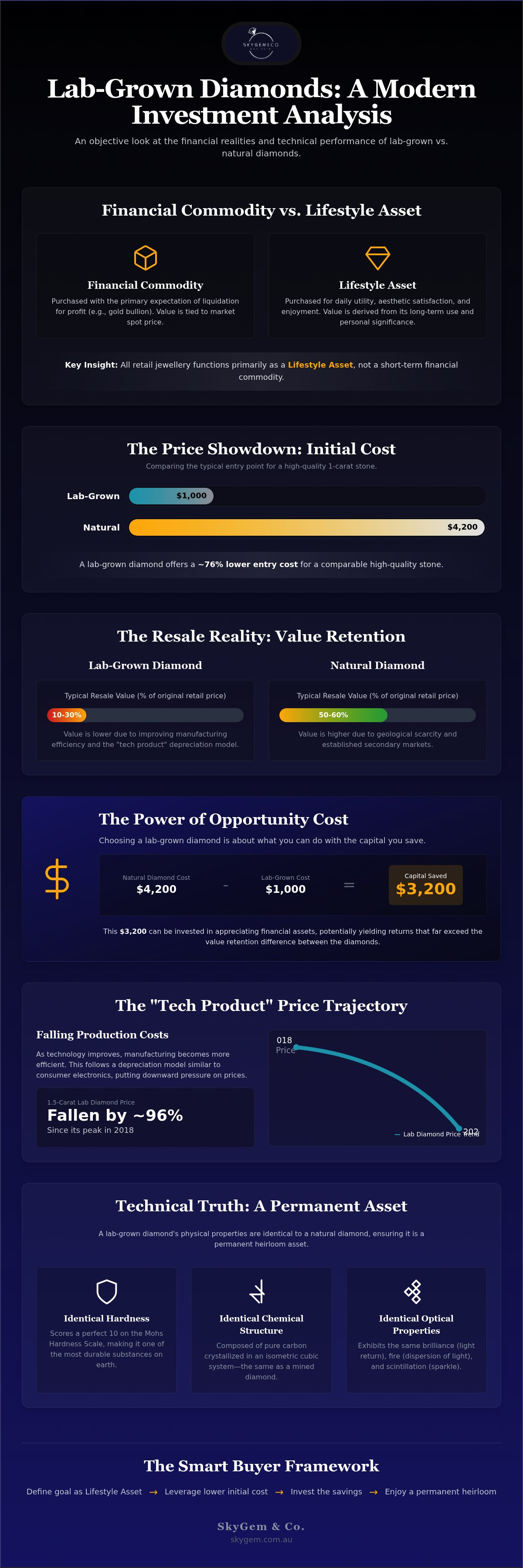
When assessing whether are lab diamonds a good investment, the secondary market provides the most transparent answer. Unlike natural stones, which have established liquidation channels through specialized dealers and auction houses, the secondary market for lab-grown diamonds is still in a developmental phase. A 2-carat lab-grown diamond currently retails between $2,500 and $4,500, but its resale value typically ranges from 10% to 30% of that original price. In contrast, a 2-carat natural stone costing $15,000 or more generally retains 50% to 60% of its retail value. This discrepancy exists because natural diamonds are valued for their geological scarcity, while lab stones are priced based on manufacturing efficiency.
The claim that lab-grown diamonds are "worthless" on the secondary market is technically inaccurate, but their value retention is undeniably lower. This is largely due to the "tech product" depreciation model. As GIA research on lab-grown diamonds indicates, production costs have plummeted as technology improves. For example, the price of a 1.5-carat lab-grown diamond has fallen by approximately 96% from its peak in 2018. This downward pressure on new retail prices inevitably pulls down the value of stones already in circulation. If you're prioritizing capital preservation above all else, exploring our collection of lab-grown white diamonds allows you to see how these price points function in a real-world context before committing.
Liquidity and the Secondary Market
Liquidity for lab-grown stones remains a challenge. Most traditional jewellers hesitate to buy back lab diamonds because they can often source a new, identical stone from a wholesaler for less than the cost of a used one. Sellers often find more success through private peer-to-peer sales or specialized online platforms. Trust in these transactions is maintained through standardized certification. Just as with natural stones, GIA and IGI reports are essential for verifying the technical specifications and origin of the diamond, ensuring a baseline level of confidence for any potential buyer.
Price Trends and Market Maturity in 2026
The market in 2026 shows signs of significant maturation. While natural diamonds have faced their own price fluctuations due to global economic shifts, the price floor for lab diamonds has finally begun to stabilize. We no longer see the double-digit percentage drops that characterized the early 2020s. Market equilibrium for lab-grown diamonds is the point where manufacturing efficiencies and global supply reach a steady state, effectively halting the aggressive price depreciation seen in previous years. This stability allows buyers to make a more predictable financial assessment of their purchase.
The Opportunity Cost: Investing the Price Difference
Financial analysis often focuses solely on the asset's liquidation value, yet this narrow view overlooks the most significant factor in any high-value acquisition: opportunity cost. When evaluating if are lab diamonds a good investment, one must consider the capital preservation achieved through a lower initial outlay. In early 2026, a 1.5-carat natural diamond typically commands a price point four to five times higher than its lab-grown counterpart of equivalent technical specifications. This price delta represents liquid capital that remains in the purchaser's control rather than being locked into a depreciating retail asset.
Choosing a lab-grown stone facilitates a strategy of strategic spending. It allows for the experience of debt-free luxury, where the psychological benefit of owning a premium piece is not dampened by high-interest financing or the depletion of emergency reserves. When clients ask are lab diamonds a good investment, the answer frequently lies in how they utilize the thousands of dollars saved at the point of purchase. By viewing the diamond as a lifestyle choice and the savings as a financial tool, a buyer can achieve a more balanced and resilient personal balance sheet.
The "Jewellery + Portfolio" Strategy
Consider a hypothetical scenario where the $12,000 price difference between a high-quality natural stone and a lab-grown alternative is diverted into a diversified index fund. Assuming a conservative 7% annual return, that $12,000 would grow to approximately $23,600 over a ten-year period. Conversely, a natural diamond purchased for $15,000 might retain 50% of its value, resulting in a resale figure of $7,500. The lab-grown path, combined with disciplined reinvestment, results in a significantly higher net worth. This approach transforms a traditional purchase into a proactive wealth-building exercise.
Allocating Budget to Craftsmanship
A portion of the savings can be strategically reinvested into the technical integrity of the piece itself. We often recommend allocating funds toward a superior bespoke engagement ring setting. While the stone's market value may fluctuate, high-quality platinum or 18K gold maintains a consistent "scrap value" based on global metal spot prices. Investing in hand-finished details and reinforced structural design ensures the piece's long-term durability, reducing maintenance costs over the decades and preserving the heirloom's physical condition for future generations.
Technical Longevity: Is a Lab Diamond a "Permanent" Asset?
A technical assessment of any asset must include its physical degradation over time. When questioning are lab diamonds a good investment, the technical durability of the material is a critical metric. A lab-grown diamond is not a stimulant or a look-alike; it is a crystal consisting of a pure carbon lattice. Whether produced through High Pressure High Temperature (HPHT) or Chemical Vapour Deposition (CVD), the resulting stone possesses the exact chemical, physical, and optical identity of a mined diamond. This means the crystal structure is entirely stable. It will not fade, cloud, or change colour over centuries of use, ensuring the asset remains physically identical to the day it was purchased.
Durability is where the lab diamond outperforms other alternatives in the "longevity investment" category. On the Mohs Scale of Mineral Hardness, a diamond is a 10, the highest rating possible. This makes it significantly more resilient than a sapphire, which sits at 9, or moissanite at 9.25. While other gems may develop a "frosted" appearance due to surface scratches over decades of daily wear, a lab diamond maintains its sharp facet edges and internal brilliance. This technical permanence is why we view the stone as a reliable component of a multi-generational heirloom. If you're ready to select a stone that matches this level of technical precision, you can browse our lab-grown diamond database to find a GIA-certified asset for your project.
Maintenance and Wearability
Because the physical properties are identical, lab diamonds require the same professional care as natural stones. Periodic ultrasonic cleaning and prong inspections are necessary to maintain the technical integrity of the piece. We often discuss the "Investment in Appearance" with our clients. Because you can acquire a larger stone with higher clarity for a fraction of the cost of a mined diamond, the daily ROI in terms of aesthetic impact is significantly higher. Choosing lab grown white diamonds for daily luxury allows you to wear a high-performance asset without the liability concerns associated with five-figure mined stones.
Ethical and Social Capital
We're seeing a shift toward "Reputational Investment" in the luxury sector. The value of a gem is increasingly tied to its ethical transparency and conflict-free origin. As Millennial and Gen Z buyers become the primary stakeholders in the jewellery market, their preference for traceable, sustainable production methods provides a form of social capital that protects the future demand for lab stones. This "Green Premium" suggests that the investment case for eco-friendly luxury isn't just about current price points, but about the long-term viability of the asset in a more conscious global economy.
Conclusion: How to Make a Smart Diamond Purchase
The objective analysis of the 2026 market indicates that the question of are lab diamonds a good investment depends entirely on your definition of return. If you seek a liquid asset for speculative trading, neither retail natural diamonds nor lab-grown stones are ideal. However, if your goal is to maximize the visual impact of your jewellery while preserving capital for other financial objectives, the lab-grown path is technically and economically superior. A smart buyer focuses on the technical precision of the stone they love rather than a hypothetical resale value they may never utilize. We recommend following a structured framework before finalizing your acquisition.
Our "Smart Buyer" checklist prioritises technical verification and financial foresight. First, ensure the stone meets your specific aesthetic requirements for colour and clarity. Second, insist on GIA certification to confirm the stone's pedigree and optical performance. Third, evaluate the opportunity cost of the purchase by comparing the retail price against alternative investment vehicles. By adopting this methodical approach, you can confirm if are lab diamonds a good investment for your unique financial landscape. This balanced strategy involves selecting a high-performance lab stone for its optical identity and redirecting the substantial savings into a diversified portfolio, ensuring your luxury purchase doesn't compromise your long-term net worth.
Regardless of your final choice, the technical integrity of the piece remains paramount. GIA certification serves as the industry's technical baseline, providing an authoritative record of a diamond's physical properties. This documentation is essential for insurance purposes and future verification. While the financial metrics provide a logical foundation, a diamond's greatest return on investment is found in the enduring meaning it brings to your partnership. This symbolic value, combined with the technical permanence of the carbon lattice, makes the purchase a significant and lasting asset in any family's history.
The SkyGem & Co. Consultation Advantage
Our expert consultants act as technical partners to help you navigate the engagement rings selection process with precision. We maintain a commitment to total transparency, providing detailed performance data for both natural white diamonds and lab-grown alternatives. This dual-track expertise allows us to provide a solution-oriented perspective tailored to your specific financial and aesthetic requirements. We focus on the intersection of technical precision and personal significance, ensuring every project meets the highest standards of craftsmanship. We invite you to book a consultation to find your perfect balance of value and beauty, ensuring your choice is grounded in both technical excellence and practical wisdom.
Securing Value Through Technical Precision
Strategic diamond acquisition in 2026 requires a move away from speculative resale expectations toward a model of capital preservation. We've established that while lab-grown stones don't function as traditional financial commodities, they excel as high-performance lifestyle assets. The technical permanence of the carbon structure ensures your piece remains an heirloom for centuries. When determining are lab diamonds a good investment, the most significant factor is your ability to reinvest the substantial upfront savings into higher-yielding assets.
At SkyGem & Co., we prioritise your long-term satisfaction through a transparent pricing model and bespoke design expertise. We only offer GIA and IGI certified stones to guarantee that every diamond meets rigorous performance standards. This technical consulting approach ensures you don't have to choose between aesthetic excellence and financial prudence. You can confidently select a stone that embodies both your personal values and your commitment to smart asset management. Explore our curated collection of Lab-Grown Diamonds to find the perfect balance for your project. We're here to help you design a piece that represents a meaningful and stable investment in your future together.
Frequently Asked Questions
Do lab-grown diamonds have any resale value at all?
Yes, lab-grown diamonds currently retain between 10% and 30% of their original retail price on the secondary market. While this is lower than the 50% to 60% typically seen with GIA-certified natural stones, a market for pre-owned lab diamonds does exist. Liquidity is generally found through private peer-to-peer sales or specialized online platforms rather than traditional boutique buy-back programmes.
Is a natural diamond a better hedge against inflation than a lab diamond?
Natural diamonds serve as a more effective hedge against inflation due to their finite geological supply and historical price stability. Lab diamonds are priced based on industrial production efficiency, which doesn't track with inflation in the same way as scarce natural resources. However, both assets require a long-term holding period to overcome the initial retail-to-wholesale price gap.
Will lab diamond prices continue to drop in 2026?
Market data for 2026 suggests that lab diamond prices have finally reached a point of stabilisation. While the cost of a 1.5-carat stone fell by approximately 96% from its 2018 peak, the current market has entered a period of equilibrium. We expect prices to remain relatively steady now that manufacturing processes and global supply chains have matured.
Can a jeweller tell the difference between a lab and a natural diamond?
A jeweller cannot distinguish between the two using traditional tools like a loupe or a standard thermal diamond tester. Because the chemical and optical properties are identical, only specialized laboratory equipment can detect the minute growth patterns that separate them. This is why independent certification from the GIA or IGI is essential for any professional technical assessment.
Why do people say lab diamonds are a bad investment?
The argument that lab diamonds are a poor investment is based on their high depreciation and lack of scarcity. When consumers ask are lab diamonds a good investment, they are often looking for an asset that appreciates. Because lab stones are manufactured tech products rather than rare minerals, they don't offer the same capital appreciation potential as traditional financial assets.
Should I buy a smaller natural diamond or a larger lab diamond for better value?
The answer depends on whether you prioritise capital preservation or aesthetic utility. A smaller natural diamond holds its value better over time, making it a more conservative financial choice. Conversely, a larger lab diamond offers superior "lifestyle value," allowing you to secure a high-clarity 2-carat or 3-carat stone for a fraction of the cost of a mined equivalent.
Does GIA certify lab-grown diamonds for investment purposes?
GIA provides technical grading reports for lab-grown diamonds to ensure transparency, but they don't certify any stone specifically for investment purposes. A GIA report verifies the stone's 4Cs and confirms its lab-grown origin. This documentation is vital for insurance and technical verification, providing confidence in the stone's physical specifications regardless of its intended use.
What is the "opportunity cost" of buying a natural diamond?
The opportunity cost is the potential profit you forfeit by spending $15,000 on a natural stone instead of $3,000 on a lab-grown alternative. When evaluating are lab diamonds a good investment, you must consider the compound interest the $12,000 difference could earn in a diversified portfolio. Over ten years, that saved capital often grows to exceed the natural diamond's total resale value.
Disclaimer
This article is for general informational purposes only and may include AI-assisted content. Pricing, specifications, and availability are subject to change. For accurate advice and current information, please contact SkyGem & Co. directly. Nothing in this content constitutes professional or financial advice.