
Are GIA Certified Diamonds Worth It? 2026 Buyer's Guide

A diamond grading certificate isn't an arbitrary retail markup; it's your primary defence against systemic grading inflation. When budgeting for a bespoke ring or fine jewellery investment, you might reasonably wonder: are gia certified diamonds worth it, or does the prestigious dossier merely add unnecessary expense to the bottom line? It's easy to understand why buyers feel cautious, especially when alternative gemmological laboratories advertise identical colour and clarity grades for noticeably less money.
In this guide, you'll discover how a rigorous Gemological Institute of America report acts as essential price protection rather than an overhead cost. We outline the technical differences between competing laboratory standards, examine how strict grading affects insurance and resale valuations, and equip you with a reliable framework to verify that your loose stone matches its laser-inscribed dossier without ambiguity.
Key Takeaways
- Discover why an impartial GIA dossier establishes true baseline metrics, protecting your fine jewellery investment from lenient commercial grading standards.
- Evaluate whether are gia certified diamonds worth it for your commission, balancing rigorous laboratory scrutiny against long-term valuation security.
- Understand the measurable grading variances between GIA and alternative institutions, and how these tolerances directly affect insurance replacements.
- Identify which pieces require individual stone certification and where uncertified accent stones offer practical efficiency without compromising structural integrity.
- Master a reliable verification protocol to cross-reference micro-laser inscriptions and physical proportions against official laboratory registries before fabrication begins.
What Does GIA Certification Actually Mean for a Diamond?
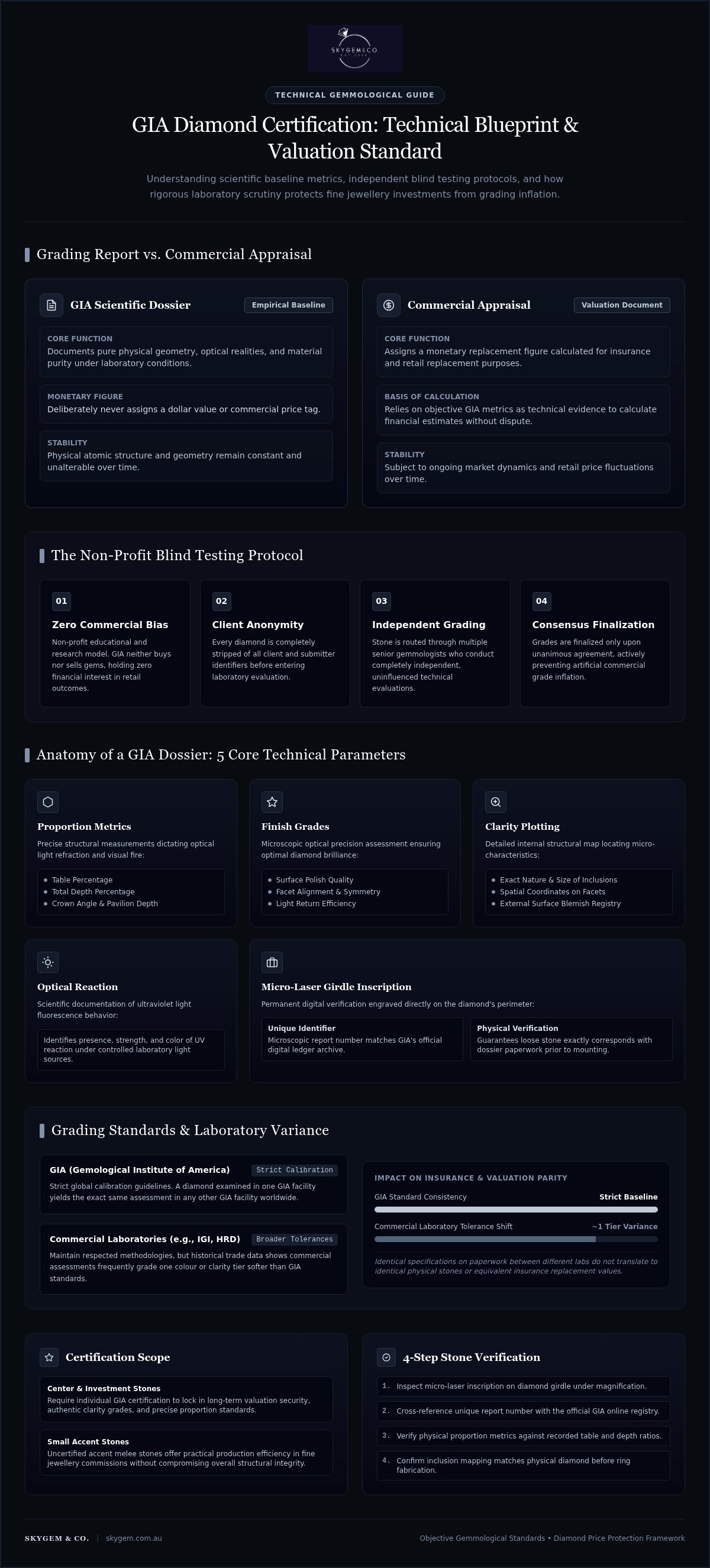
A GIA certificate is not an endorsement or an advertising pamphlet. It functions as an empirical, scientific blueprint that documents the physical and optical realities of an individual stone. To determine whether are gia certified diamonds worth it, you must first understand the structural integrity behind the laboratory's findings. Rather than offering subjective marketing claims, the document records repeatable gemmological data gathered under strictly controlled laboratory conditions.
The Non-Profit Grading Standard and Impartiality
Unlike commercial operations, the Gemological Institute of America (GIA) operates as an independent, non-profit educational and research institution. Because the organization neither buys nor sells gems, it maintains zero financial interest in the retail outcome of any diamond submitted for evaluation.
To eliminate personal bias, the laboratory implements a rigorous blind testing protocol. Every stone is stripped of client identifiers and routed through multiple senior gemmologists who conduct completely independent evaluations. A grade is finalized only when these separate evaluations reach consensus. This methodical checks-and-balances framework actively prevents the artificial grade inflation frequently observed in profit-driven commercial laboratories.
Anatomy of a GIA Diamond Dossier and Grading Report
A comprehensive GIA report presents a thorough structural audit across multiple technical parameters:
- Proportion Metrics: Precise measurements of table percentage, depth percentage, crown angle, and pavilion depth, which dictate light refraction and visual fire.
- Finish Grades: Microscopic assessment of surface polish and facet symmetry to ensure optimal brilliance.
- Clarity Plotting: A detailed graphic map recording the exact nature, size, and spatial coordinates of internal inclusions and surface blemishes.
- Optical Reaction: Scientific notation of ultraviolet fluorescence and its visual characteristics.
- Girdle Inscription: A microscopic, laser-engraved unique report number on the stone's girdle, matching the digital ledger archive.
When curating fine jewellery or sourcing loose natural diamonds, verifying this microscopic inscription against the official digital registry guarantees that the physical gem precisely matches its technical documentation.
The Distinction Between a Grading Report and an Appraisal
Many consumers confuse gemmological certificates with commercial insurance appraisals. A GIA dossier documents pure physical geometry and material purity; it deliberately never assigns a dollar figure. Conversely, a retail appraisal assigns a monetary replacement valuation based on current market dynamics. Because market prices fluctuate while physical atomic structures do not, objective GIA metrics provide the indispensable technical foundation that allows independent valuers to calculate accurate replacement figures without dispute.
GIA vs Other Gemmological Laboratories: Is There a Measurable Difference?
The global jewellery trade relies on grading reports to establish parity across transactions, yet grading criteria vary noticeably between institutions. While many labs utilise the 4Cs framework, their tolerances for minor inclusions or subtle body colour differ. This variance directly impacts whether are gia certified diamonds worth it when evaluating two stones that share identical paperwork specifications on surface inspection.
Evaluating Strictness Across Major International Laboratories
Laboratories operate under distinct protocols. Established as an independent, nonprofit organization, GIA enforces strict calibration guidelines across its global footprint, ensuring a stone examined in one facility yields the same assessment in another. Commercial entities such as the International Gemological Institute (IGI) and Hoge Raad voor Diamant (HRD) maintain respected grading methodologies, though historical market data shows they often apply slightly broader tolerances. For instance, commercial assessments frequently grade one colour or clarity tier softer than GIA standards. Trade professionals recognize this baseline consistency, which is why wholesale diamond pricing globally benchmarks against GIA dossiers.
The Financial Danger of the Paper Discount Illusion
Lenient certification creates the illusion of value by presenting a stone with higher tier metrics on paper than its physical reality warrants. Consider a stone issued an F colour and VS2 clarity report by a lenient lab: under GIA testing conditions, that identical gem often registers as an H colour and SI1 clarity. The apparent bargain disappears instantly. You end up paying a premium rate for lower actual performance. When asking are gia certified diamonds worth it, this structural protection against grade inflation represents genuine financial security.
- Colour Inflation: A stone appearing colourless on commercial paperwork may show warm undertones under controlled master-stone lighting.
- Clarity Overstatement: Borderline inclusions that compromise durability can be masked by generous clarity grading bands.
- True Per-Carat Expense: Discounted non-GIA diamonds often cost significantly more per actual quality tier than properly graded counterparts.
Natural vs Lab-Grown Diamond Grading Conventions
Sourcing strategies depend heavily on diamond origin. For buyers exploring natural diamonds, GIA reports provide the highest market standard, strictly preserving secondary market liquidity and replacement accuracy. In contrast, those opting for modern lab-grown diamonds frequently rely on IGI documentation. IGI established an early technical footprint in certifying synthetic stones with detailed 4Cs grading, providing comprehensive optical specifications for lab-created gems. If you want assistance reviewing laboratory documents against unmounted stones, you can book an expert consultation to evaluate specifications with full technical clarity.
The Price Premium: Why GIA Diamonds Cost More and What You Pay For
When comparing identical specifications on retail listings, stones carrying GIA documentation routinely command higher figures than uncertified gems or those backed by secondary certifiers. This price gap frequently leads buyers to question whether are gia certified diamonds worth it or if the disparity simply represents arbitrary branding costs. In practice, this variance reflects two distinct factors: the administrative cost of empirical testing and the true economic value of accurately assessed physical properties.
Direct Examination Costs vs Real Market Valuation
Direct laboratory examination fees constitute a negligible fraction of a finished diamond's total valuation. The actual pricing difference observed in the market stems from accurate tier classification. Diamond cutters submit their finest rough material to GIA precisely because the global trade recognizes these strict standards without hesitation. Conversely, stones with marginal cuts or borderline inclusions are often routed to lenient commercial laboratories where generous grading certificates can be printed. You aren't paying extra for a logo; you're paying for an authentic physical baseline that prevents you from buying lower-tier material under an inflated label.
Insurance Coverage, Appraisals, and Legal Protection
A diamond grading dossier serves as vital legal protection should a stone experience catastrophic damage, loss, or theft. When establishing replacement policies, Australian insurers and independent valuers require unequivocal proof of quality:
- Clear Replacement Specifications: Explicit cut parameters and plotted inclusion charts ensure an insurer replaces your stone with a gem of genuine equivalent quality, rather than an inferior stone matching an inflated commercial grade.
- Benchmarking During Maintenance: The microscopic inclusion plot acts as an immutable physical fingerprint, safeguarding you whenever a ring is handed over for prong re-tipping, rhodium plating, or resizing.
- Settlement Speed: Claims backed by verifiable digital registry records resolve far faster because valuation metrics require no protracted re-examination disputes.
Secondary Market Liquidity and Long-Term Value Retention
Liquidity on the secondary market provides the clearest proof of value. Estate buyers, auction houses, and fine jewellers heavily discount or reject uncertified stones until they undergo third-party laboratory verification. A diamond backed by an unverified grading card introduces severe valuation volatility, as potential buyers will invariably hedge their offers against downside grading risk. When calculating are gia certified diamonds worth it over generations, documented provenance eliminates transaction friction, protecting your capital should heirloom restructuring or resale ever occur.
When a GIA Certificate Is Worth It (and When It Isn't)
Determining whether are gia certified diamonds worth it depends primarily on scale, setting architecture, and total project expenditure. Demanding individual certification across every single gemstone within a complex design leads to unnecessary administrative overhead without tangible performance benefits. Strategic allocation of your jewellery budget requires distinguishing between high-impact focal stones and secondary decorative accents.
Essential Applications: Centre Stones and Engagement Rings
For stones weighing 0.50 carats or higher, third-party laboratory verification is indispensable. The centre stone represents the overwhelming majority of an engagement ring's financial investment and optical presence. When designing custom solitaire engagement rings, exacting cut criteria directly dictate light return, fire, and scintillation. Without a GIA dossier verifying table percentages and crown angles, subtle proportion flaws can escape detection, leaving you with a lacklustre stone that fails to perform in everyday lighting conditions.
Exceptions: Melee Diamonds, Minor Accents, and Everyday Pieces
Individual certification becomes counterproductive when dealing with melee stones, which are miniature diamonds typically under 0.30 carats used in pavé settings, halo borders, or fine eternity bands. Subjecting dozens of accent stones to individual laboratory examination would dramatically inflate manufacturing costs past the inherent value of the gems themselves.
- Batch Sorting: Reputable master jewellers verify small accent diamonds via optical screening equipment and manual parcel grading rather than individual reports.
- Colour Parity: Bench jewellers visually match melee stones to ensure seamless tone and clarity alignment alongside the certified centre diamond.
- Everyday Fine Jewellery: Delicate diamond pendants or multi-stone cluster earrings function effectively with overarching workshop quality guarantees rather than dedicated dossiers per point.
Treated and Fancy Colour Gemstone Considerations
Natural fancy colour diamonds represent an arena where GIA analysis is non-negotiable. Microscopic spectroscopic testing is required to confirm that vibrant canary yellow, pink, or green body colours result from genuine geological phenomena rather than artificial radiation or high-pressure high-temperature (HPHT) lab treatments. Additionally, when engineering bespoke rings that combine diamonds with Australian sapphires or unheated rubies, a definitive certificate guarantees that the diamond portion matches the rarity of its accompanying natural gemstones.
When weighing whether are gia certified diamonds worth it for your bespoke build, reserve individual laboratory grading for the focal stones that anchor your design.
How to Evaluate and Secure a GIA Certified Diamond with Confidence
Procuring an investment-grade gemstone requires combining empirical data with tactile inspection. When deciding whether are gia certified diamonds worth it, having a methodical verification routine gives you absolute autonomy over your fine jewellery commission. A certificate provides baseline security, but cross-referencing that paperwork against the physical stone ensures complete alignment before setting fabrication begins.
Verifying Authentication via Digital Report Check
Confirming authenticity starts with digital validation. Every contemporary dossier corresponds directly to an entry within GIA's online Report Check archive. Using a 10x gemmological loupe or microscope, locate the micro-laser inscription etched along the diamond's girdle edge and cross-examine the serial digits against the official digital ledger. Verify that physical millimetre measurements, exact carat weight, and plotted internal clarity features match the loose gem resting on the bench.
Optimising the 4Cs within Your Personal Budget
Maximising visual performance within a defined investment requires strategic prioritisation across the 4Cs:
- Cut Precision: Always prioritise an Excellent cut grade. Precision facet alignment maximises light return and scintillation, which can effectively mask subtle inclusions.
- The Eye-Clean Threshold: Stones graded VS1, VS2, or eye-clean SI1 display no visible inclusions to the naked eye, offering the visual appearance of flawless clarity without the steep price jump.
- Strategic Colour Selection: Near-colourless grades from G to J present crisp white face-up colour once mounted in platinum or 18k yellow or white gold settings.
Consultative Bespoke Creation and Diamond Sourcing
Securing a certified gemstone establishes the structural foundation; engineering the setting completes the architecture. Partnering with technical craftspeople ensures your stone's specific depth and girdle proportions integrate seamlessly into custom 3D CAD modeling. This tailored approach prevents mechanical stress on the stone while showcasing its light dispersion. To inspect curated stones under magnification alongside verified reports, access our custom scheduling portal to initiate a technical design consultation.
Securing Lasting Value for Your Fine Jewellery Investment
Deciding whether are gia certified diamonds worth it comes down to securing absolute clarity and price protection. Independent laboratory grading shields you from subjective commercial grade inflation, establishes transparent baseline metrics for insurance replacements, and protects secondary market liquidity across generations. While melee accents thrive under master workshop screening, dedicating your budget to an independently verified centre stone ensures enduring structural and optical excellence.
Through transparent education and precision engineering, bespoke fine jewellery design transforms empirical gemmological data into lasting heirloom pieces. Whether configuring bespoke rings with natural GIA certified diamonds or evaluating premium lab-grown stones, starting with verified laboratory documentation guarantees total confidence in your finished commission.
Take the next step in bringing your design to life with complete technical certainty and lasting peace of mind.
Frequently Asked Questions
Is a GIA certificate worth paying extra for on an engagement ring?
Yes, investing in a GIA report is essential for an engagement ring's centre stone. The cost difference isn't an arbitrary retail markup; it's price protection against grade inflation. When asking are gia certified diamonds worth it, remember that an uncertified or leniently graded diamond often disguises lower colour or clarity tiers, meaning you risk overpaying for lesser material without independent, non-profit verification.
Can a diamond be fake even if it comes with a GIA certificate?
While genuine GIA dossiers are issued only to authentic stones, fraudulent sellers sometimes pair authentic paperwork with synthetic imitations or lower-grade natural diamonds. A scammer might replicate a report or laser-inscribe a fake serial number onto a cubic zirconia or moissanite. That is why independent verification, microscopic inspection of inclusion plots, and testing physical stone dimensions against GIA digital records remain essential protective steps before purchase.
What is the difference between a GIA diamond certificate and an appraisal?
A GIA grading report documents verifiable gemmological attributes, such as cut proportions, colour grades, clarity traits, and carat weight, without assigning financial worth. A retail jewellery appraisal, by contrast, estimates monetary replacement cost for insurance coverage based on current retail conditions. Appraisers rely on the objective technical metrics established within a GIA dossier to calculate an accurate, defensible market replacement figure for your policy.
Do lab-grown diamonds receive GIA certificates like natural stones?
GIA assesses lab-grown diamonds, but its modern protocol differs from natural stone evaluation. GIA currently issues a Laboratory-Grown Diamond Quality Assessment that sorts stones into broad categories rather than traditional 4Cs grades. Consequently, many buyers and jewellers prefer IGI certificates for lab-created stones, as IGI continues providing granular colour and clarity specifications. For natural diamonds, however, GIA remains the undisputed global benchmark.
Does a GIA certificate increase the resale value of a diamond?
Yes, a GIA report directly supports resale liquidity and preserves secondary market capital. Secondary buyers, auction houses, and estate jewellers heavily discount uncertified diamonds to hedge against downside grading errors. When evaluating whether are gia certified diamonds worth it for long-term security, an internationally recognized dossier establishes proven physical provenance, eliminating price disputes and expediting transaction settlements across the global trade.
Why do some diamond certificates have higher grades than GIA for the same stone?
Different gemmological laboratories operate under varying evaluation tolerances. Some commercial labs utilize lenient assessment criteria to make inventory appear more attractive on paper, routinely grading colour or clarity one to two tiers higher than GIA would assign. While the paperwork seems impressive, the physical stone remains unchanged. This disparity creates a false sense of discount, as buyers effectively pay premium prices for lower-grade material.
How can I verify that my diamond matches its GIA grading report?
Verification requires matching both physical traits and digital records. First, enter the report number into GIA's online Report Check system to confirm registered specs. Next, use a 10x loupe or gemmological microscope to read the micro-laser inscription etched on the stone's girdle. Finally, confirm that physical millimetre measurements, carat weight, and plotted inclusion locations documented on the report align perfectly with the unmounted gem.
Disclaimer
This article is for general informational purposes only and may include AI-assisted content. Pricing, specifications, and availability are subject to change. For accurate advice and current information, please contact SkyGem & Co. directly. Nothing in this content constitutes professional or financial advice.