
Aquamarine: The 2026 Guide to the Ocean-Blue Gemstone

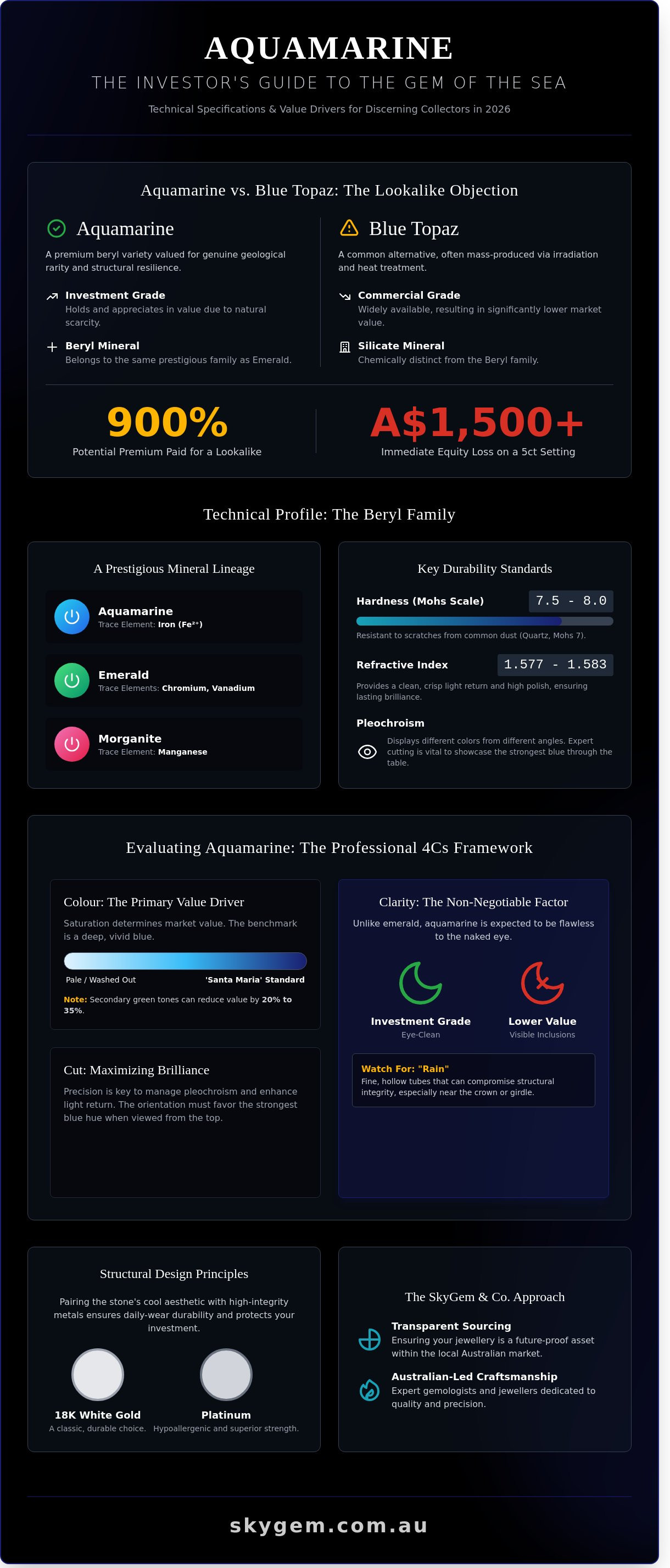
Would you knowingly pay a 900% premium for a stone that's chemically indistinguishable from a mass-market alternative to the untrained eye? Many Australian collectors discover too late that their high-value aquamarine is actually a common blue topaz, a mistake that can result in an immediate equity loss of over A$1,500 on a standard five-carat setting. You likely want a gemstone that offers genuine geological rarity and the structural resilience to withstand decades of daily wear without losing its characteristic brilliance.
It's reasonable to feel cautious when technical terms like "thermal enhancement" or "eye-clean" are used inconsistently by different suppliers. This 2026 guide delivers the precise specifications and value drivers you need to make a calculated investment in fine jewellery. We'll analyse the 4Cs from a technical perspective, explain how to verify treatment stability, and show you how to engineer a bespoke design that protects the stone's 7.5 Mohs hardness for the long term.
Key Takeaways
- Understand the mineralogical profile of aquamarine as a premium beryl variety, distinguished by its characteristic seawater clarity and specific technical specifications.
- Master the professional 4Cs framework to identify investment-grade specimens, with a particular focus on why clarity remains the non-negotiable factor for long-term value.
- Learn to navigate the coloured gemstone market by distinguishing genuine beryl from common lookalikes like blue topaz through technical performance rather than price alone.
- Explore structural design principles that pair the stone’s cool aesthetic with high-integrity metals like 18K white gold or platinum to ensure daily-wear durability.
- Discover the benefits of Australian-led craftsmanship and transparent sourcing to ensure your jewellery remains a future-proof asset within the local market.
What is Aquamarine? Understanding the 'Gem of the Sea'
Aquamarine is the blue to greenish-blue variety of the beryl mineral species, prized for its exceptional transparency and cool, liquid-like hues. The name itself is a direct translation of the Latin words for seawater, which serves as a fitting description for the stone's characteristic clarity and colour profile. This gemstone has a long-standing reputation as a protective talisman. Ancient sailors carried it to ensure safe passage across the oceans, believing it calmed the waves. In a modern context, it serves as the primary birthstone for March, offering a sophisticated alternative for those seeking a unique aesthetic in fine jewellery.
Aquamarine is a beryllium aluminium silicate with a Mohs hardness of 7.5 to 8.0. This specific chemical composition places it within an elite group of minerals that balance visual beauty with practical durability. For those seeking a bespoke ring, understanding these foundational properties is the first step in selecting a stone that will withstand the rigours of daily wear while maintaining its brilliance over several decades.
The Beryl Family: Aquamarine's Chemical Cousins
While aquamarine is a distinct gemstone in its own right, it belongs to the prestigious beryl family, making it a close relative to emerald and morganite. The primary difference between these stones lies in the trace elements present during their formation. While chromium and vanadium give emeralds their rich green, aquamarine derives its signature blue tones from the presence of iron trace elements within the crystal lattice. These iron ions can result in a range of saturations, from a pale, almost translucent blue to a deep, vibrant "Santa Maria" blue. The hexagonal crystal structure of beryl is highly stable, which allows for the growth of large, high-quality crystals that are often more eye-clean than their emerald counterparts.
Physical Properties and Durability Standards
Technical performance is a critical factor when selecting a gemstone for an engagement or dress ring. The physical properties of this stone make it an excellent candidate for high-end applications:
- Hardness: A rating of 7.5 to 8.0 on the Mohs scale indicates that the stone is harder than quartz, making it resistant to common household dust and scratches.
- Refractive Index: With a refractive index of 1.577 to 1.583, the stone provides a crisp light return. While it doesn't possess the fire of a diamond, its brilliance is clean and bright.
- Pleochroism: This stone is pleochroic, meaning it displays different colours when viewed from different angles. Expert cutters must orient the crystal precisely to ensure the strongest blue is visible through the table.
Because of these technical specifications, an aquamarine provides a reliable solution for those who value architectural clarity and long-term durability. The stone's ability to take a high polish ensures that it remains a focal point of any design, reflecting a sense of quiet confidence and professional craftsmanship.
Evaluating Aquamarine Quality: The Professional 4Cs Framework
Assessing an aquamarine requires a shift from standard diamond grading to a framework tailored specifically for the beryl mineral species. While the 4Cs remain the industry standard, the weighting of these factors changes significantly for coloured gemstones. For a Melbourne client seeking an investment-grade piece, clarity and colour saturation represent the primary technical benchmarks that determine long-term value.
Colour Saturation and the 'Santa Maria' Standard
The market value of beryl is primarily driven by its spectral output. Commercial-grade stones often display a pale, washed-out appearance, whereas the 'Santa Maria' standard refers to a deeply saturated, vivid blue. This specific hue, originally sourced from the Santa Maria de Itabira mines in Brazil, remains the benchmark for quality. Secondary green tones can reduce a stone's value by 20% to 35% depending on the intensity. It's vital to evaluate these stones under 5500K daylight equivalent lighting, as incandescent bulbs often shift the blue towards a less desirable teal, altering the perceived chromaticity of the gem.
Clarity and Internal Characteristics
Unlike its cousin the emerald, which is frequently "garden-like" with inclusions, aquamarine is expected to be eye-clean. Professional graders look for "rain," which are fine, hollow tubes that can compromise the stone's structural integrity if located near the crown or girdle. A stone with no visible internal flaws commands a premium of 40% over stones with minor inclusions. For those prioritising long-term asset value, clarity is a non-negotiable metric. You can explore our collection of certified loose gemstones to see these standards in practice.
Precision Cutting for Maximum Luminous Efficacy
The cut of a gemstone determines its photometric performance. Because the material has a relatively low refractive index of 1.57 to 1.58, a poor cut often leads to "windowing." This is a technical failure where light passes directly through the centre of the stone rather than reflecting back to the viewer, resulting in a dull, transparent patch. Master cutters use specific proportional symmetry in emerald and oval cuts to eliminate light extinction. A well-executed bespoke round cut ensures the stone maintains its brilliance even in low-light environments, reflecting the same engineering precision required in high-end architectural lighting design. Key shapes for this material include:
- Emerald Cuts: These highlight the stone's clarity and depth of colour through long, stepped facets.
- Ovals and Pears: These shapes maximise carat weight retention while maintaining high luminous efficacy.
- Bespoke Rounds: Custom facet patterns can increase internal reflection by 15% compared to standard commercial cuts.
Aquamarine vs. Blue Topaz: Navigating the Lookalike Objection
Distinguishing between aquamarine and blue topaz is a frequent challenge for clients seeking bespoke jewellery in the Melbourne market. While they share a similar aesthetic on the surface, the technical specifications and long-term asset value diverge sharply. Relying on price as a primary indicator of identity is a mistake; high-grade topaz can sometimes carry a premium that mimics entry-level beryl. We focus on the physical properties that define these minerals. This gemstone has a refractive index of 1.57 to 1.58, whereas topaz sits higher at 1.61 to 1.64. This results in a distinct brilliance profile. The density of topaz is also roughly 25 percent higher than beryl. Consequently, a one-carat beryl will physically appear larger than a one-carat topaz of the same cut. We position this stone as the soulful choice for custom-made engagement rings because its light performance feels more organic and less clinical than its silicate counterpart.
Compositional Differences and Value Retention
The aquamarine is a rare variety of beryl, the same mineral family as emerald. In contrast, topaz is an abundant silicate mineral. This fundamental difference in scarcity dictates how each stone retains value over decades. While a 5-carat blue topaz might retail for under A$100, a high-quality beryl of the same size can exceed A$3,000 depending on its saturation. The market for beryl is driven by natural rarity, whereas the topaz market is heavily saturated with mass-produced, irradiated stones. Beryl offers a softer, more sophisticated palette that reflects the Southern Ocean, avoiding the electric or neon blues typical of treated topaz. This makes it a superior long-term investment for those prioritising heritage and authenticity in their gemstone selection.
Identifying Heat Treatment and Enhancements
Industry standards for beryl often include mild heat treatment at approximately 400 degrees Celsius to remove yellow or green overtones. This process is stable and permanent, aligning with CIBJO trade standards. Blue topaz, however, almost always undergoes high-energy electron or gamma irradiation to achieve its colour, followed by heating. For clients who value minimal intervention, we recommend requesting a laboratory report from a recognised body like the GIA or a reputable Australian gemmological lab. These documents confirm if a stone is unheated, a status that can increase the value of a specimen by 20 to 30 percent. Understanding these technical nuances ensures your selection meets both aesthetic goals and rigorous compliance standards for durability and ethical sourcing.
Designing with Aquamarine: Structural Integrity and Aesthetics
Designing a high-performance ring requires more than just aesthetic intuition; it demands a deep understanding of mineral properties and structural engineering. Aquamarine sits at 7.5 to 8 on the Mohs scale of hardness. This provides sufficient durability for daily wear, yet its hexagonal crystal structure requires precise setting techniques to prevent chipping at the girdle. It's a stone that rewards careful planning, especially when balancing the desire for light exposure with the necessity of physical protection.
Metal Selection and Colour Harmony
Technical specialists often recommend platinum or 18K white gold for aquamarine. These metals act as a neutral substrate, allowing the stone's natural blue saturation to remain the undisputed focal point. Using 18K white gold settings ensures a high-lustre finish that complements the stone's cool undertones without introducing unwanted warmth into the gem's reflections. For those seeking a vintage aesthetic, rose gold provides a striking contrast. The pinkish hues of the copper alloy create a warm juxtaposition that can make the blue appear more vivid through basic colour theory principles.
Setting Styles for Longevity
Longevity is a primary concern for any investment piece. While a four-prong setting offers a minimalist aesthetic, a six-prong configuration provides redundant security for larger stones, typically those exceeding 2.0 carats. Bezel settings offer the highest level of protection by encircling the entire perimeter of the gemstone. This is a practical solution for clients with active lifestyles in Melbourne. Every design must include an open gallery; this allows light to enter from multiple angles and facilitates the removal of debris. Regular cleaning is essential for maintaining the stone's refractive performance over time.
Integrating this gemstone into bespoke engagement rings allows for a tailored approach to light management. Adding colourless diamond accents creates a high-contrast environment. This technical arrangement enhances the perceived 'ice blue' saturation of the aquamarine. Small, brilliant-cut diamonds placed along the shoulders of the band increase the overall light return of the piece, ensuring the centre stone doesn't appear washed out in low-light environments. This methodical approach to design ensures the ring remains a permanent asset rather than a fragile accessory.
Explore our collection of precision-cut stones to find your perfect match. View our professional gemstone inventory
The SkyGem & Co. Approach: Sourcing and Craftsmanship
SkyGem & Co. operates as a technical consultancy for fine jewellery, moving beyond the traditional retail model to provide an engineering-focused perspective on design. We prioritise transparency during the procurement of loose gemstones, ensuring every client understands the specific characteristics of their stone. Our Australian-led design philosophy focuses on creating future-proof jewellery that balances architectural aesthetics with long-term structural integrity. This approach ensures that a ring isn't just a temporary fashion statement but a permanent asset.
Every project begins with a technical consultation designed to help you balance your A$ budget with optimal optical performance. We analyse the refractive index, light return, and colour zoning of potential stones to ensure the aquamarine you select performs exceptionally under various lighting conditions. By focusing on the intersection of gemmological data and precision manufacturing, we eliminate the guesswork often associated with bespoke jewellery.
Ethical Sourcing and Regulatory Compliance
Our procurement process relies on a network of reputable global suppliers who provide documented chains of custody for every stone. We maintain a focus on quality over quantity; our gemmologists reject 90% of the stones they inspect. This rigorous screening process ensures that only the top 10% of available material, characterised by superior clarity and saturation, enters our inventory. We ensure every bespoke piece meets Australian manufacturing standards, which are among the strictest in the world. This commitment to local compliance guarantees that the metal alloys and stone-setting techniques used in your piece are designed for durability and safety.
Your Journey from Loose Stone to Finished Masterpiece
The transition from a raw concept to a finished piece involves advanced CAD (Computer-Aided Design) technology. This allows you to visualise the final engagement ring with mathematical precision before any metal is cast. Digital prototyping identifies potential stress points, allowing us to reinforce the setting for generational wear. While aquamarine is prized for its serene, icy blue tones, we also provide technical comparisons with natural sapphires for clients who might require a different blue profile or a higher level of mineral hardness for an active lifestyle.
Our master jewellers employ hand-finishing techniques that mass-produced items cannot replicate. This includes multi-stage polishing and precise claw alignment that protects the stone's girdle. We invite you to explore custom engagement ring design to begin the process of engineering a piece that meets your exact specifications and aesthetic goals. Our team remains dedicated to the long-term success of your commission, offering a partnership that extends well beyond the initial purchase.
Securing Your Investment in 2026 and Beyond
Selecting a high-quality aquamarine requires a technical understanding of the 4Cs, particularly the distinction between natural saturation and the common treatments found in lookalikes like blue topaz. By applying a professional framework to stone selection, you ensure the structural integrity of the setting complements the gemstone's unique crystal habit. SkyGem & Co. bridges the gap between raw mineralogy and refined Australian craftsmanship, providing a transparent path from ethical sourcing to the finished piece.
Our approach prioritises long-term durability and aesthetic precision, reflecting the high standards of GIA-trained gemmologists. We've refined our sourcing protocols to ensure every stone meets rigorous 2026 compliance standards for ethical origin. This technical focus ensures your bespoke piece remains a permanent asset rather than a fleeting purchase. Whether you're evaluating the refractive index or the thermal stability of a mounting, our team provides the data-driven insights necessary for an informed acquisition. We look forward to helping you navigate the complexities of gemstone engineering to create something truly exceptional.
Book a Technical Consultation for Your Bespoke Aquamarine Ring
Frequently Asked Questions
Is aquamarine durable enough for an engagement ring?
Aquamarine scores between 7.5 and 8 on the Mohs scale of mineral hardness, which makes it suitable for daily wear if handled with professional care. It doesn't have the extreme resilience of a diamond, so we recommend a protective bezel or a six-prong setting to mitigate the risk of chipping. A structural inspection every 12 months ensures the mounting remains secure for Melbourne’s active lifestyles.
What is the most valuable colour for an aquamarine?
The most valuable aquamarine specimens exhibit a deeply saturated, moderately strong blue hue, often referred to as "double blue" in technical trade circles. While lighter, water-like tones are common, stones with intense saturation can command prices exceeding A$1,200 per carat for high-clarity 5-carat gems. Collectors prioritise stones that maintain their colour depth under varying light conditions without showing grey or green secondary undertones.
How can I tell the difference between aquamarine and blue topaz?
Identifying the difference requires an analysis of the stone's refractive index; aquamarine typically measures between 1.57 and 1.58, whereas blue topaz sits higher at approximately 1.61. Blue topaz is also significantly more common and generally costs 80% less than a natural beryl of similar size. Under a 10x loupe, topaz often shows stronger doubling of back facets, a technical detail our specialists use to verify authenticity.
Does aquamarine lose its colour over time?
Natural aquamarine is a stable gemstone that doesn't fade when exposed to standard UV levels or everyday sunlight. Its colour is permanent because the iron impurities within the beryl crystal structure are chemically bonded. You can wear your ring daily across Australia’s high-UV climate without fear of pigment degradation, provided the stone hasn't been subjected to experimental surface coatings or unstable, non-standard irradiation treatments.
Is aquamarine more expensive than a diamond?
Aquamarine is significantly more affordable than a diamond; a high-quality 1-carat stone might retail for A$450, while a GIA-certified 1-carat diamond can exceed A$10,000. This price differential allows couples to secure a much larger centre stone for their specific budget. For a fixed investment of A$3,000, you could choose a substantial 4-carat aquamarine or a modest 0.40-carat diamond, depending on your aesthetic priorities.
How should I clean and maintain my aquamarine jewellery?
Maintaining your jewellery involves a simple routine of soaking the piece in warm water mixed with a mild, pH-neutral detergent for 15 minutes. Use a soft-bristled toothbrush to gently remove oils and debris from the underside of the setting. You should avoid ultrasonic cleaners if the stone has visible inclusions, as the 40 kHz vibrations can cause internal fractures to expand. Professional steam cleaning every 24 months ensures the metal retains its architectural finish.
What does 'Santa Maria' aquamarine mean?
'Santa Maria' is a trade term used to describe stones with an exceptionally rare and intense blue saturation, originally sourced from the Santa Maria de Itabira mine in Brazil. These gems are the benchmark for quality, often fetching a 300% premium over standard commercial grades. While the original mine is largely exhausted, similar high-saturation stones from African deposits are sometimes marketed under this name to signify their elite colour profile.
Are lab-grown aquamarines common in fine jewellery?
Lab-grown aquamarines are surprisingly rare in the Australian retail market because the hydrothermal growth process is expensive compared to the cost of mining natural stones. Most "synthetic aquamarine" sold at low price points is actually blue synthetic spinel or faceted glass. At SkyGem & Co., we focus on natural beryl to ensure the long-term value and geological heritage of your investment remains secure for decades to come.
Disclaimer
This article is for general informational purposes only and may include AI-assisted content. Pricing, specifications, and availability are subject to change. For accurate advice and current information, please contact SkyGem & Co. directly. Nothing in this content constitutes professional or financial advice.