
Aquamarine Engagement Rings: The 2026 Definitive Guide to Colour, Clarity, and Custom Design

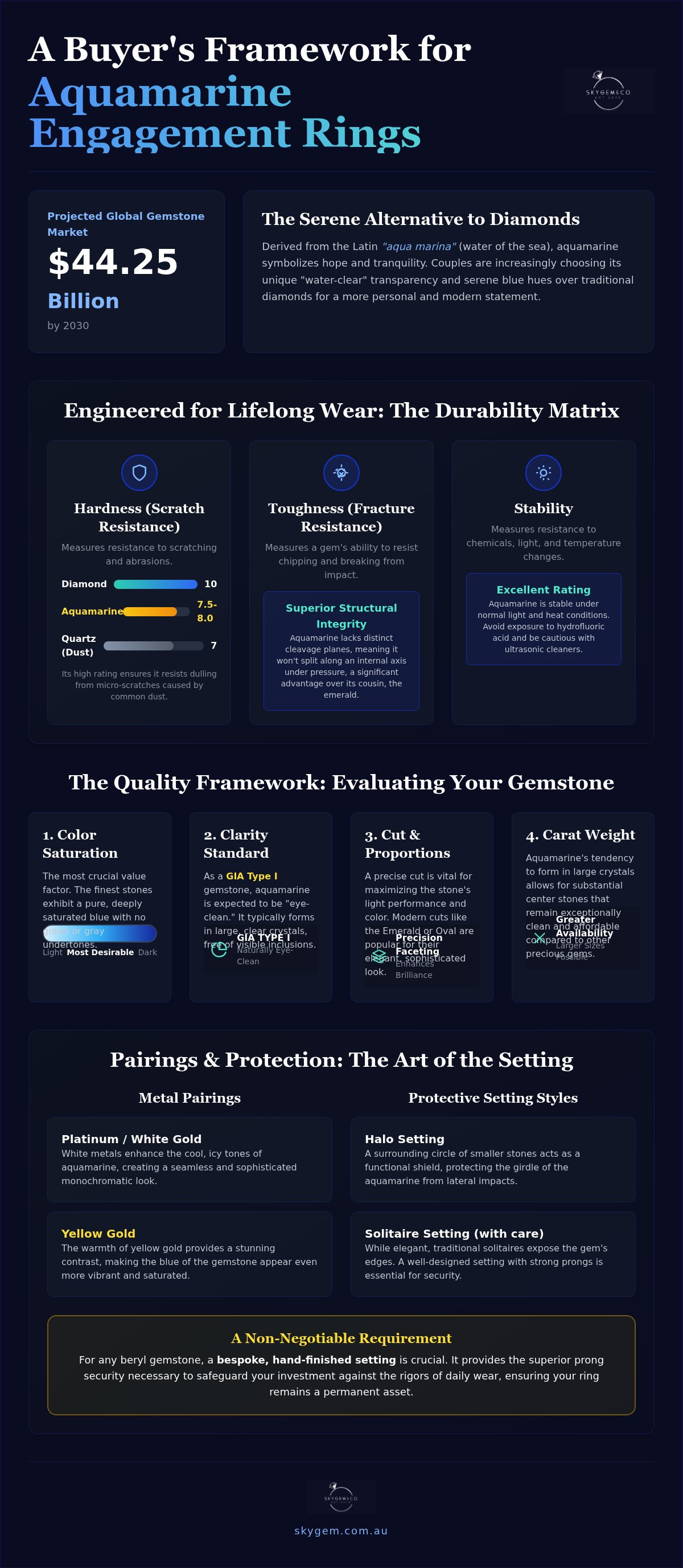
A gemstone’s aesthetic appeal becomes a liability if the structural engineering of its setting fails to account for its specific physical properties. As the global gemstone market expands toward a projected $44.25 billion by 2030, more couples are moving away from traditional diamonds in favour of the serene, icy hues of aquamarine engagement rings. You likely appreciate the sophisticated, modern look of an emerald-cut stone, yet you may harbour concerns about how a gem with a Mohs hardness of 7.5 to 8.0 will withstand the rigours of daily wear over several decades.
We understand that selecting a centre stone involves more than just an appreciation for colour; it requires a deep dive into technical performance and long-term viability. This guide provides the definitive framework for evaluating aquamarine quality, from the GIA Type I clarity standards to the specific metal pairings that enhance its natural saturation. You'll discover how bespoke, hand-finished settings act as a necessary safeguard for your investment, ensuring your ring remains a permanent asset. We will examine the precise metrics of colour saturation, the impact of heat treatments, and the architectural principles required to create a piece that balances delicate beauty with structural integrity.
Key Takeaways
- Identify the critical distinction between mineral hardness and toughness to ensure your gemstone is engineered for lifelong durability.
- Understand the GIA Type I clarity standards and colour saturation metrics that distinguish premium aquamarine engagement rings from commercial-grade alternatives.
- Evaluate how specific metal choices, such as platinum or yellow gold, interact with the gemstone's light performance to achieve your desired aesthetic.
- Learn why hand-finished settings are a non-negotiable requirement for providing the superior prong security necessary to protect stones in the beryl family.
- Gain a structured framework for the bespoke design process, from expert gemstone procurement to the final technical execution of a custom setting.
The Allure of Aquamarine Engagement Rings: A Serene Alternative
Aquamarine belongs to the beryl mineral species, making it a direct relative of the emerald. While emeralds are defined by their chromium-rich green, aquamarine derives its signature blue from iron impurities within the crystal lattice. According to 2026 market data, the global gemstone industry grew to $34.92 billion as couples increasingly sought alternatives to the traditional diamond solitaire. Aquamarine engagement rings have become a focal point of this shift, offering a "water-clear" transparency that diamonds cannot replicate. This aesthetic provides a sense of depth and stillness that aligns with modern bridal preferences for calm and clarity.
The History and Symbolism of the Sea-Blue Stone
The name originates from the Latin aqua marina, translated as water of the sea. Historically, sailors relied on the gem as a protective talisman to ensure safe passage across turbulent waters. Today, this symbolism has evolved to represent hope and tranquility in a lifelong partnership. When examining Aquamarine gemstone properties, we see that its dichroic nature allows it to display varying blue and near-colourless tints depending on the viewing angle. This technical characteristic creates a sophisticated, understated elegance that appeals to the minimalist aesthetic. It doesn't shout for attention; instead, it invites closer inspection of its internal clarity.
Why Couples are Choosing Aquamarine Over Traditional Diamonds
The rising popularity of precious gemstones in 2026 is driven by a desire for personalisation. Aquamarine offers a unique value proposition, as it typically forms in larger, cleaner crystals than its emerald counterparts. This allows couples to select a substantial centre stone that maintains exceptional clarity without the visual clutter of heavy inclusions. Beyond the technical specs, the stone’s cool blue hue is remarkably versatile. It complements various metal alloys and skin tones with ease. For many, the choice is also about the narrative of the stone itself. The presence of tiny, needle-like inclusions, often called "rain", can provide a natural fingerprint that makes every bespoke design entirely unique. This connection to the natural world provides an emotional resonance that mass-produced diamonds often lack.
Durability and Longevity: Is Aquamarine Suitable for Daily Wear?
Mineral durability is a multi-dimensional metric involving hardness, toughness, and stability, all of which are vital when evaluating aquamarine engagement rings. These stones possess a Mohs hardness of 7.5 to 8.0, which ranks them higher than the quartz particles found in common household dust. This ensures the surface resists the dulling effect of micro-scratches over time. While this rating is lower than a diamond's 10, it remains a robust choice for a piece intended for daily wear. The GIA on Aquamarine notes the stone's excellent stability under normal light and heat conditions. However, you must distinguish hardness from "toughness," which refers to the ability to resist fracturing. Even a hard stone can chip if it strikes a hard surface like a granite benchtop at a high-velocity angle.
The Technical Hardness of Beryl
Aquamarine offers superior structural integrity compared to other beryl varieties like emerald. Emeralds are often prone to internal "gardens" of inclusions that act as fault lines. In contrast, aquamarine typically grows in cleaner, more uniform crystals and lacks distinct cleavage planes. This absence of cleavage means the stone won't split along a specific internal axis when subjected to pressure. We focus on sourcing high-density rough stones that lack surface-reaching fissures to maximise longevity. To maintain the stone’s brilliance, avoid chemical exposure to hydrofluoric acid and limit the use of home ultrasonic cleaners, which can occasionally vibrate stones loose if the setting isn't hand-finished.
Design Strategies to Protect Your Gemstone
A well-engineered setting acts as a mechanical buffer for your centre stone. Traditional Solitaire Engagement Rings are elegant but leave the girdle of the gem exposed to lateral impacts. If you lead an active lifestyle, a Halo Engagement Ring serves as a functional shield. The surrounding diamond border absorbs the force of accidental knocks, protecting the softer aquamarine core. For geometric cuts, we recommend bezel settings or V-prongs that encapsulate the corners. These bespoke frameworks are essential for preventing chips on vulnerable edges. Consulting with an expert on custom-designed engagement rings ensures your ring is built to endure the specific rigours of your daily routine.
The Quality Framework: How to Evaluate Aquamarine Gemstones
Standard diamond grading often fails to capture the technical nuance of coloured gemstones. For aquamarine engagement rings, the evaluation framework shifts toward colour saturation and specific light performance metrics. Unlike diamonds where "D" colourless represents the peak of the scale, aquamarine value doesn't rely on the absence of tint. Instead, it is defined by the depth, purity, and consistency of its blue. Precision in grading ensures that the chosen gem possesses the structural stability and visual impact required for a permanent piece of jewellery.
Mastering the Spectrum of Blue
Iron traces within the crystal lattice determine the stone’s specific shade, which ranges from nearly colourless pastels to the intense "Santa Maria" blue. This saturation often correlates with carat weight; larger stones tend to display deeper hues because light travels a longer path through the mineral. We also consider pleochroism, a phenomenon where the gem shows different colours, often a stronger blue and a greenish-blue, when viewed from different angles. Expert orientation during the cutting process is required to ensure the most desirable hue is visible through the table.
Most aquamarines on the market undergo heat treatment to remove yellow or green overtones. This process is permanent and widely accepted within the industry, but a reputable bespoke jeweller must provide full transparency regarding such enhancements. According to the Gemological Institute of America (GIA) on aquamarine quality, the most valuable stones are those that achieve a moderately strong, vivid blue without losing transparency. This balance of saturation and clarity is what creates the "water-clear" aesthetic unique to this beryl variety.
Clarity and the Importance of an Eye-Clean Stone
Aquamarine is classified as a Type I gemstone, which means the market standard is an "eye-clean" appearance. Because of the stone's high transparency, inclusions are far more visible than in darker gems like sapphire. While some collectors appreciate "rain" inclusions, which are fine, hollow tubes, most engagement standards demand a stone free from visible flaws. Even minor internal characteristics can disrupt the path of light, diminishing the stone's overall brilliance.
Professional inspection for precious gemstones is essential to identify surface-reaching fissures that could compromise structural integrity. Finally, the cut must be executed with mathematical precision. A shallow cut may lead to "windowing," where light passes straight through the centre, while a precise step-cut, such as an emerald cut, maximises the stone’s refractive index. This technical approach ensures the ring remains a vivid, light-filled asset rather than a dull, lifeless stone.
Pairing Metals and Settings to Enhance the Blue Sparkle
The interaction between a gemstone’s refractive index and the surrounding metal alloy dictates the final visual performance of aquamarine engagement rings. While the stone provides a serene blue, the metal acts as a reflective backdrop that can amplify cool tones or provide a warm counterpoint. Choosing the right setting is a technical decision as much as an aesthetic one. The metal colour directly influences the perceived saturation of the beryl, often shifting the viewer's perception of the stone's depth.
The Case for Platinum and 18K White Gold
Cool-toned metals remain the industry standard for aquamarine because they create a seamless, monochromatic aesthetic. Platinum and 18K White Gold are particularly effective at maintaining the "icy" brilliance of lighter stones. Platinum offers superior density and weight, providing a secure, permanent housing for the gem. Conversely, 18K white gold is prized for its structural rigidity. The rhodium plating applied to white gold ensures a high-lustre finish that reflects light back into the stone. This prevents the metal from absorbing the gem’s delicate blue tint, ensuring the aquamarine appears as vivid as possible.
Vintage vs. Modern Setting Styles
Design frameworks in 2026 often draw from historical eras to enhance the stone’s geometric properties. Art Deco influences, such as emerald-cut aquamarines paired with baguette diamond side stones, emphasise the step-cut facets and natural clarity discussed in previous sections. For those seeking a contemporary look, modern minimalism focuses on high-set solitaires. These designs allow maximum light entry through the pavilion, which is essential for lighter-coloured beryls. Alternatively, the Trilogy style allows for a technical balance. In this configuration, flanking diamonds provide a high-contrast sparkle that makes the central blue hue appear more saturated by comparison.
Yellow gold has seen a significant resurgence in 2026 as a bold, modern choice. The warmth of the gold provides a striking contrast against the cool blue. This pairing relies on complementary colour theory to make the gemstone "pop" visually. Rose gold offers a softer, vintage-inspired alternative that works well with pastel or "water-clear" stones, adding warmth without overpowering the gem’s natural brilliance. Selecting the perfect combination requires a professional eye for detail and an understanding of how light interacts with different alloys.
Explore our curated collection of bespoke engagement rings to find the ideal setting for your selected gemstone.
Designing a Bespoke Aquamarine Ring with SkyGem & Co.
The transition from evaluating gemstone metrics to the physical engineering of a ring requires a methodical approach. At SkyGem & Co., we act as technical consultants throughout the design process, ensuring that the aesthetic vision of your piece is supported by rigorous structural integrity. Our bespoke methodology begins with expert procurement. We source loose stones that meet the Type I clarity and specific colour saturation standards required for high-performance aquamarine engagement rings. By focusing on reputable sourcing, we provide a transparent chain of custody for every mineral we select.
Once the centre stone is secured, we move into the CAD design phase. Unlike mass-produced settings that use standardised moulds, our digital frameworks are built around the micron-level dimensions of your specific gemstone. This custom-fitting process ensures the seat of the setting provides maximum contact area, which is vital for the stability of beryl-group minerals. The final execution involves hand-finishing by master jewellers. This manual refinement of prongs and galleries ensures a level of security and precision that automated manufacturing simply cannot replicate.
The Advantage of Custom Manufacturing
Ready-to-wear settings often fail to account for the unique depth or girdle thickness of a natural aquamarine. This lack of precision can result in uneven pressure on the stone, which increases the risk of fracturing during daily wear. Creating a custom-made engagement ring allows for strategic prong placement that protects vulnerable edges while allowing maximum light entry through the pavilion. This bespoke approach ensures your ring is not just a temporary accessory, but a permanent asset engineered for longevity.
Ongoing Care and Maintenance for Your Ring
The long-term viability of your investment depends on a consistent maintenance schedule. We recommend annual professional inspections to evaluate prong tension and metal fatigue. While aquamarine is durable, its high transparency means that surface oils and lotions can easily dull its "water-clear" brilliance. Regular home care using a soft brush and mild detergent will maintain the stone's refractive performance. Our commitment to the health of your jewellery extends well beyond the initial procurement, providing the ongoing technical support necessary to ensure your ring remains in peak condition for generations.
Securing Your Investment in Bespoke Design
Selecting a centre stone from the beryl family involves a sophisticated balance of aesthetic preference and mineralogical performance. The long-term viability of aquamarine engagement rings depends on more than just the stone's 7.5 to 8.0 hardness. It requires a deliberate pairing of Type I clarity gems with hand-finished settings that provide superior prong security. By focusing on technical precision during the CAD phase and utilising master jewellers for the final setting, you transform a delicate mineral into a permanent family asset.
SkyGem & Co. remains dedicated to transparency and education throughout the procurement process. Our expertly curated selection of natural gemstones ensures every piece meets the highest standards of light performance and structural integrity. Don't settle for commercial-grade alternatives when you can embrace a solution-oriented approach to your ring design. To begin your journey toward a piece that reflects technical excellence and personal vision, Book a Bespoke Consultation with SkyGem & Co. today. We look forward to helping you create a legacy that lasts for generations.
Frequently Asked Questions
Is aquamarine a good stone for an engagement ring?
Aquamarine engagement rings are an excellent choice for a centre stone due to their distinctive "water-clear" aesthetic and respectable durability. With a Mohs hardness of 7.5 to 8.0, the mineral resists surface scratching from common dust particles. However, its suitability depends heavily on the setting design. We recommend bespoke, hand-finished settings that protect the stone's edges. This technical approach ensures the ring remains a permanent asset rather than a delicate accessory that requires frequent repair.
How much should I spend on an aquamarine engagement ring?
The amount you should spend on an aquamarine ring depends on the stone's saturation, clarity, and the complexity of the bespoke setting. High-quality "Santa Maria" blue stones with Type I eye-clean clarity command a premium over pale, commercial-grade alternatives. You should prioritise the structural integrity of the metalwork and the precision of the cut. Allocating your budget toward a hand-finished setting ensures the long-term safety of the gemstone, providing better value over the jewellery's lifespan.
Can I wear my aquamarine ring every day?
You can certainly wear an aquamarine ring every day if the setting is designed for high-impact protection. While the stone is hard enough to resist scratches, it is less "tough" than a sapphire or diamond, meaning it can chip upon heavy impact. We advise removing the ring during high-intensity activities like gym sessions or heavy gardening. Implementing a routine of annual professional inspections will help identify any loose prongs before they compromise the stone's security.
What is the most expensive colour for aquamarine?
The most coveted and expensive colour is a moderately strong, vivid blue known in the industry as "Santa Maria." These stones are prized for their deep saturation and lack of greenish overtones. Unlike many other gemstones, aquamarine value is driven by the purity of its blue rather than just carat weight. Natural, unheated stones with this level of saturation are exceptionally rare and represent the peak of the quality framework for collectors and bespoke clients.
How do I clean my aquamarine engagement ring at home?
Maintaining the brilliance of aquamarine engagement rings at home requires a simple yet methodical approach. Use warm water mixed with a few drops of mild, pH-neutral dish soap. Gently scrub the gemstone and the underside of the setting with a soft-bristled toothbrush to remove accumulated oils and lotions. Rinse thoroughly with clean water and pat dry with a lint-free cloth. Avoid harsh chemicals or abrasive cleaners, as these can damage the metal finish or the gemstone's surface.
Does aquamarine scratch easily compared to a diamond?
Aquamarine is softer than a diamond, which sits at the top of the Mohs scale with a rating of 10. While a diamond is virtually scratch-proof, aquamarine's 7.5 to 8.0 rating means it is durable but not invincible. It won't scratch from daily contact with most fabrics or papers, but contact with harder minerals or other diamonds can leave marks. This is why we emphasise protective setting styles like halos or bezels to shield the stone's surface.
Are lab-grown aquamarines available for engagement rings?
Lab-grown aquamarines are available, though they are less common in the premium bespoke market than lab-grown diamonds or sapphires. These synthetic stones share the same chemical and physical properties as natural beryl. However, most clients choose natural aquamarine for its unique internal characteristics and the narrative of organic origin. At SkyGem & Co., we focus on sourcing high-quality natural stones that meet strict GIA Type I clarity standards to ensure every bespoke piece remains a distinctive asset.
What is the best cut for an aquamarine gemstone?
The emerald cut is widely considered the best choice for aquamarine because its long, step-cut facets highlight the stone's natural clarity and "water-clear" transparency. This geometric shape allows the observer to look deep into the crystal, showcasing the purity of the blue hue. Other popular options include oval and pear shapes, which can enhance light return and perceived colour saturation. The best cut ultimately depends on the stone's original rough dimensions and your desired aesthetic for the final setting.
Disclaimer
This article is for general informational purposes only and may include AI-assisted content. Pricing, specifications, and availability are subject to change. For accurate advice and current information, please contact SkyGem & Co. directly. Nothing in this content constitutes professional or financial advice.