
Alexandrite Engagement Rings: The 2026 Australian Buyer’s Guide to the Colour-Change Gem

While most couples seek rarity in a diamond, gem-quality alexandrite is estimated to be 8,000 times rarer than a traditional white stone. Choosing alexandrite engagement rings involves more than just selecting a beautiful aesthetic; it requires a technical understanding of how light interacts with crystal structures. You probably appreciate the unique "emerald by day, ruby by night" effect, but you might also worry about the stone's durability or the complex price gap between natural and lab-grown options.
This guide provides the professional framework you need to navigate the 2026 market with absolute confidence. We'll help you master the nuances of this colour-change gem, from its 8.5 Mohs hardness rating to the specific value markers of unheated specimens. By the end of this article, you'll understand how to balance investment value with lifelong wear. We'll examine the structural integrity of different settings, the ethics of sourcing, and the precise metrics that define a high-quality colour shift, ensuring your choice is as resilient as it is remarkable.
Key Takeaways
- Master the technical drivers of the "Alexandrite Effect" to accurately predict how your stone will perform across varied lighting environments.
- Assess the structural integrity of alexandrite engagement rings, focusing on their 8.5 Mohs hardness and high resistance to chipping for lifelong durability.
- Compare the rarity and investment metrics of natural unheated specimens against the technical precision of lab-grown Czochralski pulled alternatives.
- Learn how to use metal choice and accent diamonds to optimise the gemstone's light-absorption properties and colour-change intensity.
- Utilise a CAD-based bespoke design framework to ensure your gemstone is secured with the precision engineering required for rare, high-value assets.
Understanding the Alexandrite Phenomenon: Nature’s Most Captivating Colour-Change
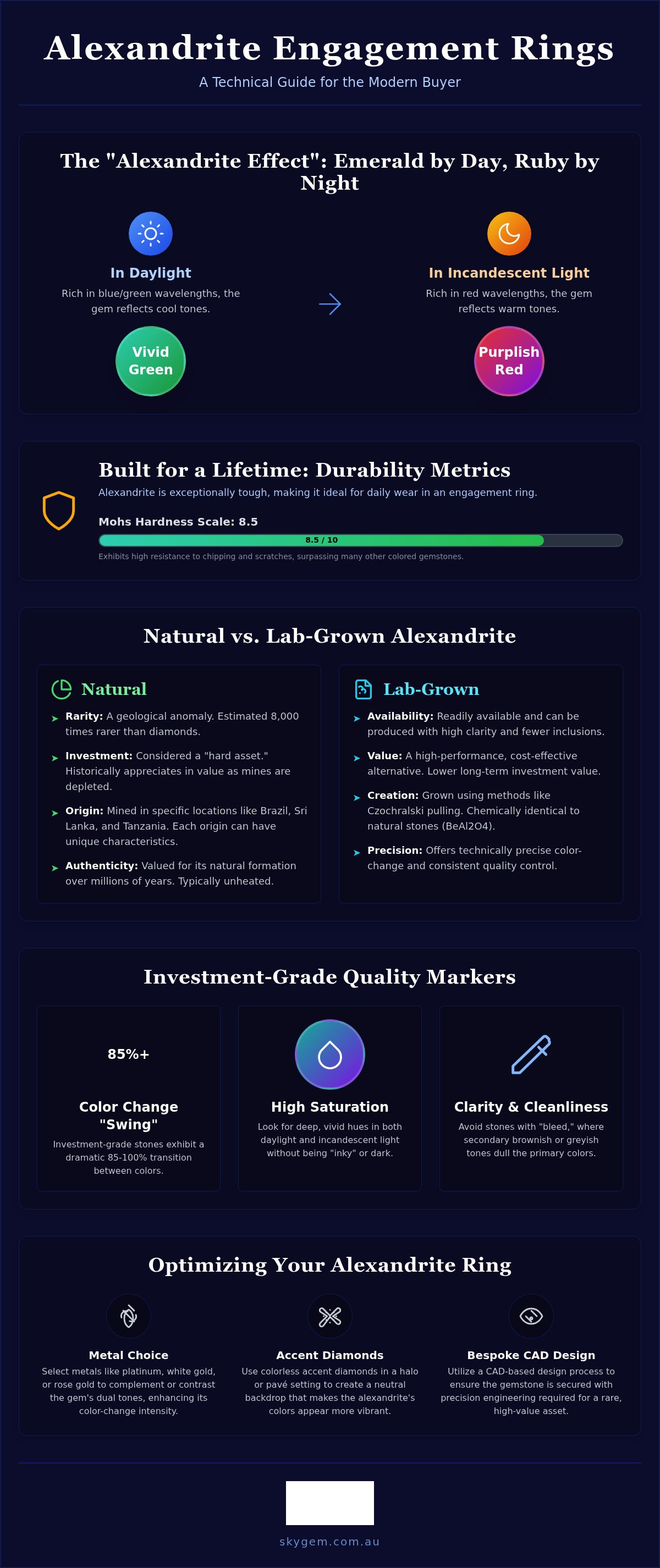
The "Alexandrite Effect" represents a rare optical event where a single gemstone displays a distinct transition between colour families. When selecting alexandrite engagement rings, you're investing in a chrysoberyl variety that owes its unique properties to trace amounts of chromium ions within its crystal lattice. These ions replace aluminium in the structure, creating a specific light-absorption pattern that shifts based on the light source. This phenomenon is further enhanced by pleochroism, a property where the crystal displays different colours when viewed from different axes. For the 2026 buyer, the benchmark of quality remains the "emerald by day, ruby by night" standard, which requires a vivid transition from forest green or teal to a saturated purplish-red. You can find more technical details on the history and chemical properties of this stone on Alexandrite on Wikipedia.
The Science of Light Absorption in Chrysoberyl
The science behind this shift lies in how the stone handles the yellow region of the visible light spectrum. Alexandrite creates a narrow absorption band around the 580-nanometre mark. It's a technical marvel. In natural daylight, which is rich in blue and green wavelengths, the stone reflects these cooler tones. Conversely, incandescent light is heavily weighted toward the red end of the spectrum. Because the stone doesn't reflect yellow light, it forces the eye to perceive either the green or the red depending on the dominant ambient light. This technical precision is why the percentage of colour change is the primary value driver in the current market. A stone that looks muddy or greyish under certain lighting fails to meet the investment-grade criteria required for high-end jewellery.
Evaluating Colour Change Quality and Saturation
When assessing potential stones for alexandrite engagement rings, the "swing" or percentage of colour change is critical. Commercial specimens often show a 30% to 50% shift, while investment-grade stones should ideally exhibit an 85% to 100% transition. Lower-quality specimens often suffer from "bleed," where secondary brownish or greyish hues dull the primary colours. High-quality unheated specimens maintain deep saturation in both states. You should look for a stone that transitions cleanly without becoming overly dark or "inky." The clarity of the colour change directly impacts both the aesthetic appeal and the long-term asset value. A saturated teal that flips to a vibrant raspberry red represents the pinnacle of 2026 market demand, providing a level of visual performance that remains unmatched by other coloured gemstones.
Natural vs. Lab-Grown Alexandrite: Rarity, Investment, and Ethics
The decision between natural and lab-grown stones is the most significant technical hurdle for buyers of alexandrite engagement rings. Chemically, both varieties are identical chrysoberyl crystals with the formula BeAl2O4. They share the same refractive index, hardness, and light-absorption patterns. However, the market distinguishes them based on geological rarity and long-term asset value. While lab-grown stones are created through the Czochralski pulled method to achieve high clarity, natural specimens are geological anomalies formed over millions of years. This rarity translates into a significant price premium, as fine natural alexandrite is estimated to be 8,000 times rarer than white diamonds.
The Rarity of Natural, Unheated Alexandrite
Collectors and high-end buyers often view unheated alexandrite as the pinnacle of gemstone authenticity. Unlike many other precious gemstones that require thermal enhancement to improve colour, alexandrite is typically left in its natural state. This is because heat treatment rarely improves its specific colour-change properties. According to GIA's guide to alexandrite, the value of these stones is heavily dictated by their origin. Brazilian stones from the Hematita mine are famous for their dramatic colour shift, while Sri Lankan specimens often provide larger carat weights with slightly more muted transitions. East African sources, particularly Tanzania, have also emerged as providers of high-quality material. These natural origins represent a "hard asset" that historically appreciates as mine yields decrease.
Lab-Grown Alexandrite: A High-Performance Alternative
For those prioritising visual impact and scale over rarity, lab-grown alexandrite is a technically superior alternative. The Czochralski process involves melting the raw materials and "pulling" a single crystal from the melt, resulting in a stone with virtually no inclusions. This method produces stones with exceptional clarity and a consistent, vivid colour change that is difficult to find in nature. It's a practical choice for those who desire a centre stone larger than one carat without the exponential cost of a natural specimen. Much like the shift seen with lab-grown diamonds, these stones offer an ethical, conflict-free path for the modern consumer. They provide the same aesthetic experience while allowing more of the budget to be allocated toward a bespoke setting. If you're looking for a specific specimen, you can view our current alexandrite gemstones collection to see these differences in person.
Ultimately, the choice depends on your project's goals. Natural stones offer a sense of partnership with history and a tangible store of value. Lab-grown stones provide technical precision and accessibility. Both options are valid, provided the buyer understands the structural and economic differences between them.
Durability Metrics: Is Alexandrite Suitable for an Engagement Ring?
Selecting a gemstone for daily wear requires an objective analysis of surface hardness and internal structural stability. On the Mohs scale, alexandrite ranks at an 8.5. While it sits below sapphire (9) and diamond (10), it remains significantly harder than almost any other coloured gemstone available. This high rating ensures that alexandrite engagement rings can withstand the abrasive forces of daily life, such as contact with metal surfaces, household dust, or accidental knocks. For a 2026 buyer, this gem represents a definitive choice for a lifelong asset. It won't lose its polish or develop the surface dullness that affects softer stones over the decades.
Hardness vs. Toughness in Everyday Use
Technical specialists distinguish between hardness, which is the ability to resist scratching, and toughness, which is the ability to resist fracturing or chipping. Alexandrite excels in both categories. Unlike emeralds, which often contain internal fractures and possess distinct cleavage planes that make them prone to cracking, chrysoberyl is remarkably stable. It lacks these weak structural planes, meaning it doesn't easily split when struck. The Gemological Institute of America (GIA) confirms that its durability makes it an excellent candidate for various jewellery applications, particularly in rings where impact is more frequent. This structural resilience gives couples the confidence that their centre stone will survive fifty years of daily wear without compromising its integrity.
Maintenance and Long-Term Care for Alexandrite
Ensuring the longevity of alexandrite engagement rings involves a proactive maintenance schedule rather than reactive repairs. While the stone is robust, it's still susceptible to thermal shock. You should avoid exposing your jewellery to sudden, extreme temperature shifts, such as moving from a hot environment directly into icy water. Chemical resilience is high, but we recommend removing your ring before using harsh industrial cleaners or chlorine to preserve the metal setting. In a custom design, the stone's security depends on the integrity of the prongs. We suggest a professional inspection every twelve months to check for metal fatigue or loose settings. This technical oversight, combined with regular cleaning using warm soapy water and a soft brush, keeps the stone’s light-absorption properties performing at their peak, maintaining that vibrant colour-change effect for a lifetime.
Designing the Perfect Setting to Showcase Alexandrite’s Versatility
Designing alexandrite engagement rings requires a sophisticated understanding of colour theory and light dynamics. Because the gemstone shifts between a cool teal-green and a warm reddish-purple, the surrounding metal acts as a visual filter for the ambient light. A setting that is too restrictive can block light entry, dampening the "swing" of the colour change. We recommend open-basket or cathedral settings that allow light to penetrate the pavilion of the stone, ensuring the chromium-driven phenomenon is fully visible from every angle. Technical precision in the gallery design is paramount to maintaining the stone's brilliance across different environments.
The inclusion of accent diamonds serves a technical purpose beyond mere decoration. Clear, high-grade diamonds provide a constant point of neutral white light. This contrast makes the alexandrite’s colour shift appear more dramatic to the human eye. By placing a colourless reference point adjacent to the centre stone, the saturation of both the teal and purple phases is intensified. This creates a more vivid visual experience as the stone reacts to changing light sources throughout the day.
Solitaire vs. Trilogy Engagement Rings
A solitaire engagement ring is often the preferred choice for high-carat natural specimens. This minimalist approach eliminates visual noise, allowing the stone’s purity and the complexity of its light absorption to remain the primary focus. Conversely, Trilogy Engagement Rings offer a strategic advantage for those seeking a more complex design. Flanking the alexandrite with two diamonds provides a structural buffer that protects the centre gem’s girdle from lateral impacts. It's a design choice that balances aesthetic contrast with the practical requirements of a lifelong asset.
Metal Pairing: White Gold vs. Yellow Gold
The choice of metal should align with which phase of the gemstone you wish to emphasise. 18K white gold or platinum provides a crisp, clinical backdrop that complements the cool daylight phase of the stone. It highlights the blue-green wavelengths without adding unwanted warmth. Alternatively, yellow gold acts as a catalyst for the incandescent phase. The yellow tones of the metal harmonise with the reddish-purple hues, making the stone appear warmer and more saturated under evening light. For a truly bespoke solution, some collectors opt for mixed-metal settings, using white gold prongs to keep the stone’s colour "clean" while using a yellow gold band for a classic aesthetic. Explore our alexandrite gemstones to find a specimen that matches your preferred metal pairing.
The Bespoke Journey: Sourcing and Crafting Your Alexandrite Ring
The acquisition of alexandrite engagement rings is a technical process that demands a high level of professional consultation. Because the colour-change phenomenon is highly sensitive to light temperature, selecting a stone from a static online image is rarely sufficient for a high-value investment. We act as technical consultants, guiding you through the light-absorption metrics and physical properties of each specimen. This partnership ensures that the stone you select performs exactly as expected in your specific lived environment. A methodical approach to selection is the only way to guarantee that the "emerald by day, ruby by night" effect meets the 2026 market standards for saturation and swing.
Once a specimen is secured, we move to the engineering phase of the project. Using Computer-Aided Design (CAD), we create a digital twin of the ring to ensure a precision-engineered fit. This allows us to calculate the exact tolerances required to secure the gemstone while providing maximum light entry to the pavilion. For a rare asset like unheated alexandrite, this level of technical precision is non-negotiable. It bridges the gap between aesthetic design and the structural requirements of a lifelong asset.
The Sourcing Process for Rare Gems
Sourcing high-quality unheated alexandrite requires access to specialised global networks that operate beyond the commercial jewellery market. Our process involves vetting stones from primary mining origins, including Brazil and East Africa, to find specimens with a documented 85% to 100% colour shift. It's vital to view these stones under both natural daylight and 3200K incandescent light before committing to a purchase. This methodical vetting process is a core component of our bespoke engagement rings guide, which outlines the transition from raw gemstone sourcing to the final setting of a custom piece.
Final Setting and Quality Assurance
The distinction of premium jewellery lies in the hand-finishing process. After the CAD-led casting, our master jewellers refine the metalwork by hand to ensure the prongs are perfectly contoured to the gemstone’s unique geometry. Every natural specimen we source is accompanied by GIA certification. This documentation provides an objective third-party verification of the stone's origin, dimensions, and the authenticity of its colour-change properties. This is your guarantee of both quality and long-term asset value. If you're ready to begin the design journey for custom-made engagement rings, we invite you to book a technical consultation to review our current gemstone inventory and discuss your project’s specific requirements.
Securing Your Investment in Colour-Change Excellence
We've explored how chromium ions drive the dramatic shift in alexandrite engagement rings and why an 8.5 Mohs hardness rating ensures long-term viability for daily wear. Selecting between a rare unheated specimen and a precision-engineered lab-grown stone requires a technical eye for light performance and structural integrity. Every decision, from metal choice to setting style, impacts how the gemstone’s light-absorption properties perform across varied environments. It's a complex process that demands professional oversight and a focus on long-term asset value.
As a family-owned Australian boutique, SkyGem & Co. acts as a technical consultant for your project. We specialise in unheated alexandrite and GIA-certified gemstone sourcing, ensuring every stone meets rigorous quality standards. Our CAD-led bespoke manufacturing process provides the precision needed to secure these rare treasures for a lifetime of use. You don't have to navigate these technical nuances alone. Begin your bespoke alexandrite journey with a technical consultation to explore our exclusive collection. Your path toward owning one of nature's most elusive and captivating treasures starts with a commitment to expertise and precision design.
Frequently Asked Questions
Is alexandrite a good choice for an engagement ring?
Alexandrite is an exceptional choice for alexandrite engagement rings because it balances high-level durability with extreme geological rarity. Its 8.5 rating on the Mohs scale ensures it can withstand the rigours of daily use without losing its structural integrity. It's one of the few coloured gemstones that offers both a dramatic optical phenomenon and the physical resilience required for a lifelong piece. For those seeking a unique alternative to diamonds, it provides unmatched visual versatility.
How much should I expect to pay for a natural alexandrite ring in 2026?
Market data from early 2026 shows that high-quality natural alexandrite has appreciated significantly over the last four years. The cost is primarily driven by the "swing" percentage, where a stone showing a 100% colour shift represents the highest investment tier. Because yields from primary mines like Hematita in Brazil have fallen to just 12% of their 2012 levels, the scarcity of fine material continues to push market values upward for collectors and high-end buyers.
Can alexandrite be worn every day without scratching?
You can wear alexandrite every day with confidence because it is harder than common environmental abrasives. Most household dust contains quartz, which has a Mohs hardness of 7. Since alexandrite ranks at 8.5, it won't be scratched by these particles during normal activity. While it is highly resistant to surface wear, we still recommend professional inspections to ensure the metal prongs remain secure, as the setting often wears down faster than the gemstone itself.
What is the difference between heated and unheated alexandrite?
Most alexandrite on the market is unheated because thermal enhancement rarely improves its specific colour-change properties. Unlike rubies or sapphires, which are frequently heated to improve saturation, unheated alexandrite is prized for its natural, unaltered state. Collectors specifically seek out unheated specimens as they represent the pinnacle of gemstone authenticity. When you select unheated stones, you are investing in a gem that hasn't been modified to achieve its optical performance.
Does lab-grown alexandrite change colour as well as natural alexandrite?
Lab-grown alexandrite often exhibits a more consistent and vivid colour change than many natural commercial-grade stones. Because the growth environment is precisely controlled using the Czochralski method, the resulting crystals have high clarity and a 100% colour shift. While they lack the geological history of natural specimens, they provide an identical chemical experience. This makes them a high-performance alternative for those who prioritise the visual "emerald to ruby" effect in their alexandrite engagement rings.
What metal is best for an alexandrite engagement ring?
The best metal for your setting depends on which colour phase you wish to highlight. 18K white gold and platinum are superior for enhancing the cool teal and green tones seen in natural daylight. They provide a neutral backdrop that doesn't compete with the stone's light-absorption pattern. Conversely, 18K yellow gold can add warmth to the reddish-purple incandescent phase. Many bespoke designs utilise white gold prongs to keep the gemstone's colour "clean" while using a yellow gold band.
How can I tell if an alexandrite is real or a synthetic sapphire?
Distinguishing between genuine alexandrite and synthetic colour-change sapphire requires professional gemological equipment. Many older "alexandrite" rings actually contain synthetic sapphires laced with vanadium, which show a different light-absorption spectrum. A technical consultation and a GIA certificate are essential for verification. Genuine chrysoberyl will have a specific refractive index and unique inclusion patterns that synthetic simulants cannot replicate. Always insist on third-party documentation to confirm the stone's chemical identity and geological origin.
Is alexandrite more expensive than a diamond?
Fine natural alexandrite is frequently more expensive than white diamonds of comparable size and quality. Because gem-quality material is estimated to be 8,000 times rarer than diamonds, the market value for a stone with a strong colour change is exceptionally high. While lab-grown options are more affordable, natural specimens are considered "hard assets" by collectors. The combination of extreme scarcity and surging global demand has driven prices for top-tier natural stones well beyond standard diamond benchmarks.
Disclaimer
This article is for general informational purposes only and may include AI-assisted content. Pricing, specifications, and availability are subject to change. For accurate advice and current information, please contact SkyGem & Co. directly. Nothing in this content constitutes professional or financial advice.