
Alexandrite Engagement Ring Cost Australia: 2026 Price & Quality Guide

Why does one alexandrite ring command a four-figure price tag while another reaches the cost of a luxury vehicle? The alexandrite engagement ring cost australia market is primarily defined by the "optical shift," a technical metric measuring the precision of a stone's transition from forest green to raspberry red. While traditional diamonds rely on the standard four Cs, the investment value of this rare chrysoberyl variety is driven by the percentage and saturation of its colour change under varying light sources.
You're likely seeking clarity amidst the confusion of lab-grown versus natural price points and the lack of transparent grading standards. We understand that selecting a gemstone is a significant technical and emotional investment that requires precision and reliability. This guide establishes a clear framework for your 2026 budget, detailing how current market trends and regional regulations impact final valuations. You'll gain a thorough understanding of how to evaluate colour-change quality and what to look for when partnering with a specialist Australian jeweller for your bespoke project.
Key Takeaways
- Identify how chromium-induced colour change serves as the primary technical metric for determining the rarity and market value of chrysoberyl varieties.
- Evaluate how the alexandrite engagement ring cost australia scales exponentially based on the percentage of optical shift, particularly when comparing 50% versus 90% transitions.
- Compare the investment requirements for natural specimens against lab-grown stones produced via the high-precision Czochralski pulled method.
- Establish a realistic project budget by factoring in metal performance characteristics of Platinum and 18K Gold alongside the cost of diamond or sapphire accents.
- Learn how the integration of 3D rendering and technical consultations ensures aesthetic harmony and structural integrity in bespoke jewellery design.
Understanding Alexandrite Value in the Australian Market
Alexandrite is a remarkably rare stone, often more difficult to source than high-grade diamonds or sapphires. Technically classified as alexandrite, a variety of chrysoberyl, its value is derived from the presence of chromium ions within its crystal structure. These ions replace aluminium in the crystal lattice, creating a specific light absorption pattern that results in a dramatic colour shift. In the 2026 Australian market, this gemstone has moved from a niche collector's item to a premier choice for bespoke jewellery. Couples increasingly value the stone's dual personality, which aligns with the growing trend toward unique, non-traditional engagement rings that offer both technical sophistication and aesthetic versatility.
The global supply of natural specimens remains constrained, with primary deposits located in Brazil, Sri Lanka, and East Africa. Brazilian stones, particularly those from the Minas Gerais region, are prized for their high saturation and distinct transitions, though they're increasingly scarce. Sri Lankan stones often present larger carat weights but may exhibit more muted tones or brownish secondary hues. Tanzanian deposits have emerged as a reliable source for stones with excellent clarity. This scarcity is a driving factor behind the alexandrite engagement ring cost australia, as high-quality natural specimens are rarely found in standard retail inventories and require expert sourcing to ensure investment grade quality.
The "Emerald by Day, Ruby by Night" Phenomenon
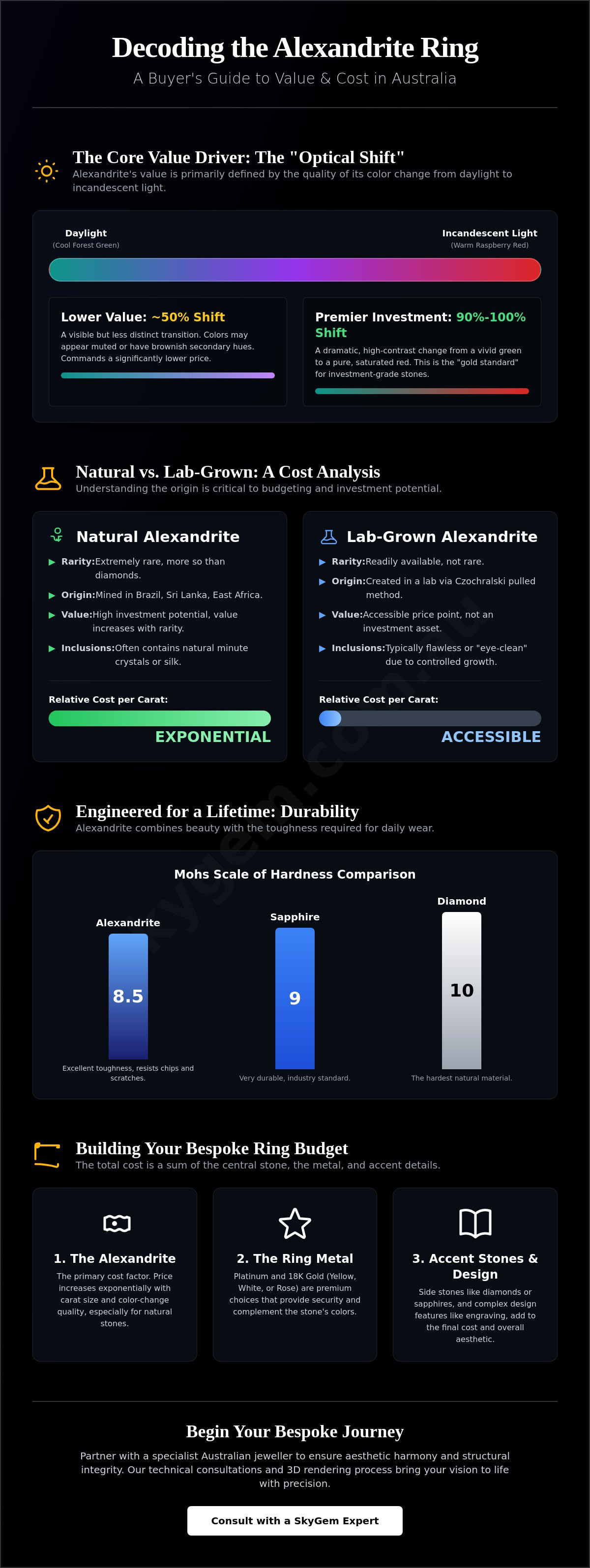
The stone's primary allure is its pleochroic nature, meaning it displays different colours when viewed from different angles or under different light wavelengths. In natural daylight, a high-quality alexandrite appears as a cool teal-green. When moved into warm, incandescent light, the chromium creates a shift toward a purplish-red hue. This transition is the most critical metric for valuation. A stone with a 100% colour change is considered the gold standard, while stones with less than 50% shift are valued significantly lower. For those exploring alexandrite gemstones, understanding this technical performance is essential for making an informed investment.
Durability for Daily Wear
Selecting a gemstone for an engagement ring requires a balance between aesthetic appeal and structural performance. Alexandrite ranks 8.5 on the Mohs scale of hardness. While it sits below diamonds (10) and sapphires (9), it remains one of the hardest natural gemstones available. It doesn't scratch easily. It also possesses excellent toughness, which is the stone's ability to resist chipping or fracturing under impact. This makes it perfectly suited for the active Australian lifestyle and daily wear over several decades. Its chemical stability ensures that it won't be damaged by common household exposures, making it a reliable, permanent asset for any wearer.
Factors Influencing Alexandrite Engagement Ring Cost
Calculating the alexandrite engagement ring cost australia requires a departure from standard diamond grading logic. While the Four Cs remain the foundation of gemstone evaluation, the hierarchy of these factors shifts significantly for this rare chrysoberyl. Colour performance is the primary driver of value, followed by clarity and carat weight. Unlike diamonds, where a slight inclusion might be overlooked in favour of a larger size, a large alexandrite with a muddy or weak colour change will consistently be valued lower than a smaller stone with a vivid, high-contrast transition. This technical hierarchy ensures that the stone's unique optical properties remain the focal point of the investment.
In the professional gemstone trade, price per carat doesn't follow a linear path. For natural alexandrite, significant price spikes occur at the 1.0ct and 2.0ct thresholds. Because natural crystals are rarely found in large, gem-quality sizes, a stone that crosses the 1.0ct mark becomes exponentially rarer. A 1.5ct stone won't just cost 50% more than a 1ct stone; it may cost double or triple due to the scarcity of the raw material. Clarity also plays a critical role. Natural alexandrite is often included with minute silk or crystals. When a specimen achieves an eye-clean rating while maintaining a strong colour shift, it enters a premier investment tier that commands a massive premium in the Australian market.
The Premium on Colour Change Percentage
Jewellers grade the "optical shift" on a scale ranging from weak to dramatic. According to the Gemological Institute of America (GIA), the quality of this colour change is the single most important factor in determining the stone's value. A "Strong" shift (usually 70% to 80%) or a "Dramatic" shift (90% or higher) represents the peak of market valuation. A 1ct stone with a 90% shift is technically superior and more valuable than a 2ct stone that only manages a 40% brownish-green to brownish-red shift. It's vital to view these stones under both natural Australian sunlight and warm indoor lighting to verify the percentage of the stone's face that actually changes colour. For those beginning their search, reviewing a curated selection of alexandrite gemstones can help establish a baseline for these visual differences.
Origin and Certification Costs
While the quality of the shift is paramount, the stone's origin still influences the final valuation. Brazilian alexandrite often carries a historical price premium due to its reputation for intense saturation and clean transitions. Regardless of the source, independent certification is mandatory for any high-value purchase. Reputable lab reports confirm the stone's natural origin and identify any treatments, though most high-end alexandrite is untreated. This documentation acts as a technical safeguard for your investment, ensuring the stone meets the rigorous standards required for a lifetime asset.
Natural vs. Lab-Grown Alexandrite Pricing in Australia
Choosing between natural and lab-created stones is the most significant decision impacting the alexandrite engagement ring cost australia. While both options share the same chemical composition and crystal structure, their market positions are vastly different. Natural alexandrite is a finite geological resource, whereas lab-grown alexandrite is a product of high-precision engineering. For the Australian buyer, this choice often comes down to a balance between long-term asset value and immediate aesthetic scale. Natural stones carry a significant premium due to their extreme rarity, while lab-grown alternatives provide a pathway to high-performance stones without the investment level required for a mined specimen.
The most advanced production technique for these stones is the Czochralski pulled method. In this process, a seed crystal is dipped into a molten mixture of chrysoberyl and chromium. As the seed is slowly rotated and pulled away, a large, high-purity crystal forms. This method produces stones that are chemically, physically, and optically identical to their mined counterparts. According to the Gemological Institute of America (GIA), these laboratory-grown specimens exhibit a colour change as dramatic as the finest natural stones, often with superior clarity. This technical precision ensures that the stone performs reliably under the varied light conditions found across the Australian landscape.
From a sustainability perspective, lab-grown stones appeal to those who prioritise a reduced environmental footprint and ethical transparency. Because they're created in controlled environments, the supply chain is direct and easily verified. However, natural stones retain an edge in terms of heirloom potential and resale value. A natural alexandrite is a geological anomaly. As global deposits deplete, high-quality natural specimens are increasingly viewed as portable assets that hold their value over generations. Lab-grown stones, while visually stunning and durable, are not finite resources and typically don't carry the same long-term investment weight.
Why Lab-Grown is an Accessible Luxury
Lab-grown alexandrite provides a solution for those who want a large, vivid centre stone on a practical budget. Because these stones are grown in a lab, they're often eye-clean and feature a near-perfect colour shift that would be nearly impossible to find in a natural stone of the same size. This allows you to focus your budget on a more intricate setting or higher-grade accent stones. If you're looking for a high-performance stone that offers exceptional value, you can browse our lab-grown gemstone options to see how these stones compare in various cuts and sizes.
Natural Alexandrite as a Rare Asset
For the collector or high-net-worth investor, natural alexandrite remains the ultimate choice. The scarcity of natural stones over one carat is so extreme that they're often sold before they even reach a retail showroom. These stones represent a tangible link to the earth's history, and their value is underpinned by their geological heritage. While they may contain minor natural inclusions, these "birthmarks" are often proof of their mined origin. To find a stone that balances rarity with exceptional colour performance, you can explore our rare natural alexandrite collection and consult with our specialists on current market availability.
How to Budget for a Bespoke Alexandrite Ring
Establishing a realistic budget for a custom project requires a clear understanding of the three primary cost pillars: the central gemstone, the metal setting, and the technical labour. The alexandrite engagement ring cost australia is a composite of these elements, where the bespoke process offers a level of precision and personalisation unavailable in mass-produced retail stock. While an off-the-shelf ring may seem convenient, it often forces compromises on stone quality or metal weight. A bespoke approach allows you to allocate your investment toward the specific performance metrics that matter most, such as the saturation of the colour change or the structural integrity of the band.
The price of craftsmanship in the Australian market involves several technical stages. This begins with Computer-Aided Design (CAD), where a specialist creates a digital model to ensure aesthetic harmony and structural stability. Following the 3D rendering, the piece undergoes casting, stone setting, and hand-finishing. This methodical workflow ensures the ring is a permanent asset rather than a temporary purchase. You should also account for hidden costs such as professional valuations and insurance, which protect the long-term value of your investment. Regular maintenance, including prong inspections and professional cleaning, should be factored into your long-term ownership plan.
Metal Choice and Setting Complexity
Your choice of metal impacts both the initial budget and the stone's visual performance. Platinum is the premium choice for rare gemstones due to its density and natural white lustre, which doesn't reflect unwanted warm tones into the alexandrite. It provides superior security for the prongs, though it carries a higher material cost than gold. 18K gold varieties—including white, yellow, and rose—are excellent alternatives. A simple solitaire engagement ring focuses the budget on the central stone, while an intricate halo or trilogy engagement ring requires more metal and labour. To see how these elements come together, learn about our bespoke design process and how we balance technical specifications with your aesthetic vision.
The Advantage of Loose Stone Selection
Selecting a loose stone before committing to a setting is the most transparent way to manage the alexandrite engagement ring cost australia. It allows you to inspect the "optical shift" without the interference of metal reflections or accent stones. This transparency ensures you're paying for the stone's actual performance rather than a clever setting that might mask inclusions or a weak colour change. We source specific stones to align with individual technical requirements and budget parameters. You can view our loose gemstones to begin comparing different cuts and shift percentages. Once you have secured your ideal stone, you can start building your custom engagement ring with confidence in the quality of your centrepiece.
The SkyGem & Co. Approach to Bespoke Alexandrite
SkyGem & Co. operates as a technical consultant rather than a traditional retailer, prioritising the intersection of engineering precision and aesthetic design. Understanding the alexandrite engagement ring cost australia is a collaborative process where we educate you on the specific performance metrics of your chosen stone. We believe transparency is the foundation of a successful project. By providing detailed data on colour-change percentages and clarity ratings, we ensure you make an informed investment that aligns with your long-term goals. Our business philosophy is built on price integrity, eschewing seasonal sales in favour of consistent, transparent year-round pricing.
Working with an independent boutique offers distinct advantages for sourcing rare gemstones like alexandrite. Unlike global corporations with rigid, mass-market inventories, we maintain a flexible global network to locate unheated and rare specimens that meet our exacting standards. This methodical approach ensures that every stone we set has been vetted for its optical performance and structural durability. Our solution-oriented design philosophy for 2026 focuses on creating structurally sound, visually balanced pieces that optimise the unique light-refractive properties of each specific stone. This approach guarantees that your ring is both a beautiful heirloom and a high-performing asset.
Expert Sourcing and Curation
Our curation process is designed to respect the reader’s professional time and investment. We leverage a specialized network to find stones that offer the best "optical shift" for your specific budget. Every stone undergoes a rigorous quality control check before it is even considered for a design. We look for:
- Saturation Precision: Ensuring the teal-green and purplish-red hues are vivid and distinct.
- Structural Integrity: Checking for internal inclusions that could compromise the stone's longevity.
- Cut Performance: Verifying that the faceting maximises the pleochroic effect of the chrysoberyl.
This commitment to quality over quantity ensures that we only present stones that represent the peak of regional expertise and design.
Finalising Your Vision
The path from initial concept to the final reveal is steady and deliberate. It begins with a technical consultation where we discuss your aesthetic preferences and budget parameters. We then move to the CAD design phase, producing a detailed 3D render. This step is crucial, as it allows you to visualise the final proportions and structural details before any metal is cast. We adhere strictly to the standards set by the Jewellers Association of Australia (JAA) and the National Measurement Act, ensuring your purchase is protected and meets all regulatory requirements. Once the design is finalised, our master setters hand-finish the piece in our Melbourne studio. To begin this journey, you can book a consultation to design your bespoke alexandrite ring and partner with an expert who values performance over hype.
Securing Your Investment for the Future
Investing in a colour-changing gemstone requires a methodical approach that prioritises technical performance over marketing hype. By focusing on the percentage of optical shift and the structural integrity of the setting, you ensure that your ring remains a permanent asset rather than a temporary purchase. Whether you select a natural specimen for its geological rarity or a lab-grown stone for its vivid precision, understanding the alexandrite engagement ring cost australia allows for a balanced and informed decision-making process.
SkyGem & Co. acts as your technical consultant, providing expert gemstone consultations to bridge the gap between complex specifications and aesthetic design. As specialists in unheated and rare gemstones, we offer independent boutique quality with a national reach, ensuring every project meets the highest regulatory standards. Our commitment to transparency and solution-oriented design provides the stability needed for such a significant milestone. Start your bespoke alexandrite journey with SkyGem & Co. today to create a piece that reflects both technical excellence and personal style. We look forward to partnering with you on this unique project.
Frequently Asked Questions
How much does a 1-carat natural alexandrite engagement ring cost in Australia?
Natural alexandrite prices for high-quality specimens with a strong colour change can exceed $30,000 AUD per carat. The total alexandrite engagement ring cost australia will vary based on the specific gemstone's origin, the complexity of the setting, and the inclusion of diamond or sapphire accents. Because natural crystals over one carat are exceptionally rare, the price per carat increases significantly at this threshold.
Is lab-grown alexandrite "real" alexandrite?
Lab-grown alexandrite is chemically, physically, and optically identical to natural mined alexandrite. It's a genuine chrysoberyl variety created through high-precision methods like the Czochralski pulled process. The Australian Competition and Consumer Commission (ACCC) considers "laboratory created" to be an acceptable descriptor for these stones. They provide a high-performance alternative for those seeking dramatic colour change without the scarcity premium of natural stones.
Why is natural alexandrite so much more expensive than sapphire?
Natural alexandrite is significantly more expensive than most sapphires because of its extreme geological rarity. While sapphires are found in relatively large quantities globally, the specific conditions required for chromium to enter a chrysoberyl crystal lattice are rare. This rarity, combined with the stone's unique optical shift, drives the market value far beyond that of standard precious gems.
Can I use alexandrite in a custom engagement ring design?
Alexandrite is an ideal centrepiece for a bespoke engagement ring design. It performs exceptionally well in various settings, including solitaire, halo, trilogy, and Toi et Moi engagement rings. Because the stone's colour changes under different light sources, a custom setting allows you to choose metal and accent stones that complement both its teal-green and purplish-red phases.
How do I care for and clean my alexandrite engagement ring?
Maintaining your ring requires simple but regular care to preserve its lustre. Use warm water, mild detergent, and a soft-bristled brush to remove daily oils and debris. While alexandrite has a high Mohs hardness of 8.5, it's best to avoid harsh household chemicals. Professional inspections every twelve months ensure the prongs remain secure and the stone is protected from accidental damage.
Does alexandrite look better in gold or platinum settings?
The choice between gold and platinum depends on your aesthetic goals and the stone's specific hues. Platinum and 18K white gold provide a neutral backdrop that doesn't interfere with the stone's teal-green daylight colour. Conversely, 18K yellow or rose gold can enhance the warm, purplish-red tones seen in incandescent light. Platinum is often preferred for its density and superior security for rare gemstones.
What is the most popular cut for an alexandrite engagement ring?
Oval and cushion cuts are the most popular choices because they maximise the stone's face-up size and colour-change performance. These shapes allow light to reflect through the crystal lattice in a way that highlights the transition between hues. Round brilliant cuts are also highly sought after for their superior fire, although they often result in more weight loss during the faceting process.
Are there any Australian mines for alexandrite?
There are currently no active commercial mines producing gem-quality alexandrite within Australia. Most natural specimens found in the domestic market are ethically sourced from established deposits in Brazil, Sri Lanka, or East Africa. While Australia is famous for its sapphires and opals, the specific geological environment required for alexandrite hasn't yielded significant commercial deposits locally.
Disclaimer
This article is for general informational purposes only and may include AI-assisted content. Pricing, specifications, and availability are subject to change. For accurate advice and current information, please contact SkyGem & Co. directly. Nothing in this content constitutes professional or financial advice.