
Alexandrite Colour Change and the Factors That Shape Quality

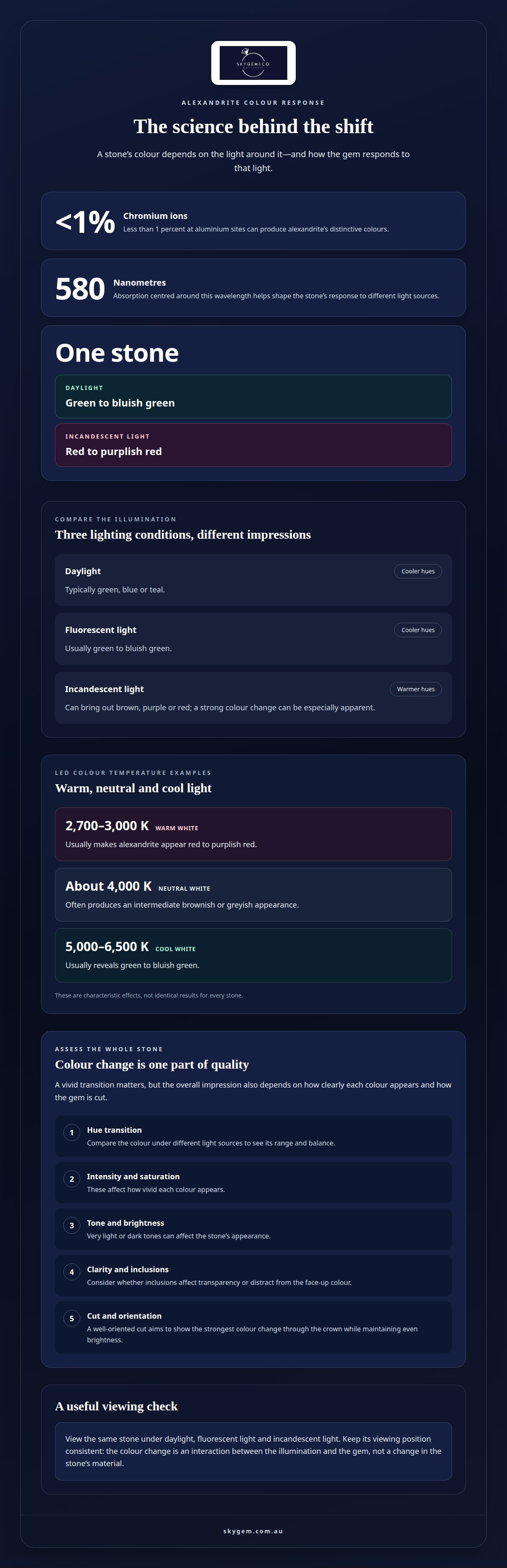
A dramatic colour shift alone doesn’t define a fine alexandrite. The key alexandrite colour change quality factors begin with chromium: less than 1 percent of chromium ions at aluminium sites can produce the stone’s distinctive colours, while absorption centred around 580 nanometres helps shape how it responds to different light sources. As a result, one stone can appear green to bluish green in daylight and red to purplish red under incandescent light.
That change is alexandrite’s defining appeal, but quality depends on more than how clearly it shifts between hues. Intensity, saturation, brightness, clarity and inclusions all shape the impression the stone makes.
This article explains how light and chromium create the colour change, then shows how to assess its strength alongside the other factors that influence quality. You’ll learn why a vivid transition matters, how very light or dark tones affect appearance, and why inclusions need to be considered in context.
Key Takeaways
- Assess an alexandrite under different light sources to understand the range and balance of its colour transition.
- Look beyond the change itself: brightness, tone and saturation affect how vivid each colour appears.
- Consider clarity and inclusions in context, since their visibility can influence appearance without defining quality on their own.
- Use colour-change strength as one quality indicator, while weighing it alongside cut, colour and clarity.
Clarity and inclusions
Alexandrite is classified as a Type II gemstone, a category in which visible inclusions are common. The Gemological Institute of America divides gemstones into three clarity types. Alexandrite often contains few inclusions, but that does not mean every stone looks flawless. The number, position, size and contrast of inclusions against the gem’s colour all affect its face-up appearance.
For Australian buyers, review any gem report alongside the written sales description. Check whether it identifies the stone as natural or laboratory-created, and note any disclosed treatments or clarity characteristics. Ask for written details about visible inclusions and colour-change behaviour, then view the stone under different light sources.
Some inclusions are more noticeable than others. A dark inclusion near the centre may interrupt the green and red face-up appearance, while a small feature near the edge may be less visible. Assess clarity by how inclusions affect transparency and the overall view, not simply by counting marks.
Inclusions can also create a distinctive optical effect. Long, thin features running parallel to one another may produce chatoyancy, also called the cat’s-eye effect. In this specific case, the inclusion pattern can increase a stone’s value rather than detract from it. The effect depends on how the features align and appear across the gem.
Cut quality works alongside clarity. A well-oriented cut aims to show the stone’s strongest colour change through the crown while maintaining even brightness. Poor orientation can weaken the face-up display, even when the rough material has attractive colour. The cut also affects how inclusions appear, as their position and visibility can vary with the gem’s facets and viewing angle.
Size makes clarity harder to find. Eye-clean alexandrites are rare above about 1 carat, while most fashioned stones weigh less than 1 carat. A larger stone with visible inclusions may still offer compelling colour, but its apparent transparency and brightness matter. Compare the inclusion pattern with the size and face-up appearance, rather than treating carat weight as a quality verdict.
Clarity and rarity contribute to value alongside colour and cut. Commercial-grade alexandrites account for 50-75% of gemstones and may show little or no colour change with heavy inclusions. That broad category illustrates why a clear-looking stone alone isn’t necessarily exceptional. The strongest assessment considers clarity alongside the shift between green and red, saturation, brightness and cut.
For a practical comparison, view each stone face-up and inspect its centre and edges. Consider whether inclusions distract from its colour or create an effect such as a cat’s eye. A report’s clarity comments, the stone’s orientation and its appearance under different lighting provide a more useful picture together than any single clarity label.
What causes the alexandrite colour change?
Alexandrite responds to changes in surrounding light, producing a visible shift between cooler and warmer hues. The effect depends on the light source’s mix of wavelengths and the wavelengths the stone transmits.
Colour Under Different Light Sources
Alexandrite’s apparent colour changes with the type and temperature of its illumination. In daylight, it typically appears green, blue or teal; fluorescent lighting usually brings out cooler green to bluish-green hues. Incandescent light shifts its appearance towards brown, purple or red, often making a strong change especially apparent.
LED colour temperature gives a useful example of this variation. Warm-white LEDs at about 2,700-3,000 K usually make alexandrite appear red to purplish red. Neutral-white LEDs at about 4,000 K often produce an intermediate brownish or greyish appearance. Cool-white LEDs or fluorescent light at about 5,000-6,500 K usually reveal green to bluish green. These are characteristic effects, not identical results for every stone.
Light Absorption and Transmitted Wavelengths
The colour-change effect occurs because alexandrite transmits green and red light equally, while different light sources contain different mixes of wavelengths. The stone doesn’t change its material when the lamp changes; the balance of light reaching the eye changes instead. That interaction explains why a single gem can show at least two colours under different illumination.
For example, a source rich in wavelengths that make the green component prominent can produce a cool appearance. Under incandescent light, the warmer wavelength mix can make the red component more visible. The resulting contrast depends on both the source and the stone, so viewing it under only one lamp gives an incomplete picture of its colour response.
Lighting and Colour Perception
Light sources affect colour perception because they illuminate alexandrite with different distributions of wavelengths. Daylight and fluorescent lighting commonly reveal cooler hues, while dim or incandescent lighting tends to bring out brown, purple and red. The dramatic shift is therefore an interaction between the illumination and the gem, not a fixed pair of colours visible in every setting.
Compare the same stone under daylight, fluorescent light and incandescent light, keeping its viewing position consistent. This helps distinguish a genuine change in hue from differences caused by the surroundings or viewing angle. A bright, clear transition is easier to assess when you can see the stone under both lighting conditions.
Natural origin and treatment can’t be established from colour change alone. Laboratory-created alexandrite has been synthesised since the 1960s and produced commercially since the 1970s, so rely on a gemmological report that identifies the stone and states any treatments.
For a considered viewing of alexandrite under varied lighting, use the appointment scheduling page.
How chromium causes alexandrite’s colour change
Chromium is the trace element responsible for alexandrite’s distinctive colouring. Its position in the crystal structure influences which wavelengths the gemstone absorbs and which colours reach the eye.
Chromium as the Colouring Element
Chromium acts as alexandrite’s colouring element, creating the optical conditions behind its green-to-red appearance. Its effect is unusually strong: less than 1 percent of chromium ions at aluminium sites is enough to produce alexandrite’s distinctive colours. This helps explain why a trace constituent, rather than a large proportion of the gemstone, can define its most recognisable visual feature.
Chromium Ions Replacing Aluminium Ions
In alexandrite’s crystal structure, chromium ions occupy sites normally held by aluminium ions. This substitution changes how the crystal interacts with incoming light. Chromium absorbs strongly in the yellow region of the spectrum, centred around 580 nanometres. That selective absorption shapes the light emerging from the stone, helping create its characteristic colour response.
The effect is not a surface coating or a layer that changes under a lamp. Chromium is incorporated within the alexandrite crystal, so its interaction with light occurs throughout the material. When illumination changes, the wavelengths available to pass through the gemstone change too. The chromium-bearing crystal then produces a different balance of visible colours.
This distinction matters when interpreting the green-to-red shift. Chromium creates the absorption behaviour, but it does not act alone as a simple colour switch. The light source provides a different mix of wavelengths, and the gem’s response determines the colours seen. A vivid transition therefore reflects both the stone’s composition and its illumination.
Chromium also helps explain how alexandrite differs from other gemstones that appear green. An emerald’s green colour does not, by itself, indicate alexandrite’s characteristic change. For alexandrite, the defining effect is the contrast between green hues in cooler lighting and red or purplish-red hues in warmer lighting.
Chromium content is not a direct quality score. A trace amount can produce the characteristic colours, but the visible result still depends on the stone’s overall optical response. Assess each stone under varied lighting rather than assuming that chromium guarantees a strong or balanced change.
Geographic origin can be associated with different colour characteristics, even among chromium-bearing alexandrites. Brazilian stones have been found with colours that rival Russian material, while Sri Lankan alexandrites tend towards yellowish greens and brownish reds rather than blue-greens and purplish reds. These examples show why chromium explains the mechanism, but colour quality must be judged from the finished stone.
In short, chromium’s role is essential but not sufficient to describe every visual difference. It absorbs strongly near 580 nanometres and occupies aluminium sites in the crystal. The resulting interaction with light underpins alexandrite’s change, while the gem’s particular colour balance determines whether that change appears subtle or dramatic.
Colour-change intensity and saturation
Intensity describes how strongly alexandrite’s visible hue shifts between lighting conditions; saturation describes how vivid each colour appears. The most desirable change is typically bright green in daylight to raspberry or purplish red under incandescent light. Dealers may express the strength as a percentage, but this is a visual estimate, not a measured result.
Intensity of the Colour Change
Reported colour-change strength can range from 5% to 100%, reflecting how noticeable the shift appears to an observer. A change described as 80-100% usually means a clear transition between bluish green and purplish red. By contrast, a softer shift may retain brownish or yellowish notes, making the two appearances less distinct.
Such figures are descriptive, not universal instrument readings. Two observers might assign different percentages to the same stone because viewing conditions and personal colour perception affect the judgement. Compare the gem under consistent lighting instead of treating a stated percentage as a laboratory measurement or complete quality grade.
Desirable Colour Changes
The most prized phenomenon is a strong transition from bright green in daylight to raspberry red under incandescent light. Colours closer to pure green and pure red, with a dramatic and complete shift, generally increase value. Purple or brown undertones can soften the contrast, although the overall impression also depends on brightness and saturation.
Intensity alone doesn’t determine appeal. A stone that is too light may lack colour strength, while an excessively dark stone can lose brightness and look almost black. Tone provides the backdrop for the shift: tones in the 75% to 85% range are described as favourable for a pronounced transition, while most alexandrites have tones in the 40% to 60% range.
Russian material is associated with the sought-after bluish-green and purplish-red combination, while yellowish green or brownish red hues create a different visual effect. Origin provides context, but it does not replace assessment of the individual stone’s colour, brightness and saturation.
Measuring or Grading Colour-Change Strength
Colour-change strength is commonly described with an estimated percentage, such as 80%, rather than a precise physical measurement. Treat that figure as a shorthand for the observer’s impression. It can help compare stones, but it doesn’t independently describe the exact hues, their saturation or how bright they look.
For a useful comparison, observe each stone under daylight and incandescent lighting, then note the hue in each setting and the contrast between them. A high estimated percentage paired with muted colours may look less vivid than a similarly described change with bright, saturated hues. Chromium explains the underlying colour response, but the visible grade remains an assessment of the finished gem.
When considering alexandrite colour-change quality factors, weigh the estimated strength alongside tone and saturation. A dramatic transition matters most when both colours remain distinct, bright and visually balanced.
Alexandrite colour-change quality
Colour change is alexandrite’s defining value factor, but quality depends on the complete face-up appearance. Assess the transition alongside colour purity, saturation, brightness and cut. A stone that changes hue dramatically may still look less balanced if one colour appears dull or the gem’s overall tone obscures its detail.
The most prized natural alexandrite combines green in daylight with reddish colour under incandescent light. The closer those hues are to pure green and pure red, the more distinctive the contrast. Moderate to strong saturation helps both colours remain vivid, while even brightness makes the transition easier to appreciate across the face of the stone.
Cutting influences how effectively the colour reaches the viewer. Alexandrite cutters orient the gem to show its strongest change through the crown and display both green and purplish-red pleochroic colours face-up. Pleochroism means different colours can appear in different crystal directions. Considered orientation brings those colours into the face-up view rather than hiding one.
Quality is an interaction between the gem’s optical properties and its finished cut. A strong colour response can be diminished by an uneven face-up appearance, while thoughtful orientation can reveal both colours clearly. Inspect the stone from above to see whether the transition is visible across its main viewing area, rather than only at one angle.
Fine alexandrite is exceptionally rare, and the top 1% of all-natural gemstones are described as having excellent colour change, high clarity and exceptional cutting. That benchmark illustrates why a single feature cannot define top quality. Colour, clarity and cut work together; an impressive change alone doesn’t establish that a stone belongs in this category.
Size needs context too. Most fashioned alexandrites weigh less than one carat, so a larger gem with a strong, balanced appearance is unusual. Carat weight describes mass, not the quality of the colour transition. Compare the stone’s face-up colour and brightness with its size instead of treating a larger measurement as proof of superior appearance.
For June birthdays, alexandrite is an alternative birthstone, but its appeal extends beyond that role. Its colour-changing character offers a different visual experience from diamonds, which do not display the same green-to-red transition. The clearest quality assessment considers how the alexandrite appears under different light sources and whether its cut presents both colours effectively.
The practical takeaway is to judge the whole stone: distinct colour change, pleasing saturation, balanced brightness and an orientation that shows both hues. These alexandrite colour-change quality factors provide a more useful assessment than any single label or measurement.
SkyGem & Co.
Once you understand how colour change, saturation, clarity and cut shape alexandrite’s appearance, SkyGem & Co. can help with your next jewellery decision. For an engagement ring, explore its Solitaire, Halo and Trilogy Engagement Rings, as well as Lab-Grown Diamonds. These options offer starting points for considering how a centre stone and its setting work together, without treating any one design as right for every wearer.
Choose a stone that feels right for you
Let your priorities guide the decision. Alexandrite colour-change quality factors matter most when they help you identify an appearance you’ll enjoy wearing, rather than simply meet an abstract ideal. Consider how the stone’s character will suit your preferred jewellery design and personal style.
For an engagement ring, the setting is part of the decision. SkyGem & Co. offers Solitaire, Halo and Trilogy Engagement Rings, giving you different design directions to consider alongside your centre stone. A thoughtful selection brings the gem and its setting together in a way that feels coherent and personal.
When you’re ready, book a consultation with SkyGem & Co. to discuss alexandrite and design possibilities that suit your plans.
Frequently Asked Questions
What is alexandrite?
Alexandrite is a rare, colour-change variety of chrysoberyl, with the chemical formula BeAl2O4. Its distinctive appearance comes from how the gemstone responds to different illumination. It’s also an alternative birthstone for June. When comparing a loose stone with jewellery, consider both its identity as chrysoberyl and its visible colour response, rather than relying on a colour description alone.
What causes alexandrite to change colour between daylight and incandescent light?
Alexandrite’s colour change comes from its interaction with light: the stone transmits green and red light, while daylight and incandescent sources contain different mixes of wavelengths. This lets a stone appear green in daylight and red under incandescent lighting without its material changing. For a clear comparison, keep the viewing angle and surroundings consistent as you switch between the two sources.
How do hue, saturation, and tone affect alexandrite quality?
Hue describes the colour family, saturation its vividness, and tone how light or dark the stone appears. Together, these traits determine whether the colours look distinct and lively or muted. For example, vivid green and red can lose impact if the stone appears too dark. Consider the colours under both lighting conditions, since one attractive hue alone does not show the full balance.
How do clarity, inclusions, and transparency affect alexandrite value?
Clarity and transparency influence how clearly light and colour appear through the stone. An inclusion near the centre may draw the eye or interrupt the face-up appearance, while one near the edge may be less prominent. Alexandrite is a Type II gemstone, so visible inclusions are common. Compare their placement and effect on transparency instead of judging quality by inclusion count alone.
How do cut, proportions, and shape influence alexandrite colour change?
Cut determines the stone’s orientation and how its colours appear face-up; shape describes its outline. Alexandrite is commonly fashioned with a brilliant-cut crown and step-cut pavilion. A well-oriented cut can show both colours through the crown, while uneven brightness can make the face-up appearance less balanced. Compare the colour display across the whole stone, not just its outline.
How does carat weight affect alexandrite rarity and price per carat?
Larger alexandrites are rarer, and per-carat value can rise sharply when size combines with strong colour change and good clarity. Most fashioned stones weigh less than one carat; stones over two carats are considered large, and those over five carats exceptionally rare. Carat weight alone does not establish value, because colour, clarity and cut also shape the finished gem’s quality.
What are current alexandrite prices by quality and carat size?
There is no single price for every alexandrite. Value depends on whether the stone is natural or laboratory-created, its carat weight, strength of colour change, hue, clarity and cut. Natural stones with strong colour and eye-clean clarity differ substantially from stones with weaker change or heavier inclusions. For an Australian comparison, consider these qualities together rather than using carat weight as a price guide.
Which lighting conditions should be used to assess alexandrite colour change?
Assess alexandrite in daylight and incandescent light, then compare its appearance under fluorescent lighting if available. These sources reveal different aspects of the stone’s colour response. Avoid drawing conclusions from a single display light: a neutral-white LED can produce an intermediate brownish or greyish appearance. View the gem face-up under each source to compare its colour balance consistently.