
2026 Buyer's Guide: Pavé Diamond Ring Ownership Costs

While most buyers focus on the initial carat weight and clarity of the centre stone, the long-term integrity of the setting often dictates the true financial commitment of the piece. You likely selected a pavé setting for its intricate brilliance, yet it's common to feel a sense of apprehension regarding the security of those small accent stones or the rising costs of insurance premiums. To make an informed investment, you must evaluate the total cost of ownership for a pave diamond ring rather than just the initial acquisition price. High-quality jewellery is an evolving asset, and understanding the technical requirements of its upkeep is essential for any serious collector.
This guide provides a detailed breakdown of these long-term financial commitments, moving beyond the showroom to examine the technical realities of maintenance and protection. We will explore how precision CAD design and expert craftsmanship mitigate repair risks. You'll gain a clear financial roadmap for ownership in the Australian market, from annual professional cleaning and prong tightening to calculating insurance based on current A$ valuations. By focusing on structural durability and proactive care, you can ensure your investment remains as secure as it is beautiful.
Key Takeaways
- Understand why the total cost of ownership for a pave diamond ring extends beyond the initial purchase to include lifetime maintenance and insurance premiums.
- Learn how the "six-month rule" for professional inspections can prevent the loss of small accent stones and reduce long-term repair expenses.
- Discover the importance of specialised Australian jewellery insurance and annual appraisals in protecting your asset against A$ replacement value fluctuations.
- Explore how bespoke engineering and CAD design can "build out" common structural vulnerabilities, ensuring your setting remains secure for decades.
- Compare the long-term financial implications of natural versus lab-grown diamonds within a pavé configuration to align with your personal investment goals.
Defining the Total Cost of Ownership (TCO) for Pavé Jewellery
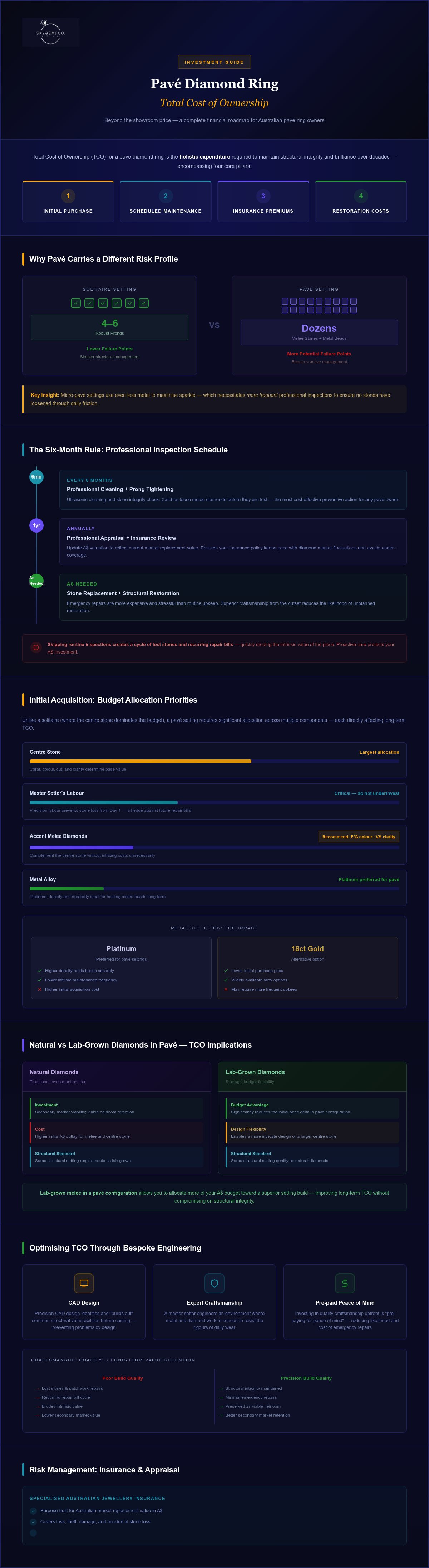
Understanding the financial commitment of high-end jewellery requires looking beyond the initial invoice. For many Australians, the acquisition of an engagement ring is a significant capital outlay, yet the ongoing management of that asset is frequently overlooked. Total cost of ownership for a pave diamond ring encompasses the initial purchase price, scheduled maintenance, insurance premiums, and potential restoration costs. TCO for a pavé diamond ring is the holistic expenditure required to maintain structural integrity and brilliance over decades. By viewing the ring as a permanent technical asset rather than a decorative accessory, you can better plan for the fiscal realities of its lifespan.
Craftsmanship acts as the primary lever in controlling these long-term costs. A master setter doesn't just place stones; they engineer an environment where metal and diamond work in concert to resist the rigours of daily wear. When you choose a setting that prioritises structural integrity, you're effectively pre-paying for peace of mind. This proactive approach reduces the likelihood of emergency repairs, which are often more expensive and stressful than routine upkeep. It's a shift in perspective from buying a product to managing a project.
The "Hidden" Variables of Pavé Settings
In a pavé configuration, the sheer number of stones introduces a different risk profile than a simple solitaire. While a solitaire relies on four or six robust prongs, a pavé band may feature dozens of melee diamonds, each held by microscopic beads of metal. The mathematics are simple: more stones mean more potential points of failure. The specific diamond cut and setting styles chosen directly influence these risks. For instance, micro-pavé settings use even less metal to maximise sparkle, which necessitates more frequent professional inspections to ensure no stones have loosened through daily friction. Choosing a style that matches your lifestyle is critical for managing your total cost of ownership for a pave diamond ring.
TCO vs. Resale Value: A Long-term Perspective
Investing in superior craftsmanship at the outset is a strategic move to reduce lifetime friction. A poorly engineered setting often leads to a cycle of lost stones and recurring repair bills, which quickly erodes the value of the piece. Conversely, a custom made engagement ring designed with technical precision prioritises the security of every accent stone. This preserves the asset's intrinsic value and ensures it remains a viable heirloom. High-quality initial builds retain better value in the secondary market because they don't show the tell-tale signs of repeated, patchwork repairs. Professional maintenance doesn't just fix problems; it protects your A$ investment against the inevitable wear of a lifetime. The psychological benefit of knowing your stones are secure is as valuable as the financial saving itself.
Initial Acquisition Costs: The Foundation of Your Investment
The initial acquisition cost of a pavé ring is more than the sum of its raw materials. It represents a complex engineering project where the centre stone, accent melee, metal alloy, and setter's labour must be balanced. Unlike a solitaire, where the centre stone often accounts for the vast majority of the budget, a pavé setting requires a significant allocation for the master-setter's time. This precision labour is a critical component of the total cost of ownership for a pave diamond ring, as a well-set ring prevents stone loss from day one. Investing in high-quality craftsmanship at this stage acts as a hedge against future repair bills.
Choosing the "sweet spot" for accent stones is essential for aesthetic and financial harmony. We recommend F/G colour and VS clarity to ensure the melee diamonds complement a high-quality centre stone without inflating costs unnecessarily. Using lab-grown diamonds in a pavé configuration can significantly reduce the initial price delta, allowing for a more intricate design or a larger centre stone while maintaining the same structural standards as natural diamonds. This choice allows you to allocate more of your A$ budget toward a superior setting build.
Metal Selection: Platinum vs. 18ct Gold Cost Analysis
Platinum is often the preferred choice for pavé due to its density and "memory-less" property, which means prongs bend rather than snap under pressure. While the initial premium for platinum is higher, it avoids the recurring maintenance costs associated with white gold. 18ct white gold requires rhodium plating every 12 to 24 months to maintain its bright finish, a recurring expense that impacts your long-term budget. Additionally, platinum’s durability provides a superior foundation for micro-prongs, reducing the risk of stone loss. Understanding these jewelry insurance costs and coverage requirements early helps in selecting a metal that balances initial outlay with long-term protection.
The Premium of Master-Set Pavé
Mass-produced, machine-cast settings are often cheaper at the point of sale, but they frequently lack the structural integrity required for a lifetime of wear. These settings often have porosity or tiny air bubbles in the metal that weaken the prongs. In contrast, SkyGem’s custom design process utilises advanced CAD technology to engineer precise seats for every accent stone. This technical precision ensures that each melee diamond is held by the optimal amount of metal. While the initial investment in master-set labour is higher, it significantly lowers the total cost of ownership for a pave diamond ring by minimising stone loss and setting failures. If you're ready to discuss a technically superior build, you can book a design consultation with our specialists.
Long-term Maintenance: Managing Recurring Ownership Costs
Maintaining a pavé setting requires a disciplined approach to technical oversight. While a solitaire might endure years of neglect without catastrophic failure, the intricate nature of pavé demands regular intervention to ensure stone security. The 6-month rule is the industry standard for professional inspections; during these sessions, a master setter examines every micro-prong under high magnification. This proactive check-up is a fundamental component of the total cost of ownership for a pave diamond ring. It allows for the detection of "sprung" prongs before they lead to stone loss. A premium pavé ring typically requires biannual inspections, one or two professional refinishing sessions, and potentially a selective prong retipping within its first decade of service.
Budgeting for stone replacement is a practical necessity for any pavé owner. Even with meticulous care, the microscopic prongs holding melee diamonds are susceptible to snagging on fabrics or impact from hard surfaces. Replacing a lost melee diamond in Australia involves the cost of the stone plus the labour for precision setting. While individual replacements are manageable, frequent losses often indicate a structural issue or a lack of preventative tightening. Owners should also be cautious with home ultrasonic cleaners. The high-frequency vibrations that remove dirt can also vibrate small stones out of their seats if the prongs are already compromised, making professional cleaning the safer, albeit more structured, option.
The Cost of "Wear and Tear" Repairs
Metal is a sacrificial element in jewellery design. Over years of contact with hard surfaces, the prongs holding your diamonds will slowly wear down, a process known as thinning. Retipping prongs involves adding fresh metal to the existing structure to restore its grip. This is particularly critical for pavé bands where the stones are smaller and more vulnerable to shifting. Resizing presents another significant financial and technical hurdle. Because stones are set into a precisely engineered arc, changing the ring's diameter can distort the stone seats and cause melee to pop out. This technical complexity makes resizing pavé rings more expensive than plain bands, reinforcing the value of accurate sizing during the initial bespoke design phase.
Professional Restoration Services
Restoration is about maintaining the asset's structural and aesthetic integrity over decades. Professional polishing and refinishing remove the patina of wear from platinum or gold, restoring the original lustre. During this process, a technician will also perform stone tightening as a preventative measure. This ensures that the total cost of ownership for a pave diamond ring remains predictable by avoiding emergency repairs. For those seeking a structured approach to upkeep, jewellery repair and maintenance fees should be viewed as an investment in the ring's longevity. Regular professional care ensures that the precise environment created during the CAD design phase remains intact for the life of the piece.
Risk Management: Insurance and Appraisal Costs
Managing the financial risk of a high-value asset requires a specific insurance strategy. While many Australians assume their home and contents policy covers their engagement ring, these general policies often have low sub-limits for individual items of jewellery. Specialised jewellery insurance is a superior alternative, offering comprehensive coverage for accidental damage, loss, and theft, even when outside the home. This specialised protection is a non-negotiable factor in the total cost of ownership for a pave diamond ring. Annual premiums are typically calculated as a percentage of the ring's total replacement value, making accurate and current documentation essential for both coverage and cost-efficiency.
Regular appraisals are a mandatory ownership cost every two to three years. In the Australian market, fluctuations in the A$ and global diamond prices mean that a five-year-old valuation may no longer reflect the true cost of replacement. If your valuation is outdated, you risk being under-insured in the event of a total loss. These professional assessments ensure your premium remains aligned with current market realities, providing a transparent financial bridge between your initial investment and your ongoing protection strategy.
The Value of GIA Documentation
Having a definitive technical record of your centre stone is the most effective way to streamline the insurance process. Natural GIA certified diamonds come with a unique serial number and a detailed grading report that removes any ambiguity during a claim. This documentation ensures that if a replacement is required, the insurer must provide a stone of identical quality. It protects the asset’s intrinsic value by establishing a verified baseline for its physical properties, such as cut precision and clarity, which are often the first things compromised in lower-quality replacements.
Claiming for Lost Accent Stones
When a single pavé stone is lost, the owner faces a strategic financial decision. Most insurance policies include an "excess" amount that must be paid before a claim is settled. In many cases, the cost of replacing a single melee diamond and the labour for setting it is lower than the policy excess. This makes an insurance claim financially illogical for minor pavé damage. Relying on insurance for small repairs often leads to higher long-term premiums. This reality reinforces why the total cost of ownership for a pave diamond ring is lower when you invest in preventative maintenance and high-quality initial settings. Proactive care is almost always more cost-effective than reactive claims.
Optimising TCO Through Bespoke Engineering
Bespoke engineering represents the most effective method for controlling the total cost of ownership for a pave diamond ring. While ready-to-wear pieces often prioritise immediate visual impact over structural longevity, a custom-engineered ring allows for the adjustment of technical specifications that directly influence your long-term budget. By increasing prong thickness by even a fraction of a millimetre or refining the "seat" where each melee diamond rests, we can significantly reduce the risk of stone displacement. This proactive approach to design ensures that the setting remains a stable environment for the accent stones throughout its multi-decade lifespan. It’s a strategy that treats the jewellery as a high-performance asset rather than a simple accessory.
Design Decisions That Lower Future Costs
Strategic design choices can drastically alter the maintenance trajectory of your piece. For example, the "half-pavé" style provides a significant durability advantage by keeping the palm-side of the ring as solid metal. This area experiences the highest levels of impact and friction, so avoiding stones here prevents the microscopic prongs from being crushed or worn down prematurely. Selecting metals like platinum or high-density 18ct gold also plays a role in reducing the frequency of professional refinishing. Integrating protective design elements, such as subtle galleries or side rails, provides a physical barrier for the micro-prongs against snags. These engineering decisions are central to managing the total cost of ownership for a pave diamond ring, ensuring your A$ investment isn't eroded by avoidable repair cycles.
The SkyGem Consultation Advantage
Our role at SkyGem & Co. is to act as technical consultants who understand the rigors of the Australian professional landscape. The custom made engagement ring process involves a detailed analysis of your lifestyle to engineer out common pavé failure points before the first stone is set. We provide a transparent roadmap for your ring’s future care, helping you budget for periodic professional cleaning and prong tightening. This partnership ensures you have access to expert maintenance support throughout the life of the piece. By prioritising technical precision and high-quality craftsmanship at the design stage, we help you achieve the financial efficiency of a "buy once, buy well" philosophy. This ensures your ring remains a permanent and evolving asset rather than a source of recurring financial friction.
Securing the Future of Your Investment
A pavé diamond ring is a sophisticated technical asset that requires a proactive management strategy. By prioritising expert CAD engineering and structural integrity at the design phase, you effectively lower the total cost of ownership for a pave diamond ring over its lifespan. We've explored how high-quality craftsmanship, combined with GIA certified diamond sourcing, establishes a robust foundation that resists the common failure points of mass-produced settings. Scheduled maintenance and accurate Australian appraisals ensure your piece remains both structurally sound and financially protected against market fluctuations.
Choosing a partner who offers comprehensive lifetime maintenance guidance is the final step in protecting your A$ investment. When you treat your ring as a permanent asset rather than a one-off purchase, you ensure its brilliance remains untarnished for decades. This holistic approach transforms a complex purchase into a rewarding long-term partnership.
We look forward to helping you engineer a piece that balances aesthetic brilliance with enduring structural reliability.
Frequently Asked Questions
How much should I budget annually for pavé ring maintenance?
Budgeting for maintenance involves professional cleaning and occasional melee replacement. While costs vary based on usage, a dedicated fund for biannual inspections ensures the total cost of ownership for a pave diamond ring remains manageable. Proactive care prevents the loss of multiple stones, which is significantly more expensive than routine tightening. You should also factor in the cost of rhodium plating every 12 to 24 months if you choose white gold over platinum.
Does pavé jewellery lose diamonds easily?
Stone loss is not inevitable but represents a higher risk in pavé settings compared to solitaires due to the microscopic prongs involved. High-quality CAD design and master-setting create more secure seats for each stone, reducing this risk. However, daily activities that involve heavy impact or friction can snag these delicate prongs. Regular professional inspections are the most effective way to identify loose stones before they fall out during your daily wear.
Is it more expensive to insure a pavé ring than a solitaire?
Insurance premiums are primarily calculated based on the total replacement value of the piece in the Australian market. A pavé ring often has a higher replacement value than a simple solitaire because of the additional melee diamonds and the intense labour required for the setting. Consequently, the annual premium may be slightly higher. Using specialised jewellery insurance ensures that the intricate labour and specific diamond quality are covered, which general contents insurance often limits.
Can a full pavé eternity band be resized?
Resizing a full pavé eternity band is technically challenging and often impossible without compromising the setting's integrity. Because stones are set around the entire circumference, stretching or compressing the metal distorts the individual stone seats. This can lead to stones popping out or prongs breaking. It's essential to confirm an accurate size during the bespoke design phase or opt for a half-pavé style that allows for a small metal sizing bar.
How often should a pavé ring be professionally inspected?
You should have your pavé ring professionally inspected every six months. This interval allows a master setter to examine the micro-prongs under magnification for signs of wear or thinning. Identifying a bent prong early is a key strategy in controlling the total cost of ownership for a pave diamond ring. These frequent checks ensure that any minor issues are addressed before they escalate into the loss of accent stones or structural failure.
What is the best metal for a pavé setting to minimize long-term costs?
Platinum is the superior choice for minimising long-term maintenance costs in pavé settings. Unlike white gold, platinum doesn't require regular rhodium plating to maintain its colour, which removes a recurring expense. Its density also means that prongs are more likely to bend than snap, providing better protection for small diamonds. While the initial acquisition cost is higher, the reduced maintenance requirements make it a more cost-effective and reliable option over several decades.
Is lab-grown diamond pavé cheaper to maintain than natural diamond pavé?
Maintenance and restoration costs are identical for both lab-grown and natural diamond pavé settings. The technical requirements for cleaning, prong tightening, and metal refinishing don't change based on the diamond's origin. While lab-grown diamonds offer a lower initial purchase price, the labour required to set and secure them remains the same. The long-term financial commitment is dictated by the setting's complexity and the metal chosen rather than the specific stone type used.
What happens if I lose a small diamond from my pavé setting?
If a small diamond is lost, you should visit a professional jeweller as soon as possible for a replacement and setting service. The technician will source a matching melee diamond and secure it into the existing seat. They will also inspect the surrounding prongs to ensure no other stones are at risk. It's often cheaper to pay for this repair out-of-pocket than to claim on insurance, given the standard policy excess amounts in Australia.
Disclaimer
This article is for general informational purposes only and may include AI-assisted content. Pricing, specifications, and availability are subject to change. For accurate advice and current information, please contact SkyGem & Co. directly. Nothing in this content constitutes professional or financial advice.