
Unheated Ruby Price Per Carat: The 2026 Guide to Value, Rarity, and Sourcing

An investment-grade ruby with no thermal enhancement is no longer just a luxury; it's a finite geological asset that has outperformed many traditional portfolios with a 15% value increase in the Australian market since early 2023. You're likely aware that the unheated ruby price per carat can swing by thousands of dollars based on a single line in a laboratory report, which creates a high-stakes environment for any serious collector. It’s natural to feel concerned about the technical gap between a "heated" stone and a truly rare, unheated specimen, especially when price tags for top-tier gems frequently exceed A$30,000 per carat in 2026.
We've designed this guide to remove the ambiguity from your acquisition process by detailing exactly how origin, fluorescence, and crystal clarity dictate current market valuations. You’ll learn to decode GIA and SSEF reports with the precision of a technical consultant, ensuring your capital is protected against misidentified treatments. We’ll also examine the long-term ROI of these stones and provide a clear path to sourcing authenticated rubies through a trusted Melbourne specialist, giving you the confidence to secure a legacy-grade asset.
Key Takeaways
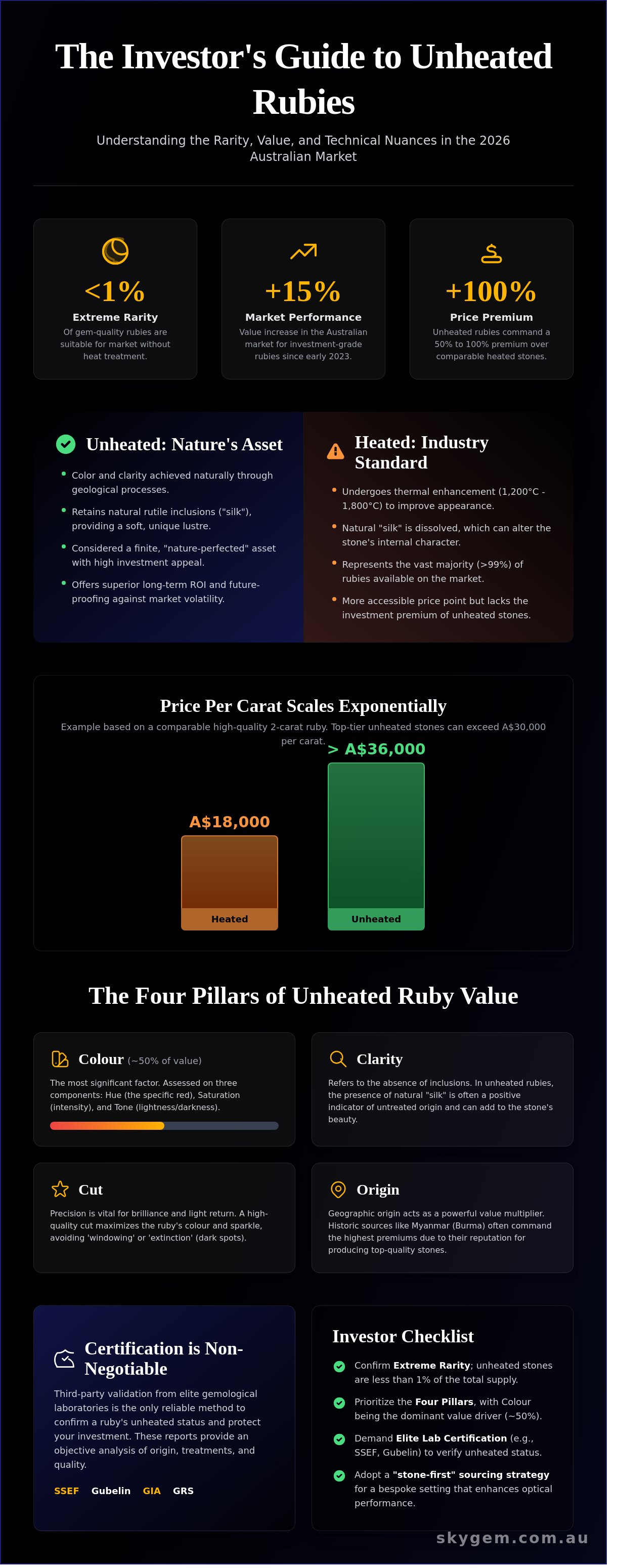
- Understand the extreme rarity of natural gemstones that achieve optimal colour and clarity without thermal enhancement, representing less than 1% of global gem-quality supply.
- Evaluate the 2026 Australian market landscape to understand how the unheated ruby price per carat scales exponentially as stone size and weight increase.
- Identify the critical technical drivers of value, from geographic origin to the specific saturation and tone levels that define investment-grade rubies.
- Learn why third-party validation from elite laboratories like SSEF or Gubelin is the only reliable method to confirm a gemstone’s unheated status and future-proof its value.
- Discover the technical benefits of a "stone-first" sourcing strategy, allowing for a bespoke setting designed to enhance the specific optical performance of your selected ruby.
Understanding the Premium: What Defines Unheated Ruby Price Per Carat?
The unheated ruby price per carat reflects a combination of extreme geological rarity and a growing preference for untreated assets in the 2026 luxury market. To understand this premium, we must first define what an unheated ruby is. These are natural gemstones that have reached their final colour and clarity entirely through geological processes, without any human-led thermal enhancement. While most rubies undergo heating to improve their appearance, unheated stones remain exactly as they were pulled from the earth, save for cutting and polishing.
Rarity is the primary driver of value here. Statistical data from major mining operations in Mozambique and Myanmar indicates that less than 1% of all gem-quality rubies are suitable for the market without heat treatment. This scarcity creates a steep pricing curve. An unheated ruby typically commands a 50% to 100% price premium over its heated counterparts of similar weight and visual grade. For instance, if a high-quality 2-carat heated ruby costs A$18,000, a comparable unheated specimen can easily exceed A$36,000. This isn't just a markup for "purity"; it's a reflection of the difficulty in sourcing stones that nature has already perfected.
In 2026, the psychological and investment appeal of these gemstones has intensified. Investors increasingly view unheated rubies as "nature-perfected" assets that offer a level of future-proofing not found in treated stones. As synthetic production and advanced treatments become more sophisticated, the market places a higher premium on stones with a documented, untouched history. It's a shift toward tangible, finite resources that serve as a hedge against market volatility.
Natural vs. Heated: The Gemological Divide
Heat treatment is a standard industry practice, but it fundamentally alters the Ruby gemstone properties. High temperatures, often ranging from 1,200°C to 1,800°C, dissolve internal rutile inclusions known as "silk." This process improves clarity but removes the stone's natural internal fingerprint. Common commercial rubies also undergo flux healing, where chemicals fill surface-reaching fractures. Unheated rubies retain their natural silk, which provides a soft, glowing lustre that treated stones often lack. Because these differences are microscopic, unheated status must be verified by independent laboratories like GIA or GRS to justify the unheated ruby price per carat.
The 2026 Market Context for Ruby Scarcity
The current market is shaped by significant global supply chain shifts. Geopolitical changes in traditional mining regions have constricted the flow of new material, making existing inventory more valuable. Unheated rubies are now firmly established as a "safe haven" asset, similar to rare pink diamonds or high-grade bullion. For those looking to acquire these rare specimens, viewing loose rubies currently available in the Australian market is essential for benchmarking current A$ valuations. This scarcity ensures that unheated stones aren't just decorative items but are strategic long-term acquisitions for serious collectors.
The Four Pillars of Value: Colour, Clarity, Cut, and Origin
Valuation of untreated gemstones requires a technical framework that prioritises optical performance and rarity. While heat-treated stones are common, the unheated ruby price per carat is dictated by a strict hierarchy of four variables. Colour remains the most significant driver, accounting for approximately 50% of the total valuation. Expert graders evaluate this through three lenses: hue, tone, and saturation. A shift in saturation from 'vivid' to 'strong' can result in a price variance of A$4,000 to A$7,000 per carat for a 2-carat specimen. Clarity and cut follow, ensuring the stone manages light efficiently, while geographic origin acts as a final multiplier for investment-grade assets.
Precision in cutting is often overlooked but remains vital for light return. A poorly proportioned cut can cause 'extinction', where areas of the stone appear black and lifeless, or 'windowing', where light passes straight through the centre. In the Australian market, collectors look for stones that exhibit high brilliance even in lower ambient lighting conditions. Detailed technical analysis, such as the data provided by GIA on ruby quality, helps buyers understand how these physical properties interact to create value.
The 'Pigeon’s Blood' Standard and Colour Saturation
The 'Pigeon’s Blood' designation represents the pinnacle of ruby grading, specifically describing a vibrant red with a soft blue secondary hue. This effect is often enhanced by strong natural fluorescence, which makes the stone appear to glow in UV-rich environments like Australian sunlight. Saturation levels must be high without becoming 'over-dark'. Stones with a tone exceeding 80% often lose their 'life' in indoor settings, significantly reducing their market liquidity. A true Pigeon's Blood unheated ruby can command prices exceeding A$35,000 per carat in the current 2024 market.
Geographic Origin: Burma vs. The New Frontiers
Burmese rubies, particularly those from the Mogok Valley, maintain a historical premium of 30% to 50% over stones from other regions. This isn't merely sentiment; the marble-hosted geology of Mogok typically produces stones with lower iron content and higher fluorescence. However, Mozambique has emerged as a powerhouse since the 2009 discovery of the Montepuez mines. These stones offer exceptional transparency and larger sizes at a more accessible price point. Madagascar has also disrupted the landscape since 2015, producing 2-carat plus unheated stones that rival Burmese quality but at a 25% discount, providing a strategic entry point for B2B procurement and private portfolios.
Clarity and Inclusions: Reading the Stone's DNA
In the world of unheated gems, 'eye-clean' is the gold standard for clarity. Because these stones haven't been subjected to high-heat treatment, they retain their natural 'DNA' in the form of inclusions. Common markers include fine rutile 'silk' and crystal fingerprints. These features are essential for laboratories to certify a stone as unheated. You should avoid 'deal-breaker' inclusions, such as large surface-reaching fissures or dark crystals located directly under the table. These flaws don't just affect aesthetics; they compromise the stone's structural durability during the setting process. For those seeking technical advice on selecting durable, high-performance assets, consulting with a specialist ensures you avoid costly procurement errors.
Comparing the Market: Unheated Ruby Price Tiers in 2026
The unheated ruby price per carat in 2026 reflects a market defined by extreme scarcity and a widening gap between commercial and investment-grade stones. Unlike mass-produced commodities, these gemstones follow an exponential pricing model where value isn't a simple multiple of weight. A 2.00-carat stone often commands a price four to five times higher than a 1.00-carat stone of identical quality. This premium accounts for the geological rarity of large crystals forming without significant inclusions or structural fractures. When selecting a centre stone for engagement rings, the jump from a 1.50-carat to a 2.00-carat ruby can shift the total project budget by A$30,000 or more.
Current 2026 data indicates 'Fine' quality unheated rubies range from A$18,000 to A$32,000 per carat. 'Extra Fine' specimens, which exhibit superior chromatic saturation and high clarity, frequently exceed A$75,000 per carat. If a laboratory certificate from SSEF or GRS designates the colour as 'Pigeon's Blood', expect an additional 40% premium on the final retail price. This designation isn't merely a marketing term; it's a technical classification based on specific iron and chromium levels that create a high-fluorescence 'glow' under UV light.
The Exponential Price Jump at Carat Milestones
- 1.00 Carat: This serves as the entry point for investment-grade unheated rubies. While smaller stones exist, the 1.00-carat mark is where the unheated ruby price per carat begins to accelerate. Expect to pay between A$12,000 and A$25,000 for stones with acceptable transparency.
- 2.00 - 3.00 Carats: Rarity begins to outpace demand at this level. These stones are the 'sweet spot' for high-end collectors. A 2.50-carat stone of top quality is significantly rarer than a 5.00-carat diamond, leading to prices that often reach A$120,000 per carat for 'Extra Fine' qualities.
- 5.00+ Carats: These are museum-quality assets. Pricing is rarely fixed and is usually determined via private treaty or international auction houses. At this size, the price per carat can exceed A$350,000 depending on the stone's origin and silk distribution.
Investment Potential and Long-term Value Retention
Unheated rubies have demonstrated exceptional resilience, showing a compound annual growth rate of 9.4% between 2016 and 2026. This performance consistently outpaces standard colourless diamonds, which have faced price pressure from the proliferation of lab-grown alternatives. Because unheated rubies cannot be replicated or artificially enhanced without detection, they remain a finite and stable asset class. Their value remains liquid in secondary markets because of the dwindling supply from traditional sources like the Mogok Valley and the Montepuez mines in Mozambique.
Investors focus on stones with minimal 'extinction' (dark areas) and high 'brilliance' to ensure future resale potential. A ruby's liquidity is directly tied to its certification; a report from a top-tier lab like GRS or Gubelin is essential for verifying the 'no heat' status. These technical documents act as a guarantee of the stone's natural state, ensuring the asset retains its premium value against lower-tier, heat-treated alternatives that dominate the commercial market.
Navigating the Purchase: Certification and Ethical Sourcing
Confirming the "unheated" status of a gemstone requires more than a visual inspection. It's a technical determination made through microscopic analysis of internal inclusions and trace element chemistry. For an investment of this magnitude, a reputable lab report is the only evidence that protects your capital. Without this documentation, the unheated ruby price per carat remains speculative. High-level laboratories use advanced spectroscopy to detect the presence of glass filling or thermal alterations that are invisible to the naked eye.
The unheated ruby price per carat is intrinsically linked to the prestige of the issuing laboratory. For stones destined for high-value portfolios, three institutions set the global benchmark. The Gemological Institute of America (GIA), founded in 1931, provides the most widely recognised reports in the Australian market. For exceptionally rare stones, the Swiss Gemmological Institute (SSEF) and Gübelin Gem Lab are preferred. These Swiss labs specialise in origin determination and are often required for rubies exceeding A$20,000. Investors should expect a higher unheated ruby price per carat when the stone is accompanied by dual certification from these top-tier entities.
SkyGem & Co. operates with a philosophy of radical transparency. We treat every procurement as a technical consultation rather than a simple transaction. By providing full disclosure on every gemstone's journey, we ensure our clients aren't just buying a product; they're investing in a verified asset. This commitment to data-driven excellence mirrors the precision required in modern architectural design.
Decoding the Lab Report: What to Look For
The "Comments" section is the most critical component of any gemological report. You're looking for the specific phrase "No indications of heating" or "N". If the report mentions "H(a)" or "H(b)", the stone has undergone thermal treatment, which significantly reduces its market value. It's also vital to distinguish between "Natural Ruby" and the treatment status. Every ruby we source is natural, but only a fraction remains unheated. Verify the "Origin" claim carefully. A Burmese origin can command a 50% premium over a Mozambican stone of similar quality, provided the lab has sufficient chemical data to support the conclusion.
Ethical Sourcing in the Australian Landscape
Australia maintains some of the world's strictest regulations regarding the gemstone trade, ensuring that conflict-free stones are the baseline, not the exception. We adhere to the Responsible Jewellery Council (RJC) 2024 Code of Practices, which mandates rigorous supply chain monitoring. This traceability extends from the primary extraction site to our Melbourne boutique, allowing us to guarantee the integrity of every carat. Ethical sourcing is the non-negotiable standard for 2026 jewellery, requiring a documented, cradle-to-gate audit trail that eliminates human rights abuses and environmental degradation from the supply chain. This focus on future-proofing ensures your acquisition remains a responsible legacy for generations.
Our commitment to technical excellence ensures every stone in our inventory meets these stringent global standards. Explore our collection of ethically sourced unheated rubies to find a stone that meets these rigorous technical benchmarks.
From Loose Stone to Bespoke Masterpiece: The SkyGem & Co. Approach
Selecting a loose gemstone is the most technically sound method for securing a high-value asset. When a ruby is already fixed in a setting, the metal claws or bezels can obscure inclusions or mask the true saturation of the crystal. By evaluating a loose stone, you're able to inspect the unheated ruby price per carat based on its raw, unfiltered optical performance. This transparency ensures that the A$15,000 or A$60,000 investment you make is backed by a clear view of the stone's internal structure and "silk" patterns, which are the hallmarks of a natural, non-treated specimen.
The choice of metal is a critical engineering decision that dictates how the ruby's colour is perceived. 18k yellow gold is a traditional choice that enriches the warmth of rubies with a slightly orange or pink secondary hue. The gold reflects through the pavilion facets, deepening the red saturation. In contrast, platinum or 18k white gold provides a cool, neutral frame. This creates a high-contrast boundary that makes the ruby's primary red "pop" with greater intensity. At SkyGem & Co., we use advanced CAD (Computer-Aided Design) technology to simulate these interactions. Every custom made engagement ring melbourne clients commission undergoes a rigorous digital review. We refine the design to a tolerance of 0.01mm before our Melbourne-based master jewellers begin the hand-finishing process.
Integrating High-Value Rubies into Solitaire and Halo Settings
A diamond halo is a strategic design choice that can increase the visual footprint of a gemstone by up to 35 percent. This is particularly effective if the unheated ruby price per carat for a larger 3-carat stone exceeds your planned budget. The surrounding brilliance of D-F colour grade diamonds creates an optical expansion, making a 1.5-carat ruby appear significantly more substantial. For stones with exceptional clarity and "Pigeon's Blood" intensity, a classic solitaire is often preferred. It allows light to enter the stone from all angles, showcasing the natural fire without distraction. Trilogy settings offer a balanced architectural feel, using flanking diamonds or white sapphires to create a structured, three-stone silhouette that symbolises a timeline of partnership.
Expert Consultations at our Melbourne Royal Arcade Boutique
Our private gemstone viewings in the historic Royal Arcade provide a controlled environment for technical assessment. You'll work with a specialist who understands the nuances of the Australian market and the specific regulatory standards for gemstone certification. During a 45-minute consultation, we use 10x magnification and daylight-balanced lighting to help you identify the unique "fingerprints" of your ruby. We focus on balancing your budget with gemstone quality, ensuring you don't overpay for features that don't add tangible value. The final step involves securing your asset with a professional valuation and tailored insurance advice. This protects your investment against the 5 to 10 percent annual appreciation often seen in the rare, unheated gemstone sector. We provide a turnkey solution that moves from technical sourcing to a finished piece of fine jewellery that meets the highest Australian standards of craftsmanship.
Securing Your Investment in Rare Natural Rubies
The 2026 market landscape confirms that the unheated ruby price per carat remains on an upward trajectory, with premium specimens from Mogok often commanding upwards of A$35,000 for high-clarity stones exceeding 2.0 carats. This valuation is underpinned by a documented 35% reduction in the global supply of top-tier rough material over the past five years. Navigating this sector requires a technical approach centered on GIA and SSEF certification to ensure your asset is free from thermal treatment. At SkyGem & Co., we operate as your specialist consultants, bridging the gap between geological data and bespoke jewellery design. Our collection is housed within Melbourne's historic Royal Arcade, where we focus on ethical sourcing and the structural integrity of every gemstone. It's essential to prioritize stones with verified provenance to future-proof your investment against market volatility. We're dedicated to providing the transparency and technical precision needed for such a significant acquisition. We look forward to helping you select a stone that meets your exact requirements.
Book a private consultation at our Melbourne boutique to view our curated unheated ruby collection and begin your journey toward owning a certified masterpiece.
Frequently Asked Questions
Is an unheated ruby worth more than a heated one?
An unheated ruby typically commands a price premium of 50% to 100% over a heat-treated stone of comparable colour and clarity. This value gap exists because less than 1% of gem-quality rubies are discovered with natural colour that doesn't require thermal enhancement. For Australian investors, the scarcity of these natural specimens ensures significantly better long-term capital appreciation in the high-end auction market.
What is the average price for a 1 carat unheated ruby in 2026?
In 2026, a high-quality 1 carat unheated ruby is projected to cost between A$15,000 and A$35,000 depending on its saturation and origin. Fine specimens from reputable sources often exceed these figures if they exhibit the "Pigeon Blood" hue. This unheated ruby price per carat reflects a 12% annual growth rate observed in the Sydney and Melbourne luxury sectors over the last five years.
How can I tell if my ruby is truly unheated without a certificate?
You can't definitively confirm a ruby is unheated without professional laboratory equipment and a certificate from a recognised body like the GAA or GIA. While microscopic inspection might reveal intact "silk" or rutile needles, only 20% of experienced gemmologists would risk a valuation without spectroscopic analysis. Always insist on a physical report to verify the absence of thermal treatment before you commit to a purchase.
Does the origin of the ruby really matter for its price?
Origin is a primary driver of value, with Burmese rubies often selling for 3 to 5 times more than stones from Mozambique or Madagascar. A 2-carat Burmese stone might fetch A$85,000, while a similar Mozambique ruby might be priced at A$28,000. These price disparities are rooted in historical prestige and the specific trace elements, such as high chromium levels, found in certain geological deposits.
What is the best setting for an unheated ruby engagement ring?
A platinum or 18k gold four-prong setting provides the best structural integrity and visual contrast for an unheated ruby. Platinum's density offers superior security for high-value gems, while yellow gold enhances the warm red tones of the stone. Ensure the setting includes a protective gallery to shield the pavilion from impact, which is a standard requirement for bespoke Australian jewellery designs.
Are unheated rubies suitable for everyday wear in an engagement ring?
Rubies are exceptionally durable for daily wear, ranking 9 on the Mohs scale of mineral hardness. This makes them the second hardest natural gemstone used in jewellery, surpassed only by diamonds. They resist scratching and chemical erosion effectively. You should still avoid heavy manual labour while wearing your ring to prevent mechanical shock to the crystalline structure, as even hard stones can chip.
Why do unheated rubies have inclusions?
Inclusions are natural fingerprints formed during the ruby's crystallisation process millions of years ago. In unheated stones, these features remain in their original state, providing proof that the gem hasn't been subjected to temperatures exceeding 1,200 degrees Celsius. Approximately 95% of unheated rubies contain some internal characteristics, which help gemmologists identify the stone's specific geographic source and verify its unheated status.
How do I maintain the value of my unheated ruby over time?
To maintain the unheated ruby price per carat and overall value, store the gem in a dedicated soft-lined compartment and obtain a professional valuation every 24 months. Regular cleaning with mild detergent and a soft brush prevents oil buildup that can dull the stone's brilliance. Keep all original laboratory certificates in a fireproof safe; these documents are essential for resale and insurance compliance within the Australian market.
Disclaimer
This article is for general informational purposes only and may include AI-assisted content. Pricing, specifications, and availability are subject to change. For accurate advice and current information, please contact SkyGem & Co. directly. Nothing in this content constitutes professional or financial advice.