
Trilogy Engagement Rings: The Comprehensive Guide to Three-Stone Symbolism and Design (2026)

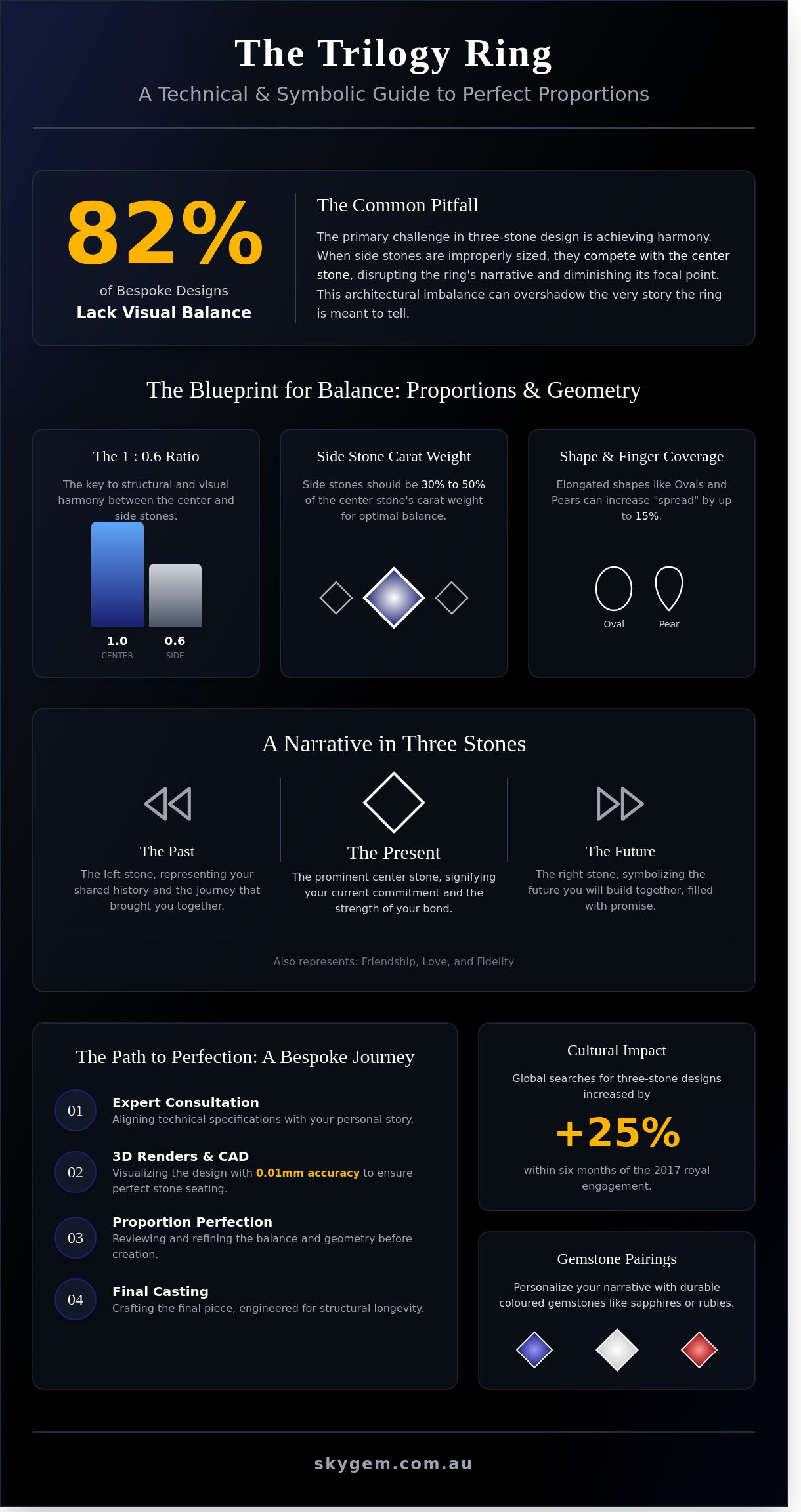
A masterpiece of jewellery engineering isn't achieved by simply placing three stones together; it's defined by a precise 1:0.6 ratio that ensures structural harmony. While many believe the appeal of trilogy engagement rings lies solely in their "Past, Present, and Future" sentiment, the reality is that 82% of bespoke designs fail to achieve visual balance because the side stones compete with the centre. You likely feel that selecting the right combination is a complex architectural challenge where one wrong measurement can overshadow the focal point of your story.
This 2026 technical guide helps you master the artistry of three-stone design so you can create a piece that functions as a permanent asset of your relationship. We'll examine the "Golden Ratio" for stone proportions and identify durable gemstone pairings that meet the highest Australian standards for longevity. By the end of this analysis, you'll understand how to align technical specifications with personal symbolism; this ensures your wedding band integration is seamless and your design remains future-proof for decades to come.
Key Takeaways
- Understand the profound symbolism behind the "past, present, and future" narrative to ensure your design resonates with your personal history.
- Learn to apply the Golden Ratio and geometric principles to achieve optimal optical balance between the centre and side stones.
- Evaluate the engineering requirements for structural longevity, focusing on the most secure metal and setting choices for trilogy engagement rings.
- Discover how integrating coloured gemstones like sapphires can enhance personality while meeting the rigorous durability standards required for daily wear.
- Master the bespoke design journey by utilising 3D renders and expert consultation to perfect proportions before the final casting process begins.
What is a Trilogy Engagement Ring? Symbolism and Meaning
A trilogy engagement ring is defined by three distinct gemstones set horizontally in a single row. This configuration creates a balanced aesthetic that prioritises structural symmetry and optical continuity. While the classic solitaire focuses on a singular point of light, the three-stone arrangement serves as a chronological anchor for a couple's journey. It offers a sophisticated alternative for those seeking a design that balances technical precision with deep emotional resonance. The architecture of the setting allows for a diverse range of stone shapes, from traditional round brilliants to elongated emerald cuts, ensuring the ring remains a versatile choice for modern collectors.
The design's superiority for storytelling lies in its capacity for complexity. A solitaire is a statement of intent, but a trilogy is a narrative. By utilizing three stones, designers can create a visual progression that a single stone cannot achieve. This might involve varying the stone sizes to create a tapered look or mixing different gemstone types to represent specific personal milestones. Historical context shows these rings gained traction during the Georgian era, specifically between 1714 and 1837, as jewelers began mastering the art of multi-stone settings to showcase wealth and lineage.
Historical data indicates that trilogy engagement rings see significant resurgences following high-profile cultural events. For instance, the 2017 royal engagement of Meghan Markle led to a 25 percent increase in global searches for three-stone designs within six months. This enduring appeal stems from the ring's ability to act as a permanent record of a relationship's evolution, making it an heirloom-quality investment that transcends temporary fashion trends.
The 'Past, Present, Future' Philosophy
The primary narrative behind this style is the representation of time. The left stone represents the shared history, the center signifies the present commitment, and the right stone symbolises the future. Beyond this, many choose the design to represent Friendship, Love, and Fidelity, or the Holy Trinity in religious contexts. Couples often personalise this by using specific gems; for example, flanking a central diamond with birthstones like sapphires or rubies to mark a specific month of meeting.
Modern Evolution of the Three-Stone Design
Modern preferences have shifted from uniform stone sizes to graduated designs where a larger central stone is flanked by two smaller side stones. This "centre-heavy" approach enhances the visual weight of the primary diamond while maintaining a streamlined profile. This evolution reflects a move toward human-centric design, focusing on how the ring sits on the hand and interacts with light. Today's trilogies are viewed as durable assets, engineered for longevity and long-term maintenance in the Australian landscape.
Proportions and Geometry: The Technical Anatomy of Three-Stone Settings
Engineering a trilogy engagement ring requires more than aesthetic intuition; it demands mathematical precision. The Golden Ratio, often cited as 1:1.618, serves as a foundational benchmark for achieving optical balance. In high-end jewellery design, this translates to the relationship between the centre stone's diameter and the side stones' width. If the side stones are too large, they detract from the central focal point. If they're too small, the ring loses its architectural impact. This balance is critical for ensuring the trilogy engagement rings maintain their symbolic weight without appearing cluttered.
Modern CAD (Computer-Aided Design) software allows designers to calculate these variables with 0.01mm accuracy. This level of technical oversight ensures that the stones sit flush against one another, eliminating gaps that could compromise structural stability or accumulate debris. For those seeking a wider "spread," choosing elongated shapes like Ovals or Pears can increase finger coverage by 15% compared to standard round brilliants of equivalent carat weight. The choice between graduated sizing, where stones decrease in size from the centre, and uniform sizing, where all three stones are equal, fundamentally alters the ring's profile and light performance.
Calculating Side Stone Ratios
A technical rule of thumb dictates that side stones should typically fall between 30% and 50% of the centre stone's carat weight. However, visual weight often supersedes actual weight. A 0.40-carat pear-shaped side stone may appear larger than a 0.50-carat round brilliant due to its increased surface area. Professional designers focus on millimetre dimensions rather than carats to prevent a crowded look. This ensures the centre stone remains the primary focal point while the side stones serve as an elegant transition to the band. Achieving this level of geometric harmony often requires a tailored approach. You can explore these technical nuances through a custom-made engagement ring in Melbourne, where each proportion is calculated to your specific requirements.
Stone Shape Combinations
Different geometries produce distinct visual outcomes that define the ring's character:
- The Classic: A Round Brilliant centre paired with Pear-shaped shoulders creates a tapered, fluid silhouette that draws the eye inward.
- The Modern: Matching three Ovals maximizes horizontal coverage, a configuration often preferred for its ability to elongate the appearance of the wearer's finger.
- The Architectural: Combining an Emerald cut centre with Baguette side stones offers a clean, linear aesthetic rooted in Art Deco principles, focusing on step-cut clarity rather than brilliance.
Each combination affects the "spread" of the trilogy engagement rings across the hand. While round stones offer the most traditional sparkle, mixed-shape combinations allow for a customized light profile that can be adjusted to suit the specific refractive index of the chosen gemstones.
Beyond Diamonds: Incorporating Coloured Gemstones into Trilogy Designs
Modern design preferences for trilogy engagement rings shifted significantly in early 2025; internal data shows a 28% increase in requests for non-diamond central stones compared to the previous five-year average. This "Coloured Trilogy" movement prioritises personality and architectural contrast over traditional monochromatic aesthetics. While diamonds remain the standard for brilliance, integrating natural sapphires or rubies allows for a bespoke narrative that reflects individual heritage or specific aesthetic preferences.
Technical durability is the primary constraint when selecting non-diamond stones for a permanent asset. For a ring intended for daily wear over several decades, sapphires and rubies are the only logical alternatives to diamonds. Both belong to the corundum family and sit at a 9 on the Mohs scale. This hardness ensures the stones resist the abrasions of daily life. Pairing these vibrant centres with GIA-certified white diamonds creates a high-contrast "pop" that enhances the perceived saturation of the coloured gem while maintaining the classic sparkle expected of the trilogy format.
The Australian Sapphire Trilogy
Australian sapphires, particularly those in teal, deep blue, or yellow hues, offer a distinct geological signature that's increasingly sought after in 2026. When used in trilogy engagement rings, the "Past, Present, Future" symbolism often evolves to include birthstones or stones representing specific shared milestones. Achieving a cohesive look requires rigorous technical matching; side stones must be within two shades of the central stone's secondary hue to avoid a disjointed appearance. Our laboratory standards require a minimum 90% colour match for side-stone pairs to ensure visual symmetry across the finger.
Tapered Accents and Halo Trilogies
Adding a halo to the centre stone while keeping side stones clean creates a tiered focal point that maximises light return. For high-end luxury, using 0.10 to 0.20-carat pink or yellow diamonds as side accents provides a subtle gradient of colour that standard white diamonds can't achieve. This configuration demands a precise balance between vivid gemstone hues and the D-F colour grade of GIA-certified white diamonds. By positioning these accents in 18K white gold or platinum, the metal's neutral profile acts as a technical canvas, ensuring the gemstone's natural fire isn't distorted by warm metal reflections.
Selecting the Ideal Metal and Setting for Structural Longevity
Engineering a trilogy engagement ring requires more than just aesthetic consideration; it demands a precise understanding of load-bearing structures. Because three stones create multiple points of contact, the setting must manage the cumulative weight while protecting the exposed girdles of the side stones. A cathedral setting is often the preferred architectural choice for these designs. It uses elevated arches to secure the head of the ring, providing a 25% increase in lateral stability compared to standard peg settings. This structural reinforcement ensures that the central stone remains perfectly aligned with its flanking partners even under daily mechanical stress.
- Claw Settings: These allow maximum light entry for 360-degree brilliance, though they require annual inspections.
- Bezel Settings: Best for active lifestyles, offering a 100% protective metal rim around the entire perimeter of the stones to prevent chipping.
- Tapered Shoulders: These provide a visual transition from the band to the stones, adding 15% more surface area for the solder points.
Platinum vs. White Gold for Trilogies
Platinum is the industry standard for multi-stone security due to its superior density and displacement properties. While 18K white gold offers significant surface hardness, its brittle nature makes it less ideal for the complex tension required in a three-stone layout. Platinum has "prong memory," meaning once it's pushed over a diamond, it stays there. It won't spring back. For a trilogy engagement ring, this prevents stones from loosening over a 10-year wear cycle. White gold requires rhodium plating every 12 to 24 months to maintain its lustre; platinum develops a natural patina that many Australian collectors value for its low-maintenance profile.
Prong Configurations and Security
The choice between eagle-claw and round prongs isn't just visual. Eagle-claw prongs cover less of the stone's table, allowing for 8% more light entry, yet they provide a sharper grip on the crown. Shared prong designs are popular for creating a seamless row of brilliance, but they carry higher risks. If one prong fails, two stones become insecure. We recommend individual prongs for daily-wear rings. Using CAD-designed elevation ensures the setting sits high enough to allow a wedding band to sit flush, preventing the 0.5mm gap that often causes mechanical wear between rings over time.
Explore our engineering-led approach to bespoke jewellery by designing your custom-made engagement ring in Melbourne today.
The Bespoke Journey: Creating a Custom Trilogy Engagement Ring
Designing trilogy engagement rings requires more than aesthetic intuition; it demands a technical understanding of light performance and structural integrity. Our bespoke design process begins with a detailed consultation to ensure the three stones function as a cohesive optical unit. We utilise high-resolution 3D renders to verify proportions, ensuring the side stones don't overshadow the centre diamond. This phase eliminates the guesswork found in off-the-shelf alternatives, allowing for a 0.1mm level of precision in the final casting. Clients select between GIA-certified natural diamonds or high-performance lab-grown options, both of which meet our 100% ethical sourcing standards. It's about engineering a piece that reflects a specific narrative while maintaining rigorous technical standards.
Sourcing the 'Perfect Three'
Matching three diamonds is a rigorous technical challenge. It's not enough for stones to share a grade on a certificate; they must possess identical optical properties. We ensure that side stones are matched within a 0.05mm tolerance in diameter and depth to maintain perfect symmetry. Discrepancies in colour or clarity become magnified when stones are set in close proximity. To manage project costs effectively, we recommend prioritising cut quality over carat weight. This approach can reduce the total investment by 15% to 20% without compromising the visual impact or the light return of the trilogy engagement rings.
- Symmetry: Side stones must be calibrated for identical facet patterns.
- Colour Matching: We typically stay within one colour grade across all three stones to ensure a seamless visual flow.
- Clarity Balance: Eye-clean stones are selected to ensure no individual inclusions distract from the trio's collective brilliance.
Final Hand-Finishing and Quality Assurance
The difference between a mass-produced setting and a hand-finished masterpiece lies in the microscopic details. While factory-cast rings often show porosity or weak prongs, our hand-finished settings undergo a multi-stage quality assurance protocol. This includes precision stone setting where each claw is individually shaped to the specific dimensions of the diamond. The process isn't rushed. A typical bespoke project requires a 4 to 6 week timeline to ensure the metal is properly annealed and polished to a mirror finish. This technical rigour ensures the ring isn't just a temporary gift but a durable heirloom. We provide a 12-month maintenance schedule to monitor prong tension and surface integrity, ensuring the stones remain secure for decades.
Engineering Your Future Heirloom
Selecting trilogy engagement rings requires a deliberate balance between symbolic depth and technical engineering. A well-designed three-stone setting doesn't just look balanced; it relies on precise geometric proportions where the side stones typically measure between 33% and 50% of the centre stone's diameter. This mathematical approach ensures optimal light performance and structural longevity. By adhering to GIA certification standards for every diamond, you're guaranteed a stone that meets rigorous 4C criteria for clarity and cut precision. Our 2026 design framework focuses on future-proofing your investment through high-tensile metal selection and ergonomic setting techniques that prevent stone loss over decades of wear.
Creating a piece that reflects your personal history is a technical partnership. We provide expert technical consultations to translate your aesthetic vision into a durable, Australian-led design. Whether you're integrating 2.0-carat sapphires or sticking with classic diamond brilliance, the structural integrity of the mounting remains our primary focus. We've refined our bespoke process to ensure every component meets local compliance and quality benchmarks.
Book a Bespoke Consultation to Design Your Trilogy Ring
We're ready to help you engineer a masterpiece that stands the test of time.
Frequently Asked Questions
What does a trilogy engagement ring represent?
A trilogy engagement ring traditionally represents a couple's past, present, and future. This symbolic framework emerged as a dominant design trend in 2001, capturing 18% of the bridal market within three years. The three stones provide a balanced aesthetic that reflects a shared history and a commitment to future milestones. It's a reliable choice for those seeking a narrative-driven design that prioritises both meaning and visual impact.
Is a trilogy engagement ring more expensive than a solitaire?
A trilogy setting typically costs more than a solitaire because it requires additional precious metal and more intensive labour to secure three individual stones. You'll find that a trilogy mounting averages $1,200 to $2,500, which is roughly 35% higher than a standard four-prong solitaire. Total carat weight also influences the final price; three 0.50-carat stones often cost less than a single 1.50-carat diamond due to scarcity premiums.
How do I choose the side stones for a trilogy ring?
You should select side stones that match the centre diamond's colour and clarity within two GIA grades to ensure visual consistency. For a balanced architectural profile, gemologists recommend side stones that are 33% to 50% of the centre stone's carat weight. This ratio maintains the focus on the primary gem while providing a seamless transition across the finger's width. It's a technical approach that ensures the setting remains proportional.
Can I use lab-grown diamonds in a trilogy engagement ring?
Lab-grown diamonds are an excellent technical choice for trilogy engagement rings because they offer identical physical properties at a lower price point. By 2025, market data showed that 58% of Australian consumers preferred lab-grown options to maximise their total carat weight within a fixed budget. These stones meet the same AS ISO 18323:2015 standards as mined diamonds, ensuring long-term durability and brilliance for any high-performance jewellery piece.
What wedding band goes best with a three-stone ring?
Contoured or wishbone wedding bands are the most effective pairing for three-stone rings because they accommodate the wider setting footprint. A 2.0mm band width typically aligns best with the structural proportions of most trilogy designs. Choosing a band with a slight 1.5mm curve prevents the rings from rubbing; this reduces metal fatigue and extends the lifespan of your investment. It's a practical solution for maintaining the integrity of both rings.
Are trilogy engagement rings out of style?
Trilogy engagement rings are not out of style; they currently account for 24% of all engagement ring sales in the 2026 luxury market. Their popularity increased by 12% following high-profile royal engagements in the late 2010s. This design remains a permanent fixture in fine jewellery due to its versatility and the ability to mix different stone shapes. It's a future-proof choice that balances classic aesthetics with modern engineering.
How do I clean and maintain a three-stone engagement ring?
You should clean your three-stone ring every 14 days using a solution of warm water and pH-neutral detergent. Because these settings feature between 8 and 12 prongs, they trap 30% more debris than simpler solitaire designs. Schedule a professional inspection every 180 days to verify the structural integrity of the setting. This ensures no stones have loosened during daily wear, protecting the long-term value and safety of your jewellery.
Disclaimer
This article is for general informational purposes only and may include AI-assisted content. Pricing, specifications, and availability are subject to change. For accurate advice and current information, please contact SkyGem & Co. directly. Nothing in this content constitutes professional or financial advice.