
The Definitive Guide to Diamond Tennis Bracelets: Craftsmanship, Quality, and Style

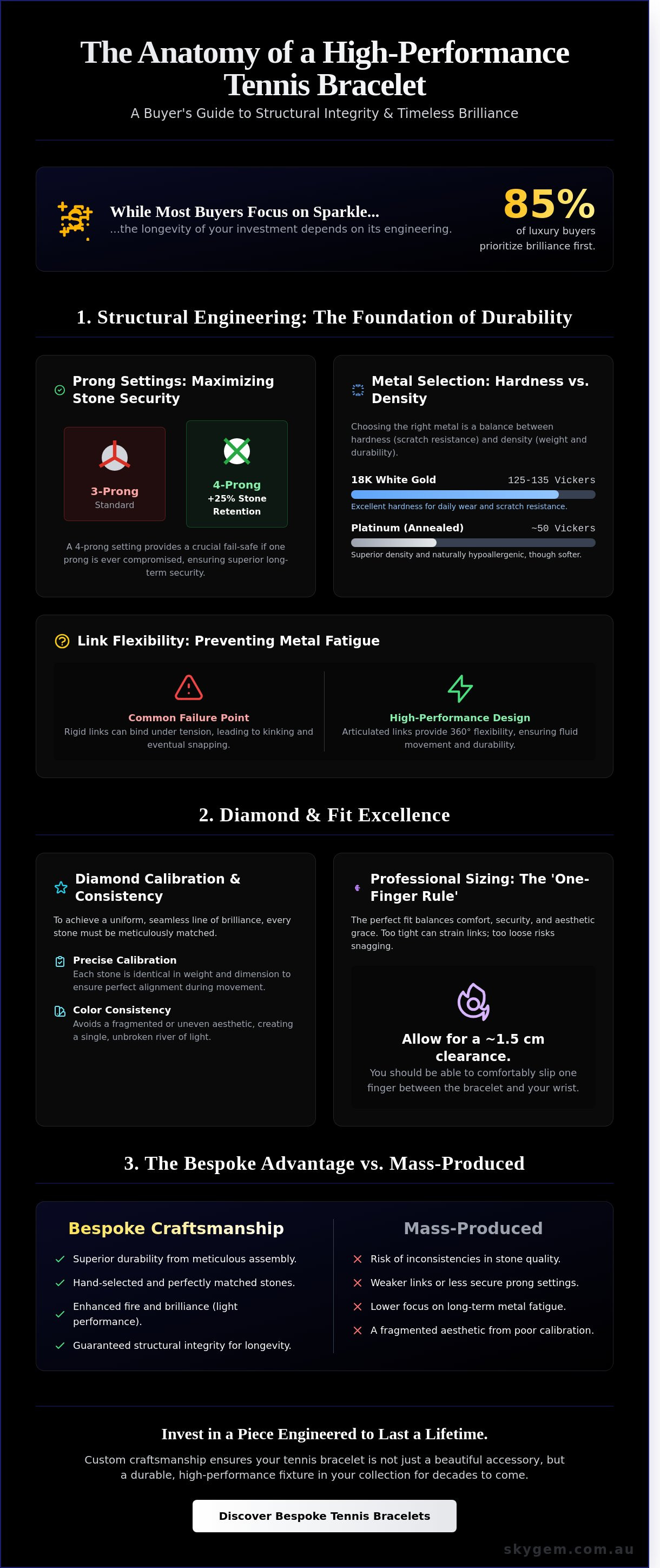
What if the most vulnerable component of your jewellery collection isn't the stone, but the 2.5-millimetre mechanism that holds it to your wrist? You likely view a tennis bracelet as more than a mere accessory; it's a permanent asset that should withstand daily wear without the constant fear of a failed clasp or a lost setting. While 85% of luxury buyers prioritise sparkle, the longevity of the piece depends entirely on the precision of its structural engineering and the integrity of its individual links.
Mastering the technical and aesthetic nuances of these pieces allows you to select a design that balances structural integrity with timeless brilliance. We've compiled this guide to help you identify the technical markers of a premium build, from the tensile strength of the metal to the light performance of the stones. You'll learn to confidently distinguish between natural and lab-grown values while determining the exact 1.5-centimetre clearance needed for a secure yet comfortable fit. We'll provide the professional clarity you need to choose a piece that remains a durable, high-performance fixture in your collection for the next 20 years.
Key Takeaways
- Understand the technical evolution of the tennis bracelet and how its symmetrical design became a benchmark for structural integrity and modern jewellery engineering.
- Identify the critical engineering elements, such as link flexibility and prong configurations, that prevent metal fatigue and ensure long-term security.
- Learn the importance of diamond calibration and colour consistency to achieve a uniform brilliance and avoid a fragmented aesthetic.
- Master professional sizing techniques, including the 'One-Finger Rule,' to ensure your piece provides a perfect balance of comfort and safety.
- Discover why bespoke craftsmanship and hand-selected stones offer superior durability and fire compared to mass-produced alternatives.
What is a Tennis Bracelet? Defining the Iconic Diamond Staple
The tennis bracelet is a precision-engineered piece of fine jewellery characterised by a continuous, symmetrical line of individually set diamonds or gemstones. This design prioritises structural integrity and fluid movement, allowing the piece to drape naturally around the wrist. While it's now a fundamental component of a sophisticated collection, the name itself originated from a specific event in professional sports. During the 1987 US Open, athlete Chris Evert lost her diamond bracelet during a match and requested a pause in play to recover it. This high-profile incident permanently shifted the nomenclature of the "line bracelet" or "eternity bracelet" to the modern term we use today. Detailed records regarding the History of the Tennis Bracelet confirm that this moment transformed a traditional formal accessory into a versatile, everyday essential.
The transition from a rigid "line" design to the flexible tennis style represents a significant evolution in jewellery manufacturing. Older iterations often featured stiff, interlocking components that lacked the ergonomic comfort required for active wear. Modern craftsmanship focuses on articulated links that provide 360 degrees of flexibility. When sourcing diamonds online in Melbourne, collectors look for this specific combination of durability and light performance. The tennis bracelet remains a non-negotiable staple because it offers a consistent display of brilliance without the bulk of traditional bangles, making it suitable for high-performance environments and formal settings alike.
The Anatomy of a Classic Line Bracelet
A high-quality tennis bracelet relies on a repetitive link structure where each unit is identical in weight and dimension. This calibration ensures the stones remain perfectly aligned during movement. Most professional designs utilise 18K gold or platinum as the primary canvas, providing the necessary tensile strength to secure the stones. While the classic full-circle design remains the industry standard, modern variations include partial settings or "half-line" styles that focus detail on the top of the wrist. Technical excellence in this category is measured by the seamless integration of the clasp mechanism, which must be both secure and visually unobtrusive to maintain the "infinite" aesthetic of the diamond line.
Why Versatility Drives Long-Term Value
The enduring appeal of this piece lies in its day-to-night utility. It functions effectively in a professional boardroom, yet possesses the refractive power required for evening events. This adaptability allows it to complement other essential pieces, such as high-end timepieces or engagement rings, without creating visual clutter. The tennis bracelet serves as a symbol of understated luxury that transcends seasonal trends. Because the design is based on geometric symmetry rather than fleeting fashion motifs, it retains its aesthetic relevance for decades. Investing in a well-constructed piece ensures a balance of architectural beauty and practical durability that fits the lifestyle of the modern wearer.
Structural Engineering: Ensuring Durability and Security
The integrity of a tennis bracelet depends on the precision of its articulation. Each individual link serves as a mechanical joint that must provide fluid movement while resisting metal fatigue. High-quality construction prioritises link flexibility to prevent kinking, which is a common failure point where the metal structure binds and eventually snaps under tension. Engineering these pieces for daily wear requires a balance between aesthetic lightness and structural rigidity.
Security became the primary design driver following the 1978 US Open, a moment that defined the history of the tennis bracelet when Chris Evert's diamond strand snapped mid-match. Modern standards now demand a future-proofing approach. This involves selecting 4-prong settings over 3-prong configurations for 25% better stone retention, because four points of contact provide a redundant fail-safe if one prong is compromised.
Metal selection is equally critical for long-term durability. While platinum offers superior density, 18K white gold is often preferred for its hardness, reaching approximately 125 to 135 on the Vickers scale compared to annealed platinum's 50. This hardness ensures that the delicate prongs maintain their grip over decades of friction. Choosing the right alloy is a technical decision that impacts the maintenance cycle of the piece.
The Triple-Lock Security System
A secure tennis bracelet utilises a multi-stage closure to prevent accidental loss. The primary mechanism is a tongue-and-groove clasp that should produce a distinct, audible click when engaged. This mechanical feedback indicates a flush fit. To augment this, we integrate side figure-eight safety wings. These secondary latches provide 100% redundancy, ensuring the piece remains on the wrist even if the main clasp is jarred open. For those prioritising a seamless look, hidden clasps offer a continuous line of diamonds but require tighter machining tolerances to maintain reliability.
Setting Styles and Light Performance
The choice of setting dictates how the piece interacts with ambient light. Classic claw settings maximise the surface area of the diamond exposed to light, enhancing the stone's fire and scintillation. Conversely, channel settings provide a protective corridor of metal, shielding the girdle of each stone from impact. Bezel settings offer a contemporary, snag-free finish by encircling the diamond in a thin rim of gold. This style is particularly effective for active individuals who require a low-profile design that won't catch on clothing or equipment. For those seeking a bespoke technical consultation on gemstone selection, exploring our range of diamonds online in Melbourne provides a starting point for a high-performance build.
The Diamond Decision: Natural vs. Lab-Grown Brilliance
Selecting diamonds for a tennis bracelet requires a technical approach that differs significantly from choosing a solitaire stone. The primary engineering challenge lies in calibration. A standard 18cm bracelet typically incorporates between 45 and 55 individual diamonds. Each stone must be matched precisely in millimetre size, table percentage, and crown angle to ensure the finished piece sits flush against the skin. If calibration is poorly executed, the bracelet will twist or catch on fabric, disrupting the intended "river of light" effect.
Consistency in colour and clarity is the benchmark of a high-quality build. Lower-grade bracelets often suffer from a "patchwork" appearance, where stones of varying tints are set side by side. This visual inconsistency is particularly noticeable in white gold or platinum settings. Since the mid-2010s, lab-grown diamonds have emerged as a technically superior option for those seeking high-carat weights without the premium price of rarity. These stones are chemically and physically identical to mined diamonds but offer 100% ethical transparency and often reach higher clarity grades for the same investment. Natural diamonds continue to hold their position as a finite geological asset, favoured by those who value long-term resale value and the unique history of a stone formed over billions of years.
Evaluating the 4Cs in a Multi-Stone Context
Cut is the most critical of the 4Cs when assembling a multi-stone piece. Every diamond must feature an Excellent or Ideal cut to ensure uniform light return across the entire length of the wrist. When consulting a tennis bracelet buying guide, professionals emphasize that colour matching is more important than the specific grade itself. For white gold settings, stones should generally stay within the F to H range. Yellow gold is more forgiving, allowing for I or J grades that still appear white against the warm metal. For clarity, "eye-clean" is the industry standard. Because the stones in a tennis bracelet are smaller than those in engagement rings, inclusions are rarely visible to the naked eye, making SI1 or SI2 grades a practical and cost-effective choice.
Sourcing and Certification
Rigorous sourcing protocols ensure that every stone meets Australian compliance standards for quality and ethics. For bracelets featuring individual stones weighing 0.30 carats or more, GIA certification is recommended to verify the technical specifications of each diamond. Ethical integrity is non-negotiable; all stones must be conflict-free and sourced through reputable channels like the Kimberley Process. You can browse our extensive range of natural and lab-grown options to compare how different stone types impact the final design. This technical scrutiny ensures your jewellery remains a durable and valuable asset for decades.
Practical Selection: Sizing, Styling, and Maintenance
Selecting a tennis bracelet involves more than aesthetic preference; it requires technical consideration of ergonomics and long-term durability. Precision in sizing is the first step toward ensuring the piece remains a permanent fixture in your collection. A well-fitted bracelet shouldn't migrate too far down the hand, nor should it constrict the wrist during natural movement. To find this balance, we utilise the 'One-Finger Rule'. If you can slide one finger comfortably between the chain and your wrist, the fit provides enough clearance for skin expansion without risking a snag.
Measuring your wrist at home provides a reliable baseline before a professional consultation. Use a flexible measuring tape or a piece of string wrapped around the widest part of your wrist bone. Mark the point of overlap and measure the length against a ruler. For a standard fit, add 1.5 to 2 centimetres to this raw measurement. This extra length accounts for the thickness of the diamond settings, which occupy internal volume that a flat measuring tape doesn't account for.
Finding Your Perfect Fit
Standard lengths for a tennis bracelet typically range between 17 and 18 centimetres. However, off-the-shelf options often fail to account for the specific drape required for different carat weights. A piece with a 10-carat total weight has a larger profile and different centre of gravity than a 3-carat piece. A bracelet that is too loose is more prone to snagging and impact damage. If you're looking for a piece engineered to your exact wrist profile, SkyGem Bespoke Design offers tailored adjustments to ensure the clasp and safety catch sit perfectly flush.
Caring for Your Investment
Maintenance is a non-negotiable aspect of fine jewellery ownership. At home, you can maintain the luminous efficacy of your diamonds using a solution of warm water and mild, ammonia-free detergent. Use a soft-bristled brush to gently clear debris from the gallery beneath the stones. This prevents the accumulation of oils that can dull the diamond's light return over time.
Professional inspections should occur every 12 months. During these checks, a specialist examines the tension of the safety clasp and performs a 'Prong-Check' to identify any metal fatigue. This technical oversight ensures the structural integrity of the piece remains intact, preventing the accidental loss of stones. For expert guidance on maintaining your collection, contact our team for custom sizing advice and professional care schedules.
Styling your piece allows for a blend of engineering excellence and personal expression. Stacking different metals, such as pairing 18K white gold with yellow gold, creates a sophisticated architectural look. When combining your bracelet with a luxury timepiece, place the watch closer to the hand to act as a physical buffer, protecting the more delicate diamond links from excessive movement. This arrangement highlights the contrast between the technical precision of a watch and the fluid brilliance of the diamonds.
The Bespoke Advantage: Why Custom Craftsmanship Wins
Mass-produced jewellery often relies on high-volume casting methods that prioritise speed over structural integrity. This frequently results in lightweight pieces that lack the durability required for daily wear. By contrast, a bespoke tennis bracelet from SkyGem & Co. is engineered as a high-performance asset. We move beyond the limitations of generic manufacturing by tailoring every individual link to your specific requirements. This architectural approach ensures that the articulation of the bracelet remains fluid and the metal resists fatigue over decades of use.
Our stone selection process is governed by a commitment to optical performance. While machines can sort diamonds by basic 4Cs, they cannot account for the subtle nuances of fire and scintillation that define a premium piece. We hand-select each stone to ensure 100% consistency in diameter, depth, and crown angles. This level of technical precision creates a seamless "river of light" that commercial-grade bracelets simply cannot replicate. We view each project as a technical consultation, blending engineering excellence with refined aesthetics to create a multi-generational asset.
The Custom Design Journey
The bespoke process begins with advanced CAD design, where we map out the bracelet with 0.01mm precision. This stage allows you to define the exact profile of the settings, ensuring they sit flush against the skin for maximum comfort. For those seeking a unique signature, incorporating coloured gemstones offers a sophisticated alternative to the traditional all-diamond look. You can integrate vibrant SkyGem Coloured Gemstones such as sapphires or rubies to add a personal layer of meaning to the design. This collaborative phase ensures the final product is a precise reflection of your vision rather than a compromise found in a showroom tray.
Quality Over Quantity
The physical weight of a hand-finished piece provides an immediate indicator of its superior construction. A bespoke bracelet typically contains 20% to 30% more precious metal than its cast counterparts, providing the tensile strength needed to secure the stones for a lifetime. We take pride in our local Australian expertise, managing the manufacturing process within Melbourne to ensure compliance with our rigorous quality standards. This proximity allows for total transparency and a level of finish that global mass-producers cannot match. Precision isn't just a goal; it's our baseline. To begin your journey, book a consultation with SkyGem & Co. to design your bespoke tennis bracelet.
Securing Your Investment in Timeless Brilliance
Selecting a high-performance jewelry piece requires a deep understanding of both aesthetic appeal and structural engineering. A well-constructed tennis bracelet isn't just a classic accessory; it's a technical achievement where each individual setting must maintain consistent alignment and mechanical security. Our GIA-trained consultants provide the precise data needed to navigate the nuances of diamond light performance, whether you're evaluating natural stones or lab-grown alternatives. By focusing on bespoke manufacturing within our Royal Arcade workshop, we eliminate the structural vulnerabilities often found in mass-produced components. This precision-led approach ensures your investment meets rigorous Australian standards for durability and craftsmanship. We prioritize the long-term integrity of every piece through meticulous assembly of the articulation links and clasp mechanisms. It's about creating a permanent asset that withstands the rigors of daily wear while maintaining its peak optical brilliance. Our team remains dedicated to providing the technical expertise required for a sophisticated, informed selection process.
Explore our curated collection of Diamond Tennis Bracelets
We look forward to helping you find a piece that combines engineering excellence with unmatched elegance.
Frequently Asked Questions
Can I wear my tennis bracelet every day?
You can wear a tennis bracelet daily if it's constructed with robust 14K or 18K gold settings. While Chris Evert famously lost her jewellery during the 1978 US Open, modern craftsmanship focuses on triple-locking mechanisms to prevent such incidents. Periodic inspections every 6 months ensure the structural integrity of the 50 to 60 individual prongs. Regular cleaning maintains the 100% light return of the diamonds.
How tight should a tennis bracelet be on my wrist?
A tennis bracelet should have enough slack to fit one finger between the chain and your wrist. This gap, typically measuring about 1 to 1.5 centimetres, prevents the links from over-stretching during movement. If the piece is too tight, the tension can compromise the 18K gold pins that connect each diamond setting. A correct fit ensures the bracelet drapes naturally without sliding more than 5 centimetres down the arm.
What is the difference between a tennis bracelet and a line bracelet?
There's no technical difference in the structural design; the term tennis bracelet simply replaced line bracelet following the 1978 US Open. Both styles feature a symmetrical pattern of diamonds joined by a thin, precious metal chain. Before this 20th-century sporting event, jewellers exclusively used the line terminology to describe this linear arrangement of stones. Today, the names are used interchangeably in 95% of retail environments.
Are lab-grown diamond tennis bracelets a good investment?
Lab-grown diamond tennis bracelets provide exceptional value for those seeking 30% to 50% more carat weight for the same budget. While they possess identical chemical and physical properties to mined stones, their resale value doesn't track with the historical appreciation of natural diamonds. According to 2023 industry reports, lab-grown stones are an excellent choice for aesthetic durability and ethical compliance rather than speculative financial gain.
How do I know if the clasp on my tennis bracelet is secure?
A secure clasp must produce an audible click when the tongue enters the box and include at least one safety wing. High-specification designs often feature a triple-lock system, which reduces the risk of accidental opening by 80% compared to single-latch versions. You should test the tension of the 18K gold safety wire every 12 months. If the latch feels loose, a professional jeweller can recalibrate the metal's spring tension.
Can a tennis bracelet be resized if it's too long?
A professional jeweller can resize a tennis bracelet by removing individual diamond links to achieve the desired length. Most standard bracelets measure 18 centimetres, but many wearers require a reduction to 16 or 17 centimetres for a precise fit. The removed links should be retained, as they contain 100% of the original gold and diamond value. These spare components are useful for future repairs or creating matching jewellery like pendants.
What is the most popular carat weight for a tennis bracelet?
The most popular total carat weight for a tennis bracelet ranges between 3.0 and 5.0 carats. This specific weight provides a balanced aesthetic that's suitable for both daytime wear and formal events. In a standard 18-centimetre bracelet, a 3-carat total weight typically consists of approximately 50 to 60 individual diamonds. Data from 2022 retail trends indicates that 45% of first-time buyers select a 3-carat model for its versatility.
Is platinum better than 18K white gold for a tennis bracelet?
Platinum is the superior choice for long-term durability because it's a naturally white, dense metal that doesn't require rhodium plating. While 18K white gold is 75% pure gold mixed with other alloys, platinum is typically used at 95% purity. This higher density makes it more resistant to the daily friction that affects a tennis bracelet. It's also 100% hypoallergenic, making it the standard recommendation for clients with sensitive skin or metal allergies.
Disclaimer
This article is for general informational purposes only and may include AI-assisted content. Pricing, specifications, and availability are subject to change. For accurate advice and current information, please contact SkyGem & Co. directly. Nothing in this content constitutes professional or financial advice.