
The Best Setting for a Peach Sapphire: A Technical Design Guide

Selecting the best setting for a peach sapphire is less about personal preference and more about a technical calibration between the stone's light-return properties and the reflective index of the metal. While yellow gold has claimed 57% of the engagement ring market in 2026, choosing the wrong alloy can unintentionally wash out a sapphire's saturation. You likely feel a sense of hesitation, fearing that your stone might lose its identity or look like a common Morganite once it's mounted. It's a valid concern, as the interaction between a sapphire's "champagne" or "salmon" tones and its surrounding environment determines its ultimate vibrancy and perceived value.
This guide provides a technical framework to help you select the perfect metal, style, and accent stones to enhance your gem's unique brilliance. You'll learn how different gold karats influence color perception and why structural choices like bezel settings are gaining traction for their superior protection. We'll examine the bespoke design process to give you confidence in a piece that balances aesthetic precision with the long-term durability required for daily wear. From understanding the impact of elongated cuts to matching metal alloys with regional design standards, we'll outline the exact steps to ensure your sapphire performs at its peak.
Key Takeaways
- Identify how specific secondary hues like salmon or champagne dictate the choice of metal to ensure the gemstone’s color is properly intensified.
- Discover how to select the best setting for a peach sapphire by balancing light-return properties with the reflective index of rose gold, yellow gold, or platinum.
- Compare the structural advantages of halo and solitaire designs to determine which style best frames your sapphire while maintaining its visual prominence.
- Evaluate the technical performance of various prong configurations and bezel settings to ensure your bespoke ring withstands the rigours of daily wear.
- Understand the bespoke sourcing process for unheated sapphires and how technical precision during design leads to a superior, long-lasting asset.
Understanding the Spectrum: Matching Setting to Peach Sapphire Hues
A peach sapphire isn't a single, uniform colour but rather a complex geological result of trace elements within the corundum family. It represents a precise intersection of orange, pink, and yellow hues. When you're determining the best setting for a peach sapphire, you must first isolate which of these three primary colours dominates the stone's appearance. This isn't just an aesthetic exercise; it's a technical requirement because the metal's reflective property will either complement or clash with these internal light reflections.
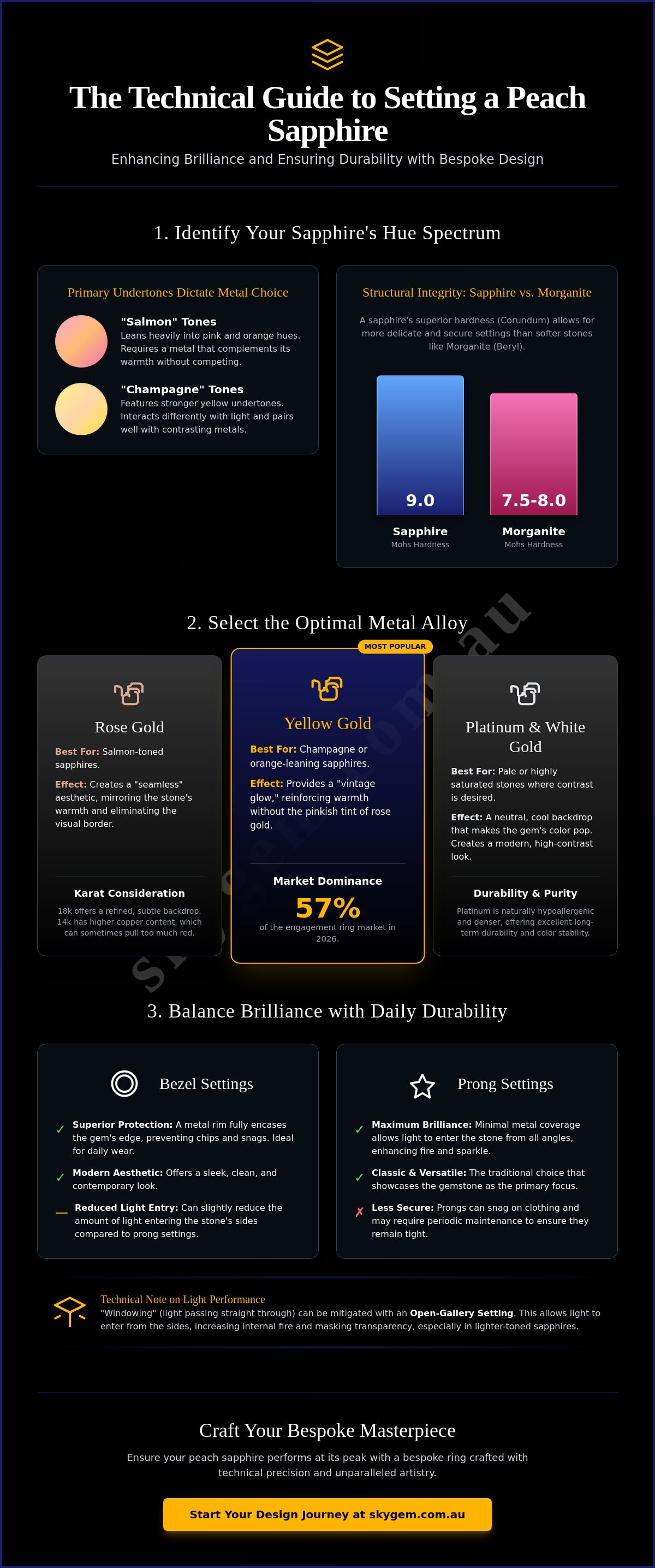
Industry professionals often categorise these stones into two distinct camps: "salmon" and "champagne." Salmon-toned stones lean heavily into pink and orange, requiring a metal that doesn't compete with the warmth. Champagne-toned stones, which feature stronger yellow undertones, behave differently under various light sources. If you ignore these secondary hues, you risk selecting a setting that makes a premium sapphire appear dull or overly saturated in a way that looks artificial.
It's critical to distinguish these gems from Morganite, a mistake often made by those new to precious gemstones. While Morganite is a variety of beryl with a Mohs hardness of 7.5 to 8.0, sapphires are a much denser corundum with a hardness of 9.0. Understanding Sapphire mineral properties is essential because the higher refractive index of a sapphire allows for more intricate, delicate settings that a softer stone couldn't safely inhabit. A sapphire's brilliance is structural, not just surface-level.
Identifying Your Sapphire’s Primary Undertones
To accurately assess your stone, you should view it under both natural daylight and incandescent indoor lighting. Natural light often reveals the "Pastel" qualities of a peach sapphire, highlighting the softer pinks. Conversely, incandescent light can bring out the "Sunset" orange and gold tones. The saturation level of your stone; whether it's a vivid, deep peach or a pale, airy tone; dictates your metal requirements. A highly saturated stone can hold its own against 18K yellow gold, while a pale stone might require the neutral backdrop of platinum to avoid being overwhelmed by the metal's reflection.
The Light Return Factor in Setting Choice
Light performance is the metric that separates a masterfully set sapphire from a mediocre one. Many peach sapphires exhibit "windowing," a phenomenon where light passes straight through the centre of the stone rather than reflecting back to the eye. To mitigate this, the depth of the setting must be calibrated to the stone's cut. Open-gallery settings are often the best setting for a peach sapphire with lighter tones because they allow light to enter from the sides, increasing the internal fire and masking minor windowing.
Light return in sapphires is the primary driver of setting elevation, as it dictates how much vertical space the stone requires to achieve maximum internal reflection.
Choosing the Best Metal: Rose Gold vs. Yellow Gold vs. Platinum
The metal choice acts as the technical foundation for the sapphire's visual performance. While the stone's internal chemistry dictates its hue, the surrounding metal alloy determines how that hue is perceived by the human eye. The debate between 14ct and 18ct gold is particularly relevant here; 18ct gold contains a higher percentage of pure gold (75%), whereas 14ct gold incorporates more base metals like copper or silver. This higher copper content in 14ct rose gold can sometimes pull too much red from a stone, making it look muddy. For most designers, the best setting for a peach sapphire involves an 18ct alloy that provides a more refined, subtle backdrop.
Rose gold creates a "seamless" aesthetic by mirroring the copper-like warmth found in salmon-toned sapphires. It essentially eliminates the visual border between the stone and the ring. Conversely, yellow gold provides a "vintage glow" that suits champagne or orange-leaning stones, reinforcing their warmth without the pinkish tint of rose gold. If your goal is a high-contrast, modern look, cool metals like platinum or white gold are superior. You might consider the SkyGem & Co. 18K White Gold collection to see how a crisp, neutral frame allows a pastel peach sapphire to maintain its individual identity.
The Synergy of 18ct Rose Gold
18ct rose gold is often the preferred choice for stones with deep saturation. The specific alloy blend provides a monochromatic look that feels cohesive and premium. However, you should avoid rose gold for exceptionally pale or light-toned stones. In these instances, the metal can "bleed" into the gem, causing it to lose its distinct peach character and appear washed out. It's a technical balancing act where the metal must support the stone's colour without consuming it.
Platinum for Modern, High-Contrast Designs
Platinum offers a significant technical advantage due to its chemical neutrality. It doesn't cast a warm reflection into the stone, which is vital for "Cool Peach" sapphires that feature subtle blue or grey secondary flashes. According to GIA on sapphire durability, these stones are robust enough for daily wear, but the setting must protect them. Platinum prongs are denser and more durable than gold, providing a secure grip that requires less frequent maintenance over the decades. This makes it a technically superior choice for high-value, unheated stones that require long-term stability.
If you're still weighing these options, exploring different engagement rings can help you visualise how these metals interact with various gemstone saturations.
Optimal Setting Styles for Protection and Brilliance
While the choice of metal establishes the colour temperature of the ring, the setting style dictates its optical performance and structural longevity. Selecting the best setting for a peach sapphire requires a balance between aesthetic openness and the physical security of the gem. Because sapphires are crystalline structures with a high refractive index, the architecture of the setting must be engineered to facilitate light entry from multiple angles to prevent the stone from appearing "flat" or dark once mounted.
Trilogy designs offer a technical advantage by using side stones to "stretch" the visual profile of the centre gem. In 2026, pairing peach sapphires with pear or marquise-shaped side diamonds has become a standard for those seeking to elongate the finger's appearance. For a more avant-garde approach, the Toi et Moi style is a significant trend; specifically pairings that contrast the warm peach hues with the cool, moody depths of teal sapphires. This juxtaposition highlights the unique saturation of both stones through colour theory contrast.
The Minimalist Solitaire: Maximising Light Entry
A four-prong minimalist solitaire is frequently the best setting for a peach sapphire when the stone possesses exceptional clarity and a vivid saturation profile. This style minimizes the amount of metal covering the stone, allowing for maximum "scintillation" or sparkle. When designing the basket, it's essential to ensure the culet is protected while still allowing for side-light entry. You can explore SkyGem & Co. Engagement Rings to see how various basket heights influence the stone's brilliance and daily wearability.
Halo Designs: Enhancing Colour Saturation
Halo settings serve a functional purpose beyond just increasing the ring's surface area. A border of white diamonds acts as a high-contrast frame, which can make a pale peach sapphire appear more saturated and vibrant than it would in a solitaire. For a more subtle effect, a "Hidden Halo" provides extra sparkle that's only visible from the profile, maintaining a clean look from the top. To ensure the sapphire remains the focal point, we recommend using F/G colour diamonds for the halo; these provide a crisp, white brilliance that complements rather than competes with the peach tones. The choice between a scalloped halo, which creates a vintage, floral silhouette, and a flush halo, which offers a sleek, modern finish, will ultimately define the ring’s final character.
Regardless of the style you choose, the inherent sapphire durability makes these stones ideal for intricate designs. Since they rank 9 on the Mohs scale, they can withstand the pressure of complex settings that might cause softer stones to fracture during the mounting process or over years of daily use.
Technical Details: Prongs, Bezels, and Daily Wear Durability
The technical execution of a ring's head determines both the stone's visual profile and its resistance to mechanical stress. While previous sections focused on metal alloys and broad styles, the specific hardware used to secure the gem is where design meets engineering. The best setting for a peach sapphire is one that minimizes optical obstruction while maximizing the structural security of the gemstone's girdle. In high-end bespoke design, the choice between claw and round prongs isn't merely aesthetic; it's a functional decision regarding how much of the sapphire's crown remains visible to the observer.
Claw prongs, particularly the sharp "talon" variety, are preferred for sophisticated designs because they taper to a fine point, covering less of the stone’s surface area than traditional round prongs. This results in a cleaner, more unobstructed view of the peach hue. For larger elongated stones, such as the oval cuts popular in 2026, double claw prongs provide a technical advantage. By distributing the pressure across two points at each corner, they offer extra security and a vintage-inspired aesthetic that complements the "sunset" tones of the sapphire without compromising the stone's stability.
The Allure of the Bezel Setting
The bezel setting represents a modern, architectural approach to gemstone security. Unlike prongs, which hold the stone at specific intervals, a bezel fully or partially encases the sapphire in a continuous metal frame. This provides superior protection for the girdle, which is the most vulnerable part of the stone during accidental impacts. For those with active lifestyles, the low-profile nature of a bezel prevents snagging on fabrics and protects the sapphire from the rigours of daily wear. A bezel setting can actually deepen the perceived colour of a pale sapphire by concentrating light within the stone's pavilion and creating a bold, reflective boundary.
Prong Placement and Gemstone Security
Prong orientation is a critical factor in the ring's final silhouette. While standard corner placement is common, a "North-South-East-West" (N-S-E-W) orientation can make a round or cushion-cut sapphire appear more geometric and unique. For round peach sapphires exceeding 1.5 carats, we technically recommend a 6-prong setting. This provides a redundant layer of security; if one prong is damaged, the remaining five will maintain the stone's position until a repair can be made. When sourcing durable, high-quality stones for these intricate settings, it's vital to consult a specialist in Precious Gemstones to ensure the material integrity matches the design's requirements.
To discuss the technical specifications of your project and ensure your design balances beauty with longevity, you can begin the process of a custom made engagement ring in Melbourne with our technical consultants.
Crafting Your Bespoke Peach Sapphire Ring at SkyGem & Co.
At SkyGem & Co., we treat the creation of a bespoke ring as a technical project that requires both engineering precision and an eye for aesthetic balance. Finding the best setting for a peach sapphire isn't just about picking a design from a catalogue; it's about matching a specific stone’s unique physical properties with a structure that ensures its long-term viability. Our approach focuses on unheated peach sapphires, which represent the pinnacle of our collection. These stones haven't undergone thermal treatment to enhance their colour, meaning the hues you see are entirely natural and inherently rare. This geological purity requires a setting that respects the stone's integrity while highlighting its natural light performance.
Transparency remains a cornerstone of our operations. We maintain a rigorous ethical sourcing protocol to ensure every sapphire in our inventory has a clear, documented path from the mine to our workshop. This commitment to transparency provides you with a permanent asset that aligns with modern environmental and social standards. By acting as your technical consultant, we ensure that the final piece isn't just a purchase, but a long-term investment in quality and craftsmanship.
The Consultation and Sourcing Experience
The design process begins with a curated selection of loose peach sapphires. We present stones that align with your specific hue preferences, whether you're seeking a saturated "Sunset" orange or a delicate "Pastel" pink. During this phase, we also facilitate a technical comparison between natural and lab-grown options. While natural sapphires offer geological rarity, lab-grown stones provide a high-clarity alternative with identical chemical properties. You can learn more about our integrated approach by exploring Custom Made Engagement Rings to see how we bridge the gap between gemstone sourcing and final design.
From CAD to Creation
Once you've selected your gemstone, we move into the Computer-Aided Design (CAD) phase. This is where technical precision becomes paramount. We use high-resolution 3D rendering to ensure the best setting for a peach sapphire is perfectly calibrated to the exact millimetre dimensions of your specific gem. This process allows us to verify the clearance of the pavilion and the security of the prongs before the metal is even cast, eliminating the structural guesswork often found in mass-produced jewellery.
After the digital model is approved, the ring is cast and then hand-finished in our Australian workshop. This final stage involves meticulous polishing and stone setting by seasoned experts who understand the nuances of working with 18ct gold and platinum. The result is a structurally sound, aesthetically superior piece of jewellery designed to endure for generations. If you're ready to begin your project, we invite you to book a consultation at SkyGem & Co. to speak with a technical design consultant.
Securing Your Investment in Permanent Brilliance
Selecting the best setting for a peach sapphire requires a methodical approach that respects the gem's unique refractive index and chemical composition. You've seen how the calibration between 18ct alloys and specific secondary hues ensures your stone maintains its identity rather than fading into the metal's reflection. By prioritising structural integrity through precise prong placement or architectural bezel designs, you create a piece that withstands the rigours of daily wear while showcasing maximum internal fire. The transition from a loose stone to a finished ring is a technical journey that demands accuracy at every stage.
As specialists in unheated rare sapphires, we provide the technical expertise necessary to balance aesthetic desire with engineering reality. Our bespoke CAD design process ensures every setting is custom-fit to your chosen gem, whether you prefer the classic allure of natural diamonds or the modern performance of lab-grown diamonds. We invite you to act as a partner in this creative process, transforming a high-value asset into a lasting legacy. Design your bespoke peach sapphire engagement ring with SkyGem & Co. and experience the intersection of technical precision and timeless design. Your vision deserves a foundation built on reliability and expert craftsmanship.
Frequently Asked Questions
Is rose gold the best metal for a peach sapphire?
Rose gold is a highly popular choice for peach sapphires because its copper content complements salmon-toned gems, creating a monochromatic look. However, it isn't always the best setting for a peach sapphire if the stone is exceptionally pale, as the metal can "bleed" into the gem and reduce its distinct character. For lighter or "champagne" stones, 18ct yellow gold or platinum often provides superior visual definition and contrast.
How is a peach sapphire different from a Padparadscha sapphire?
A Padparadscha sapphire is a specific, rare variety of corundum that must exhibit a delicate balance of pink and orange, often compared to the hue of a lotus flower. Peach sapphires are a broader category that includes stones with secondary yellow or brown undertones that wouldn't meet the strict Padparadscha criteria. While both are prized, Padparadscha stones are significantly rarer and command higher premiums due to their specific colour saturation requirements.
Do peach sapphires fade in sunlight over time?
Natural peach sapphires are chemically stable and do not fade or change colour when exposed to sunlight. This stability is a significant advantage over stones like Morganite, which can occasionally lose saturation over decades of exposure. Because the colour is an inherent part of the crystal’s trace elements, you can be confident that the stone's hue is a permanent asset that requires no special light-avoidance protocols for daily wear.
Which accent stones look best with a peach sapphire?
White diamonds in the F to G colour range are the technical standard for accent stones because their crisp brilliance intensifies the warmth of the peach centre. Using diamonds with lower colour grades can make the setting look yellowed or dull. For more contemporary designs, teal sapphires provide a high-contrast pairing that highlights the orange-pink spectrum of the centre stone through sophisticated colour theory and visual depth.
Can I use a peach sapphire in a daily wear engagement ring?
Peach sapphires are exceptionally well-suited for daily wear because they rank 9 on the Mohs scale of hardness. This density makes them resistant to scratching and surface abrasions, which is essential for a piece of jewellery worn every day. When paired with a structurally sound setting like a bezel or a multi-prong basket, a peach sapphire offers the longevity and durability required for a permanent engagement ring.
What is the best prong style for an oval peach sapphire?
Double claw prongs are often considered the best setting for a peach sapphire with an oval cut because they distribute pressure more evenly across the stone's girdle. This configuration provides extra security against accidental impacts while maintaining a sophisticated, vintage-inspired aesthetic. The sharp points of the claws also minimize the amount of metal covering the stone, allowing for maximum light entry and internal reflection to enhance brilliance.
Are peach sapphires more expensive than blue sapphires?
Peach sapphires generally offer a more accessible entry point than high-grade cornflower or royal blue sapphires of the same carat weight. However, the price increases significantly for unheated stones with high clarity and vivid saturation. While they're often more affordable than their blue counterparts, their growing popularity in 2026 has narrowed the price gap for premium, large-scale specimens found in bespoke designs and high-end collections.
Should I choose a natural or lab-grown peach sapphire for my setting?
Choosing between natural and lab-grown peach sapphires depends on your priorities regarding rarity versus budget. Natural sapphires are valued for their geological history and unique trace elements, making them a permanent asset with potential investment value. Lab-grown sapphires offer identical chemical and physical properties at a lower price point, providing exceptional clarity and saturation for those who prioritize visual perfection and ethical transparency in a controlled environment.
Disclaimer
This article is for general informational purposes only and may include AI-assisted content. Pricing, specifications, and availability are subject to change. For accurate advice and current information, please contact SkyGem & Co. directly. Nothing in this content constitutes professional or financial advice.